
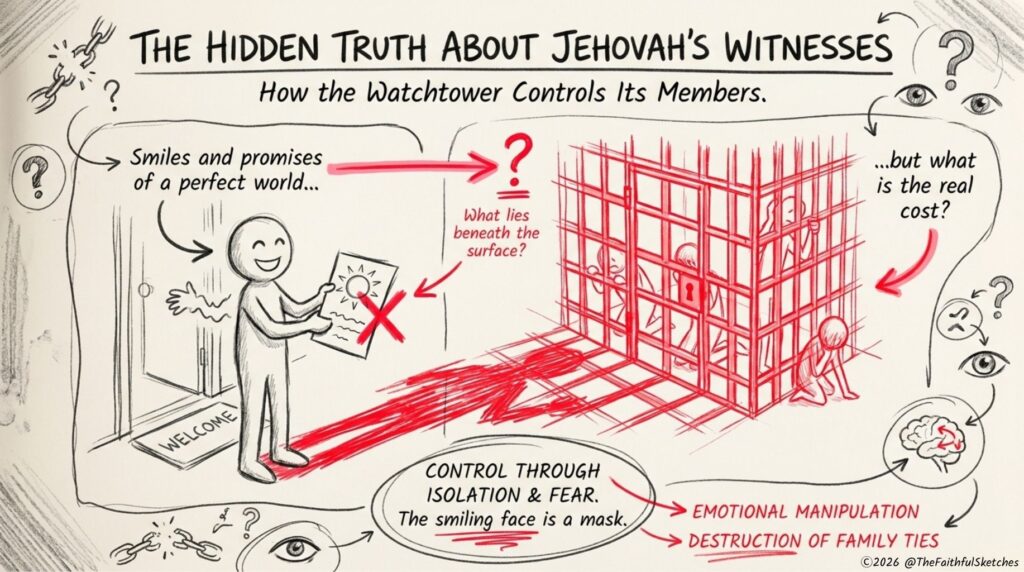
They come to your door with smiles and promises of a perfect world. A world without sickness, death, or war. An eternal paradise on earth. It’s a compelling vision. But thousands of former members and cult experts describe the Jehovah’s Witnesses cult as one of the most sophisticated high-control organizations in the world. What does membership actually cost?
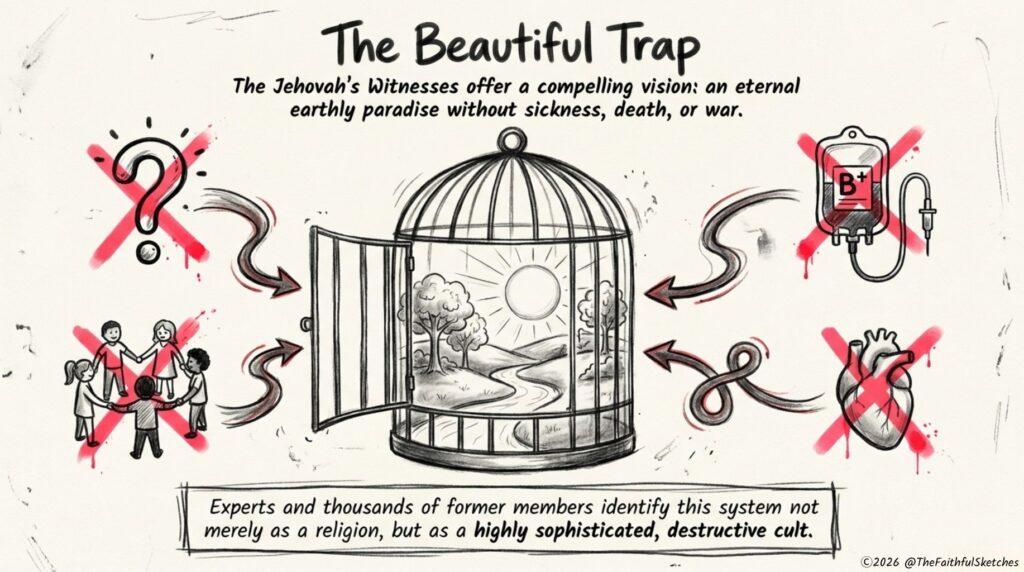
This post pulls back the curtain on Jehovah’s Witnesses cult characteristics that experts and thousands of former members have documented. This isn’t the story they tell you at your doorstep. This is the story of a highly sophisticated, controlling organization that many experts and former members identify as a destructive cult.
Part 1: Built on Broken Prophecy
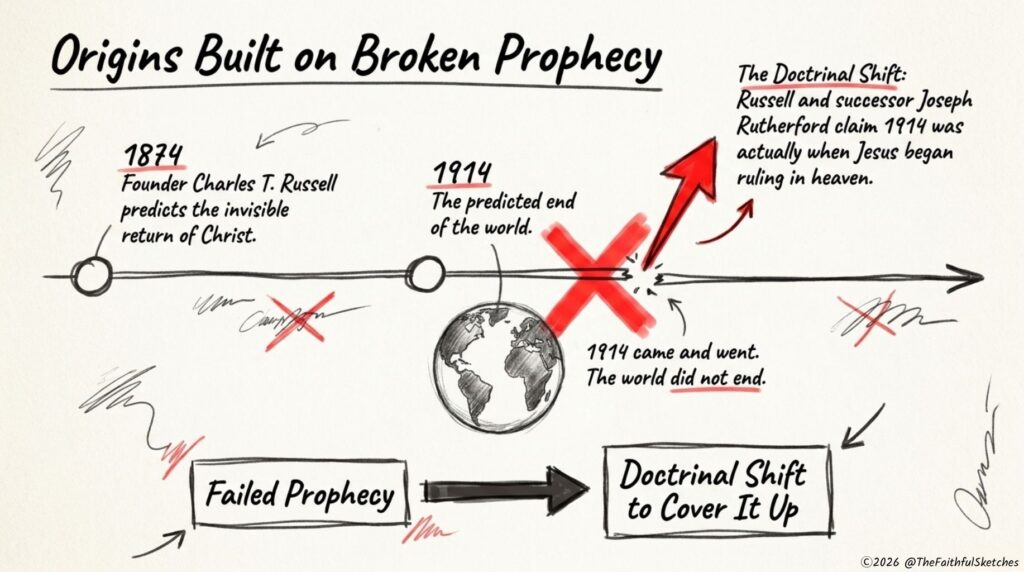
Every high-control group needs a founding prophet. For the Witnesses, that was Charles Taze Russell.
Russell didn’t start with a new revelation from God. He started with a failed prediction. He confidently forecast the invisible return of Christ in 1874 and the end of the world in 1914. When 1914 came and went without incident, Russell and his successor Joseph Rutherford didn’t admit the error. Instead, they changed the meaning of the prophecy, claiming 1914 was actually the year Jesus began ruling invisibly in heaven.
This pattern, failed prophecy followed by a doctrinal revision to cover it up, became the organizational blueprint. Notably, it continues to this day. The Watch Tower Society has revised its end-times predictions multiple times, including 1925 and 1975, each time reframing the failure as a misunderstanding rather than a false prophecy.
Part 2: The BITE Model — How Jehovah’s Witnesses Cult Control Actually Works
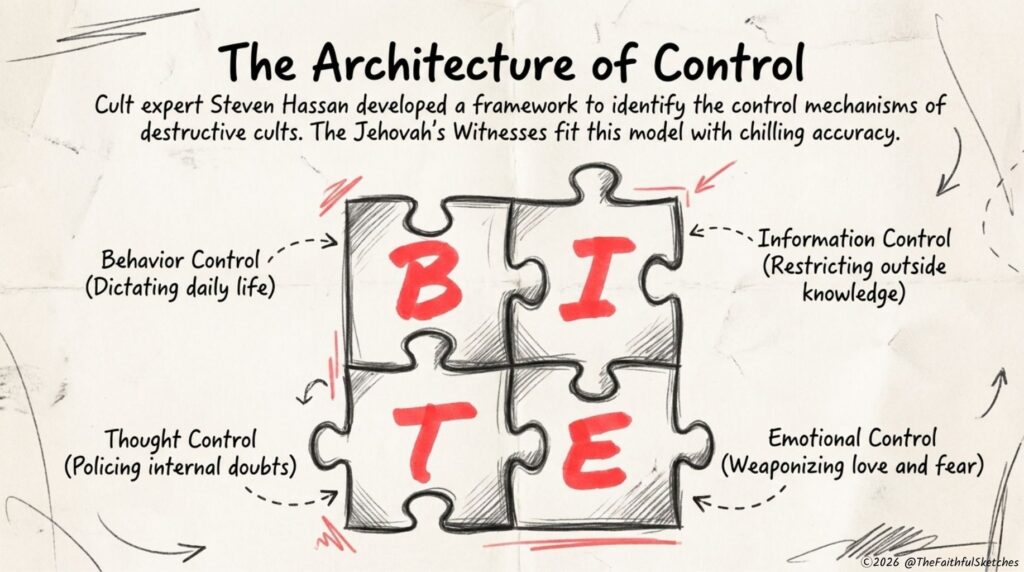
Cult researcher Steven Hassan developed the BITE Model to identify control mechanisms used by destructive groups. BITE stands for Behavior, Information, Thought, and Emotional control. The Jehovah’s Witnesses fit this model precisely.
Behavior Control
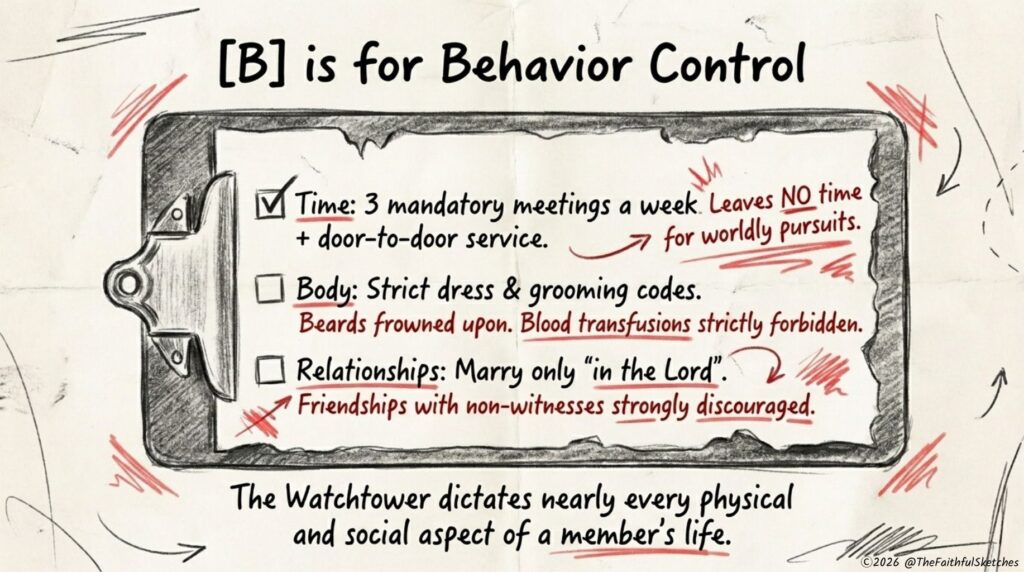
The Watchtower dictates nearly every aspect of a member’s daily life.
Three meetings a week combined with mandatory door-to-door service consume most of a member’s free time, leaving little room for outside relationships or interests. The organization forbids blood transfusions, regulates dress and grooming, and in many congregations discourages beards. Members can only marry fellow Witnesses, and friendships with non-Witnesses, referred to as “worldly” people, face active discouragement.
Information Control
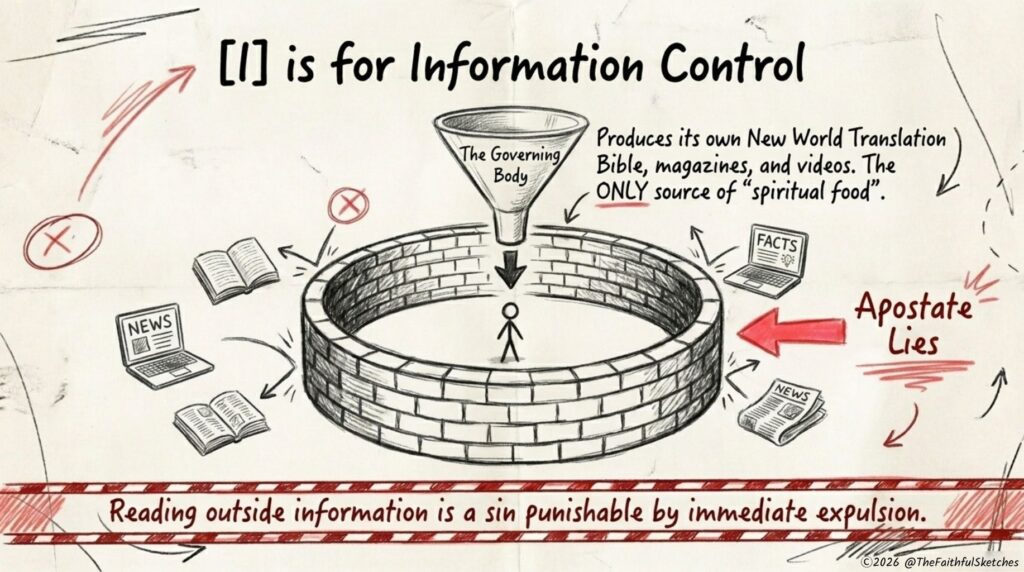
The organization functions as a closed information loop. Furthermore, it actively labels outside criticism as dangerous.
Any book, website, or news report critical of the organization gets classified as “apostate lies.” Reading such material is treated as a sin that can result in expulsion. The Watchtower produces its own Bible translation, its own magazines, and its own video content. Members consume spiritual information from one source only: the Governing Body.
Thought Control
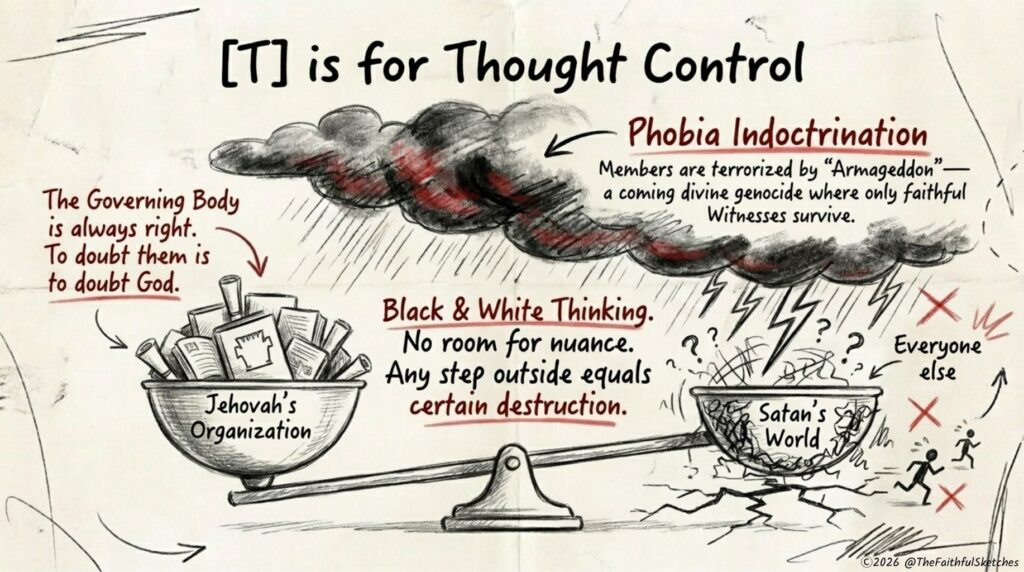
This is arguably the most damaging form of control the organization exercises.
Members operate under a strict us-versus-them framework. Witnesses belong to “Jehovah’s organization.” Everyone outside belongs to “Satan’s world.” This framing creates constant fear and suspicion toward outsiders. Additionally, the Governing Body is positioned as always right. Doubting their teachings equates to doubting God, leaving no room for personal interpretation or nuance.
Beyond that, the organization instills what Hassan calls phobia indoctrination. Members face constant messaging that Armageddon is imminent and that only faithful Witnesses will survive it. Consequently, any step outside the group carries the psychological weight of certain destruction.
Emotional Control
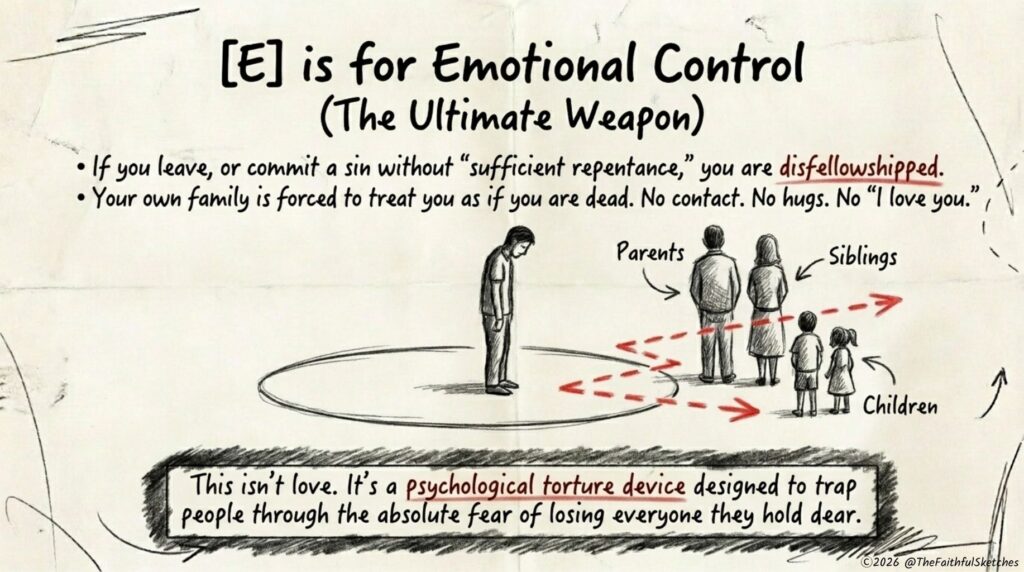
Love and acceptance within the organization are entirely conditional.
The primary enforcement tool is shunning. If a baptized member leaves, or if elders determine that a member’s repentance for a sin is insufficient, the organization disfellowships that person. Family members, including parents, children, and siblings, must then cut off all contact. No conversation, no messages, and no acknowledgment.
This practice traps members through fear of losing every relationship they have ever built inside the organization.
Part 3: Theology as a Tool of Control
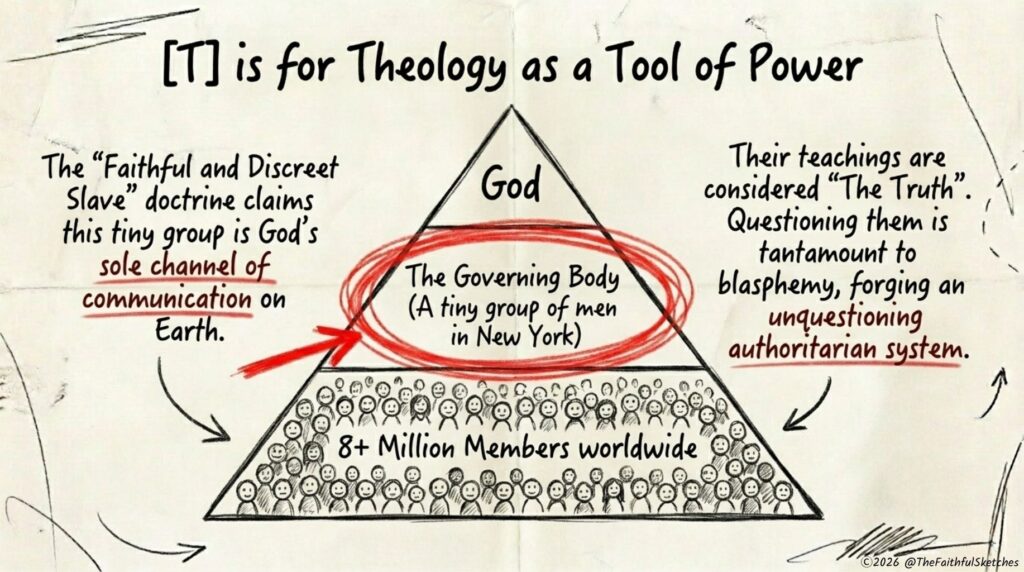
Jehovah’s Witnesses cult theology isn’t simply a set of beliefs. It functions as a carefully constructed system for maintaining organizational authority.
The “Faithful and Discreet Slave”
Witnesses believe that the Governing Body, a small group of men based in Warwick, New York, serves as God’s sole channel of communication on earth. Their teachings carry the label “the truth,” capitalized and treated as beyond question. To challenge them is treated as blasphemy. This creates a structure where unquestioning obedience flows directly from theological conviction rather than personal loyalty.
A Doctrinally Altered Bible

The New World Translation is not a scholarly work. Scholars and linguists have documented alterations to key verses that support Watchtower doctrine. The most cited example is John 1:1, where the translation inserts the word “a” to read “the Word was a god” rather than “the Word was God.” This single change supports their position that Jesus is not Almighty God. As a result, ultimate theological authority shifts away from Christ and toward the organization that interprets him.
Part 4: The Documented Consequences
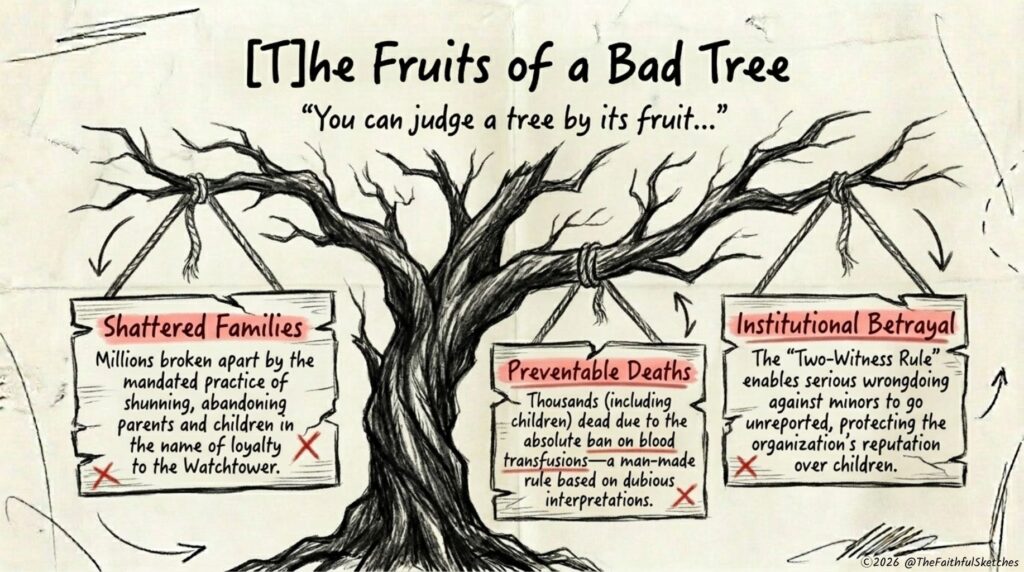
You can assess any organization by what it produces in the lives of its members.
Shattered Families
The shunning practice has fractured millions of families. Parents cut off adult children. Adult children abandon elderly parents. All of it happens in the name of loyalty to the Watchtower. Former members and mental health professionals have extensively documented the psychological damage this causes, including depression, anxiety, and post-traumatic stress.
Preventable Deaths
The blood transfusion ban has resulted in the deaths of thousands of members, including children. These deaths stem from a doctrinal interpretation of Acts 15:28-29, a passage about dietary law that most biblical scholars do not interpret as prohibiting medical transfusions.
Child Protection Failures
The organization’s internal “Two-Witness Rule” requires two witnesses to an act before elders take action on abuse allegations. Critics and legal authorities argue this policy enables serious wrongdoing against minors to go unreported. Courts in multiple countries have issued multimillion-dollar penalties against the organization for handling abuse cases internally rather than reporting them to law enforcement. In 2022, the Australian Royal Commission documented over 1,000 alleged abusers within Australian congregations whose cases the organization never reported to authorities.
Conclusion
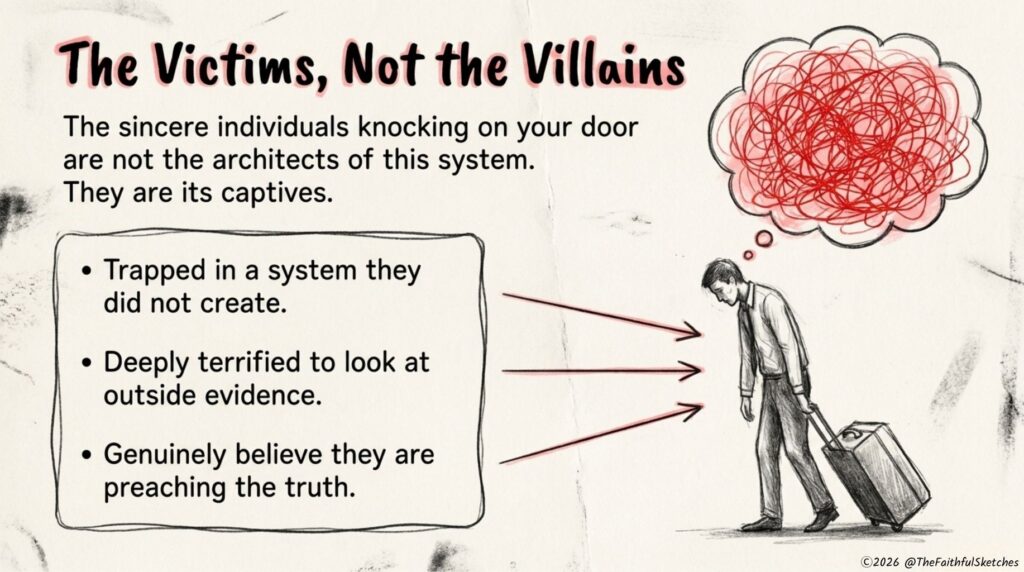
The Jehovah’s Witnesses offer a genuinely beautiful picture of hope. However, the system behind that picture demands a specific price: your freedom to think independently, question authority, choose your relationships, celebrate life events, make your own medical decisions, and love your family without conditions.
The people knocking on your door are not the villains in this story. In most cases, they are sincere individuals trapped inside a system they were born into or converted into before they understood its full demands. They believe they are sharing the truth. Unfortunately, no organization that uses fear, information control, and family separation to maintain membership can credibly claim to represent a God of love.
If you or someone you know has left the Jehovah’s Witnesses and needs support, Recovery from Religion and JW Support offer resources specifically for former members.
This is Part 2 of a two-part series. Read or watch Part 1: Jehovah’s Witnesses Beliefs: What They Believe and What Sets Them Apart for a full breakdown of their theology and practices.
Click Below to Download The Full PDF Summary Guide:
*Free for personal use only. Please don’t resell or redistribute commercially.