
Have you ever wondered why Christians can believe in the same Bible and the same Jesus, yet hold such different views on salvation? The Calvinism vs Arminianism debate traces back to two theological paths that emerged during the Reformation era. Both sides love Scripture. Both want to honor God. Yet they reach strikingly different conclusions about how a person is saved.
In this post, we’ll walk through the history behind the split, then compare the five points of each system side by side, including the verses each side cites. By the end, the Calvinism vs Arminianism divide will make a lot more sense.
Reformation Background
The Protestant Reformation had just shaken Europe. Reformers like Martin Luther taught that salvation comes by grace alone, through faith alone, in Christ alone, not by human effort.
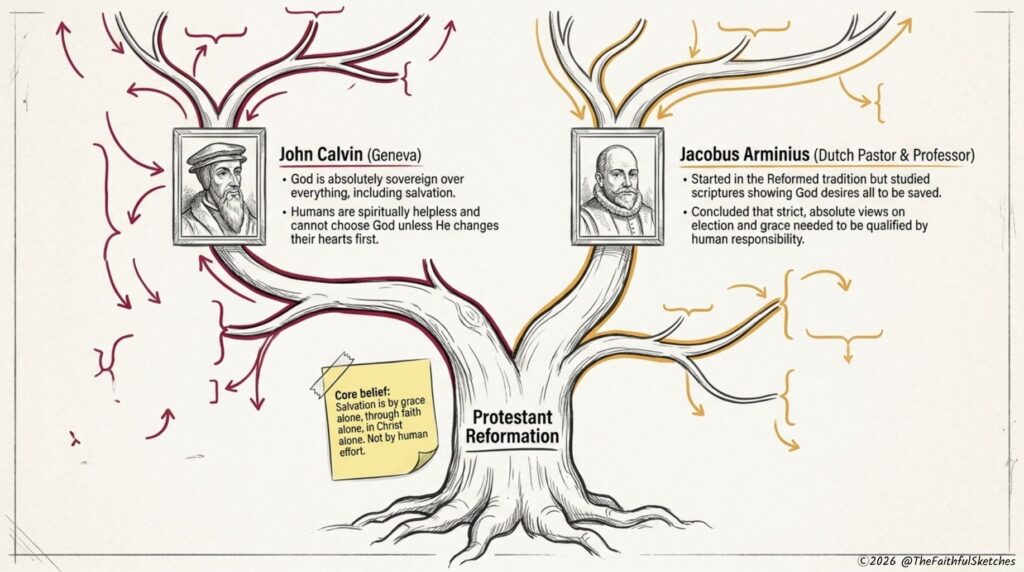
John Calvin, a pastor and theologian in Geneva, continued and developed this teaching. But he emphasized two things strongly.
First, God is absolutely sovereign over everything, including salvation.
Second, humans are spiritually helpless and cannot choose God without God first changing their hearts.
Yet not everyone agreed on how God’s sovereignty and human responsibility fit together. If you want the broader picture of Calvin’s system, my post on Reformed theology and Calvinism covers it in depth.
Arminius and the Remonstrants
Jacobus Arminius was a Dutch pastor and professor who actually started in the Reformed and Calvinist tradition. But as he studied Scripture, especially passages about God desiring all people to be saved and about people resisting God, he became convinced that some of the harder, more absolute ways Calvinists talked about election and grace needed qualifying.
After Arminius died, his followers wrote a document in 1610 called the Remonstrance, essentially a respectful disagreement paper. In it, they set out five points where they differed from strict Calvinism: election, the extent of the atonement, the power of grace, and whether believers can fall away.
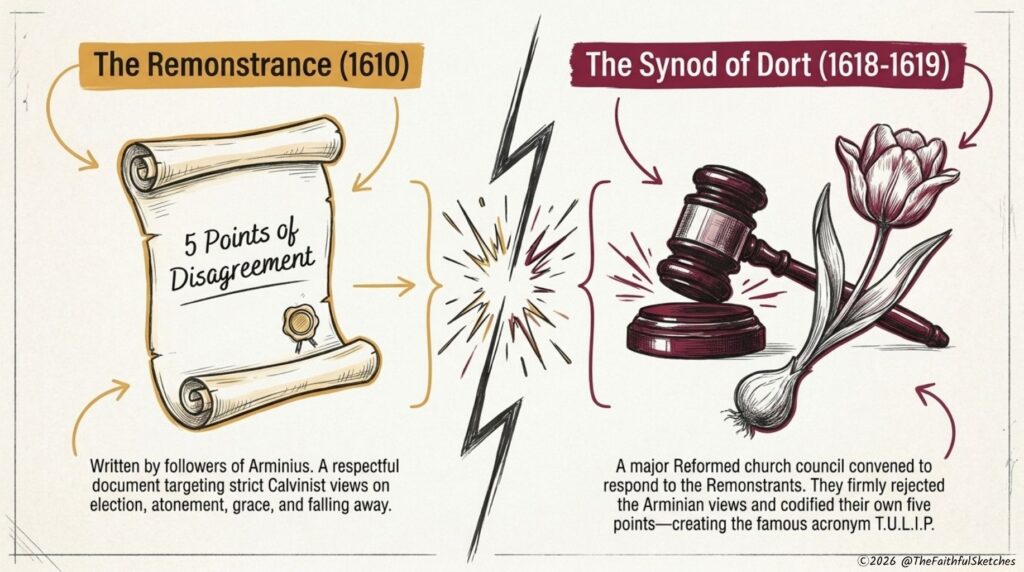
The Reformed churches responded with a major church council, the Synod of Dort, held from 1618 to 1619. There they rejected the Remonstrants’ views and replied with their own five points, later remembered by the acronym TULIP. That’s the split. Now let’s walk through the actual differences.
TULIP vs FACTS: An Overview
Calvinism is summed up by TULIP. Arminianism is often summed up by the acronym FACTS. Here’s the quick version before we dig into each point.
| Acronym | Calvinism (TULIP) | Arminianism (FACTS) |
|---|---|---|
| Point 1 | Total Depravity | Freed by Grace (depravity plus prevenient grace) |
| Point 2 | Unconditional Election | Atonement for All |
| Point 3 | Limited Atonement | Conditional Election |
| Point 4 | Irresistible Grace | Take it or Leave it (resistible grace) |
| Point 5 | Perseverance of the Saints | Salvation can be lost |
The letters don’t line up topic for topic, so below I’ve paired them by the question each one answers. Let’s take them in order.
Point 1: Total Depravity, Where Both Sides Start
Interestingly, both sides agree on the problem: the devastating effect of sin.
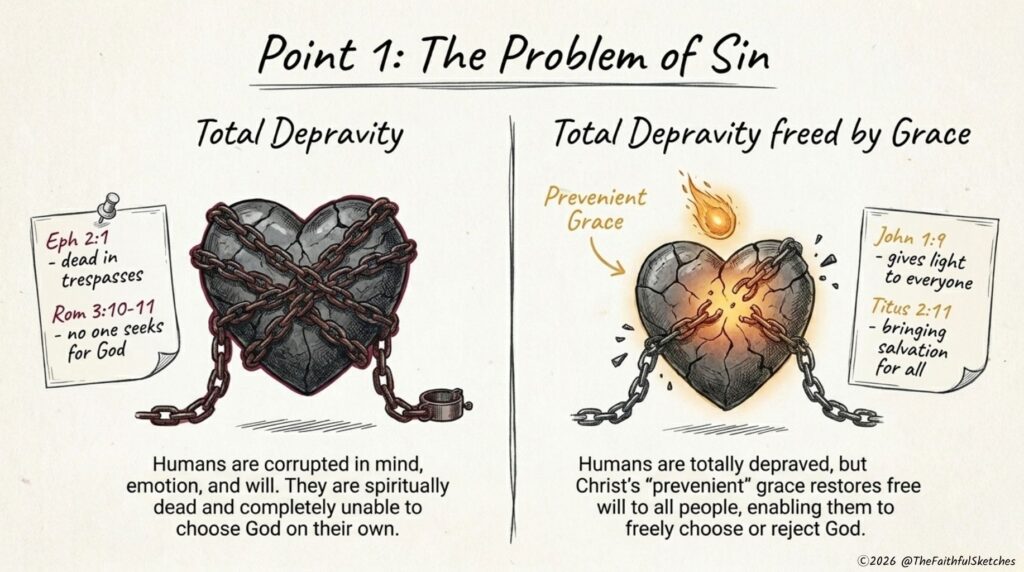
Calvinists teach that as a result of the Fall, every part of humanity is corrupted by sin, our mind, emotions, and will. We are spiritually dead and unable to choose God on our own. They cite Ephesians 2:1, “And you were dead in the trespasses and sins,” along with Romans 3:10-11, “None is righteous, no, not one,” and Jeremiah 17:9, “The heart is deceitful above all things.”
Arminians fully agree that humans are totally depraved and cannot save themselves. However, they believe that through Jesus’s death, prevenient grace restores free will to all people, enabling them to choose or reject God. They point to John 1:9, “The true light, which gives light to everyone,” Titus 2:11, “the grace of God has appeared, bringing salvation for all people,” and John 12:32, “I… will draw all people to myself.”
Point 2: Unconditional vs Conditional Election
This point addresses the basis of God’s choice to save.
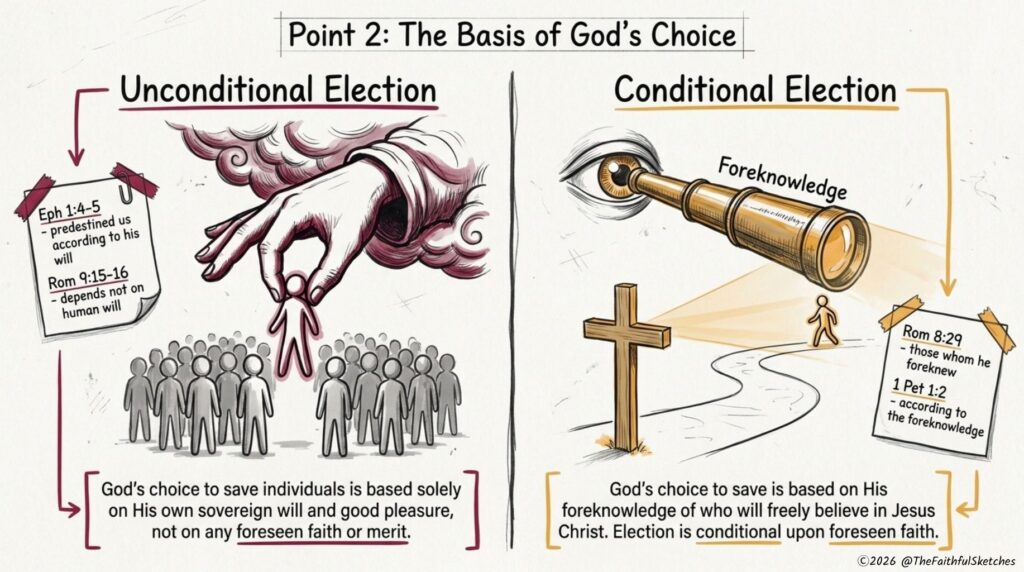
Calvinists say God’s choice to save individuals rests solely on His own sovereign will and good pleasure, not on any foreseen faith, merit, or quality in the person. They cite Ephesians 1:4-5, “he chose us in him before the foundation of the world,” Romans 9:15-16, “it depends not on human will… but on God, who has mercy,” and John 6:44, “No one can come to me unless the Father… draws him.”
Arminians argue that God’s choice rests on His foreknowledge of who would, by prevenient grace, freely believe in Christ. Election is conditional upon foreseen faith. They lean on Romans 8:29, “those whom he foreknew he also predestined,” 1 Peter 1:1-2, “elect according to the foreknowledge of God,” and Acts 2:23. For a fuller treatment of this exact tension, see my post on predestination and free will.
Point 3: Limited vs Universal Atonement
This point asks one question: for whom did Christ die?
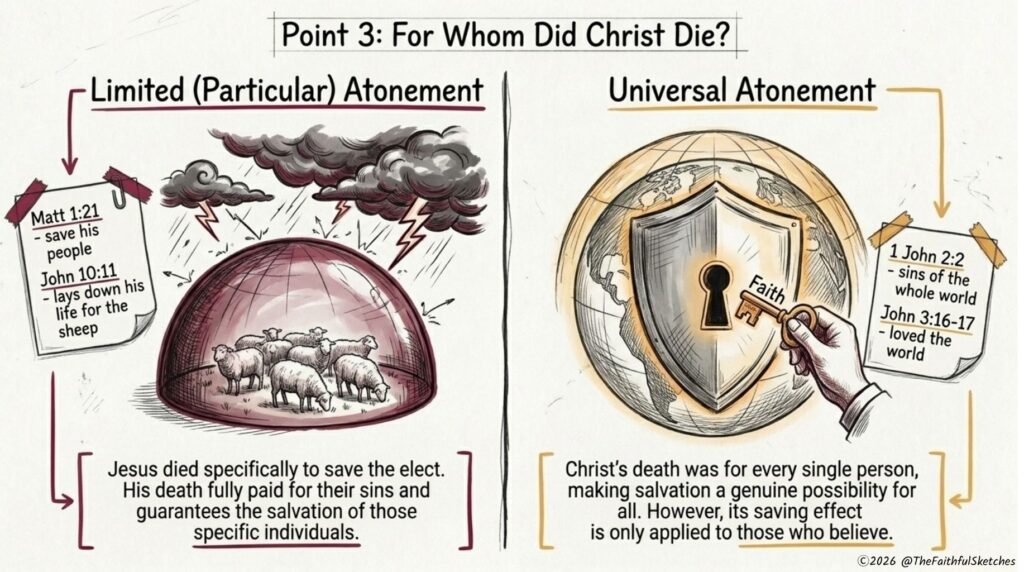
Calvinists hold to Limited Atonement, sometimes called Particular Redemption. They say Christ’s atonement was intended to secure the salvation of the elect alone. His death was a definite atonement that actually saves rather than merely making salvation possible. They cite Matthew 1:21, “he will save his people from their sins,” John 10:11, “The good shepherd lays down his life for the sheep,” and Ephesians 5:25. Calvinists interpret “his people,” “my sheep,” and “the church” as the elect, not the whole world.
Arminians claim Christ’s death was for every single person, making salvation a genuine possibility for all, though its saving effect applies only to those who believe. They quote 1 John 2:2, “the propitiation… for the sins of the whole world,” John 3:16-17, “For God so loved the world,” 2 Peter 2:1, and Romans 5:18.
Point 4: Irresistible vs Resistible Grace
This point asks how God’s saving grace is applied.
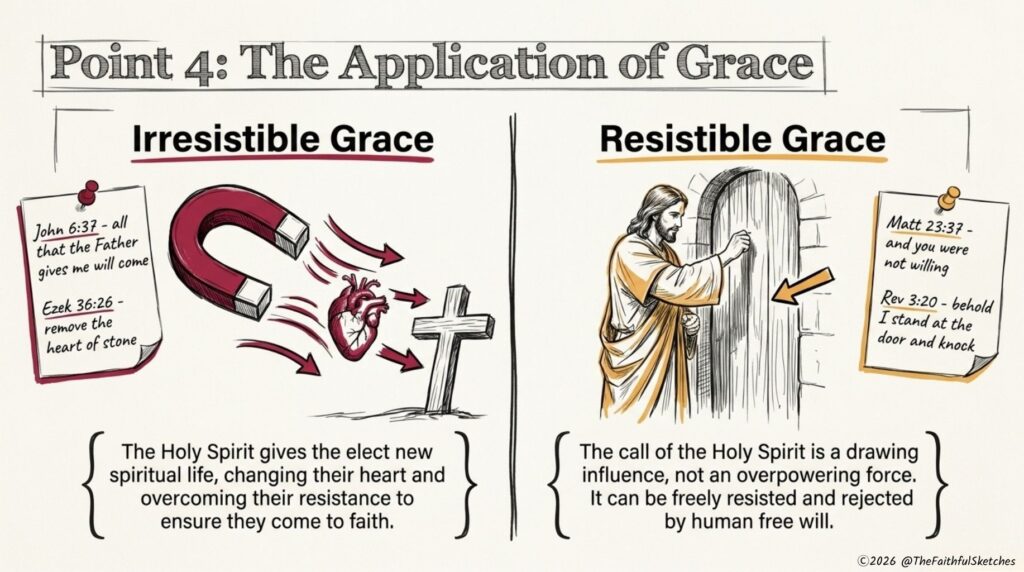
Calvinists hold to Irresistible Grace, also called the effectual call. When God calls the elect, He effectually applies salvation by regenerating them. The Holy Spirit overcomes their natural resistance and unfailingly brings them to saving faith. They cite John 6:37, “All that the Father gives me will come to me,” Acts 13:48, “as many as were appointed to eternal life believed,” and Ezekiel 36:26, “I will give you a new heart.”
Arminians say the call of the Holy Spirit through the Gospel can be resisted and rejected by human free will. God’s grace is not an overpowering force but a drawing influence that can be refused. They point to Matthew 23:37, “you were not willing,” Acts 7:51, “you always resist the Holy Spirit,” and Revelation 3:20, “I stand at the door and knock.”
Point 5: Perseverance of the Saints vs Conditional Salvation
The final point concerns the security of the believer.
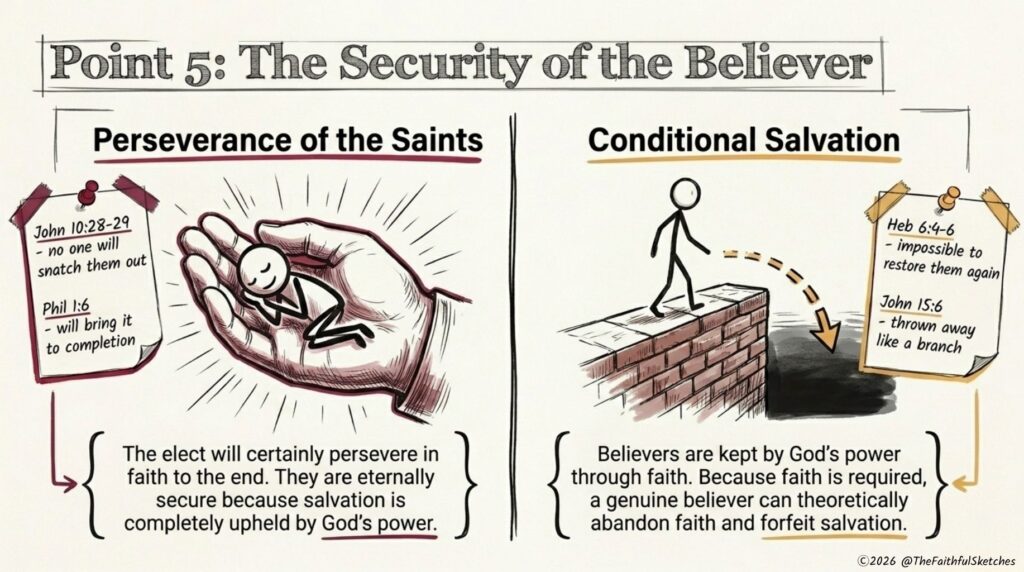
Calvinists hold that those whom God has elected, called, and regenerated will certainly persevere in faith to the end. They are eternally secure because God’s power upholds their salvation, not their own. They cite John 10:28-29, “they will never perish,” Philippians 1:6, “he who began a good work in you will bring it to completion,” and Romans 8:30.
Arminians believe God keeps believers through faith, but since salvation requires an ongoing faith response, a genuine believer can later abandon that faith, fall away, and forfeit salvation. They reference Hebrews 6:4-6, John 15:6, “thrown away like a branch and withers,” and 1 Timothy 4:1, “some will depart from the faith.”
Calvinism vs Arminianism: The Full Comparison
Here’s everything in one place so you can scan the whole Calvinism vs Arminianism debate at a glance.
| Question | Calvinism | Arminianism |
|---|---|---|
| Human condition | Total depravity, spiritually dead | Total depravity, but prevenient grace restores free will |
| Basis of election | God’s sovereign will alone | God’s foreknowledge of who would believe |
| Extent of atonement | For the elect only | For all people, applied to believers |
| Nature of grace | Irresistible, effectual | Resistible, can be refused |
| Security of salvation | Cannot be lost | Can be forfeited through unbelief |
Conclusion: Test Everything
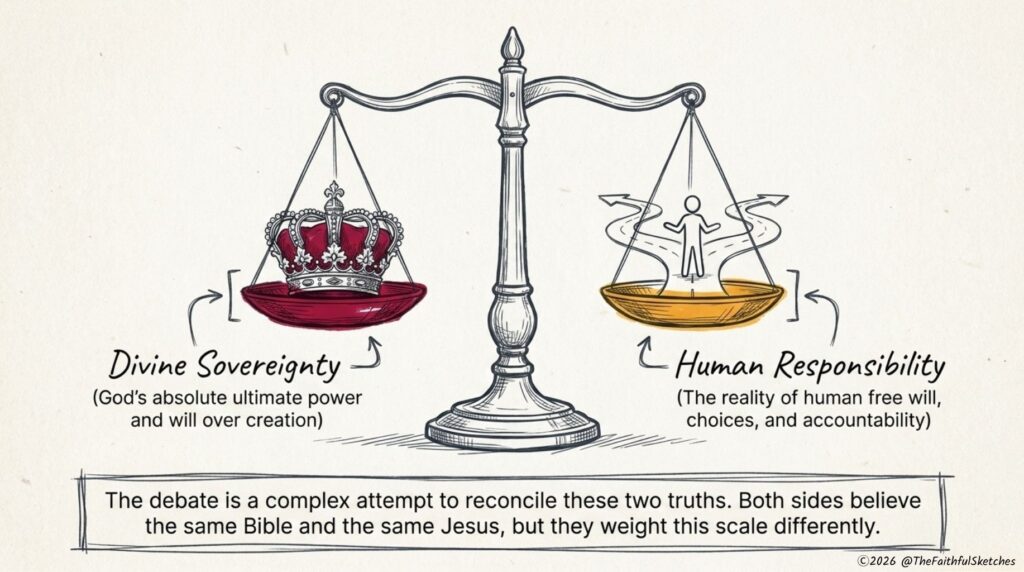
The Calvinism vs Arminianism debate is a complex attempt to reconcile divine sovereignty and human responsibility. Two groups of sincere believers, reading the same Scriptures, land in different places. Our goal should be to study Scripture diligently, hold our views with conviction, and extend grace and charity to those who interpret it differently.
As 1 Thessalonians 5:21 tells us, “Test everything; hold fast what is good.” We should examine all teachings carefully and keep what proves true. If you want to go deeper on the case against the five points of TULIP, read my post asking whether Calvinism is biblical, and for the wider picture, see Calvinism vs Hyper-Calvinism.
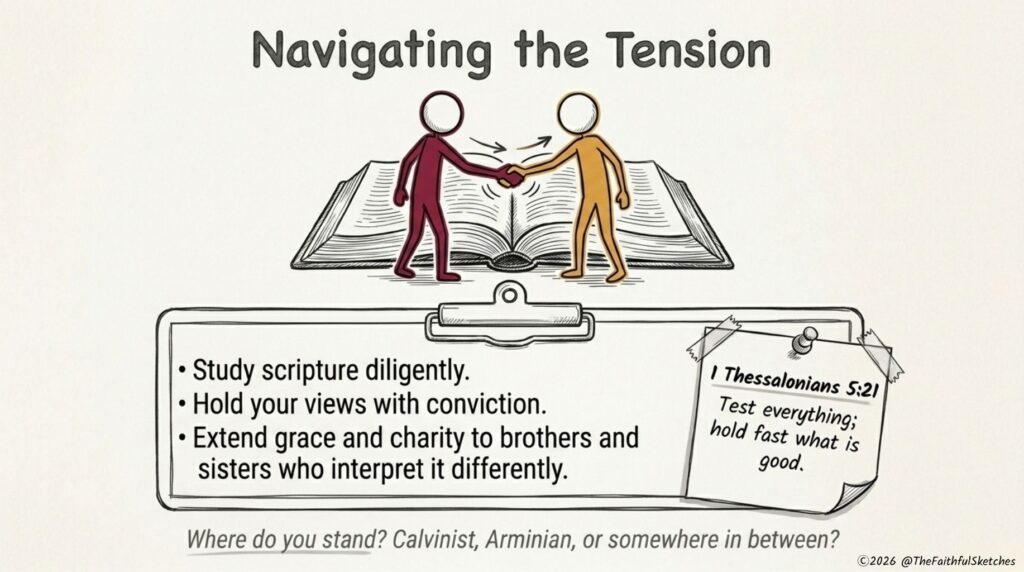
So where do you stand? Calvinist, Arminian, or somewhere in between? Let me know in the comments below. If you found this helpful, don’t forget to like, subscribe, and let’s explore God’s Word together, one doodle at a time.
Click Below to Download The Full PDF Summary Visual Guide:
*Free for personal use only. Please don’t resell or redistribute commercially.