
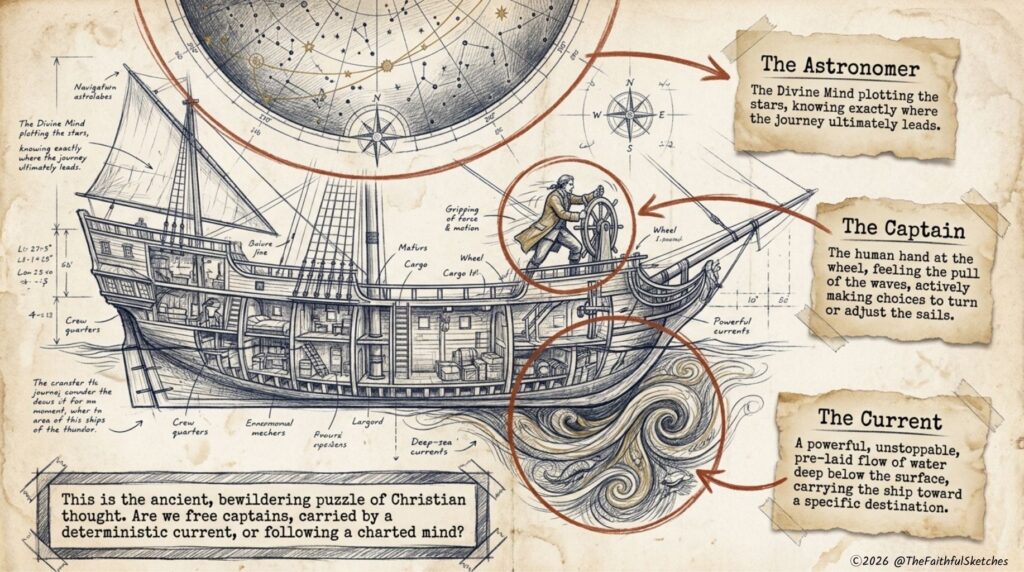
Picture a ship sailing across a vast ocean. The captain stands at the wheel, feeling the pull of the waves, making real choices: turn left, turn right, adjust the sails. But deep below the surface runs a powerful, pre-laid current carrying the ship on a specific course. High above, an astronomer who plotted the stars knows exactly where that current leads.
Which one is actually in charge? The captain’s hand on the wheel? The unstoppable current? Or the mind that charted the journey?
That question captures the tension at the heart of one of Christianity’s oldest debates. The puzzle of predestination and free will has occupied theologians, philosophers, and ordinary believers for two thousand years. This post won’t pretend to fully solve it. Instead, it will give you the clearest possible map of the territory: the definitions, the biblical texts, the major Christian positions, and why your answer to this question shapes the entire color of your faith.
Part 1: Defining the Terms
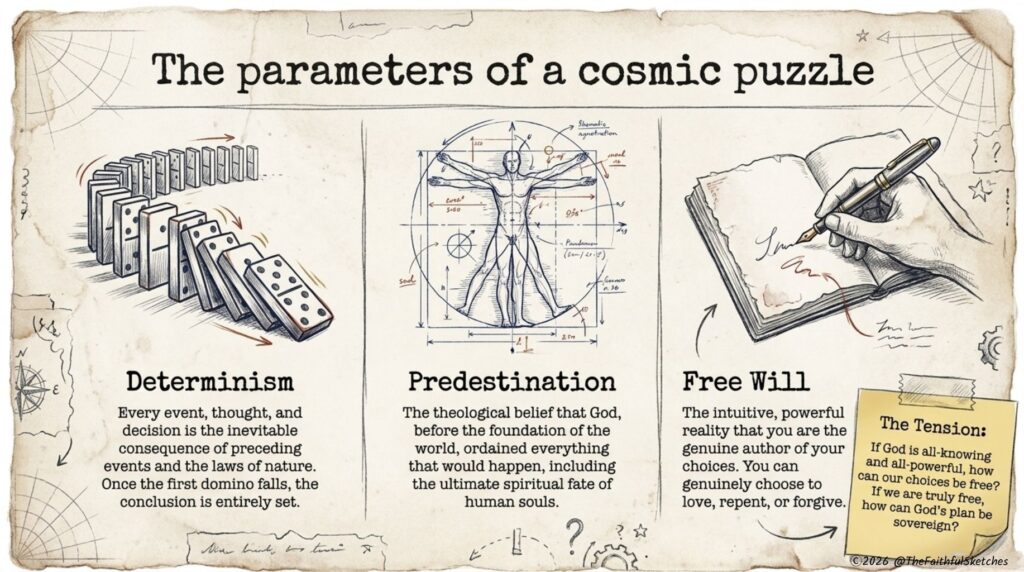
Before engaging the debate, we need precise definitions. These three concepts are frequently confused or conflated.
Determinism
Determinism is a philosophical position, not exclusively a theological one. At its core, it holds that every event, including every human thought, decision, and action, is the inevitable consequence of preceding events and the laws of nature. Think of a perfect cosmic chain of dominoes. Once the first one falls, the conclusion of the entire sequence is already set. Nothing interrupts it. Nothing redirects it.
Predestination
Predestination is a theological belief that God, from before the foundation of the world, ordained everything that would happen, including the ultimate fate of human souls. It asks a direct question: did God choose us, or do we choose God?
Free Will
Free will is the powerful, intuitive conviction that you are the genuine author of your choices. You could have chosen tea instead of coffee this morning. You can choose to forgive, to love, to repent. Your decisions belong to you in a meaningful sense.
The tension between these three concepts is immediate. If God is all-knowing and all-powerful, how can our choices be genuinely free? If our choices are genuinely free, how can God’s plan be truly sovereign? It feels like a zero-sum game where one side must lose.
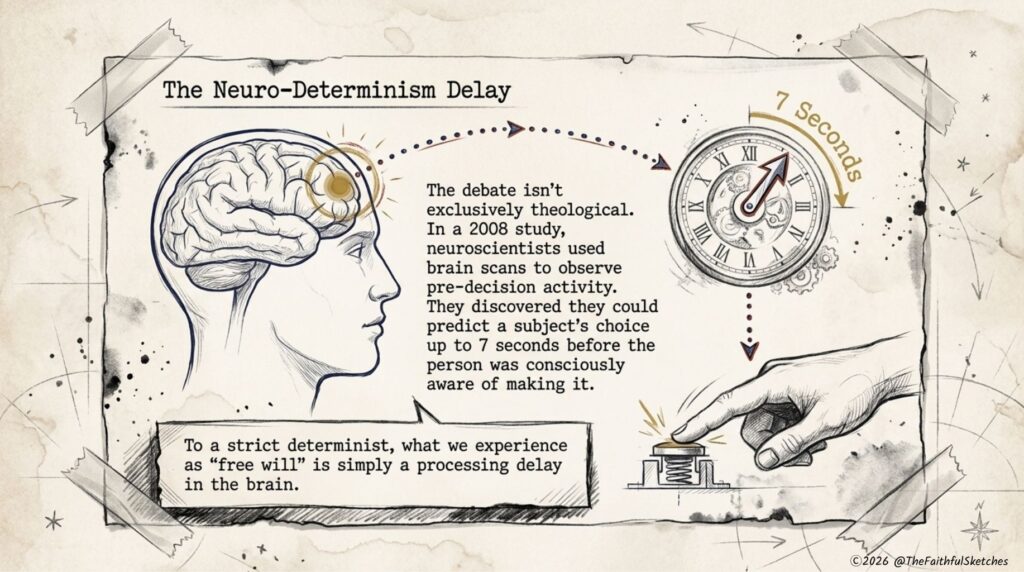
Interesting fact:
In a 2008 neuroscience study, researchers used brain scans to identify “pre-decision” neural activity up to seven seconds before participants reported consciously making a choice. To a strict determinist, this suggests that what we call free will is simply a delayed awareness of a decision the brain had already made.
Part 2: What the Bible Actually Says
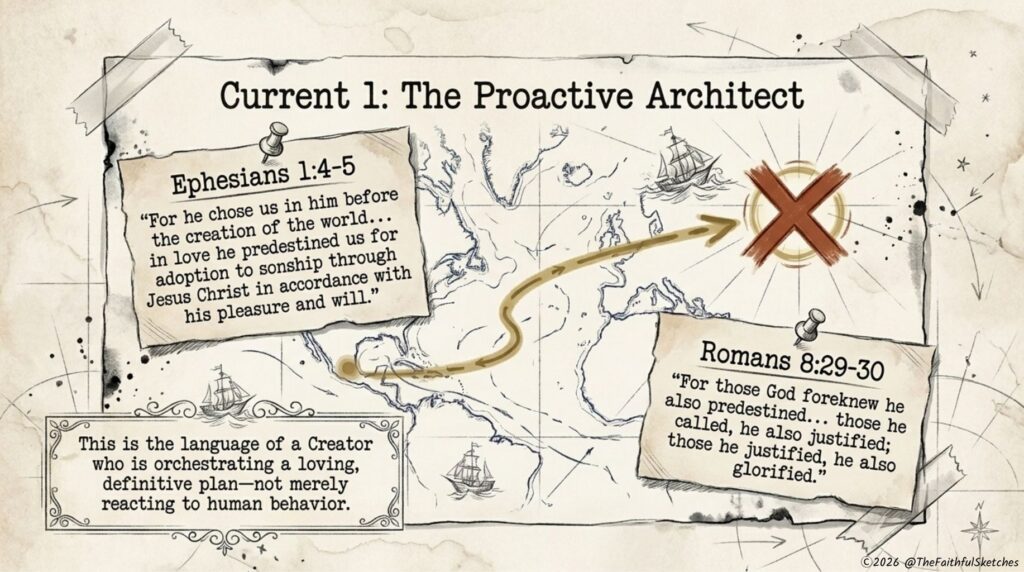
The Bible doesn’t resolve this tension with a single systematic chapter. Instead, it presents both divine sovereignty and genuine human choice in what can only be described as a deliberate, paradoxical harmony.
The Texts on God’s Sovereignty
Ephesians 1:4-5 states it directly: “For he chose us in him before the creation of the world to be holy and blameless in his sight. In love he predestined us for adoption to sonship through Jesus Christ, in accordance with his pleasure and will.”
Romans 8:29-30 extends this further: “For those God foreknew he also predestined to be conformed to the image of his Son… And those he predestined, he also called; those he called, he also justified; those he justified, he also glorified.”
This is strong language. It describes a God who is not reacting to human decisions but proactively working out a loving plan that precedes the creation of the world itself.
The Texts on Human Choice
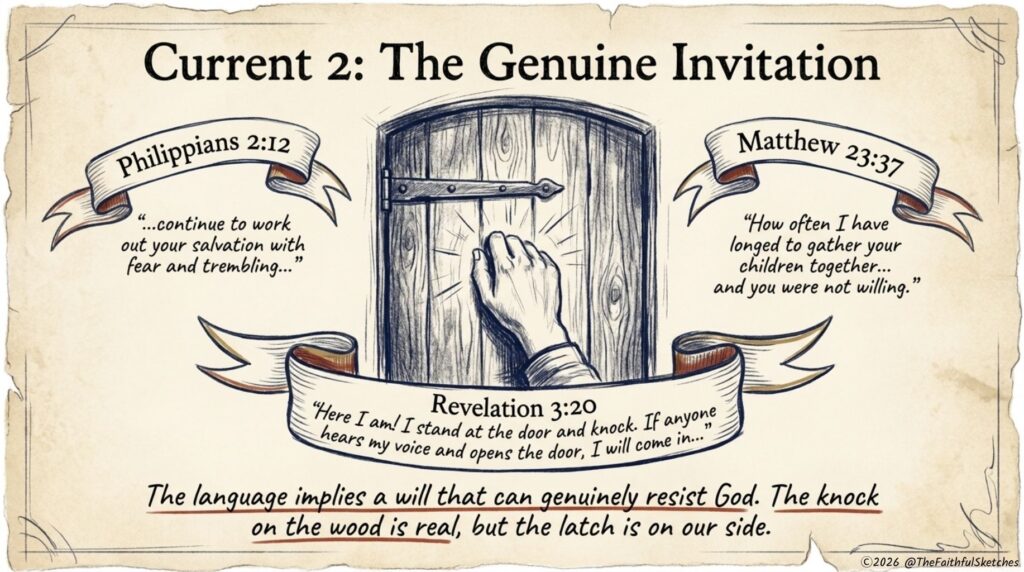
Immediately after some of scripture’s most profound statements about God’s sovereign plan, the same writers issue urgent calls to choose and act.
Philippians 2:12-13 holds both truths in a single breath: “Continue to work out your salvation with fear and trembling, for it is God who works in you to will and to act in order to fulfill his good purpose.” Human obedience and divine empowerment sit side by side without apology.
Jesus himself laments over Jerusalem in Matthew 23:37: “How often I have longed to gather your children together… and you were not willing.” That phrase, “you were not willing,” implies a will genuinely capable of resisting God’s desire.
Revelation 3:20 frames the gospel as an invitation requiring a response: “Here I am! I stand at the door and knock. If anyone hears my voice and opens the door, I will come in.” The knocking is real. Crucially, the latch is on our side.
Interesting fact:
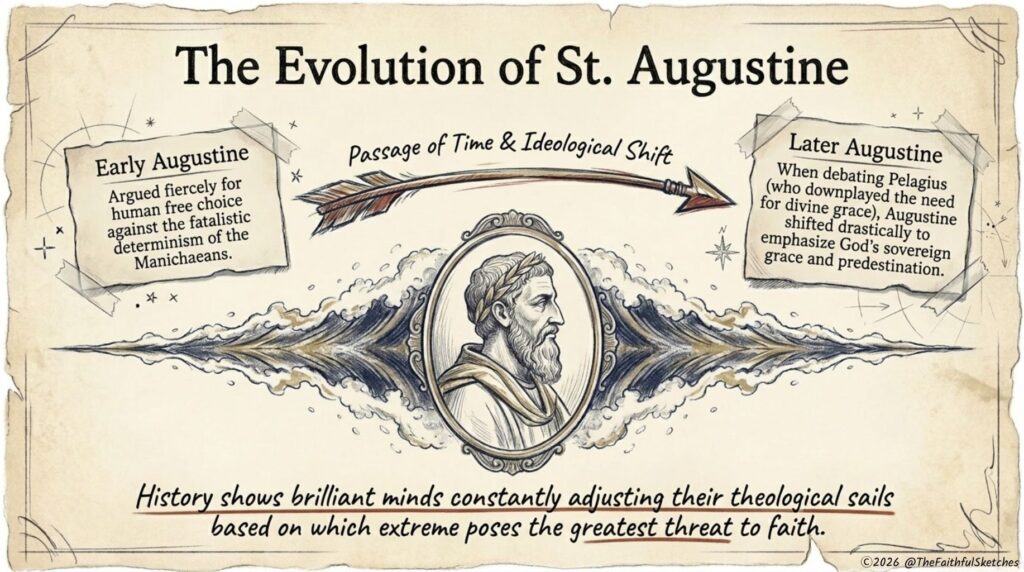
Augustine of Hippo, one of Christianity’s most influential early thinkers, initially argued strongly for human free choice against fatalistic philosophies like Manichean determinism. Later, in his debate against Pelagius, who minimized the need for divine grace, Augustine shifted emphasis toward God’s sovereign grace and predestination. His thinking on this topic evolved significantly across his lifetime.
Part 3: How Christians Have Navigated This Through History
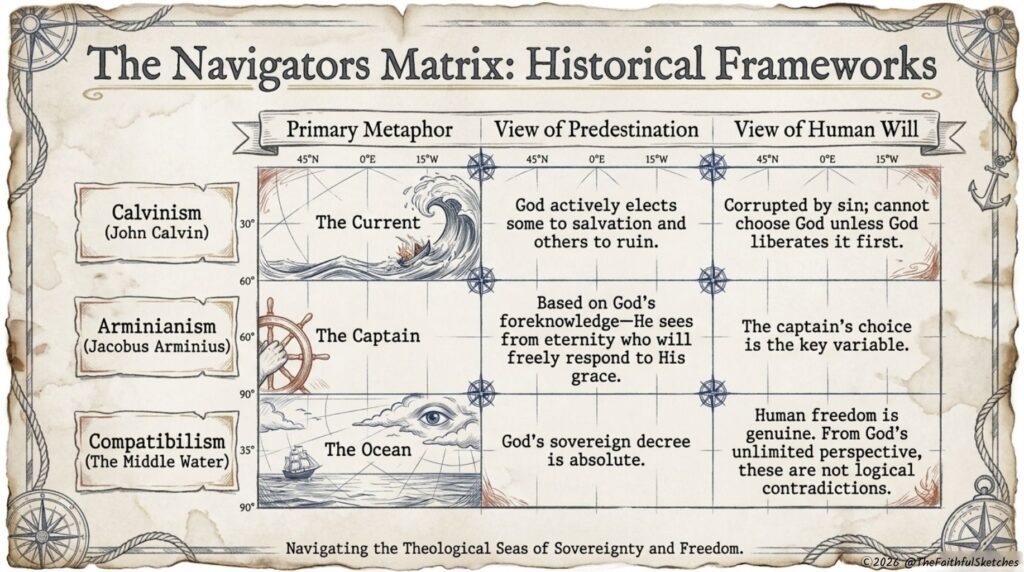
Throughout church history, theologians have tried to hold these two biblical currents together. They generally land at different points on a spectrum.
The Calvinist Position
On one end stands John Calvin, who emphasized divine sovereignty so thoroughly that he taught God actively elects some people to salvation and passes over others. Furthermore, Calvin argued that human free will, corrupted by sin, cannot choose God unless God first liberates it through regenerating grace. The current, in this view, is everything. The captain’s wheel turns only because the current moves it.
The Arminian Position
On the other end stands Jacobus Arminius, who taught that God’s predestination is grounded in His foreknowledge. God sees from eternity who will freely respond to His grace, and He predestines them on that basis. The captain’s choice is genuine and determinative. God’s sovereignty works through, rather than over, human freedom.
The Compatibilist Position
For many believers and theologians across the centuries, the answer lies not in choosing one side but in living within the mystery. Compatibilists propose that God’s sovereign decree and genuine human freedom are not logical contradictions. They only appear contradictory from our limited human perspective. From God’s vantage point outside of time, both are simultaneously and fully true.
Interesting fact:
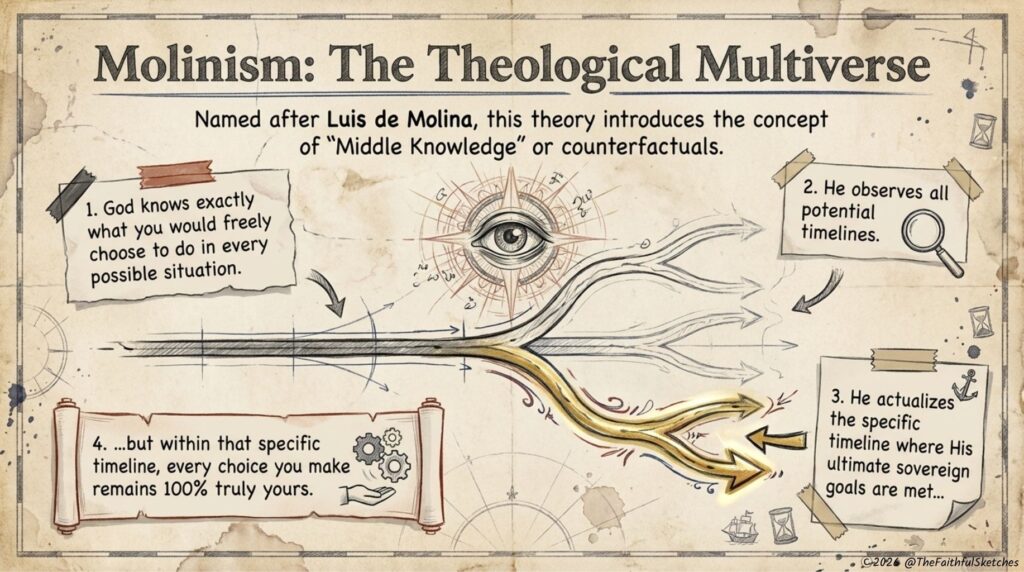
A middle-ground theological position called Molinism, named after 16th-century Jesuit theologian Luis de Molina, attempts a creative resolution. Molina proposed that God possesses “middle knowledge,” meaning He knows exactly what any free creature would choose in any possible situation. God then actualizes the specific timeline in which His purposes are achieved while every human choice remains genuinely free. Some theologians have compared it to a theological multiverse theory.
Part 4: Why Your Answer Changes Everything
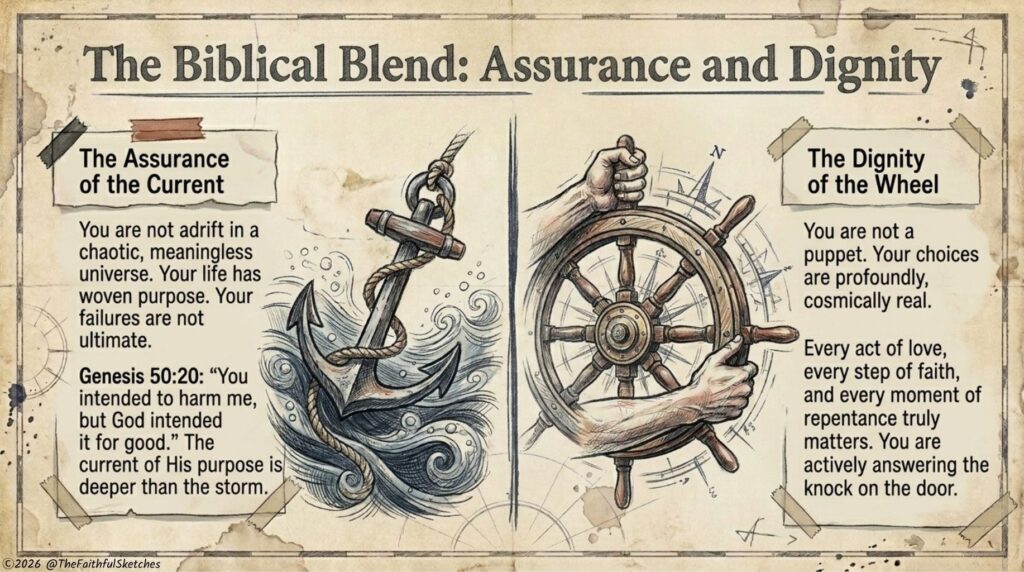
This debate is not merely intellectual. How you lean on predestination and free will shapes the practical texture of your faith in concrete ways.
Leaning too heavily into predestination alone carries real dangers. It can produce passivity (“whatever will be, will be”), fatalism, or a quiet spiritual arrogance (“I am chosen; perhaps you are not”). It can drain urgency from evangelism and make prayer feel performative.
Leaning too heavily into free will alone carries different dangers. It can generate chronic anxiety (“did I choose correctly?”), spiritual pride (“my wisdom led me to God”), and a subtle drift away from grace as the foundation of salvation.
The biblical balance between predestination and free will, however, produces something distinct and genuinely beautiful.
The Assurance That Comes From Sovereignty
You are not adrift in a meaningless universe. A loving Navigator exists. Your life carries a purpose woven into it before time began. Your failures are not final. Joseph captured this precisely when he told his brothers, who had sold him into slavery: “You intended to harm me, but God intended it for good.” (Genesis 50:20). The current of God’s purpose runs deeper than any storm above it.
The Dignity That Comes From Genuine Choice
Your choices are real and they matter cosmically. You are not a puppet. Every act of love, every step of faith, every moment of genuine repentance has weight. You cooperate with the divine current. You answer the knock on the door. That cooperation is not nothing. Scripture treats it as everything.
Part 5: Resting in the Mystery
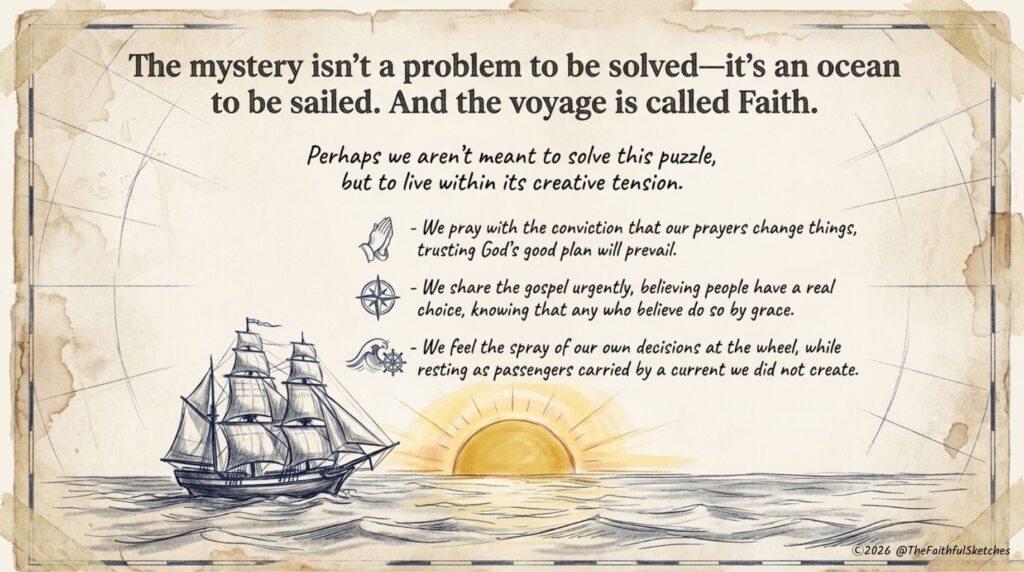
So does the puzzle get solved? Probably not, at least not this side of eternity. But perhaps it was never meant to be solved in the way we want. Perhaps Christians are meant to live in its creative tension, like a sailor who trusts both the chart and his own skilled hand on the wheel.
We pray with the conviction that our prayers genuinely change things, while trusting that God’s good plan will ultimately prevail; We share the gospel with urgency, believing every person faces a real choice, while knowing that anyone who believes does so by the grace of God alone.
We are captains feeling the spray of our own decisions; We are also beloved passengers carried by a current of grace we did not create and cannot earn. Above it all is the Mind who plotted the stars, ordained the destination, and stepped personally into the boat with us in the person of Jesus Christ.
The mystery of predestination and free will is not a problem to be solved. It is an ocean to be sailed. And the voyage is called faith.
Which position do you land on? Leave a comment below.
For related reading, explore our post on Covenant Theology vs Dispensationalism and deep dive on Molinism for another look at how theological frameworks shape the way we read scripture.
Click Below to Download The Full PDF Summary Guide:
*Free for personal use only. Please don’t resell or redistribute commercially.