
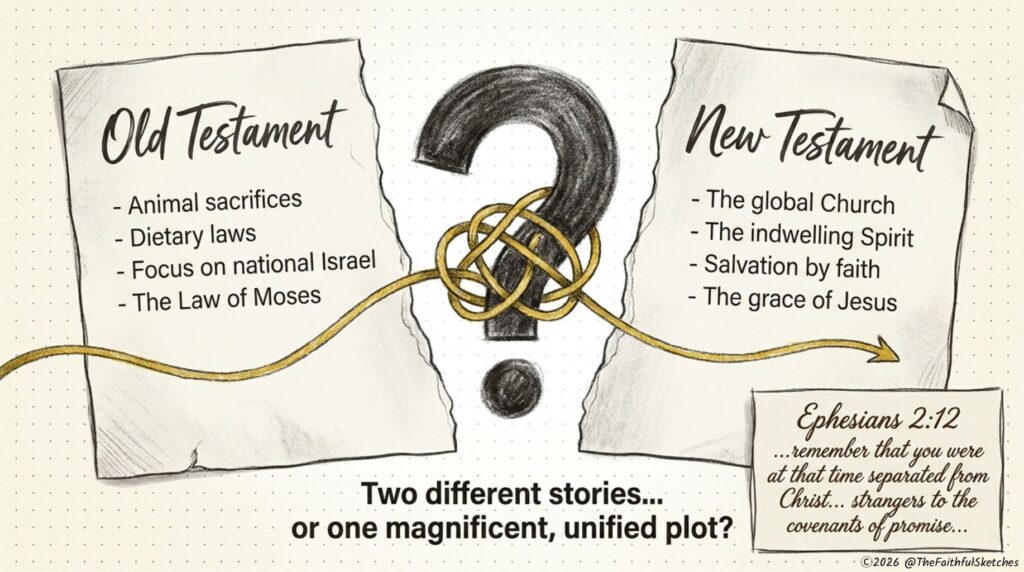
Have you ever felt a disconnect between the God of the Old Testament and the God of the New? Between the law of Moses and the grace of Jesus? We read about animal sacrifices, dietary laws, and national Israel, then turn the page to find the church, the Spirit, and salvation by faith. The question is obvious: are these two different stories, or one magnificent, unified story?
The Apostle Paul gives us the key in Ephesians 2:12: “Remember that you were at that time separated from Christ, alienated from the commonwealth of Israel and strangers to the covenants of promise, having no hope and without God in the world.”
Strangers to the covenants of promise. Plural. Not a single static contract, but a series of unfolding, interconnected covenants — a chain of divine promises forming the single, unbreakable storyline of Scripture. That is Covenant Theology. This post traces that golden thread from Eden to eternity, covering what Covenant Theology actually teaches, how the biblical covenants connect, and why it changes everything about how you read the Bible.
Part 1: What Is a Covenant?
Before tracing the covenants, we need to understand the word itself.
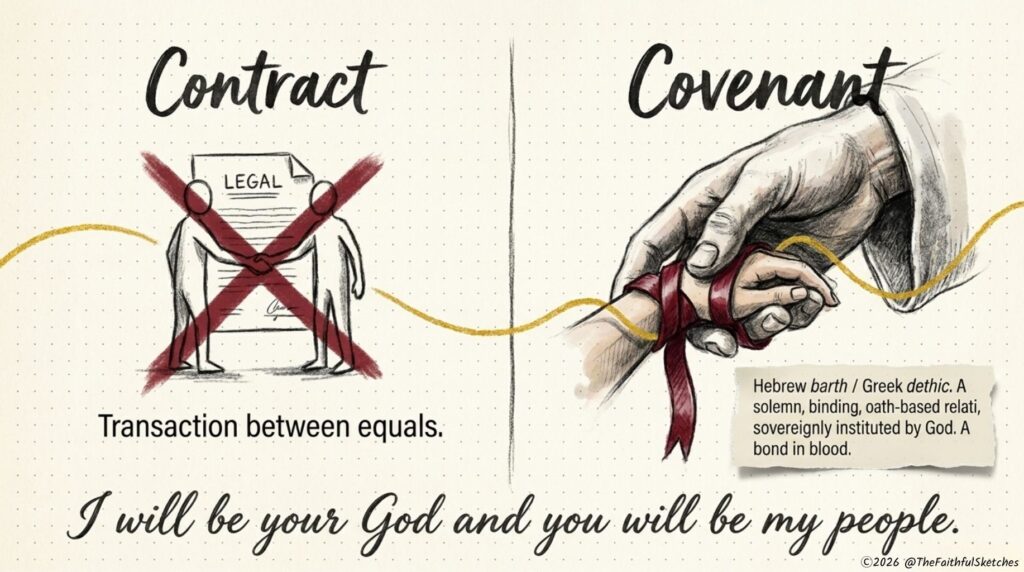
In everyday usage, a covenant often means a contract — a transaction between equals. The Hebrew word berith and the Greek diatheke point to something richer: a solemn, binding, oath-based relationship sovereignly initiated by God. It is a bond in blood. It is God declaring, “I will be your God, and you will be my people.” That refrain echoes from Genesis to Revelation.
A covenant carries promises, obligations, and signs. It is how the supreme, transcendent God chooses to relate to humanity in a knowable, promise-bound way. Critically, God always initiates. The covenants are not negotiated agreements. They are sovereign acts of divine commitment.
Part 2: The Two Foundational Covenants
Covenant Theology organizes God’s entire redemptive story around two overarching covenants. Everything else builds on these.
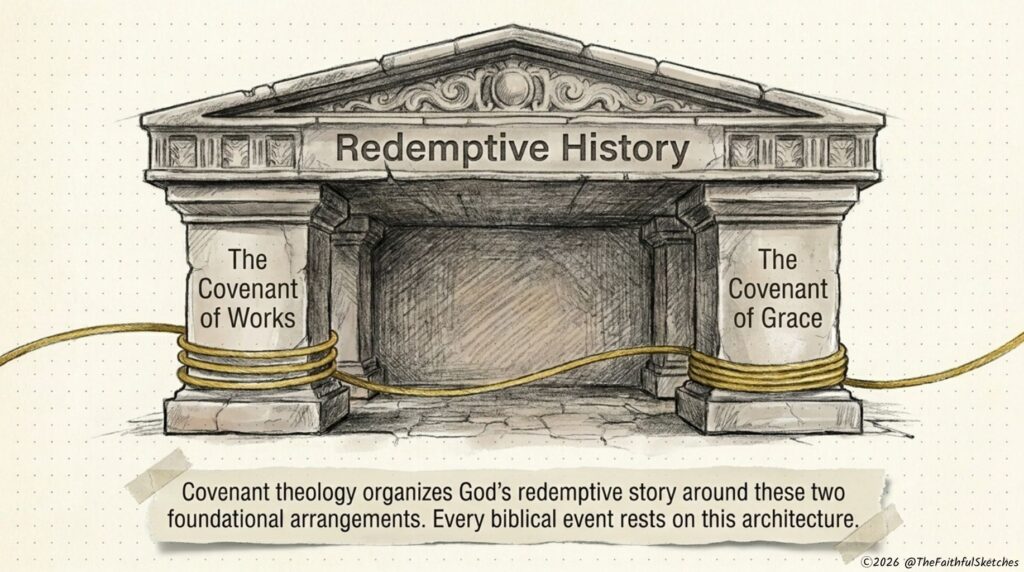
The Covenant of Works
This was God’s original arrangement with humanity in Eden. The terms were clear, gracious, and life-giving. Genesis 2:16-17 states them plainly: “You may surely eat of every tree of the garden, but of the tree of the knowledge of good and evil you shall not eat, for in the day that you eat of it you shall surely die.”
Perfect, perpetual obedience was the condition for eternal life. Adam acted as the federal head, the representative of all humanity. When he broke the covenant, the consequences extended far beyond personal failure. His breach introduced spiritual fracture, moral corruption, and death into the entire human race. Shame, fear, alienation from God, and a cursed creation followed immediately.
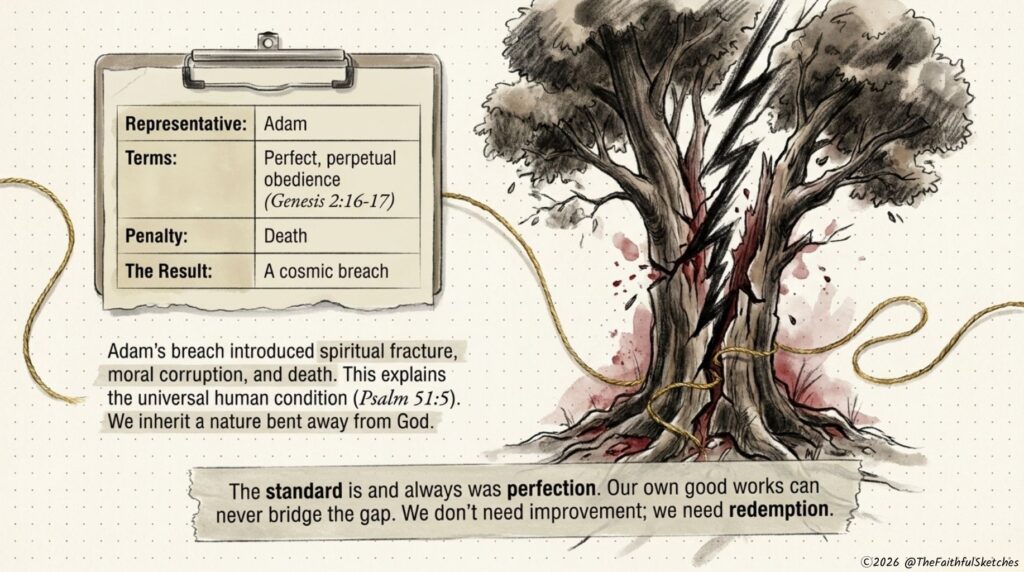
This covenant explains the universal human condition. As Psalm 51:5 teaches, we enter the world already affected by sin. The standard of perfect obedience established in Eden reveals precisely why our own good works can never bridge the gap back to God. The required standard was always a perfection we cannot achieve. We don’t need improvement. We need redemption.
The Covenant of Grace
God did not leave humanity in that state of fracture. He revealed a second, redemptive covenant, and this is the heart of the Bible’s good news.
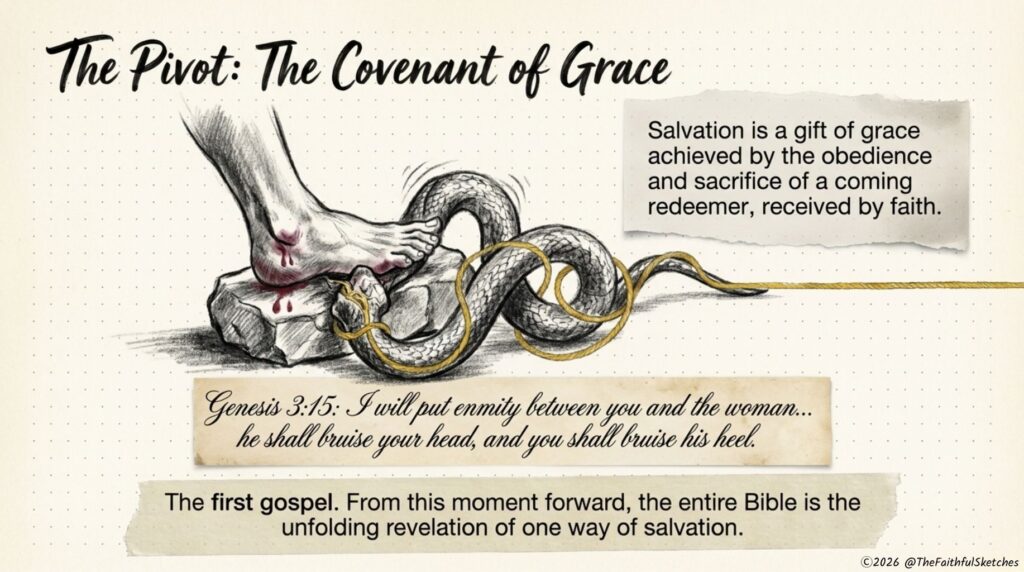
Its premise is straightforward: salvation is a gift of grace, achieved by the obedience and sacrifice of a coming Redeemer, received through faith. The first shimmer of this promise appears in Genesis 3:15, spoken directly to the serpent: “I will put enmity between you and the woman, and between your offspring and her offspring; he shall bruise your head, and you shall bruise his heel.”
Theologians call this the protoevangelium, the first gospel. A victor would come from humanity who would crush the serpent, though wounded in the process. From this moment forward, the entire Bible is the unfolding revelation of this Covenant of Grace — one way of salvation, administered differently across different periods of history.
Part 3: How Grace Unfolds — The Biblical Covenants
Think of the Covenant of Grace as the unchanging substance: salvation by grace through faith in Christ. The way it is administered — the ceremonies, laws, and community structures — changes throughout history. The specific biblical covenants we encounter in Scripture are successive administrations of this single, underlying covenant.
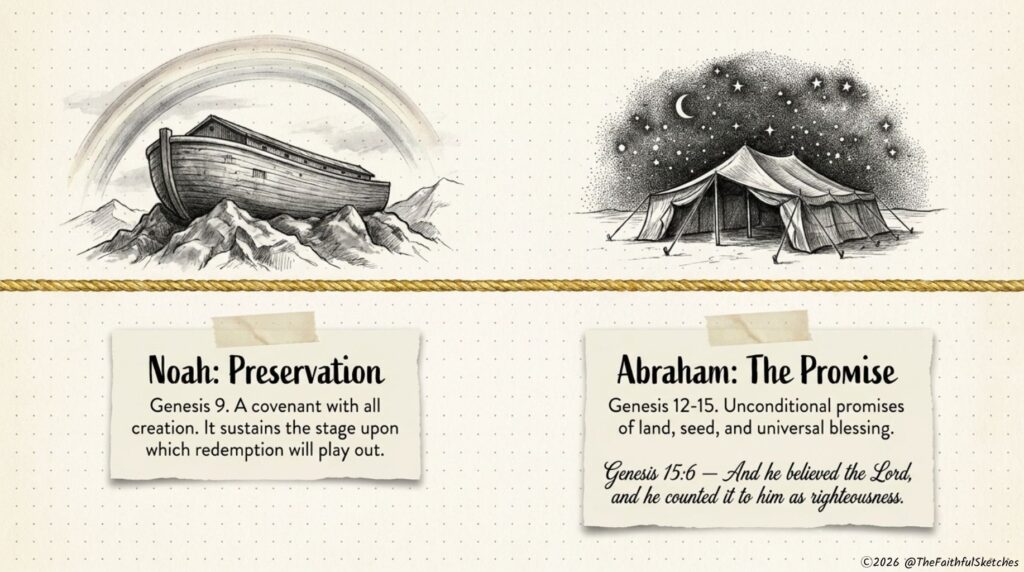
With Noah (Genesis 9)
God established a covenant of preservation with all creation, signified by the rainbow. This covenant sustains the stage upon which redemption will play out. It guarantees that the world will remain intact long enough for God’s redemptive purposes to be accomplished.
With Abraham (Genesis 12, 15, 17)
This is the pivotal administration. God makes unconditional promises covering three things: land, seed or offspring, and universal blessing for all nations. Genesis 15:6 provides the theological keystone: “And he believed the LORD, and he counted it to him as righteousness.” Abraham was justified by faith, not works — the same basis on which every believer in every age stands before God.
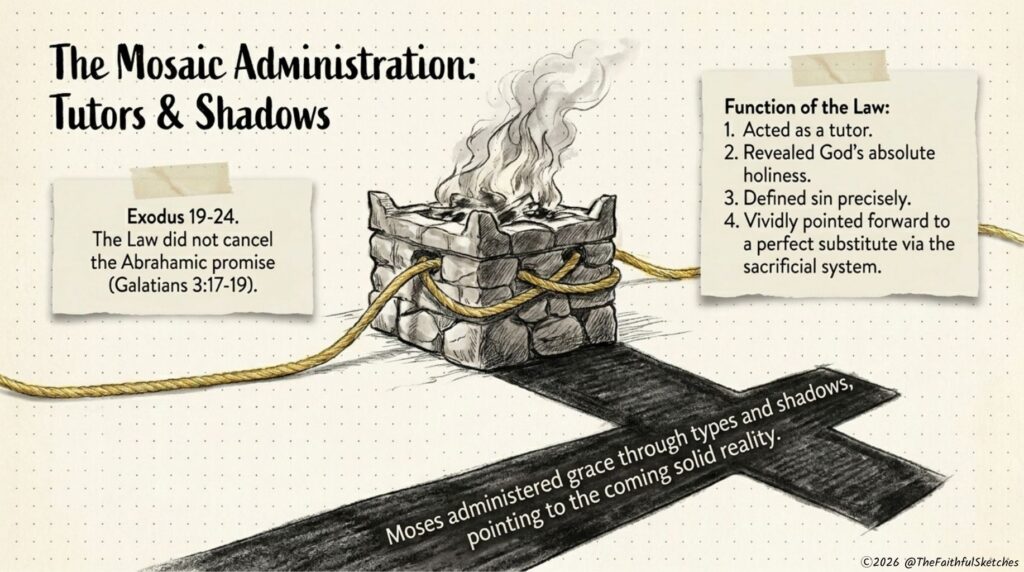
With Moses (Exodus 19-24)
The Mosaic covenant did not replace or contradict the Abrahamic covenant. Galatians 3:17-19 clarifies this directly: “The law that came 430 years later does not cancel a covenant previously ratified by God, so as to invalidate the promise. It was added because of transgressions, until the arrival of the descendant to whom the promise had been made.”
The Mosaic covenant served as a tutor. It revealed God’s holiness, defined sin precisely, and through its entire sacrificial system pointed forward to the need for a perfect substitute. Every animal sacrifice was a visual sermon about the coming Redeemer. The law administered grace through types and shadows.
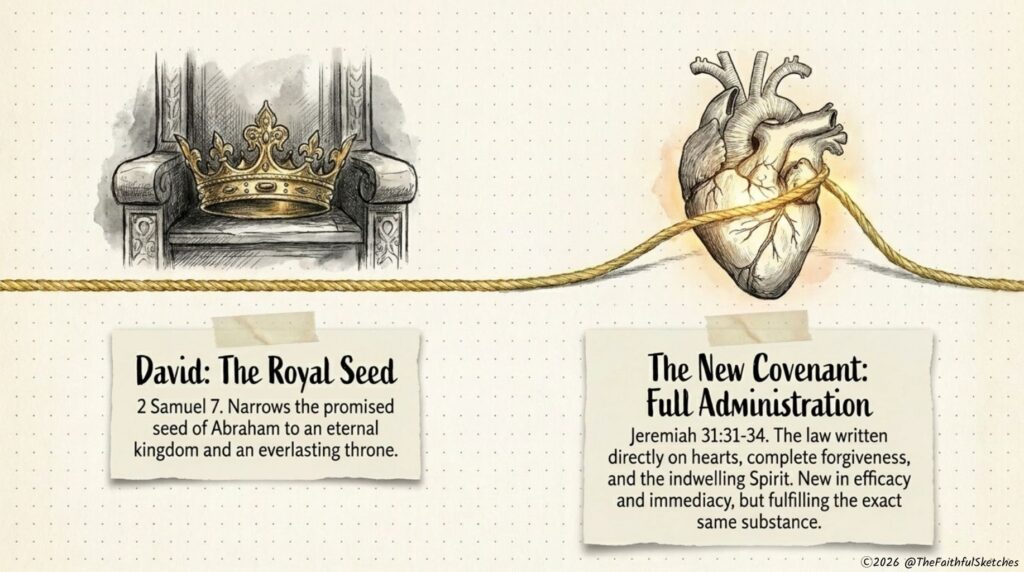
With David (2 Samuel 7)
God promised an eternal kingdom and an everlasting throne to David’s line. This administration narrowed the promised Seed of Abraham from a general human descendant to a specific royal King. The hope became more focused, more concrete, and more anticipatory.
The New Covenant (Jeremiah 31:31-34)
This is the promise of the final and full administration. God promises to write His law on human hearts, provide complete and permanent forgiveness, and indwell His people by His Spirit. As Jeremiah 31:33-34 states: “I will put my law within them, and I will write it on their hearts. And I will be their God, and they shall be my people… for I will forgive their iniquity, and I will remember their sin no more.”
The New Covenant is new in its efficacy and immediacy, not in its underlying substance. It fulfills every earlier promise simultaneously.
Part 4: How It All Comes Together in Christ
Every covenant finds its fulfillment in the person and work of Jesus Christ. He is the center toward which every administration points.
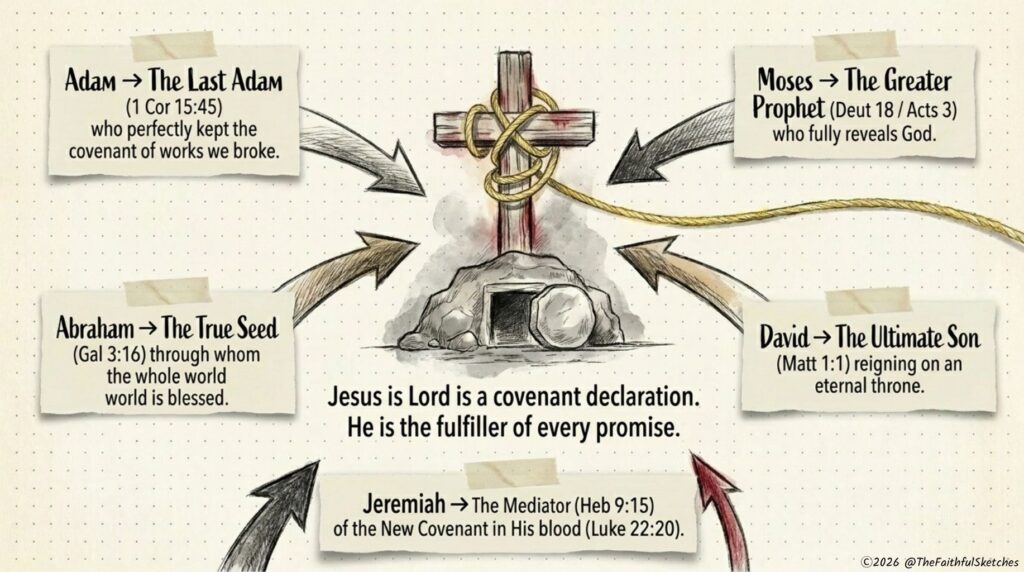
The Last Adam, as 1 Corinthians 15:45 identifies him, who perfectly kept the Covenant of Works we broke and earned the life we forfeited;
He is the true Seed of Abraham, as Galatians 3:16 explains, through whom the whole world receives blessing;
He is the Prophet greater than Moses, as Deuteronomy 18:15 and Acts 3:22 confirm, who finally and fully reveals God;
And he is the ultimate Son of David, as Matthew 1:1 announces, reigning on an eternal throne.
Most decisively, he is the Mediator of the New Covenant. At the Last Supper, he declared: “This cup is the new covenant in my blood” (Luke 22:20). His death fulfilled the entire sacrificial system of the Mosaic covenant. His resurrection inaugurated the age of the Spirit that Jeremiah had promised centuries earlier.
This is why the earliest Christian confession was “Jesus is Lord.” It is a covenant declaration. He is the fulfiller of every promise God ever made.
Part 5: What Covenant Theology Means Practically
Understanding Covenant Theology changes how you engage Scripture and your faith in three concrete ways.
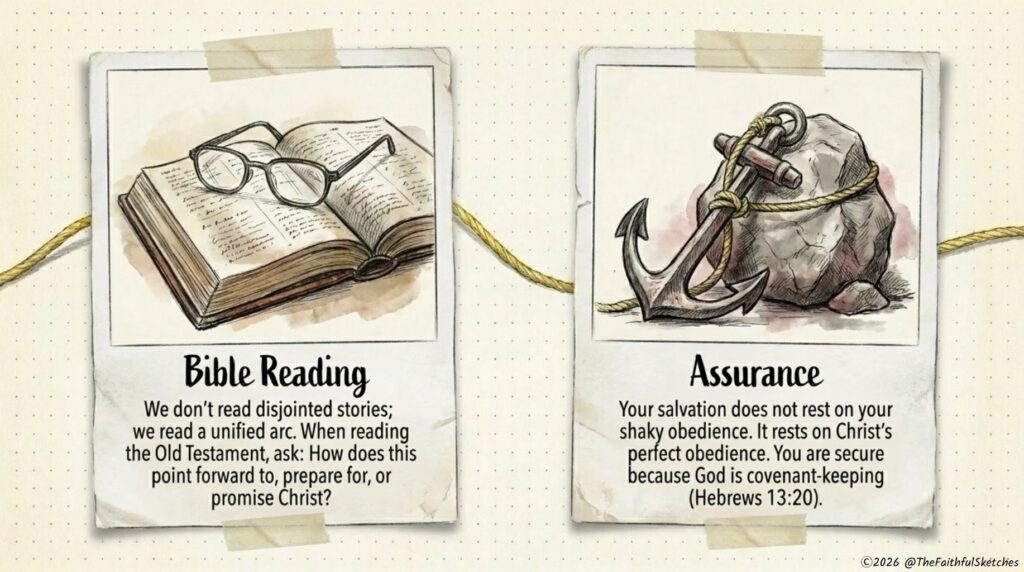
For Bible Reading
Covenant Theology transforms how you read the entire Bible. Rather than seeing disconnected stories separated by a sharp Old Testament and New Testament divide, you see one unified story of redemption moving consistently toward Christ. When you read the Old Testament, the productive question becomes: how does this point forward to, prepare for, or promise Christ?
For Assurance
Your salvation does not rest on your shaky obedience. It rests on Christ’s perfect obedience within the eternal Covenant of Grace. You are secure because God is covenant-keeping. Hebrews 13:20 calls him “the God of peace who brought again from the dead our Lord Jesus, the great shepherd of the sheep, by the blood of the eternal covenant.”
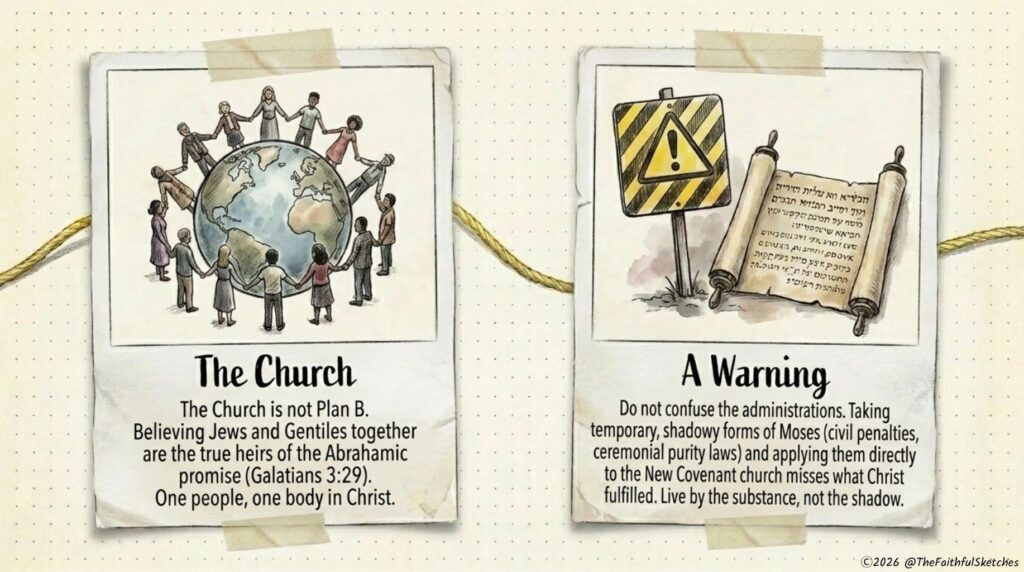
For Understanding the Church
The church is not Plan B. Believing Jews and Gentiles together are the true heirs of the Abrahamic promise, as Galatians 3:29 states: “If you are Christ’s, then you are Abraham’s offspring, heirs according to promise.” The covenant community has expanded from a single nation to include all nations, but it remains one people, one body, in Christ.
A Necessary Warning
The great error in applying Covenant Theology is confusing the administrations. Taking the temporary, shadowy forms of the Mosaic covenant — its civil penalties, its ceremonial purity laws — and applying them directly to the New Covenant church misses what Christ fulfilled. We live by the substance, not the shadow.
Conclusion: From Theology to Worship
Covenant Theology, at its best, does not produce dry doctrinal charts. It produces a staggering view of God’s faithfulness. For thousands of years, across human failure, national exile, and long periods of divine silence, God was meticulously keeping every single promise, guiding history toward a cross outside Jerusalem.
It reveals a God who binds himself to his people with oaths of love. He commits. He promises. And he delivers. In Christ, he has delivered decisively and permanently.
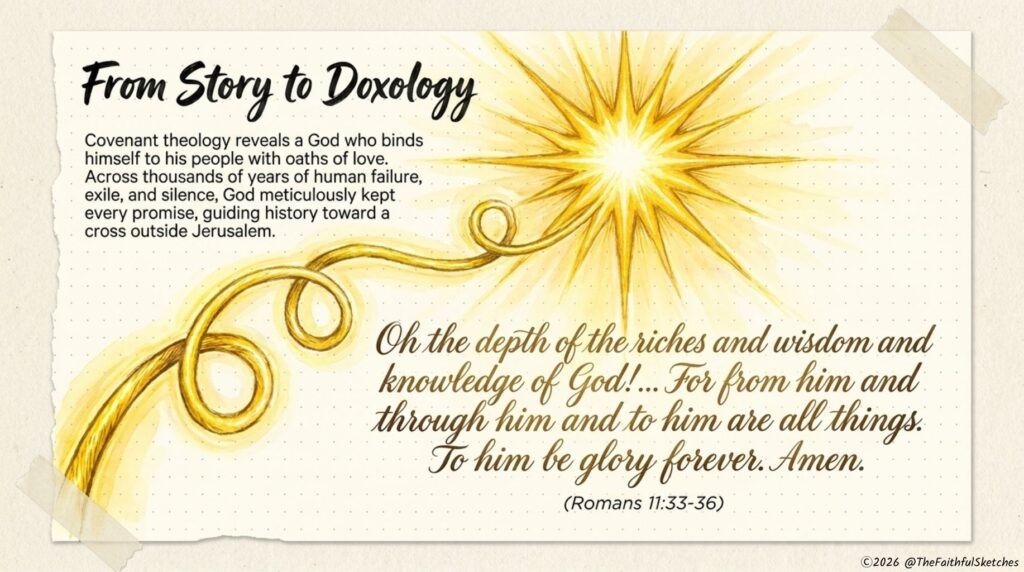
Paul captures the only adequate response in Romans 11:33-36: “Oh, the depth of the riches and wisdom and knowledge of God! How unsearchable are his judgments and how unfathomable his ways!… For from him and through him and to him are all things. To him be glory forever! Amen.”
That is our covenant-keeping God. To him be the glory.
What questions does Covenant Theology raise for you? Leave a comment below.
This post is part of a broader series on how Christians read the Bible theologically. For the full comparison of Covenant Theology against other major frameworks, read Covenant Theology vs Dispensationalism: 5 Biblical Frameworks Every Christian Should Know. To understand how these frameworks connect to the question of Israel and the church, see our post on Replacement Theology: Did the Church Replace Israel?
Click Below to Download The Full PDF Summary Visual Guide:
*Free for personal use only. Please don’t resell or redistribute commercially.