
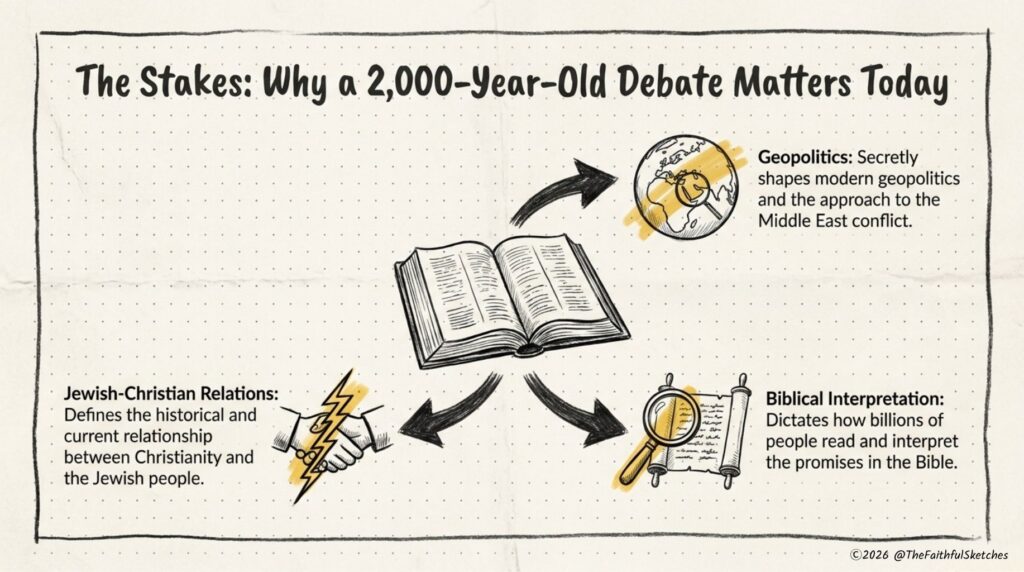
Replacement theology, also called supersessionism is one of the most contested topics in Christian history.
It’s a 2,000-year-old theological debate that is quietly shaping modern geopolitics, the Middle East conflict, and how billions of people read the Bible. The question at the center of it is deceptively simple: Did the Christian Church replace the Jewish people in God’s eyes?
My goal here is not to argue for one side but to explain what replacement theology actually is, trace its historical roots, and walk through the strongest biblical arguments on both sides. You can decide what to do with that.
What Is Replacement Theology?
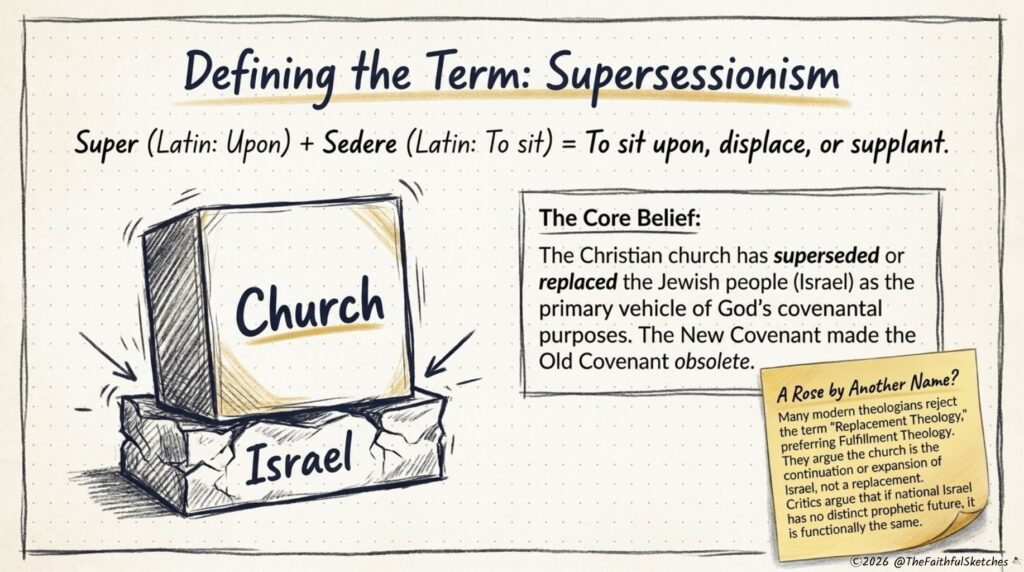
The academic term is Supersessionism, from the Latin supersedere, meaning “to sit upon” or “to preside over.” The basic idea is that one thing displaces or supplants another.
In practice, supersessionism is the belief that the Christian Church has superseded the Jewish people as the primary vehicle of God’s covenantal purposes. The New Covenant through Jesus Christ, in this view, made the Old Covenant obsolete. The universal Church is now God’s “New Israel.”
But this isn’t one uniform belief. Theologian R. Kendall Soulen identifies three distinct types:
Punitive Supersessionism is the harshest version. God actively rejected and punished the Jewish people for disobeying Him and rejecting Jesus. Israel forfeited its promises permanently as a divine consequence.
Economic Supersessionism is less about punishment and more about a planned expiration date. Israel’s role was always meant to be temporary. Once Jesus arrived, ethnic Israel’s specific role expired, and the Church took over by design.
Structural Supersessionism is the most subtle. It reads the Bible in a way that effectively skips the Old Testament entirely. The narrative jumps from the Fall of Adam and Eve straight to Jesus, treating God’s specific history with Israel as a footnote with no decisive theological weight.
One more thing worth knowing: many modern theologians reject the label “replacement theology” altogether. Reformed and Covenant theologians prefer “Fulfillment Theology,” arguing that the Church didn’t replace Israel but continued, expanded, and fulfilled it. Gentile believers, in their view, were simply added to the true, believing Israel.
Critics push back on that framing. If national, ethnic Israel no longer holds a distinct prophetic future or a claim to the original promises, the end result is still functionally supersessionism, whatever you call it.
How Replacement Theology Took Hold: A Historical Timeline
The Jewish Roots of Early Christianity
The earliest followers of Jesus were entirely Jewish. Jesus was Jewish. The Apostles were Jewish. The first church in Jerusalem was Jewish. So how did a Jewish movement produce a theology that claims God is finished with the Jewish people?
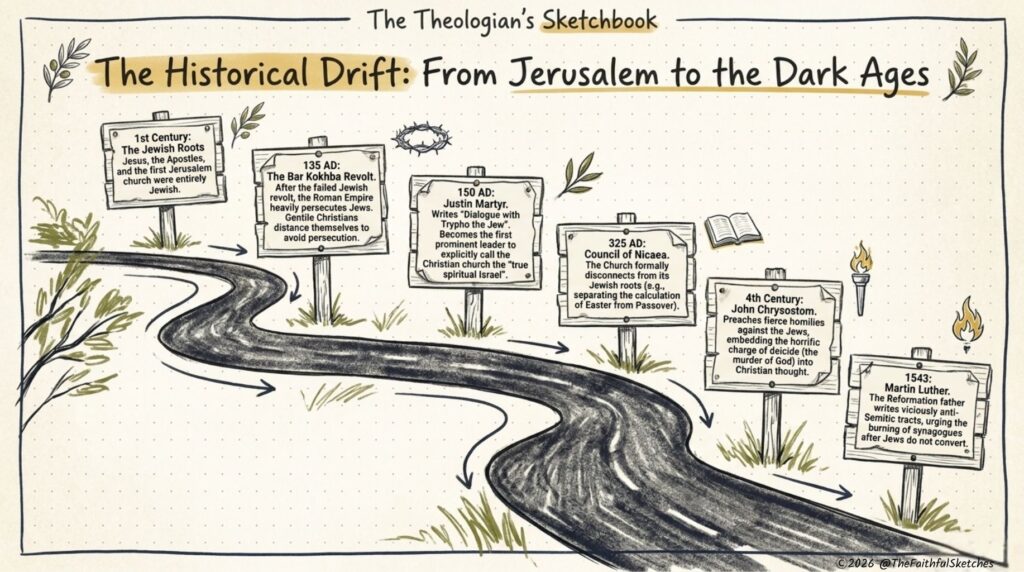
As the Church spread through the Roman Empire, it became increasingly Gentile. The Romans heavily persecuted Jews, especially after the failed Bar Kokhba revolt in 135 A.D. To avoid being associated with that persecution, Gentile Christians began distancing themselves from Judaism.
The Early Church Fathers
Around 150 A.D., Justin Martyr wrote Dialogue with Trypho the Jew, becoming the first prominent church leader to explicitly call the Christian Church “the true spiritual Israel.” He argued God’s relationship to Israel was physical and temporary, while His relationship to the Church was spiritual and permanent.
Origen, writing around 200 A.D., went further, claiming that Jews would “never be restored to their former condition” because of their rejection of Jesus. Irenaeus taught that the Old Covenant had been superseded.
Constantine, Nicaea, and the Deicide Charge
By the 4th century, the Emperor Constantine legalized Christianity. At the Council of Nicaea in 325 A.D., the Church formally severed ties with its Jewish roots, separating the calculation of Easter from the Jewish Passover. Then things got darker. John Chrysostom, a highly influential 4th-century archbishop, preached eight homilies against the Jews, accusing them of deicide, the murder of God, and declaring that God hated them. That charge became embedded in Christian thought for centuries.
The Reformation and Its Consequences
During the Protestant Reformation, Martin Luther initially hoped Jewish people would convert to his reformed Christianity. When they didn’t, he wrote viciously antisemitic tracts, including On the Jews and Their Lies in 1543, arguing that their 1,500-year exile proved God had rejected them. He urged the burning of synagogues. The Nazis appropriated that playbook four centuries later.
The Holocaust and the Rebirth of Israel
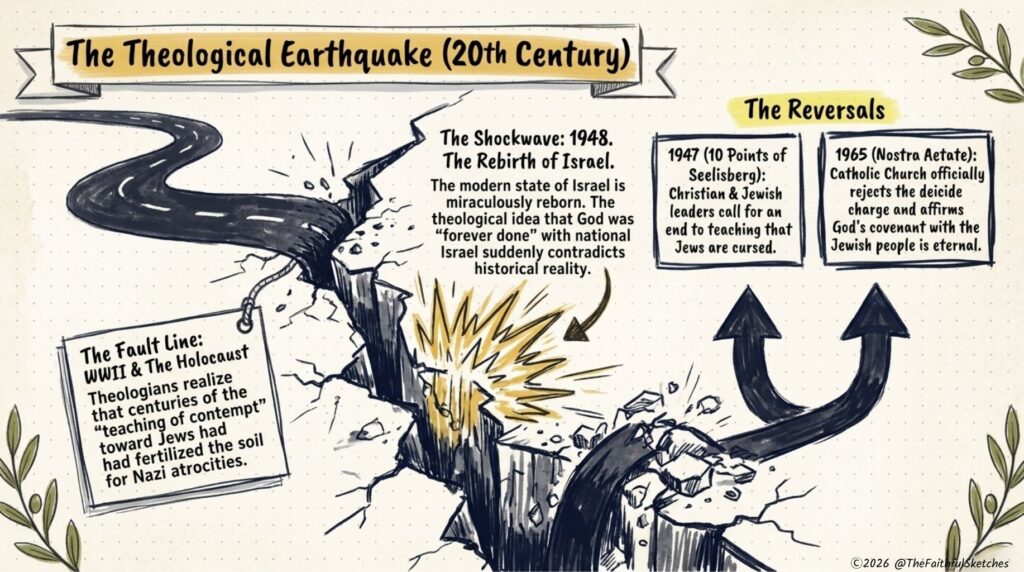
After World War II, the Holocaust forced a theological reckoning. Scholars recognized that centuries of institutionalized contempt for the Jewish people had created the conditions that made the Nazi atrocities possible.
Then, in 1948, the modern State of Israel was reestablished. Suddenly, the claim that God was permanently finished with national Israel looked much harder to defend.
In response, the “Ten Points of Seelisberg” (1947) called for an end to teaching that Jews are cursed. In 1965, the Catholic Church’s Nostra Aetate officially rejected the deicide charge and affirmed that God’s covenant with the Jewish people is eternal.
The Biblical Case For Replacement Theology
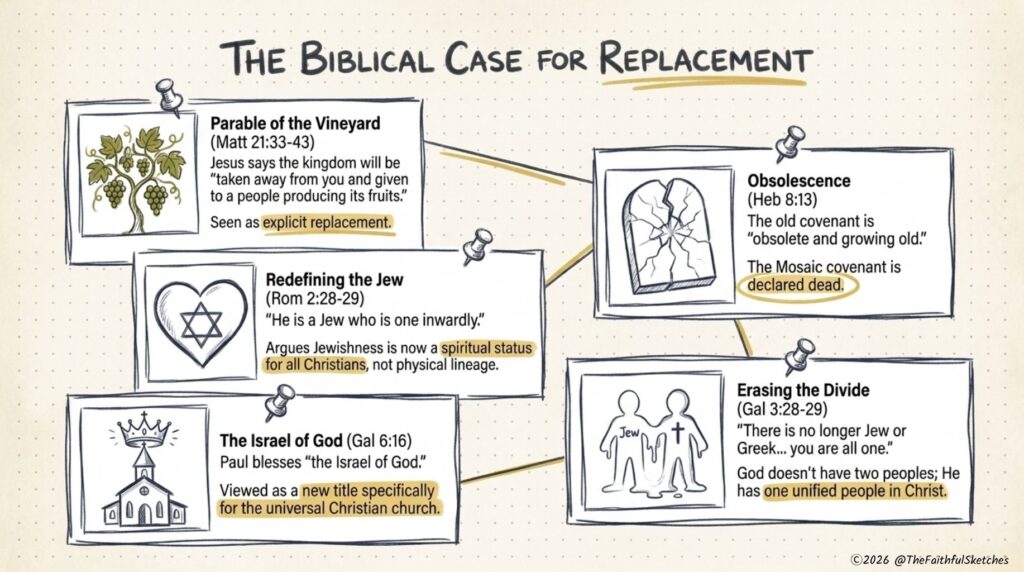
Proponents of supersessionism don’t just rely on history. They point to specific texts.
1. The Parable of the Vineyard (Matthew 21:33-45) Jesus tells a parable about wicked tenants who kill the landowner’s son. He then says directly to the religious leaders: “The kingdom of God will be taken away from you and given to a people producing its fruits” (Matthew 21:43). Supersessionists read this as Jesus explicitly transferring Israel’s covenant role to the Church.
2. Redefining “The Jew” (Romans 2:28-29) Paul writes: “He is not a Jew who is one outwardly… but he is a Jew who is one inwardly; and circumcision is that of the heart, in the Spirit.” Proponents argue this redefines Jewish identity from ethnic lineage to a spiritual status that applies to all Christians.
3. The Obsolete Covenant (Hebrews 8:13) “In speaking of ‘a new covenant’, he has made the first one obsolete. And what is obsolete and growing old will soon disappear.” This is read as a direct declaration that the Mosaic covenant with Israel has ended.
4. The “Israel of God” (Galatians 6:16) Paul writes: “Peace and mercy be upon them, and upon the Israel of God.” Many replacement theologians argue that “the Israel of God” is a new title for the universal Christian Church.
5. One Heir in Christ (Galatians 3:28-29) “There is no longer Jew or Greek… for all of you are one in Christ Jesus. And if you are Christ’s, then you are Abraham’s seed, and heirs according to promise.” Covenant theologians argue this proves the Church is the true Israel. God doesn’t have two separate peoples; He has one unified people, and anyone who believes in Christ inherits Abraham’s promises.
The Biblical Case Against Replacement Theology
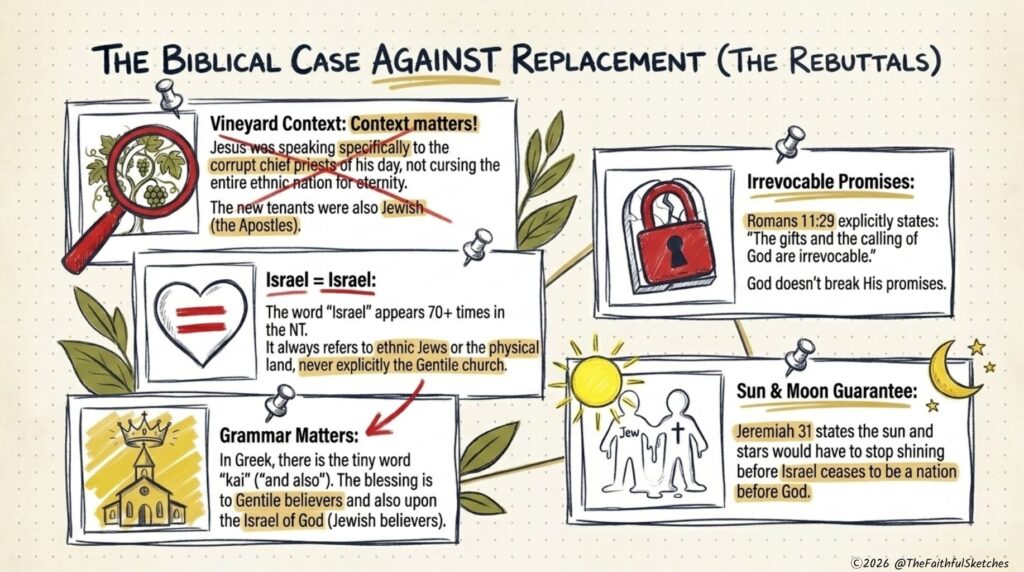
Those are serious arguments. But scholars who reject supersessionism say those verses are being read out of context.
1. Israel Still Means Israel The word “Israel” appears over 70 times in the New Testament, and it almost exclusively refers to the literal, ethnic Jewish people or the physical land, never explicitly to the Gentile Church. Try substituting “Israel” with “the Church” in the New Testament, and many passages stop making sense.
2. God’s Promises Are Irrevocable (Romans 11) Paul addresses this head-on. In Romans 11:1-2, he asks: “Has God cast away His people? Certainly not! For I also am an Israelite… God has not cast away His people whom He foreknew.” And in verse 29: “For the gifts and the calling of God are irrevocable.”
3. The Parable of the Vineyard in Context (Matthew 21) Non-supersessionists point out that Jesus was addressing the corrupt chief priests and Pharisees specifically, not pronouncing an eternal curse on all ethnic Israel. The “other tenants” who received the kingdom were also Jewish: the Apostles and the first Jewish believers.
4. Grammar in Galatians 6:16 In the original Greek, Galatians 6:16 contains the word kai, meaning “and” or “also.” The most accurate reading is: “peace and mercy be upon them [Gentile believers], and also upon the Israel of God [Jewish believers].” Paul was blessing both groups separately, not renaming the Gentile Church as Israel.
5. The Sun and Moon Guarantee (Jeremiah 31) In Jeremiah 31, God declares that the sun, moon, and stars would have to stop shining before the descendants of Israel would cease to be a nation before Him. The sun is still shining.
The Olive Tree: What Romans 11 Actually Says
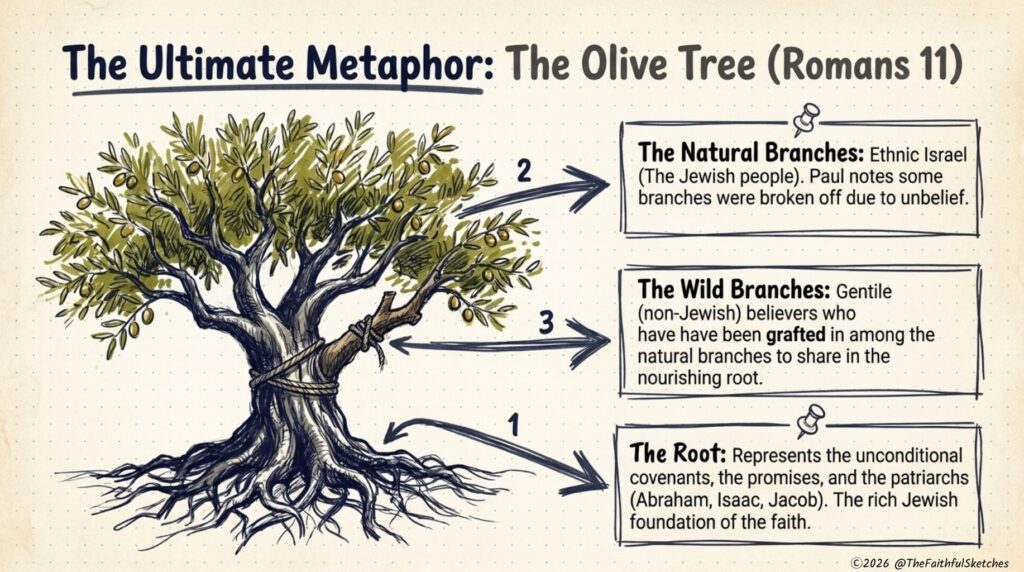
To see how the New Testament frames the relationship between Israel and the Church, you need Romans 11 and the image Paul builds there.
Paul describes a cultivated olive tree with three components:
The Root represents the covenants, the promises, and the patriarchs: Abraham, Isaac, and Jacob. It’s the Jewish foundation of the entire faith.
The Natural Branches represent ethnic Israel. Some were broken off because of unbelief.
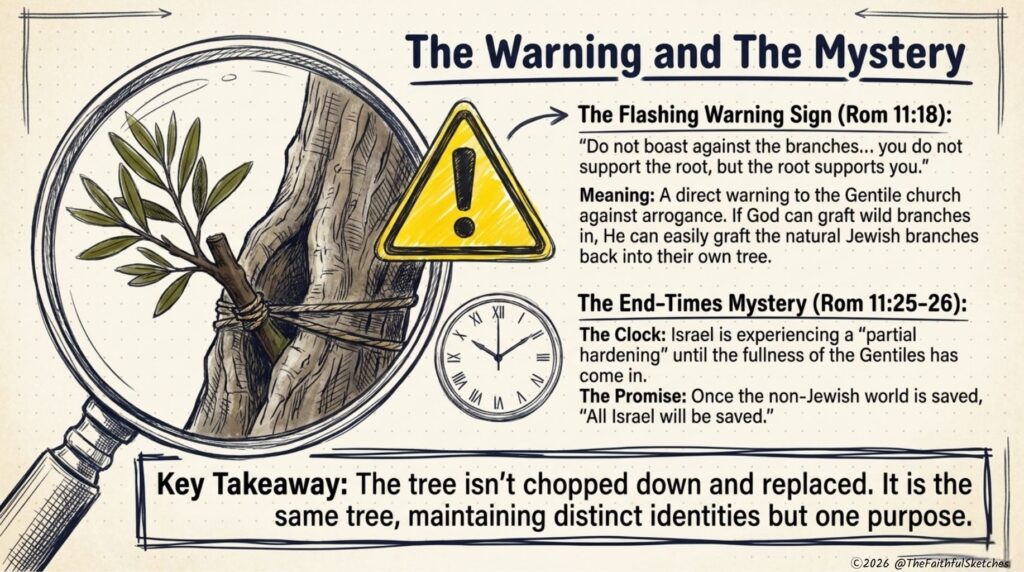
The Wild Branches represent Gentiles. Gentile believers were grafted into the tree to share in the nourishing root.
Paul doesn’t leave it there. He gives the Gentile Church a direct warning in Romans 11:18: “Do not boast against the branches. But if you do boast, remember that you do not support the root, but the root supports you.”
Church history largely ignored that warning.
Paul continues: if God can graft wild branches into a cultivated tree, how much more easily will He graft the natural Jewish branches back into their own tree when they believe?
He closes with a specific end-times statement in Romans 11:25-26. Israel has experienced a “partial hardening” until the “fullness of the Gentiles has come in,” meaning God is using this period to bring the non-Jewish world to faith. Once that is complete, Paul declares: “And so all Israel will be saved.”
The tree isn’t replaced. It’s the same tree. The Church is grafted into the spiritual heritage of Israel, with Jews and Gentiles together, maintaining distinct identities, serving one purpose.
Where Does This Leave You?
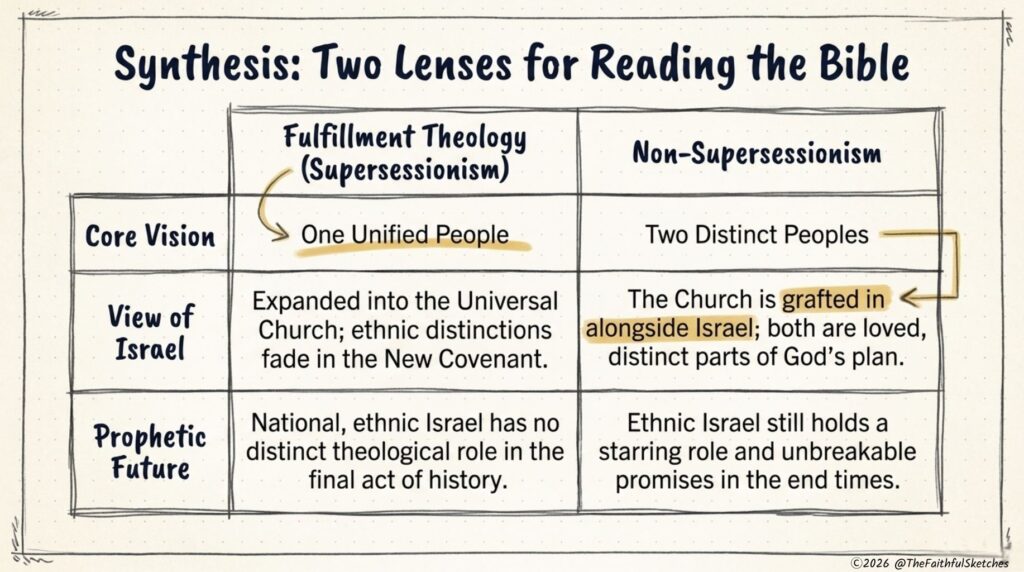
Two major readings of Scripture emerge from this debate.
One sees a single people of God, growing from a family to a nation to a Church, with ethnic distinctions fading in the light of the New Covenant. The other sees two distinct peoples, Israel and the Church, both loved by God, with ethnic Israel still holding a specific role in the final chapters of history.
Both positions claim to uphold God’s faithfulness. Both take Scripture seriously. The disagreement is in what Scripture actually says.
Replacement Theology is only one piece of the puzzle. Christians who wrestle with Israel and the Church eventually have to engage the bigger frameworks sitting behind that debate: Covenant Theology, Dispensationalism, Progressive Dispensationalism, and New Covenant Theology. Each one reads the same Bible and reaches different conclusions about prophecy, the law, and the future of Israel. The next post breaks all five views down side by side, including the history, the key Bible verses each side uses, and where they agree and disagree. Read it here.
What do you think? Does the Church replace Israel, or are they two distinct parts of one plan? Leave your answer in the comments.
Click Below to Download The Full PDF Summary Guide:
*Free for personal use only. Please don’t resell or redistribute commercially.