
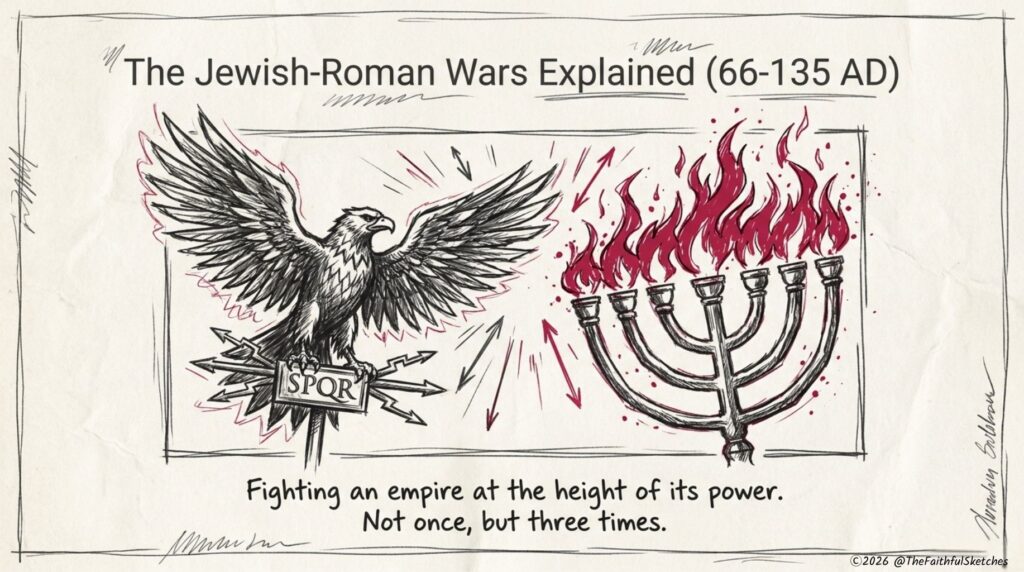
Imagine fighting the Roman Empire at the peak of its military power. The people of ancient Judaea did not just do this once. They launched three separate rebellions over a 70-year period.
The Jewish-Roman Wars, fought between 66 and 135 AD, completely altered the course of biblical history. The consequences of these conflicts were catastrophic. Roman legions burned the Second Temple to the ground, killed hundreds of thousands of people, and forced survivors into slavery. Rome eventually erased the name of Judaea from the map.
Yet, this narrative is also about survival. Out of the ashes of these devastating campaigns, the Jewish people preserved their faith and identity without a homeland. When you look closely at the history, you can see how a small, fiercely religious province challenged the world’s greatest empire.
The Origins of the Conflict (63 BC – 66 AD)
The roots of the Jewish-Roman Wars began long before the first spear was thrown. In 63 BC, the Roman general Pompey the Great entered Judaea. Two royal brothers were fighting a civil war for the throne, and they invited Pompey to arbitrate. Pompey chose to conquer instead. He marched his legions into Jerusalem and walked directly into the Holy of Holies inside the Temple. This room was a sacred space reserved exclusively for the High Priest on the Day of Atonement. To the Jewish people, Pompey committed a severe desecration.
Rome initially ruled Judaea through client kings. The most famous was Herod the Great. Herod was an effective administrator and a master builder. He built the fortress at Masada, constructed the port city of Caesarea, and expanded the Second Temple into an architectural wonder. However, Herod was a ruthless Roman puppet. His heavy taxation and foreign customs earned him deep resentment from his subjects.
Key Timeline of Roman Escalation:
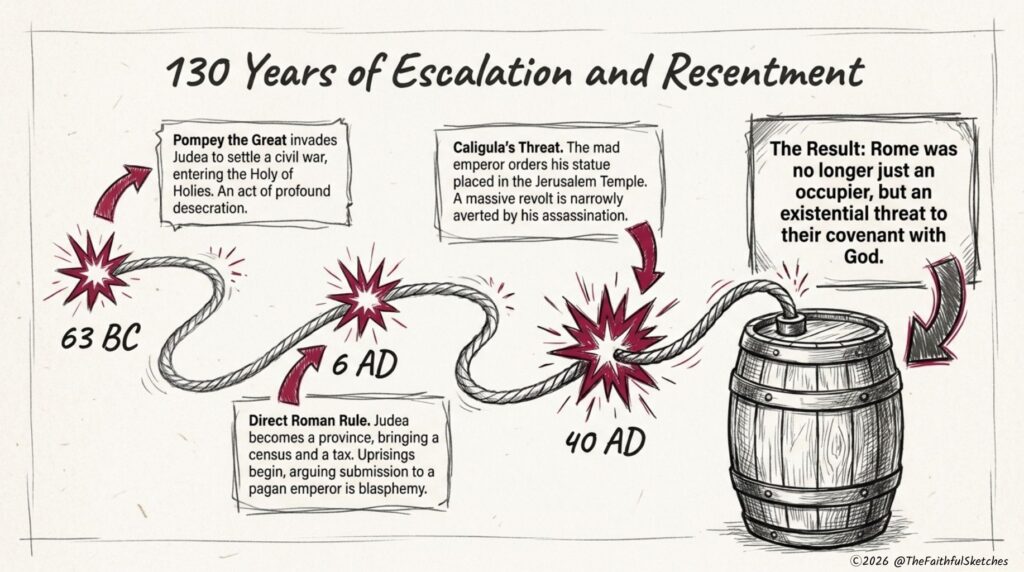
- 63 BC: Pompey the Great enters the Temple Holy of Holies.
- 6 AD: Judaea becomes an official Roman province.
- 40 AD: Emperor Caligula orders his statue placed in the Temple.
- 66 AD: Governor Gessius Florus plunders the Temple treasury.
When Herod died in 4 BC, his sons divided the kingdom, causing widespread instability. Rome took direct control in 6 AD, converting Judaea into an official province ruled by governors. These rulers brought a census and direct taxation. To the local population, paying tribute to a pagan emperor was an act of blasphemy against God.
Tensions reached a breaking point in 40 AD. The unstable Emperor Caligula declared himself a living god and ordered his troops to install his statue inside the Jerusalem Temple. Thousands of Jewish citizens protested, willing to face death to prevent the defilement of their holy site. The Roman governor of Syria delayed execution of the order to avoid an immediate war. Caligula’s assassination in 41 AD stopped the plan, but the threat convinced the population that Rome was an existential danger to their covenant with God.
The First Jewish-Roman War (66 – 73 AD)
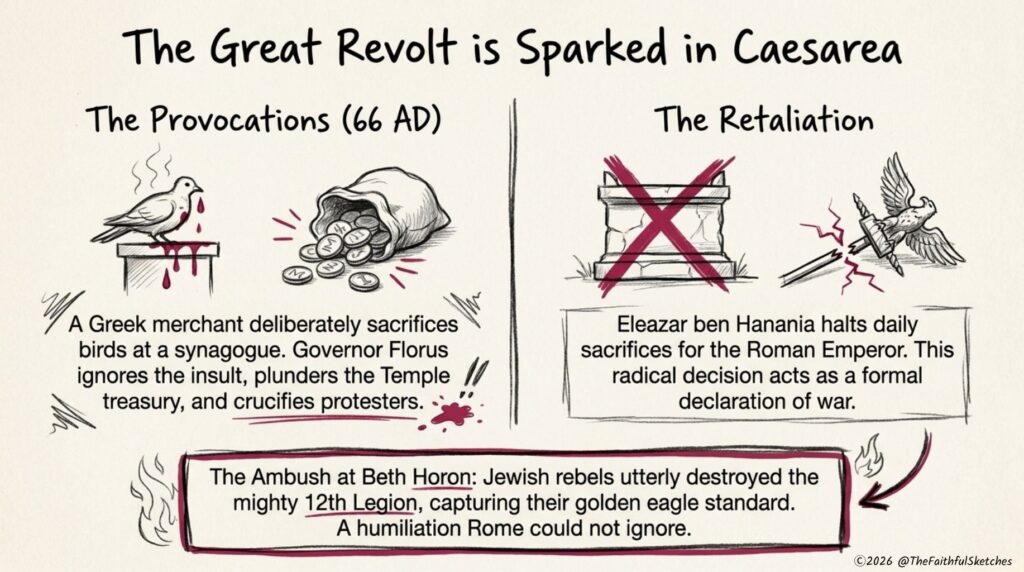
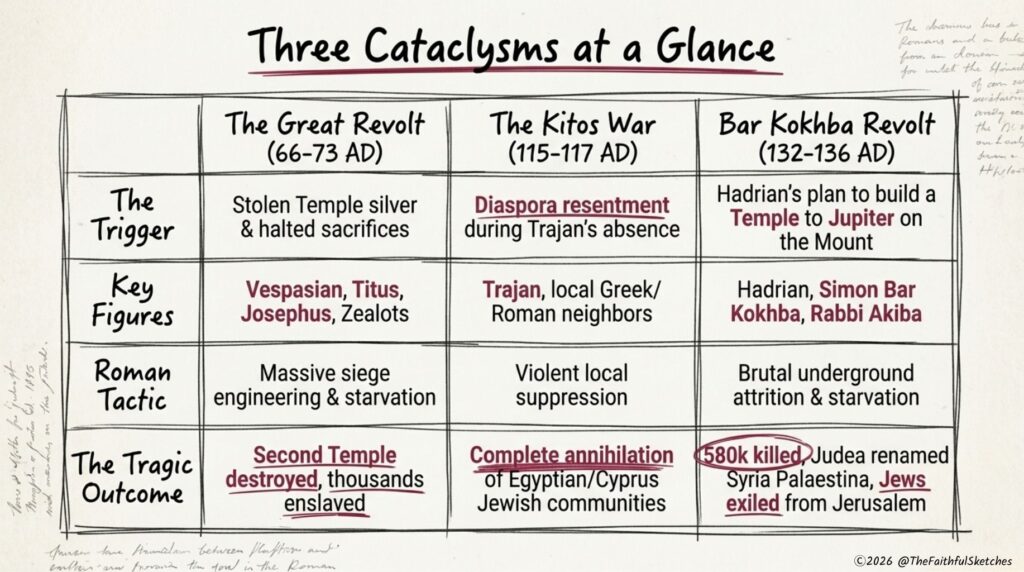
The spark that ignited the First Jewish-Roman War occurred in 66 AD in the city of Caesarea. A Greek merchant sacrificed birds directly in front of a local synagogue. The Roman governor, Gessius Florus, ignored Jewish protests. Instead, Florus arrested the protestors, marched into Jerusalem, and plundered seventeen talents of silver from the Temple treasury.
Casualty Estimates (First War):
- Tacitus: 600,000 dead
- Josephus: Over 1,000,000 dead
- Enslaved: Approximately 100,000 survivors
This theft provoked massive outrage. Eleazar ben Hanania, the Temple captain, stopped the daily sacrifices offered on behalf of the Roman emperor. This political move signaled an official declaration of independence. Rebel forces quickly overran the small Roman garrison in Jerusalem.
The Roman Defeat at Beth Horon
The Roman governor of Syria, Cestius Gallus, marched south with the 12th Legion and thousands of auxiliary troops to crush the rebellion. His overconfidence led to a major military disaster. As the Roman army retreated through the narrow mountain pass of Beth Horon, Jewish rebels ambushed them. The rebels killed nearly 6,000 Roman soldiers and captured the legion’s golden eagle standard. The rebellion was now a full-scale war.
Vespasian’s Campaign and the Siege of Jerusalem
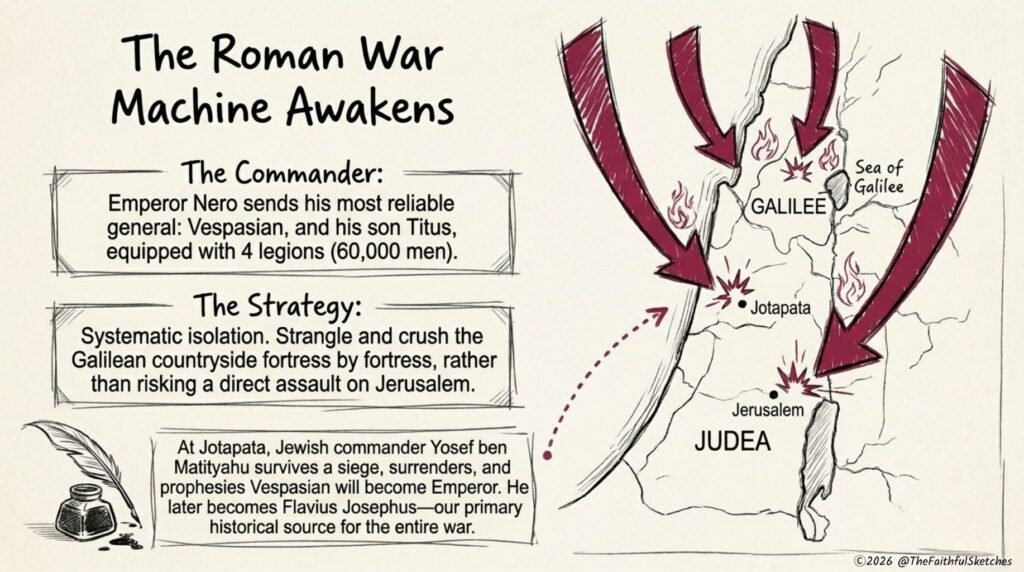
Emperor Nero sent his top general, Vespasian, to restore order. Vespasian commanded four legions, totaling roughly 60,000 disciplined soldiers. He launched a systematic campaign from the north, subduing Galilee fortress by fortress. During the siege of Jotapata, a Jewish commander named Yosef ben Matityahu surrendered to the Romans. He predicted that Vespasian would become emperor. Vespasian spared his life, and this commander became Flavius Josephus, your primary historical source for the war.
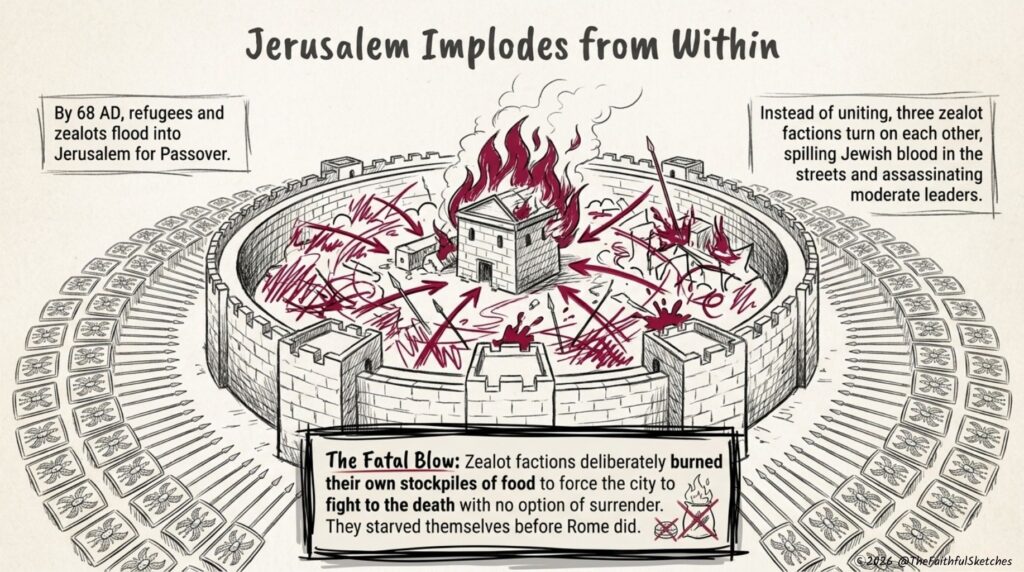
By 68 AD, Roman forces isolated Jerusalem. Inside the walls, a brutal civil war broke out between rival Jewish factions. Extreme Zealots burned the city’s massive grain storehouses to force the population to fight to the death.
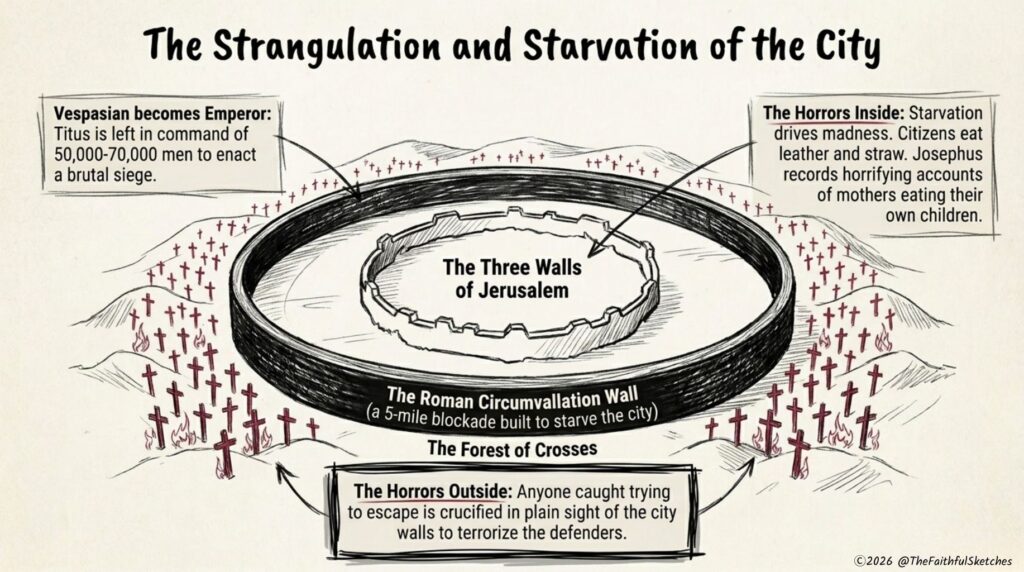
In 69 AD, Vespasian returned to Rome to claim the imperial throne after Nero’s suicide. He left his son, Titus, in charge of the war. In the spring of 70 AD, Titus besieged Jerusalem with 70,000 soldiers. The Romans built an earthen wall around the city to starve out the inhabitants. Famine devastated the population inside.
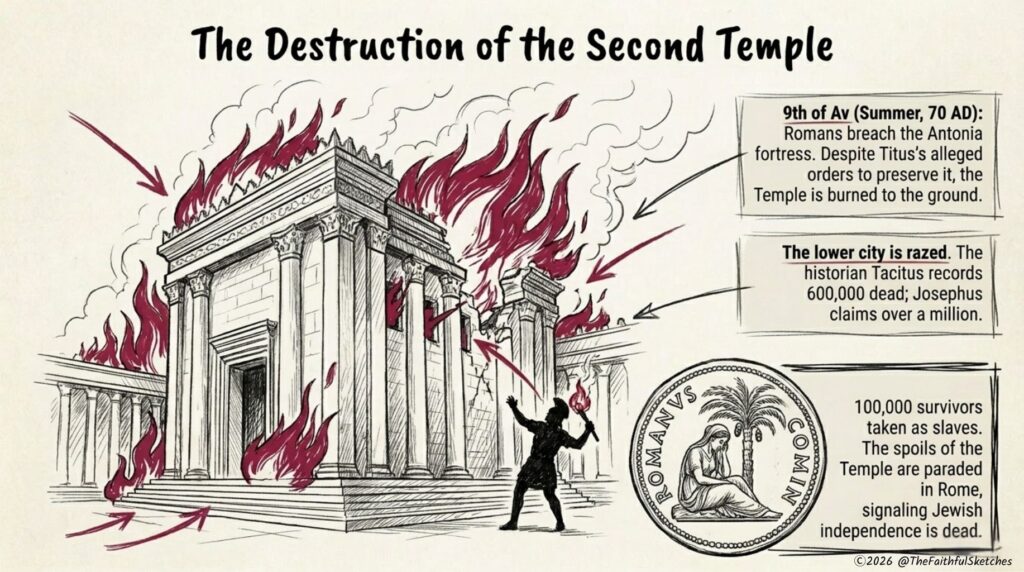
On the ninth day of the Jewish month of Av in 70 AD, a Roman soldier threw a burning torch into the Temple complex. The structure caught fire and burned to the ground. Roman legions systematically razed the city, killed the inhabitants, and took 100,000 survivors into slavery. In Rome, the government minted “Judaea Capta” coins to celebrate your defeat.
The Last Stand at Masada
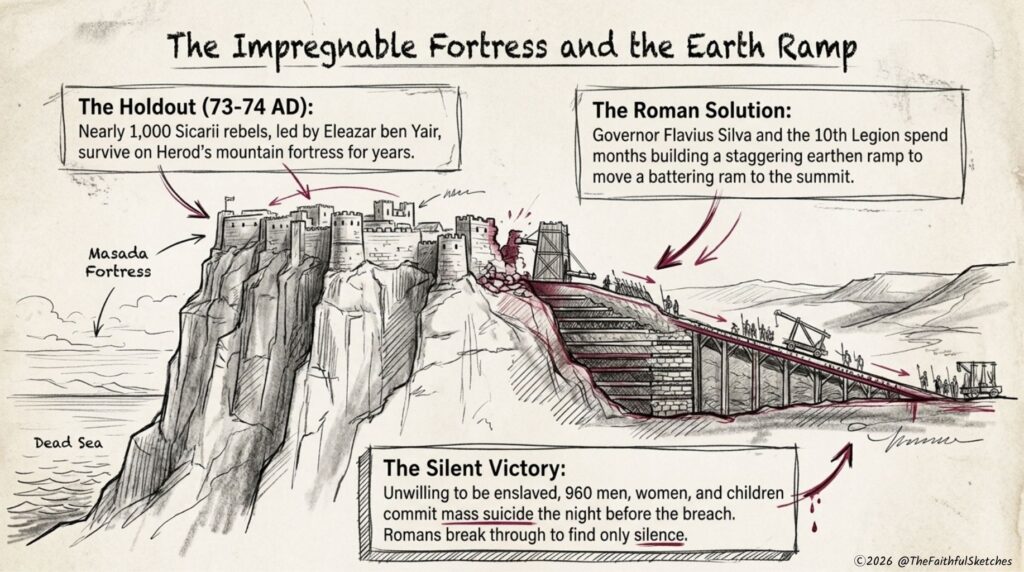
The final phase of the first war concluded at Masada, a mountaintop fortress near the Dead Sea. Nearly 1,000 men, women, and children of the Sicarii sect held out under the leadership of Eleazar ben Yair. In 73 AD, the Roman governor Flavius Silva surrounded the mountain with the 10th Legion and built a massive earthen ramp to breach the wall. Rather than face execution or slavery, the defenders chose mass suicide. When the Romans entered the fortress, they found 960 bodies.
The Transition to Rabbinic Judaism and the Kitos War
The destruction of the Temple left the Jewish faith without its central institution. Sacrifices could no longer be performed. Before Jerusalem fell, a sage named Yohanan ben Zakkai escaped the siege inside a coffin. He secured permission from Vespasian to establish a religious academy in the coastal town of Yavneh.
At Yavneh, scholars adapted the faith. They substituted animal sacrifices with prayer, Scripture study, and communal deeds. This transition established Rabbinic Judaism, providing a portable faith that could survive anywhere in the world.
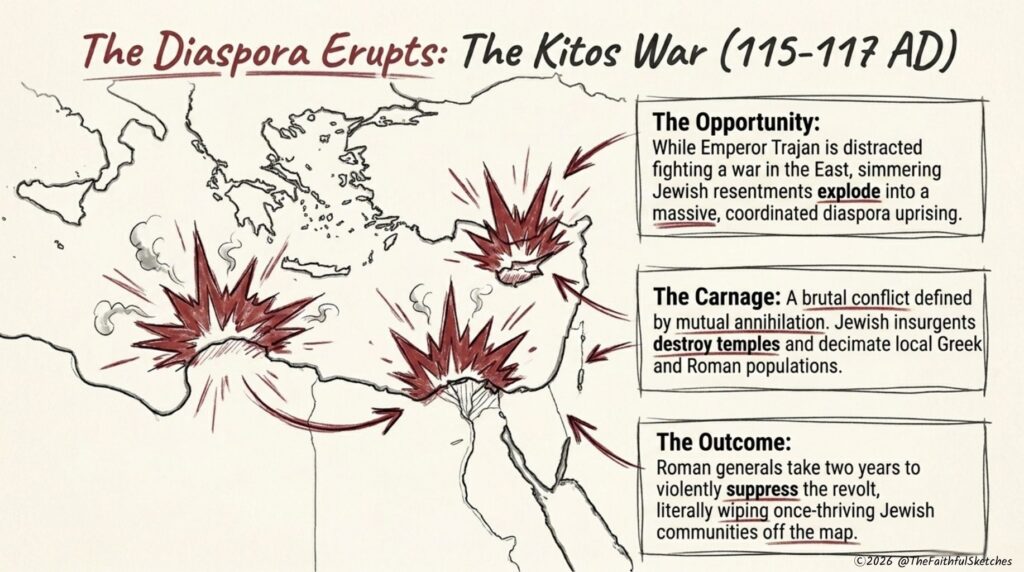
Peace did not last long. In 115 AD, while Emperor Trajan campaigned in Mesopotamia, a violent conflict known as the Kitos War erupted. Jewish communities in Cyrenaica, Egypt, and Cyprus launched an insurrection against Roman and Greek citizens. The Romans deployed substantial forces and crushed the rebellion within two years, destroying many historic Jewish communities across the Mediterranean diaspora.
The Bar Kokhba Revolt: The Final Conflict (132 – 136 AD)
The final chapter of the Jewish-Roman Wars began under Emperor Hadrian. In 130 AD, Hadrian decided to rebuild the ruined city of Jerusalem as a pagan Roman colony named Aelia Capitolina. He planned to build a temple dedicated to Jupiter directly over the ruins of the Second Temple.
Comparison of Roman Forces Deployed:
- First War (66-73 AD): ~60,000 troops (4 Legions)
- Bar Kokhba Revolt (132-136 AD): ~120,000 troops (7-12 Legions)
This decision provoked an immediate rebellion led by Simon bar Kosiba. The leading religious scholar of the era, Rabbi Akiva, proclaimed Simon to be the promised Messiah, renaming him Bar Kokhba, which means “Son of a Star.” Bar Kokhba organized a successful guerrilla war from underground tunnel systems, captured Judaea, and began minting independent coins.
Hadrian sent his best general, Sextus Julius Severus, along with up to twelve legions to crush the uprising. Severus avoided open battles, choosing instead to systematically isolate and starve out individual villages.
The Roman campaign depopulated the region. According to the Roman historian Cassius Dio, the war resulted in the deaths of 580,000 Jewish soldiers in battle, while hunger and disease killed countless civilians. The Romans destroyed 985 villages. Bar Kokhba might have eluded capture for a time, but his final stand at the fortress of Betar in 135 AD ended in his death and a massive massacre of the remaining defenders.
The Permanent Alteration of Judaea
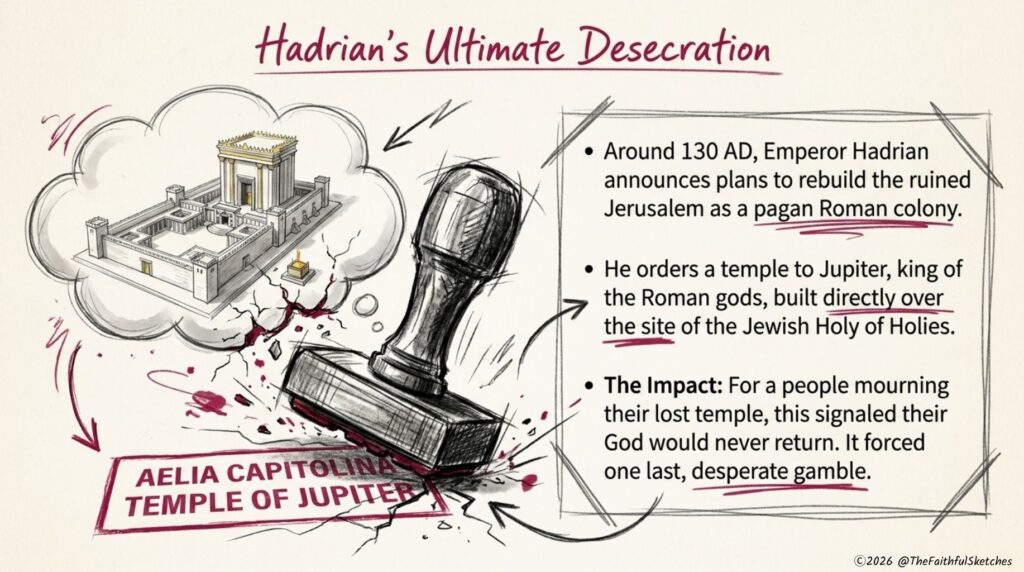
Hadrian used total military victory to erase the geopolitical footprint of the Jewish people. He banned the public reading of the Torah, observance of the Sabbath, and circumcision. He changed the name of the province from Judaea to Syria Palaestina to disassociate the land from its history. Furthermore, he completed the construction of Aelia Capitolina and banned all Jewish people from entering the city on pain of death.
The Jewish-Roman Wars effectively ended Jewish sovereignty in the region for nearly nineteen centuries. However, the military defeat did not destroy the culture. The structural framework developed by the rabbis at Yavneh allowed the religion to endure through global exile. The historical events of this era remain preserved in modern cultural landmarks, from the ruins of the Arch of Titus in Rome to the annual fast of Tisha B’Av.
Click Below to Download The Full PDF Summary Guide:
*Free for personal use only. Please don’t resell or redistribute commercially.