
If you ask a Christian who the Messiah is, they will point to Jesus Christ. But why don’t Jews believe Jesus is the Messiah? If you ask a Jew, they will point to a future King who is still to come. This is not a small disagreement. It is a fundamental definition crisis that has divided two faiths for two thousand years.
This is not a small disagreement. It is a fundamental definition crisis.
Think of it this way. Imagine a checklist of ten specific tasks. If a candidate completes nine of them but not the tenth, they do not qualify for the role. For two thousand years, the Jewish people have looked at the life of Jesus and concluded that, from their perspective, he did not complete the list.
This post explains the historical and theological reasons the Jewish community gives for rejecting Jesus as the Messiah. The goal is not to promote or endorse this position, but to understand it clearly and fairly.
What Does Messiah Actually Mean?
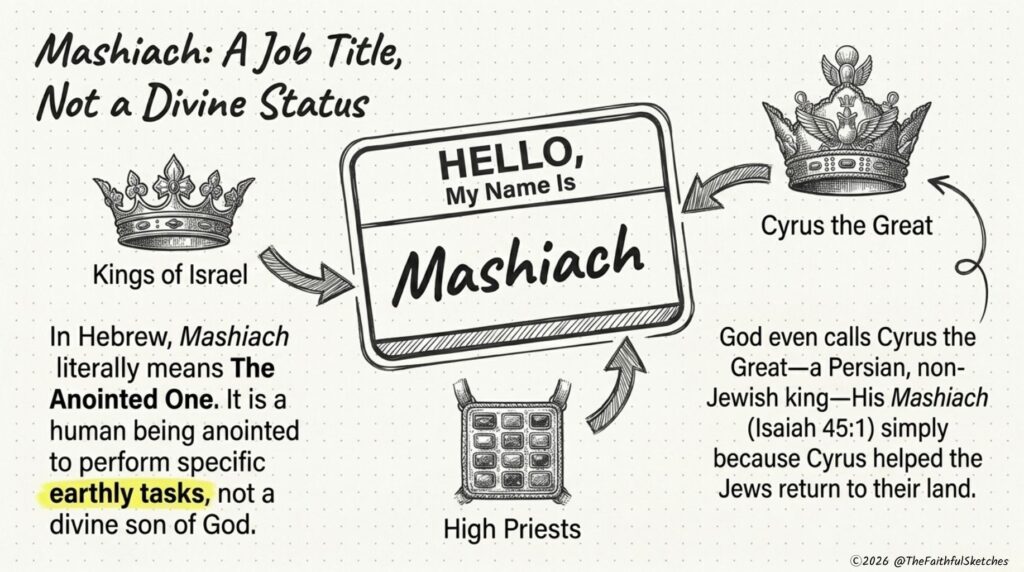
Before examining the arguments, it helps to understand what the word Messiah actually means in the original Hebrew.
The Hebrew word is Mashiach. It literally means the Anointed One. In the Bible, being a Mashiach was not a divine status. It was a job title. Every King of Israel was a Mashiach. The High Priest was a Mashiach. In Isaiah 45:1, God even calls Cyrus the Great, a Persian non-Jewish king, His Mashiach, because Cyrus helped the Jewish people return to their land.
But from a Jewish perspective, the Messiah is a human being anointed to accomplish a specific set of physical, earthly tasks. He is not God. He is not the Son of God in a literal sense. And his primary role is not offering eternal life. His role is bringing world peace.
That distinction shapes everything that follows.
Part 1: The Unfulfilled Prophecies
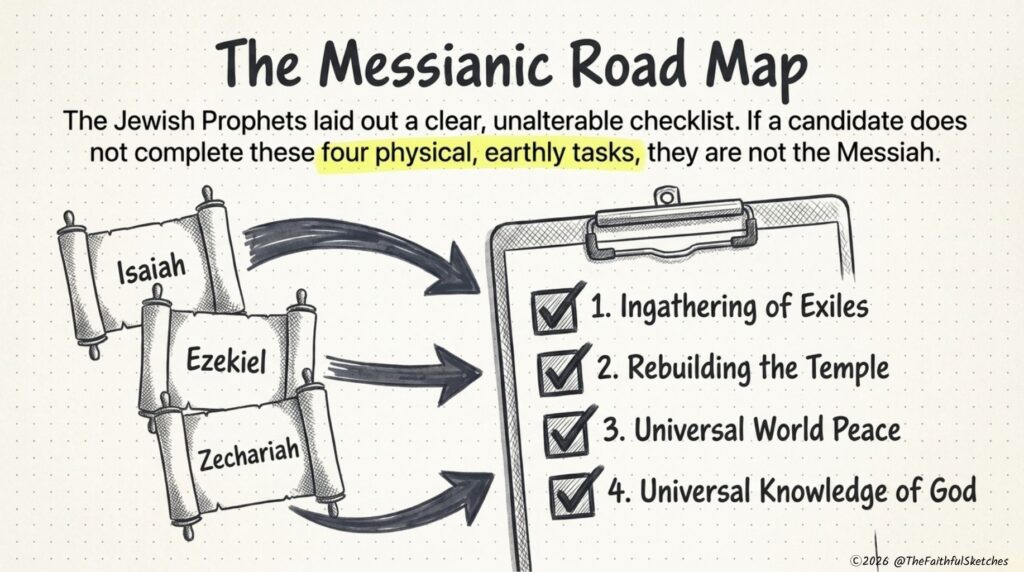
The Jewish prophets Isaiah, Ezekiel, and Zechariah laid out a clear roadmap for what the Messiah must accomplish. Jewish tradition holds that if a candidate does not complete this list during his lifetime, he is not the Messiah. Here are the four primary requirements.
The Ingathering of the Exiles
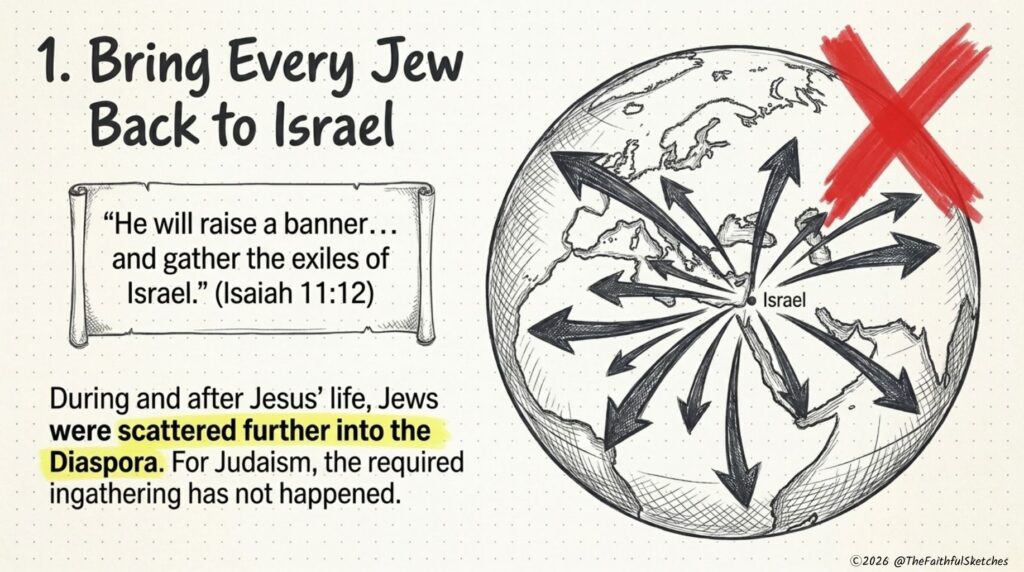
The Messiah must bring every Jewish person back to the land of Israel. Isaiah 11:12 states that he will gather the exiles of Israel and assemble the scattered people of Judah from the four corners of the earth.
From the Jewish perspective, this did not happen. During and after the life of Jesus, the Jewish people were scattered further in what became known as the Diaspora. The ingathering, in Jewish eyes, has not yet occurred.
Rebuilding the Temple
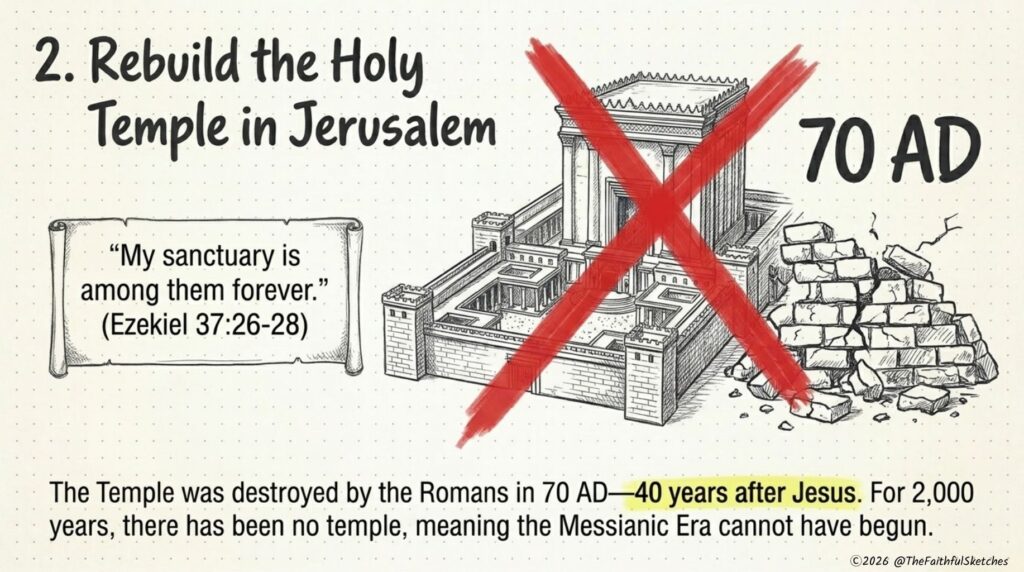
The Messiah must rebuild the Holy Temple in Jerusalem. Ezekiel 37:26-28 describes a time when God’s sanctuary will be among the people of Israel forever.
Jewish scholars point out that the Temple was destroyed in 70 AD, forty years after Jesus. It has not been rebuilt in the two thousand years since. For Judaism, the absence of the Temple means the Messianic era has not begun.
Universal World Peace
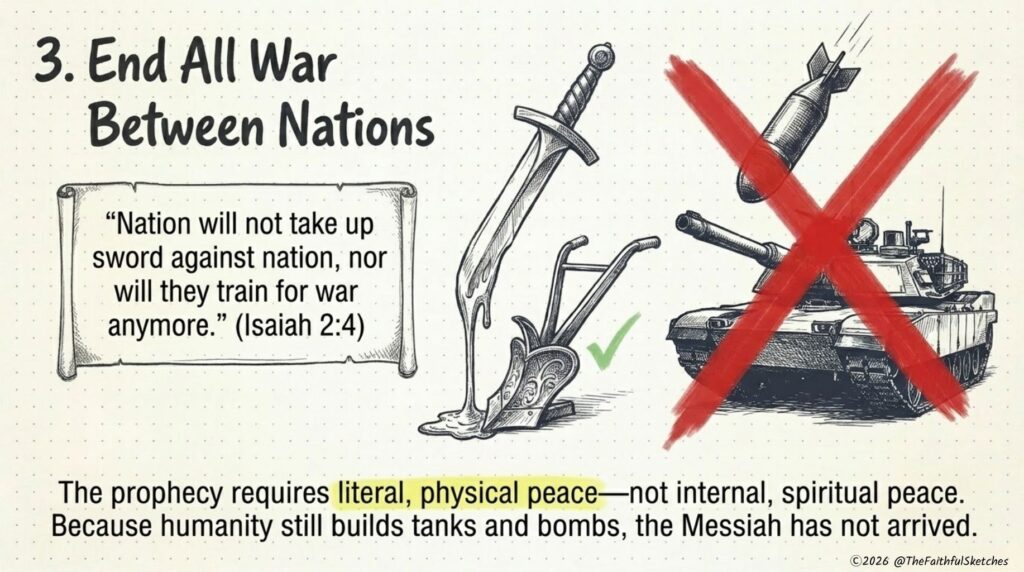
The Messiah must end all war, not as an internal spiritual experience, but as a physical reality between nations. Isaiah 2:4 describes a time when nation will not take up sword against nation, nor will they train for war anymore.
From the Jewish viewpoint, the world remains deeply divided by conflict. As long as armies exist and wars are fought, the Messiah has not arrived.
Universal Knowledge of God
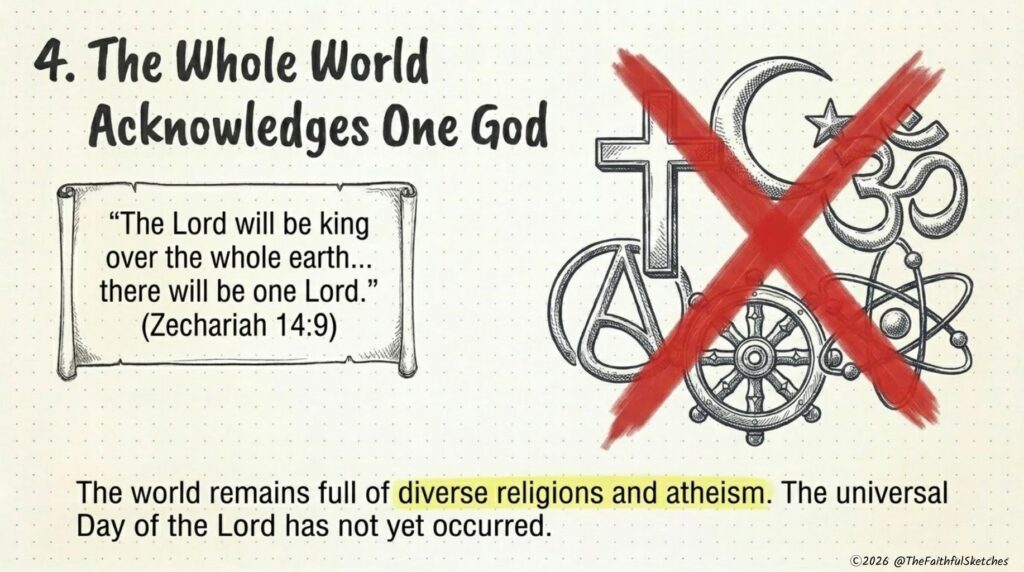
The whole world must come to acknowledge the one God of Israel. Zechariah 14:9 describes a day when the Lord will be king over the whole earth and there will be one Lord and one name.
Judaism observes that the world today contains many religions, many gods, and widespread atheism. The Day of the Lord described by Zechariah has not happened.
Part 2: The Second Coming Problem
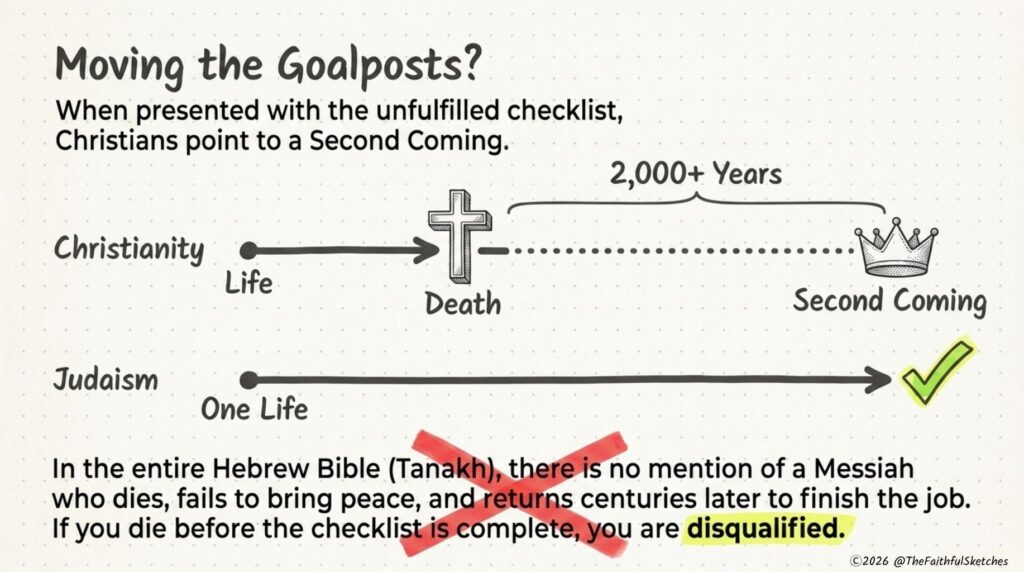
When Christians are presented with this list, the most common response is that Jesus will complete it when he returns, referring to the Second Coming.
For Jewish theologians, this is the central problem separating the two faiths. Nowhere in the Hebrew Bible, the Tanakh, is there any mention of a Messiah who comes, fails to bring peace, dies, and then returns two thousand years later to finish the job.
In Jewish thought, the Messiah has one lifetime to accomplish the work. If he dies before the Temple is rebuilt and before world peace is achieved, he does not qualify. The concept of a Second Coming, from a Jewish perspective, feels like changing the requirements after the candidate has already failed to meet them.
This is the core of why Jews don’t believe Jesus is the Messiah — the job was not finished.
Part 3: The Lineage and the Virgin Birth
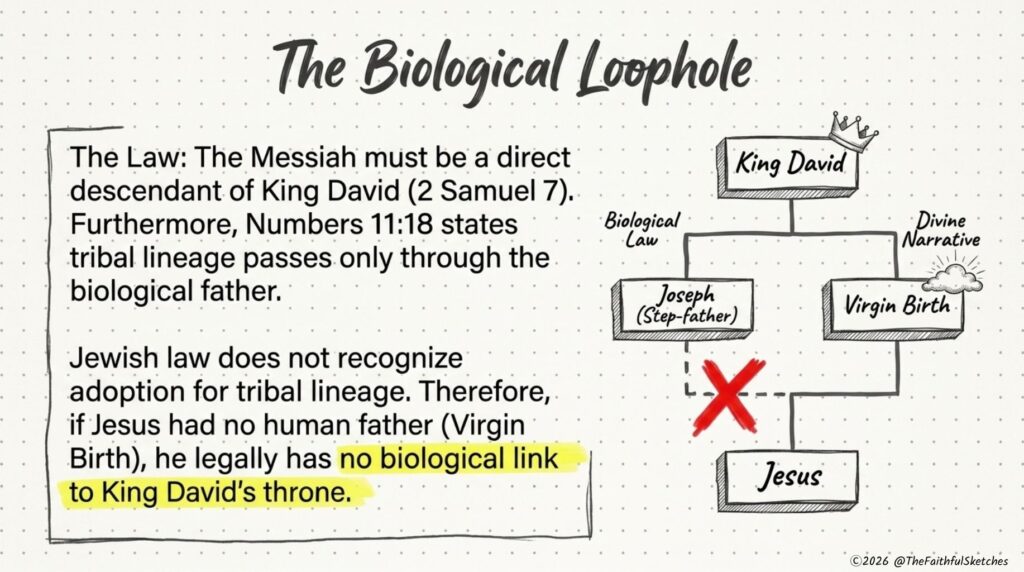
The Messiah must be a direct biological descendant of King David. 2 Samuel 7:12-13 records God promising David that he will raise up his offspring to succeed him and establish the throne of his kingdom forever.
Here is where Jewish law raises a specific legal objection.
According to Numbers 1:18, tribal lineage in Judaism, including descent from the tribe of Judah and the line of David, is passed only through the biological father. The New Testament claims that Jesus had no human father, having been conceived through a virgin birth.
The Jewish conclusion is that without a biological human father, Jesus has no legal link to King David’s throne under Jewish law. Even if his stepfather Joseph was from the line of David, Jewish tradition does not recognise adoption as a way to transfer tribal lineage.
Part 4: The Unchanging Law
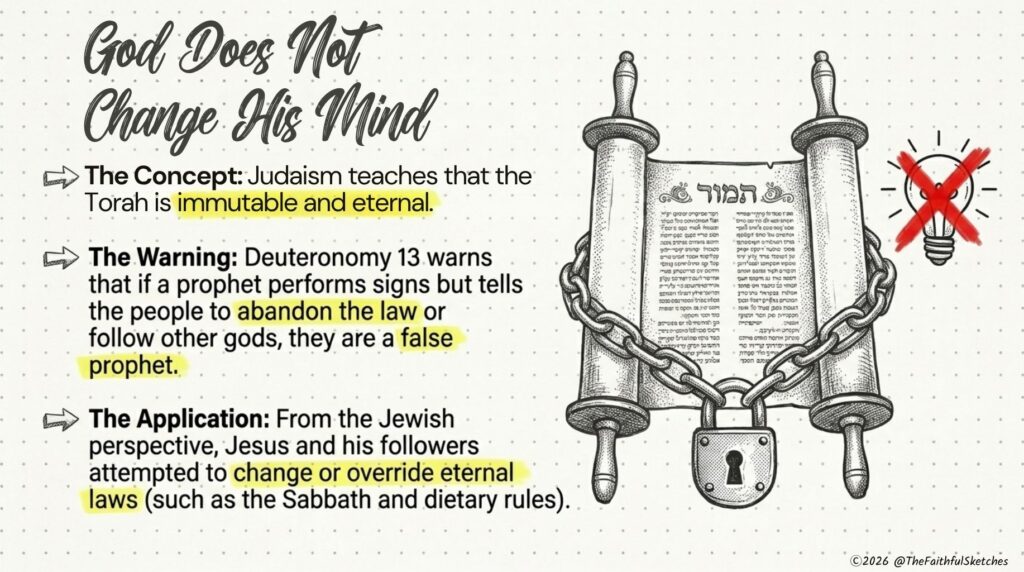
Finally, Judaism applies the test of a prophet. The Torah teaches that God’s law is eternal and that God does not change his mind.
Deuteronomy 13:1-4 warns that if a prophet performs signs and wonders but leads people to follow other gods or abandon the Law, that prophet is to be rejected regardless of the miracles performed.
From the Jewish perspective, Jesus and his followers taught that aspects of the Law of Moses, including Sabbath observance and dietary laws, were no longer binding. To a Jew, this alone is disqualifying. Miracles do not prove a person is the Messiah. Only obedience to the Law and fulfilment of the prophecies count as proof.
Why Jews Don’t Believe Jesus Is the Messiah: Two Different Conversations
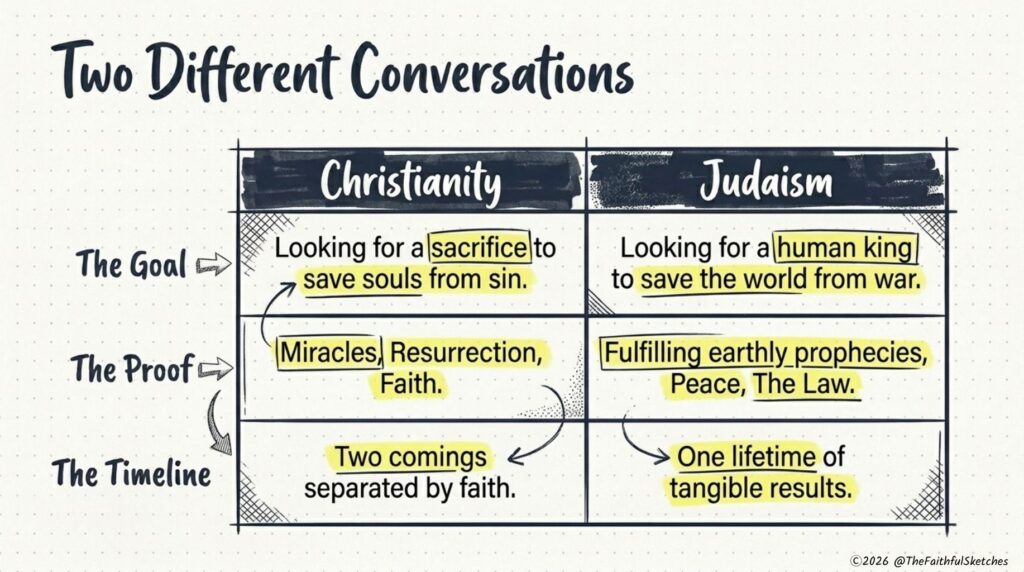
At the heart of this two-thousand-year disagreement is a fundamental difference in what each tradition is looking for.
Judaism is looking for a King who will transform the physical world, end war, rebuild the Temple, and unite humanity under one God. Christianity is looking for a Saviour who transforms the human heart and offers forgiveness and eternal life.
One is waiting for a changed world. The other believes the change begins within.
From the Jewish perspective, the reasons for rejecting Jesus are straightforward. The world is still at war. The Temple has not been rebuilt. The Law of Moses remains eternal. Until swords are beaten into ploughshares and the scattered people of Israel are fully gathered, the Jewish people will continue to wait for the Messiah they were promised.
Understanding why Jews don’t believe Jesus is the Messiah requires looking at what Judaism actually expects the Messiah to do.

What are your thoughts on the Jewish perspective? Is there a specific part of this debate you would like us to explore further? Let us know in the comments below.
Click Below to Download The Full PDF Summary Guide:
*Free for personal use only. Please don’t resell or redistribute commercially.