
Have you ever wondered why some Christians baptize infants while others dedicate them? Or why some believers treat the modern State of Israel as a prophetic countdown clock while others see it as an ordinary secular nation? Or why some insist the Ten Commandments remain binding today while others say Christians live strictly under the “Law of Christ”?
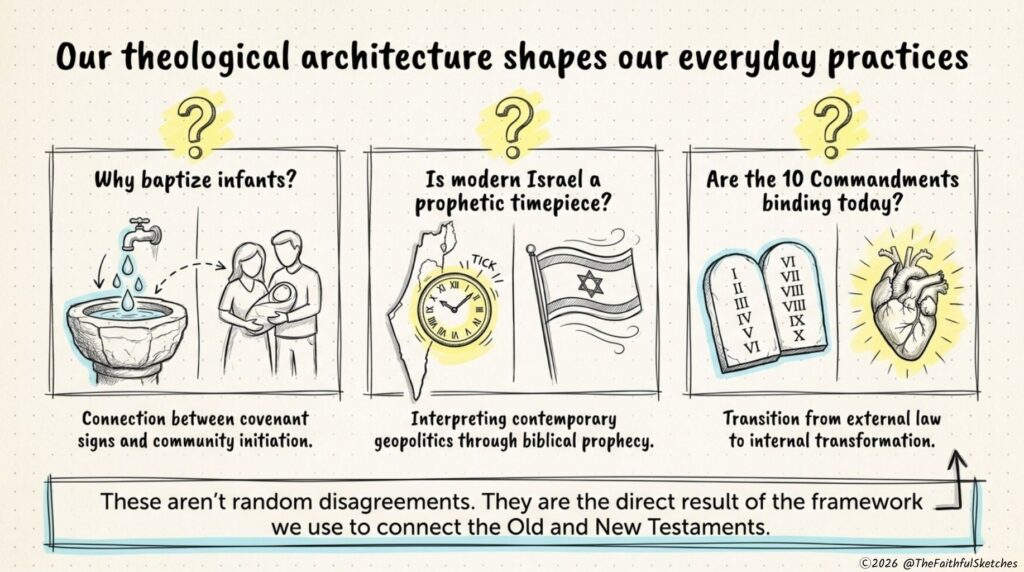
These aren’t random disagreements. They reflect the theological framework each person uses to connect the Old and New Testaments. Understanding Covenant Theology vs Dispensationalism, along with the other major systems, helps you understand why Bible-believing Christians reach such different conclusions from the same scripture.
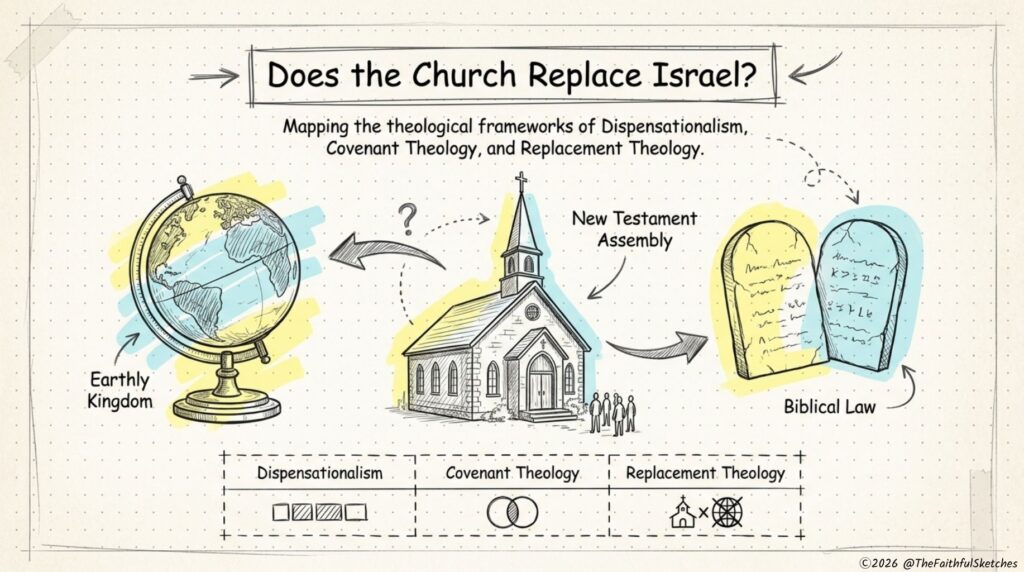
This post covers five major frameworks Evangelicals use to read the Bible: Covenant Theology, Dispensationalism, Replacement Theology, Progressive Dispensationalism, and New Covenant Theology. For each one, we’ll look at the history, the core beliefs, and the Bible verses each side uses to make its case.
Part 1: Covenant Theology
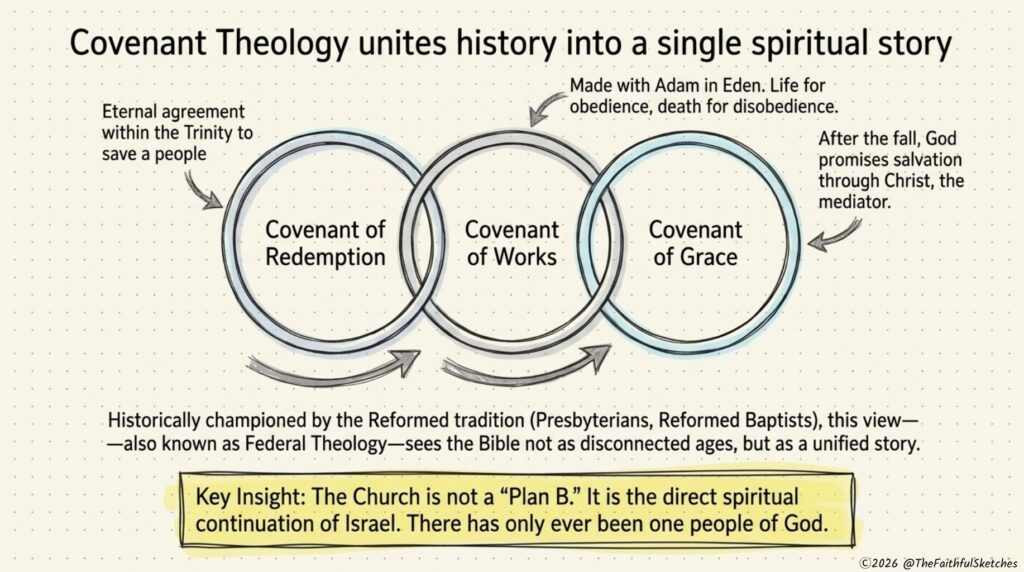
Covenant Theology, also called Federal Theology, is the historic position of the Reformed tradition. Presbyterians and many Reformed Baptists hold this view. Rather than dividing the Bible into separate ages or programs, Covenant Theology reads scripture as a unified story held together by overarching theological covenants.
The Three Covenants
Covenant theologians organize God’s dealings with humanity around three main covenants.
The Covenant of Redemption is an eternal agreement within the Trinity to save a people; The Covenant of Works was made with Adam in Eden: life for obedience, death for disobedience; The Covenant of Grace follows the Fall, in which God promises salvation through a mediator, ultimately fulfilled in Christ.
The key takeaway is this: Covenant Theologians see one people of God throughout all of history. The Church is not a backup plan. Instead, the Church represents the spiritual continuation of Israel.
The Biblical Case
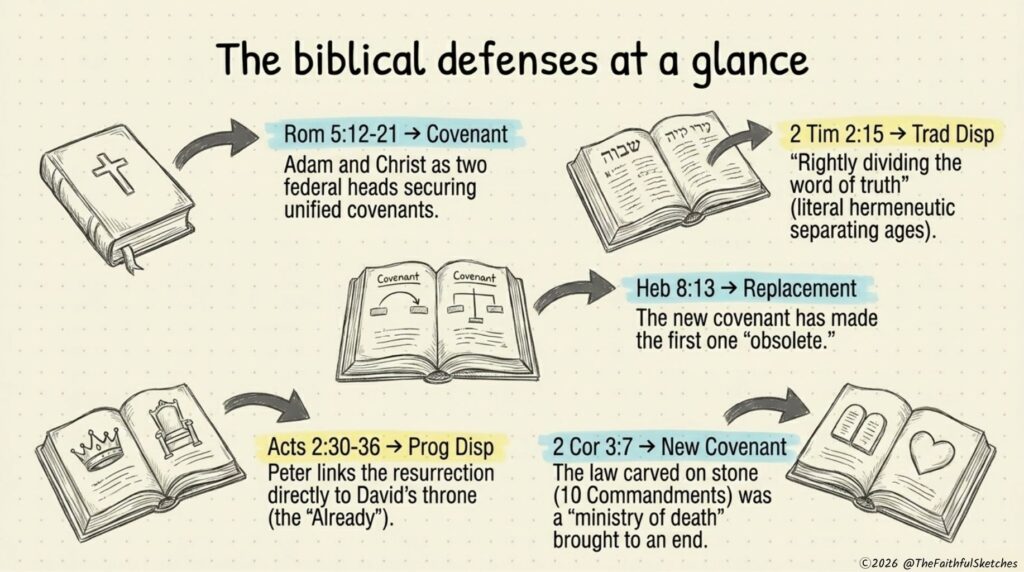
Covenant theologians point to Galatians 3:7: “Know then that it is those of faith who are the sons of Abraham.” They also draw heavily from Romans 5:12-21, which sets up Adam and Christ as two federal heads. Adam failed the Covenant of Works. Christ fulfilled it, securing the Covenant of Grace for all who believe.
Additionally, they note that the Greek word ekklesia, translated “church” in the New Testament, also appears in the Septuagint to describe the assembly of Israel in the wilderness, suggesting continuity between the two communities.
Views on the Law
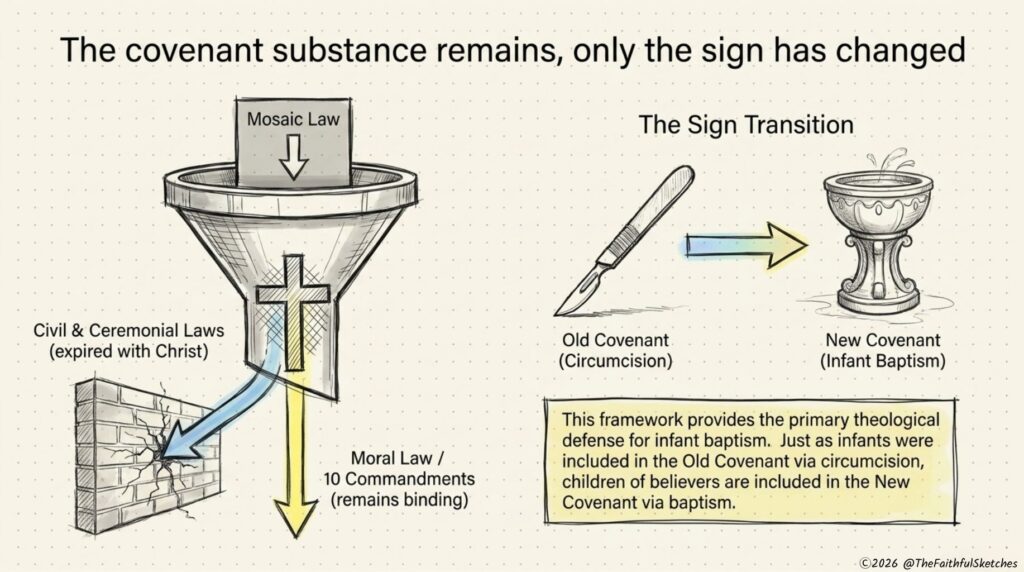
Covenant Theology divides the Mosaic Law into three categories: Moral, Civil, and Ceremonial. The Civil and Ceremonial laws expired with Christ. The Moral Law, specifically the Ten Commandments, remains binding on believers today.
Interesting fact:
Covenant Theology is the primary theological reason for infant baptism. Covenant theologians argue that just as infants received circumcision as the sign of inclusion in the Old Covenant, the children of believers receive baptism as the sign of the New Covenant. The substance of the covenant hasn’t changed, only the sign.
Part 2: Traditional Dispensationalism
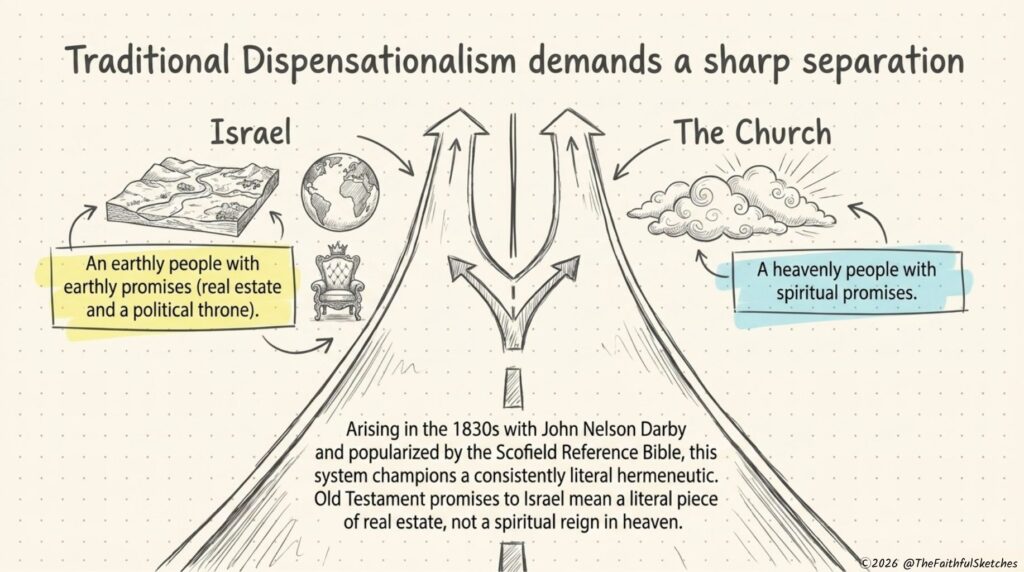
Dispensationalism emerged in the 1830s through John Nelson Darby and reached a mass audience through the Scofield Reference Bible in the early 20th century.
The Core Concept
Where Covenant Theology emphasizes continuity, Dispensationalism emphasizes distinction. The defining feature of this system is a sharp separation between Israel and the Church. Dispensationalists believe God works with two distinct peoples who carry two distinct destinies: Israel, an earthly people with earthly promises including land and a throne, and the Church, a heavenly people with spiritual promises.
The Seven Dispensations
Dispensationalists divide history into seven administrations: Innocence (Eden), Conscience (the Fall to the Flood), Human Government, Promise (Abraham), Law (Moses), Grace (the Church Age), and Kingdom (the Millennium).
The Biblical Case
Dispensationalists apply what they call a “consistently literal” hermeneutic. When the Old Testament promises Israel a land and a king, they interpret that as a literal piece of real estate and a literal political throne, not a spiritual reign in heaven.
Key texts include 2 Timothy 2:15, rendered in the KJV as “rightly dividing the word of truth,” and Ephesians 3:2-9, where Paul describes the Church as a “mystery” hidden from previous generations. This, they argue, proves the Church was not revealed in the Old Testament but represents a parenthesis in God’s ongoing plan for Israel.
End Times
Dispensationalism produces a specific eschatological timeline: a Pre-Tribulation Rapture of the Church, followed by a seven-year Tribulation during which God turns His attention back to Israel, culminating in a literal 1,000-year Millennial Kingdom on earth.
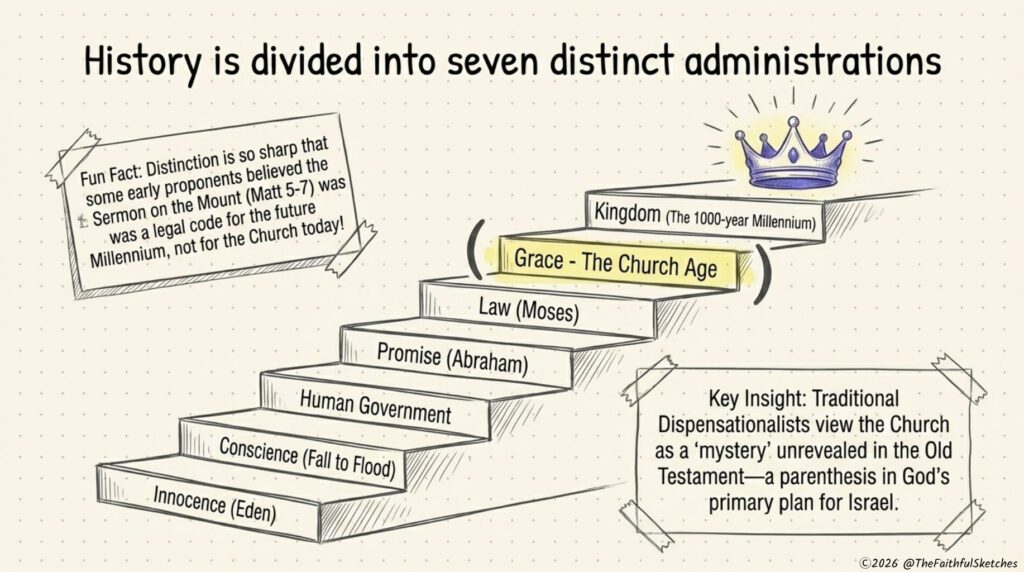
Interesting fact:
In classical Dispensationalism, the separation between Israel and the Church was so sharp that some early proponents taught the Sermon on the Mount was not intended for the Church at all, but functioned as a legal code for the future Millennial Kingdom. Most modern Dispensationalists have moved away from this position, but it illustrates how distinct they view the different ages of God’s program.
Part 3: Replacement Theology (Supersessionism)
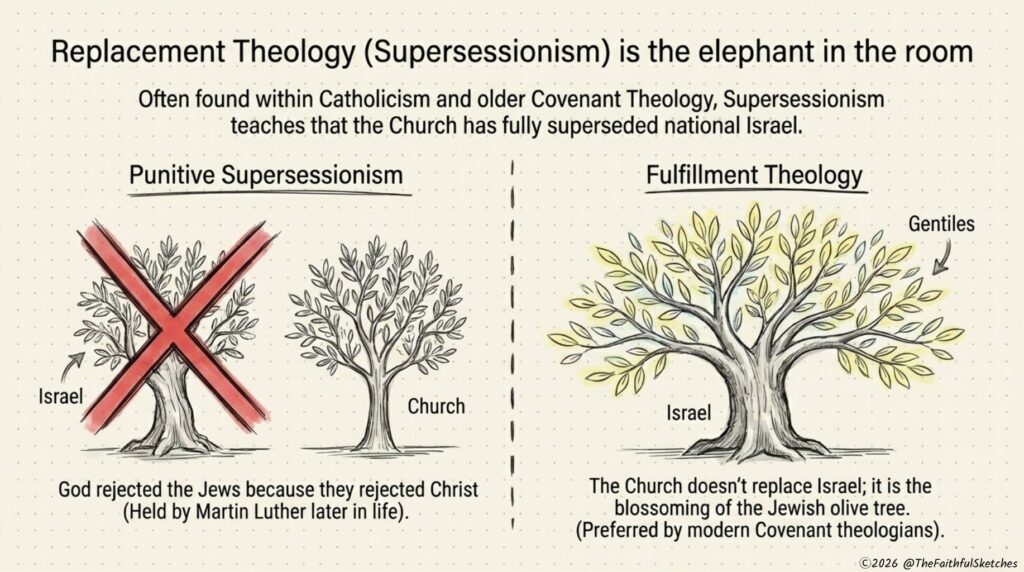
Before examining the middle-ground positions in the Covenant Theology vs Dispensationalism debate, we need to address Replacement Theology, which scholars more precisely call Supersessionism.
The Core Concept
Supersessionism is not always a standalone system. It frequently appears as a doctrine within Covenant Theology and Roman Catholicism. It teaches that the Church has superseded, or replaced, national Israel as the people of God. The promises originally made to Israel now find their fulfillment spiritually in the Church.
The Biblical Case
Supporters cite Hebrews 8:13: “In speaking of a new covenant, he has made the first one obsolete.” They also point to Matthew 21:43, where Jesus tells the Jewish leaders, “The kingdom of God will be taken away from you and given to a people producing its fruits.” Furthermore, they reference Galatians 6:16, where Paul uses the phrase “the Israel of God,” arguing this title now belongs to the Church.
A Nuance Most People Miss
Supersessionism comes in different forms. Punitive Supersessionism holds that God rejected the Jewish people because they rejected Christ. Martin Luther held this view later in his life, with deeply troubling consequences. Economic Supersessionism, by contrast, sees Israel’s role as preparation for the Church. Once the Church arrived, Israel’s task was complete. It was progression, not punishment.
Most modern Covenant Theologians prefer the term “Fulfillment Theology,” arguing they are not replacing Israel but describing the Church as the blossoming of the Jewish olive tree to include Gentiles, as Paul describes in Romans 11.
Part 4: Progressive Dispensationalism
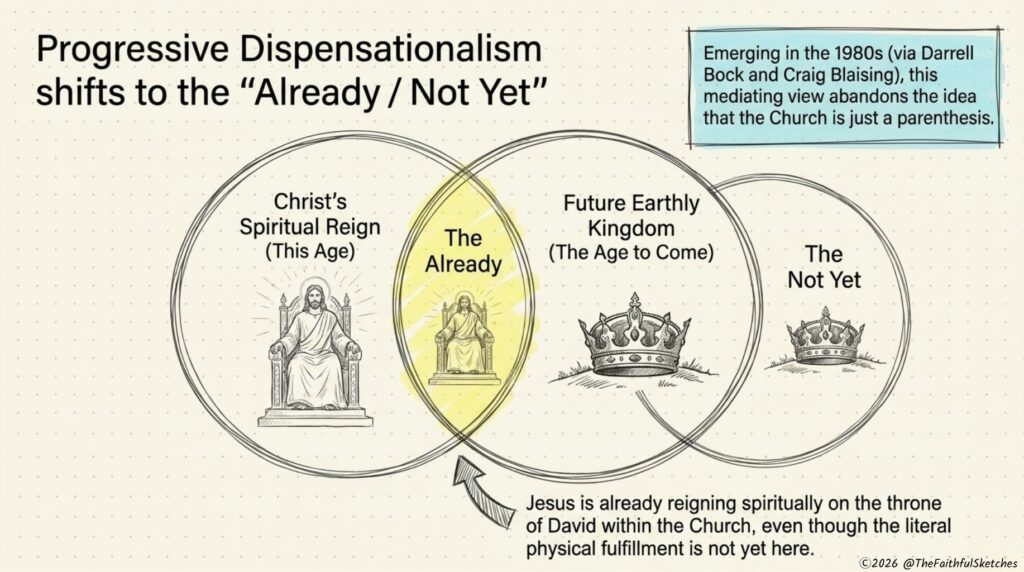
Over the past 40 years, scholars recognized the gap between Covenant Theology and traditional Dispensationalism was too wide to ignore. Two mediating positions emerged in response. The first is Progressive Dispensationalism.
The Shift
Beginning in the 1980s, scholars including Darrell Bock and Craig Blaising developed this position. They abandoned the idea that the Church represents a parenthesis in God’s plan. Instead, they teach what theologians call Inaugurated Eschatology, or the “Already/Not Yet” framework.
Progressive Dispensationalists believe Jesus is already reigning on the throne of David in heaven, a position traditional Dispensationalists deny. However, the full earthly manifestation of that kingdom is “not yet” here.
The Biblical Case
They point to Acts 2:30-36, where Peter links the resurrection and ascension of Jesus directly to the promise that David’s descendant would sit on his throne. This passage, they argue, demonstrates that the Davidic Kingdom has already begun spiritually in the Church, even though its literal earthly fulfillment remains future.
Part 5: New Covenant Theology
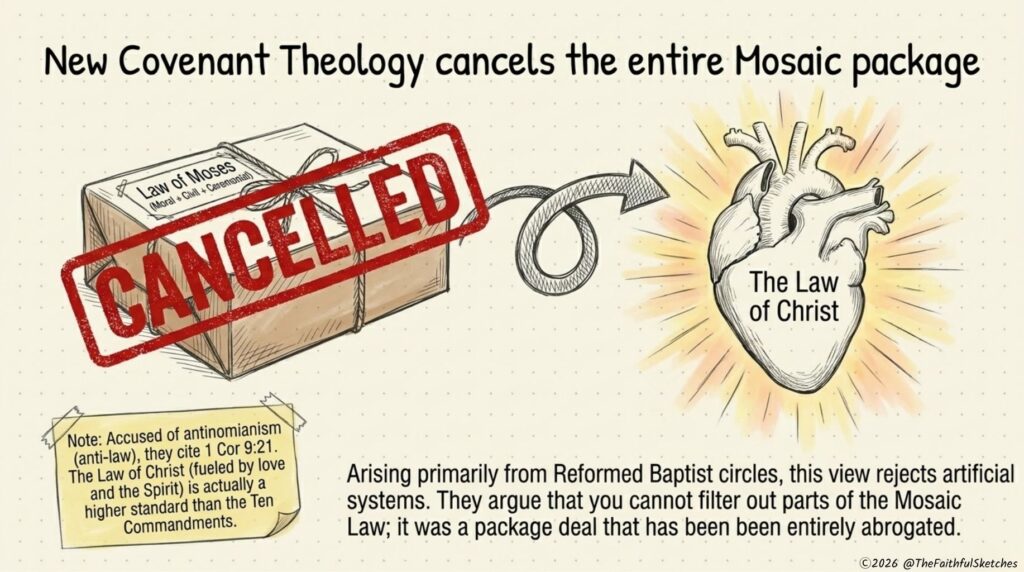
The second mediating position is New Covenant Theology, which arose primarily from Reformed Baptist circles.
The Core Concept
New Covenant Theology rejects Dispensationalism but also rejects the Covenant of Works and Covenant of Grace structures central to Covenant Theology. Its primary focus is what it calls the abrogation, or cancellation, of the Mosaic Law.
Unlike Covenant Theology, which preserves the Ten Commandments as binding moral law, New Covenant Theology teaches that the entire Law of Moses, moral, civil, and ceremonial, functioned as a unified package that Christ has now canceled. Believers today live under the “Law of Christ” rather than the Law of Moses.
The Biblical Case
Key texts include 2 Corinthians 3:7, which describes the law “carved in letters on stone,” referring to the Ten Commandments, as a “ministry of death” that was passing away. They also cite Hebrews 7:12: “For when there is a change in the priesthood, there is necessarily a change in the law as well.”
Interesting fact:
New Covenant Theology frequently faces accusations of Antinomianism, meaning opposition to law altogether. Proponents respond by pointing to 1 Corinthians 9:21, where Paul says he is “not outside the law of God but under the law of Christ.” In their view, the Law of Christ, grounded in love and the Spirit, sets a higher standard than the Ten Commandments ever did.
Part 6: Side-by-Side Comparison
Here’s how the five frameworks compare on the two most contested questions: the future of Israel and the status of the Law.
| Framework | Israel and the Church | The Law |
|---|---|---|
| Covenant Theology | One people of God throughout history | Moral Law (Ten Commandments) remains binding |
| Traditional Dispensationalism | Totally distinct peoples with distinct destinies | Mosaic Law belongs to a past dispensation; believers live under Grace |
| Replacement Theology | Church replaces Israel | Generally follows Covenant Theology on Law |
| Progressive Dispensationalism | Distinct but sharing spiritual blessings; kingdom Already/Not Yet | Nuanced; acknowledges continuity and discontinuity |
| New Covenant Theology | Church fulfills Israel | Entire Mosaic Law canceled; obey the Law of Christ |
Part 7: Why This Actually Matters
Your position in the Covenant Theology vs Dispensationalism debate shapes how you read the entire Old Testament.
Is Jeremiah 31 a promise about a future political nation of Israel, or is it the covenant you participate in every time you take communion? Is modern Israel a prophetic sign, or a secular state with no special theological significance? Does the Sabbath commandment still bind you today, or did Christ fulfill it on your behalf?
These aren’t peripheral questions. They determine how you interpret prophecy, how you engage with Jewish-Christian relations, and how you understand the unity of scripture itself.
Nevertheless, across all five frameworks, the core of the gospel remains shared ground. Salvation is by grace alone, through faith alone, in Christ alone. That agreement matters more than any of the disagreements above.
Which framework do you land on and why? Leave a comment below. And if you’d like a deeper look at any of these views individually, let me know.
For more on how these frameworks apply to current events, read our post on Are the Jews God’s Chosen People Today? and our deep dive of Replacement Theology – Does the Church Replace Israel?
Click Below to Download The Full PDF Summary Guide:
*Free for personal use only. Please don’t resell or redistribute commercially.