
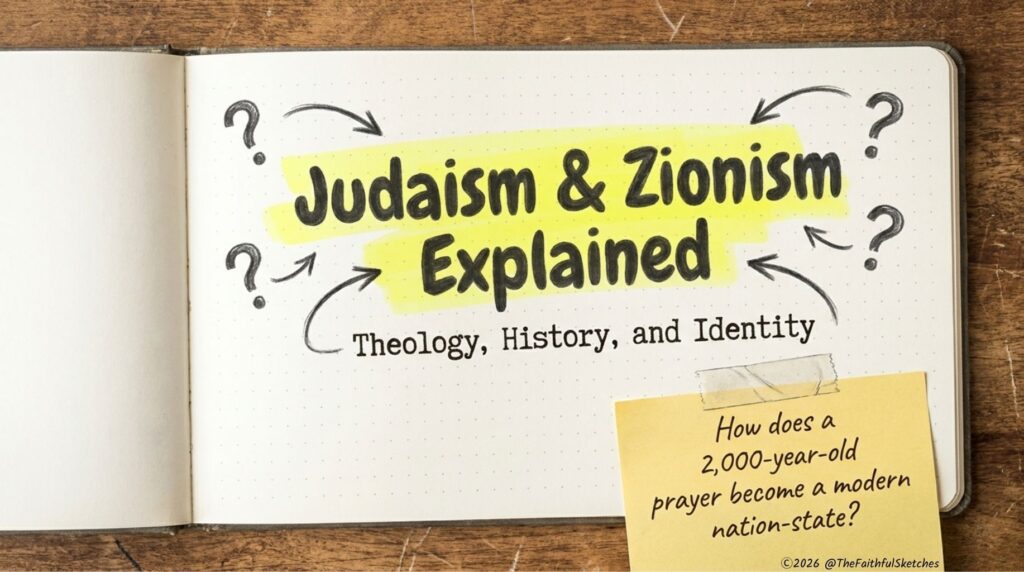
Many Christians today connect modern Israel directly to biblical prophecy. Others believe those promises find their fulfillment spiritually in Christ. Faithful believers genuinely disagree on this. Understanding Judaism and Zionism means setting aside headlines, politics, and emotion, and asking instead: how does the New Testament interpret the Old Testament, and what is the relationship between Israel and the Church?
Part 1: What Is Judaism? The Foundation
Before addressing Zionism, we need to answer a more basic question: what is Judaism?
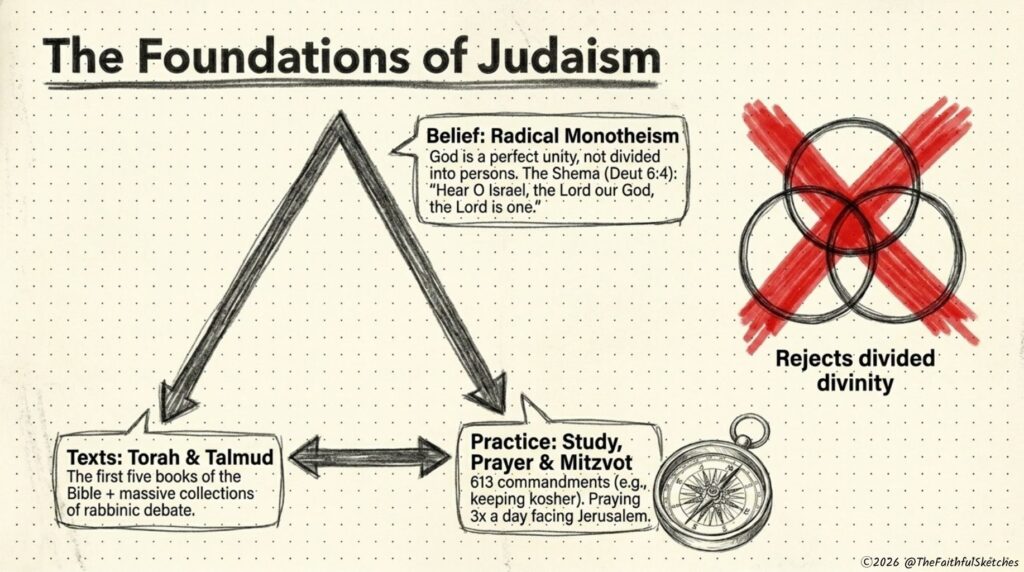
Judaism is one of the world’s oldest monotheistic religions. It began with Abraham, who, according to the Hebrew Bible, entered into a covenant with God. The core conviction is straightforward: there is one God, and the Jewish people carry a special responsibility to follow His laws.
Those laws appear in the Torah, the first five books of the Bible, and are further developed in the Talmud, a vast collection of rabbinic debates and rulings covering virtually every area of life.
How Judaism Differs From Christianity on God
Christians believe in the Trinity: one God existing as three persons, Father, Son, and Holy Spirit. Judaism rejects this entirely. God, in Jewish theology, is a perfect and indivisible unity. This conviction finds its clearest expression in the Shema, a short prayer drawn from Deuteronomy 6:4:
“Hear, O Israel: The LORD our God, the LORD is One.”
What Jewish Practice Looks Like
Judaism centers not just on belief but on practice. For thousands of years, Jewish life has organized around three pillars. First, study: reading and interpreting sacred texts as a lifelong obligation. Second, prayer: three daily prayer times, each oriented toward Jerusalem. Third, the Mitzvot: 613 commandments covering everything from dietary laws (keeping kosher) to obligations toward the poor.
Woven through all of it, the prayers, the holidays, the songs, runs a constant theme: the memory of a homeland.
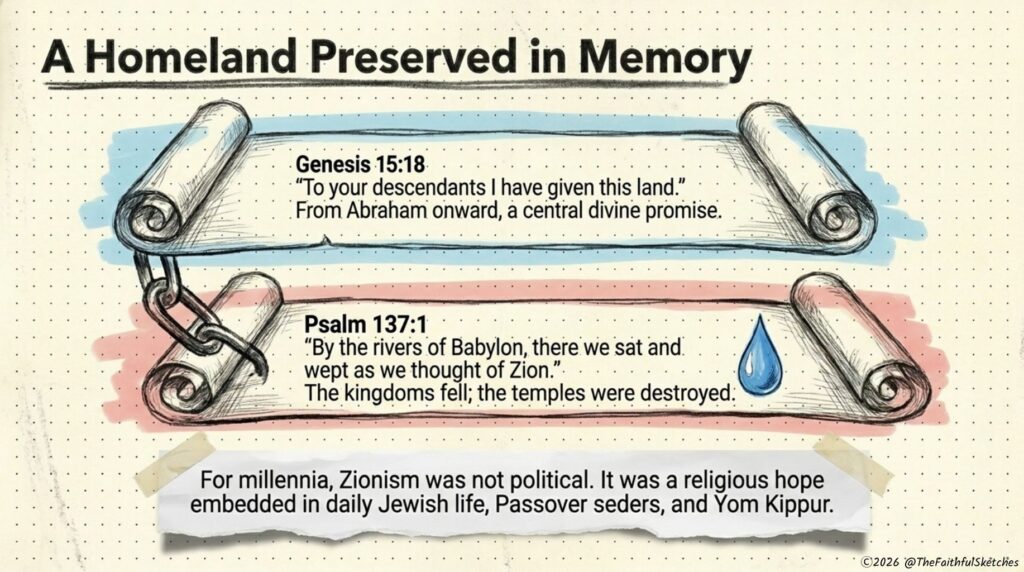
The story begins in Genesis 12:1, where God instructs Abraham to go “to the land that I will show you.” In Genesis 15:18, that land receives a specific promise: “To your descendants I have given this land.”
However, the Bible also tells the story of exile. The kingdoms fall. The Temples in Jerusalem are destroyed. The emotion of that loss is captured in Psalm 137:1: “By the rivers of Babylon, there we sat, sat and wept, as we thought of Zion.” Here, Zion becomes a symbol of a lost homeland rather than simply a geographic location.
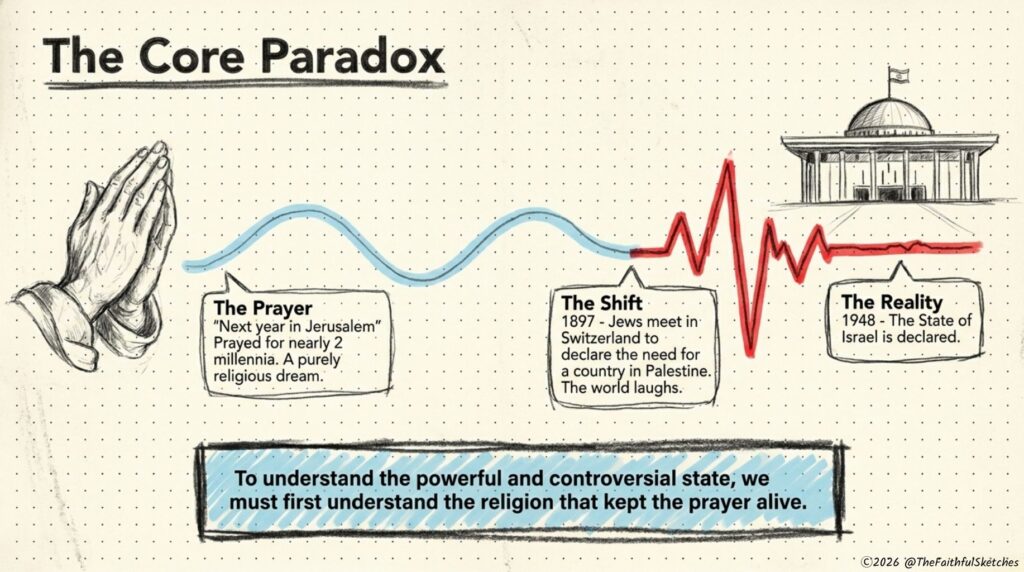
For nearly two millennia, this wasn’t a political program. Jews prayed three times daily for the ingathering of the exiles. At the end of the Passover Seder and on Yom Kippur, they declared “Next year in Jerusalem.” It was a religious hope, embedded in daily life. In the 19th century, however, that hope began to take a different shape entirely.
Part 2: The Birth of Political Zionism
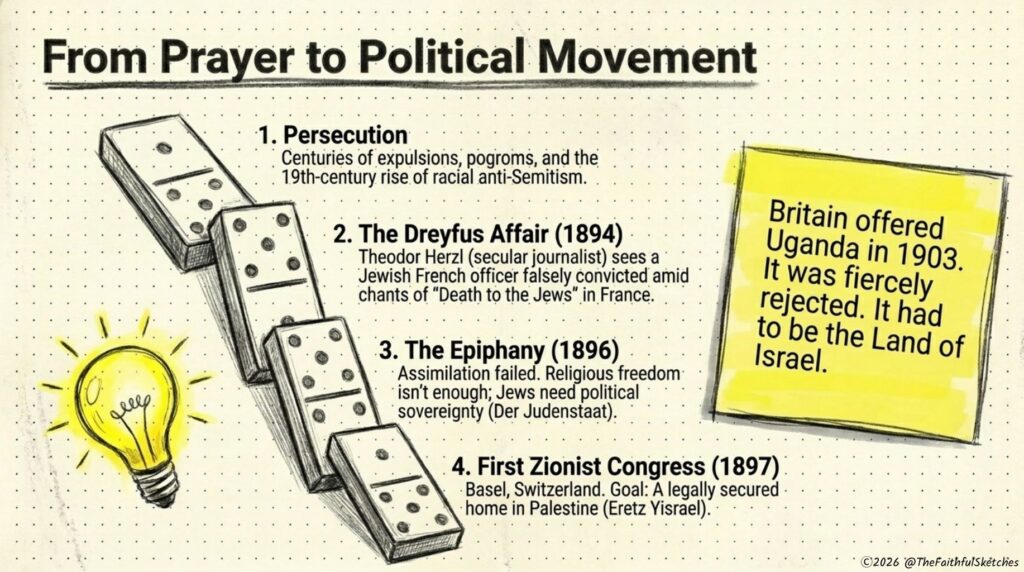
What transforms a 2,000-year-old religious prayer into a modern political movement? The short answer is persecution.
For centuries, Jews in Europe lived as a vulnerable minority. Expulsions, legal restrictions, and violent attacks called pogroms defined their existence. By the late 1800s, a new and explicitly racial antisemitism was spreading across the continent.
Theodor Herzl and the Founding of Zionism
This environment produced Theodor Herzl, a secular Jewish journalist based in Vienna. Herzl was fully assimilated into European culture until 1894, when he covered the trial of Alfred Dreyfus, a Jewish French military officer falsely convicted of treason. Herzl witnessed crowds in France, the country of liberty, chanting “Death to the Jews.”
The experience changed everything for him. Assimilation clearly hadn’t worked. If antisemitism could erupt in France, it could happen anywhere. His conclusion was radical: the Jewish people needed not just religious freedom but political sovereignty. They needed their own state.
In 1896, Herzl published Der Judenstaat (“The Jewish State”). The following year, in 1897, he convened the First Zionist Congress in Basel, Switzerland. Their platform was explicit: “Zionism aims at establishing a legally secured home for the Jewish people in Palestine.”
Why Palestine?
In 1897, the region was under Ottoman control. For the Zionists, however, this was Eretz Yisrael, the Land of Israel, the territory their religion had directed them to pray toward for two thousand years. The significance of that became clear in 1903, when Britain offered Herzl a territory in East Africa instead. The proposal caused fierce internal conflict, and the movement ultimately rejected it. For Zionists, it had to be the Land of Israel or nowhere.
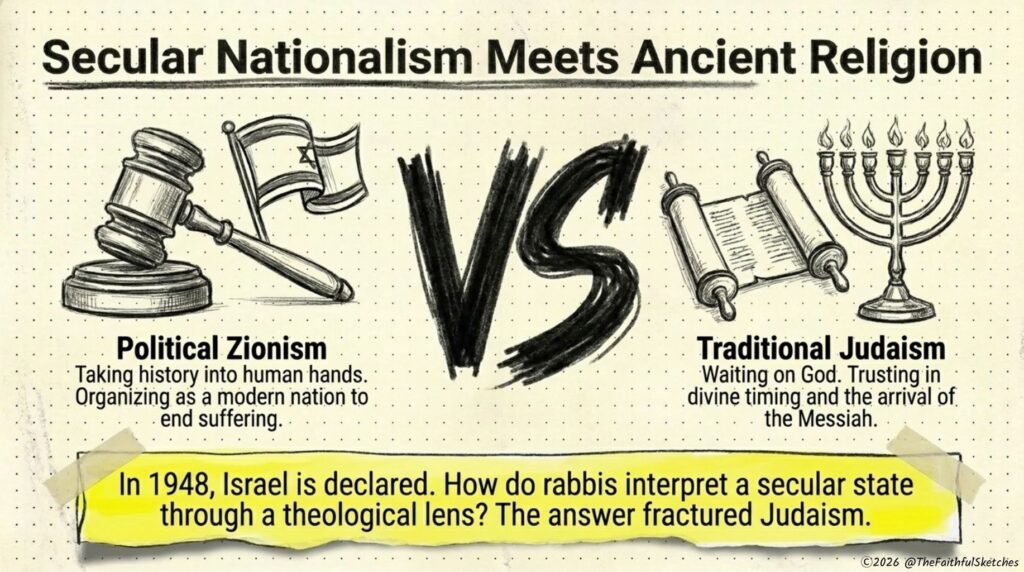
Herzl wrote in his diary after Basel: “In fifty years, everyone will see it.” He was off by one year. The State of Israel was declared in 1948.
This represented a fundamental shift. Jews were now organizing as a nation to take history into their own hands. That new secular nationalism immediately collided with the 2,000-year-old religion that had kept the dream alive in the first place.
Part 3: The Great Religious Debate — Judaism and Zionism in Conflict
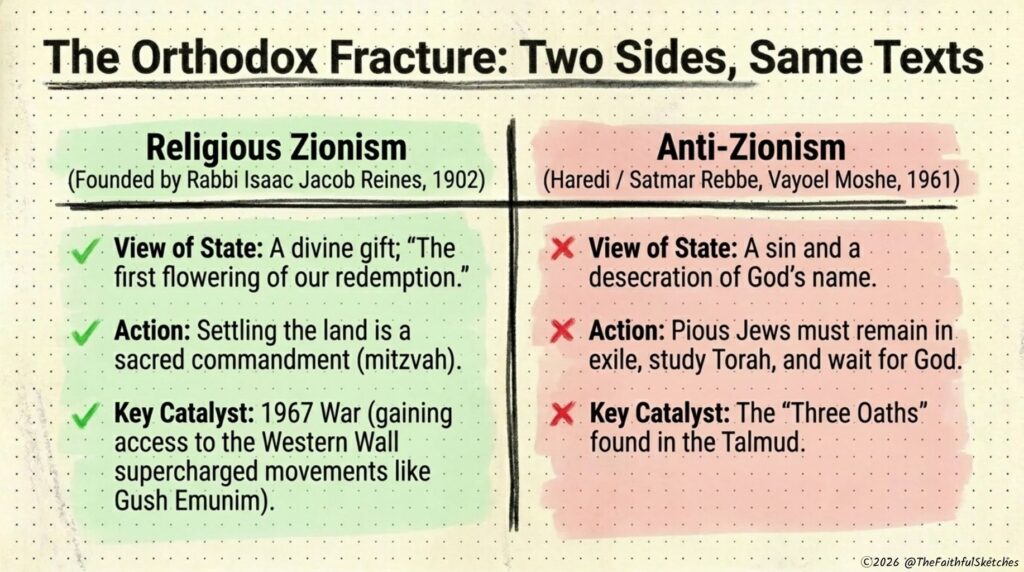
When Herzl launched his movement, most Orthodox rabbis opposed it. The debate that followed remains unresolved today, with deeply rooted arguments on both sides drawing from the same biblical and Talmudic texts.
The Religious Zionist Argument
In 1902, Rabbi Isaac Jacob Reines founded the Mizrachi movement, the religious Zionist faction. He saw Zionism as a practical means of relieving Jewish suffering, consistent with the Jewish obligation to preserve life.
For religious Zionists, the establishment of Israel carried theological significance captured in the Hebrew phrase Reshit Tzmichat Ge’ulateinu, “the first flowering of our redemption.” The idea is that the modern state signals the dawn of the Messianic Age. This conviction intensified dramatically after the 1967 Six-Day War, when Israel captured East Jerusalem and the biblical territories of Judea and Samaria. For the first time in 2,000 years, Jews had access to the Western Wall. Rabbi Tzvi Yehuda Kook declared: “This land is ours… the eternal land of our forefathers.” The movement that followed, Gush Emunim, framed Jewish settlement in those territories not as politics but as a sacred commandment to hasten redemption.
The Anti-Zionist Argument
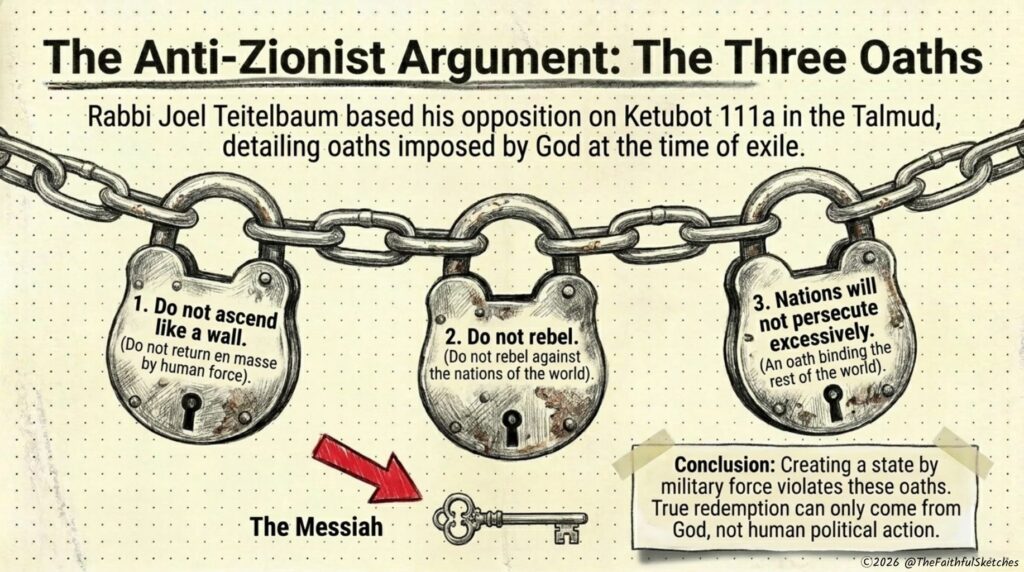
For a significant minority of Haredi (ultra-Orthodox) Jews, however, Zionism constitutes a sin against Judaism itself. The classic argument appears in Rabbi Joel Teitelbaum’s 1961 work Vayoel Moshe. His position rests on the “Three Oaths” found in the Talmud (Ketubot 111a), which teach that God imposed three conditions at the time of exile: that Jews would not return to the land en masse and by force; that Jews would not rebel against the nations; and that the nations would not persecute the Jews excessively.
Rabbi Teitelbaum argued that Zionism violates the first two oaths. Creating a state by political force before the Messiah arrives, in his view, constitutes a direct rebellion against God’s will. True redemption, he maintained, can only come from God, not human political action. Faithful Jews should therefore remain in exile, studying Torah and praying, until God chooses to bring them home.
Two positions, both rooted in the same texts, reaching opposite conclusions. One sees Israel as the “first flowering of redemption.” The other sees it as a desecration of God’s name.
Part 4: Secular and Critical Perspectives
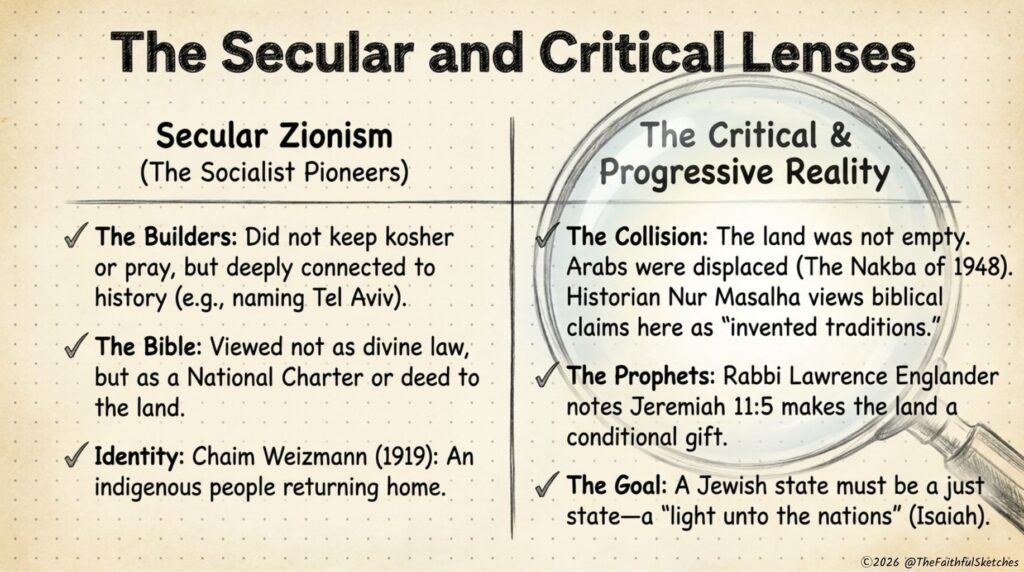
While the religious debates took place in yeshivas, secular Zionists were building a state on the ground.
For secular founders, the Bible functioned not primarily as a divine contract but as a national charter, a historical deed to the land. The socialist pioneers who established the first kibbutzim were not religiously observant. They didn’t keep kosher or maintain daily prayer. Nevertheless, they connected deeply to the land’s history. They named their towns after biblical places, most famously Tel Aviv, and revived Hebrew from a liturgical language into a living daily tongue.
Chaim Weizmann, Israel’s first president, stated in 1919: “The claim of the Jewish people to Palestine is based on the historic title rooted in the Bible.” For secular Zionists, they were indigenous people returning home after a forced absence of two millennia.
The Collision With Palestinian Reality
This claim, however, collided directly with the people already living in the region. The Zionist framing of Palestine as “a land without a people” ignored the reality of a substantial Arab population with its own deep roots in the land. Critics, including historian Nur Masalha, argue that the Zionist use of biblical texts functioned as a form of invented tradition, a divine mandate deployed to justify the displacement of Palestinians. The Palestinian Nakba (“catastrophe”) of 1948, in which approximately 700,000 Palestinians fled or were expelled, represents the other side of that historical moment.
The Progressive Jewish Voice
A third perspective comes from within Judaism itself. Rabbi Lawrence Englander and other progressive Jewish thinkers point to later prophets like Jeremiah, who in Jeremiah 11:5 frame the land promise as conditional on justice and obedience. For progressive Jews, a Jewish state must function as a just state, fulfilling the prophetic calling of Israel to be, as Isaiah 49:6 describes it, “a light to the nations.”
Three readings of the same Bible: a deed to the land, a tool of colonization, and a moral contract requiring justice.
Three Facts Most People Don’t Know
Early Zionism was largely secular. Many of its founding figures had no interest in religious observance. The movement drew its energy from nationalism and persecution, not theology.
Hebrew was effectively a dead language for daily conversation before the 20th century. Its revival as a spoken modern language, driven by figures like Eliezer Ben-Yehuda, stands as one of the most remarkable linguistic achievements in history.
The debate between religious and secular Jews about Zionism continues actively today. It plays out in Israeli politics, in synagogues worldwide, and in Jewish communities wherever questions of identity and statehood arise.
Conclusion: A Living Debate
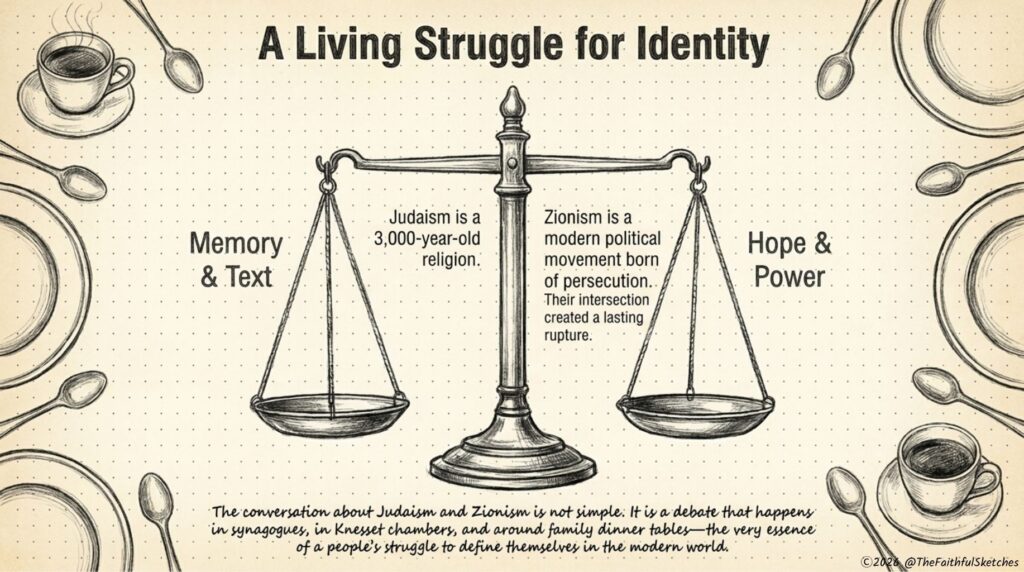
Judaism is a 3,000-year-old religion built on covenant, law, and the memory of Zion. Zionism is a modern political movement that grew directly out of that history, shaped by centuries of persecution and a longing for safety and self-determination.
That movement, in turn, created a lasting rupture within Judaism itself. Religious Zionists see the modern state as the “footsteps of the Messiah.” Ultra-Orthodox anti-Zionists see it as a rebellion against God’s explicit will. Between those poles, a wide spectrum of secular, cultural, and progressive Jews continues to debate what a Jewish state should actually look like and whether it reflects or betrays the tradition that gave it birth.
The conversation about Judaism and Zionism is not simple, and anyone who tells you it is hasn’t engaged with it seriously. It is a debate between memory and hope, between ancient text and modern power, and between competing visions of what it means to be a people in the modern world.
Where do you land on this topic? Leave a comment below.
Interested in related topics? Read our post on Are the Jews God’s Chosen People Today? for a biblical examination of Israel’s covenant status.
Click Below to Download The Full PDF Summary Guide:
*Free for personal use only. Please don’t resell or redistribute commercially.