
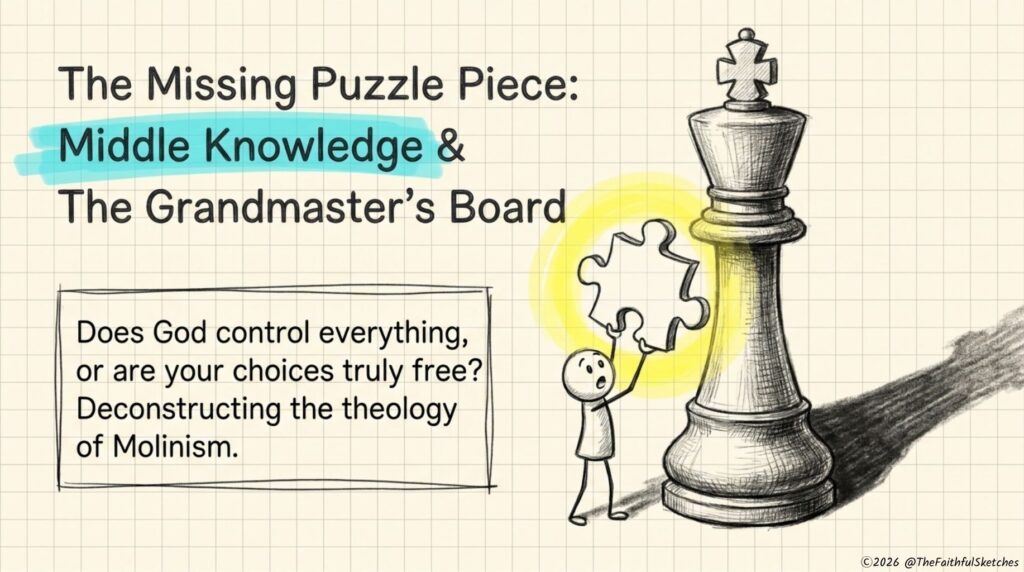
The decision you just made to read this post — was it truly yours? Or did God determine it long before you were born, in an eternal decree that fixed every atom in the universe on a predetermined course?
That question sits at the heart of one of Christianity’s oldest and most unresolved tensions. If God is sovereign and knows the future completely, how can your choices be genuinely free? Are you simply acting out a script He wrote before time began?
For most of church history, theologians felt forced to pick a side. Either you surrendered real human freedom to acknowledge God’s sovereignty, or you limited God’s power to protect human liberty. Molinism — also called God’s Middle Knowledge — proposes a third path. It argues that God’s control and your freedom are not rivals. Instead, they work together in a framework that its supporters believe resolves not only the ancient theological puzzle, but also the deeply personal questions: Why did this happen to me? Did God know I would fail? Is my story still genuinely mine?
This post explains Molinism, traces its biblical foundations, and honestly addresses its strongest criticisms.
Part 1: The Theological Problem Molinism Tries to Solve
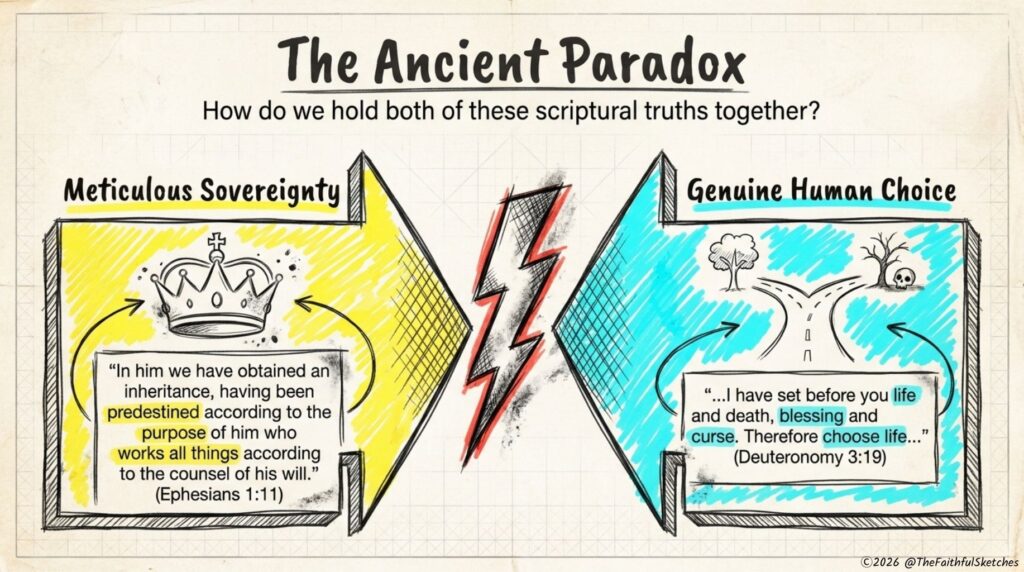
For centuries, Christian theologians have wrestled with a genuine tension in Scripture. On one hand, the Bible clearly teaches God’s complete sovereignty. Ephesians 1:11 states: “In him we have obtained an inheritance, having been predestined according to the purpose of him who works all things according to the counsel of his will.” God accomplishes all things according to His will. Nothing catches Him off guard.
On the other hand, Scripture consistently emphasizes genuine human choice and moral responsibility. Deuteronomy 30:19 records God urging Israel: “I have set before you life and death, blessing and curse. Therefore choose life, that you and your offspring may live.” The language treats their decision as real and consequential, not theatrical.
So how do Christians hold both truths together? Three major theological traditions have answered that question differently.
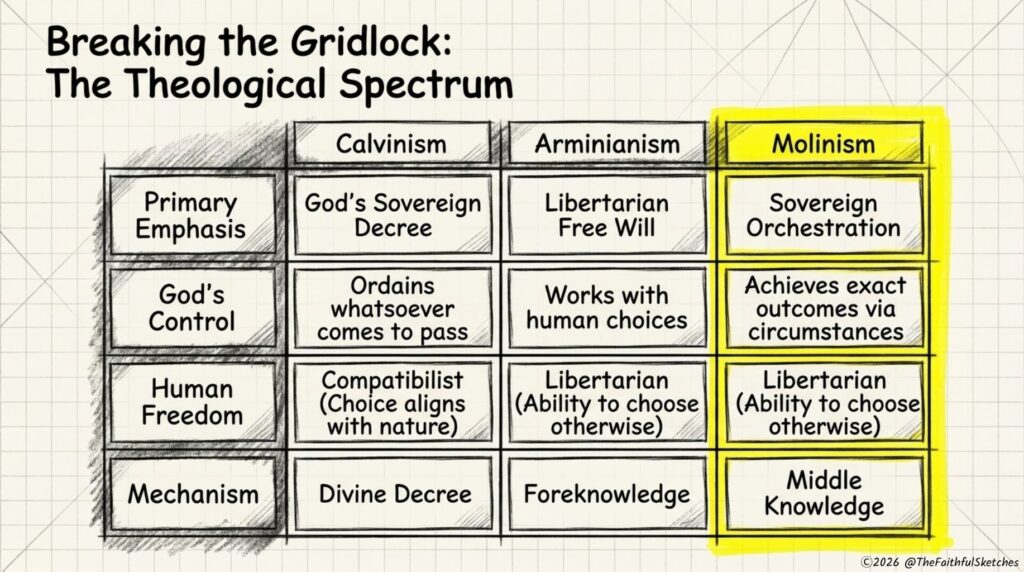
Calvinism emphasizes God’s sovereign decree. God ordains everything that comes to pass, including human choices, without this making those choices any less real from within the human experience.
Arminianism emphasizes libertarian free will. Humans make genuinely free choices, and God works providentially within and around those choices without overriding them.
Molinism attempts a third path, proposing that God possesses a special category of knowledge that allows Him to sovereignly orchestrate outcomes in history while fully preserving libertarian human freedom.
This post focuses specifically on Molinism, not to argue it is definitively correct, but to understand clearly what it actually teaches.
Part 2: Who Was Luis de Molina?
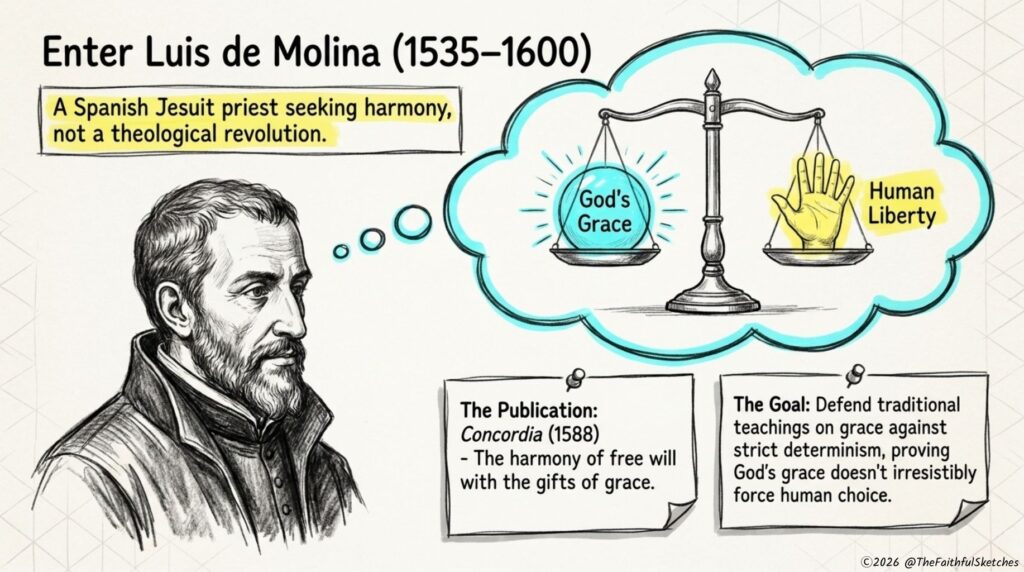
Molinism takes its name from Luis de Molina, a Spanish Jesuit priest born in 1535. In 1588, Molina published Concordia liberi arbitrii cum gratiae donis, translated as The Harmony of Free Will with the Gifts of Grace.
Contrary to what some assume, Molina wasn’t trying to be theologically innovative. He was defending traditional Catholic teaching on grace and free will against strict determinism and against Reformation arguments that God’s grace irresistibly determines human choices. Molina believed humans retain what philosophers call libertarian freedom, the genuine ability to choose otherwise, even when responding to God’s grace.
To defend this position, he proposed that God possesses a unique type of knowledge sitting logically between His knowledge of mere possibilities and His knowledge of what He has decreed to bring about. That middle category became the defining feature of the entire system.
Part 3: The Three Kinds of Divine Knowledge
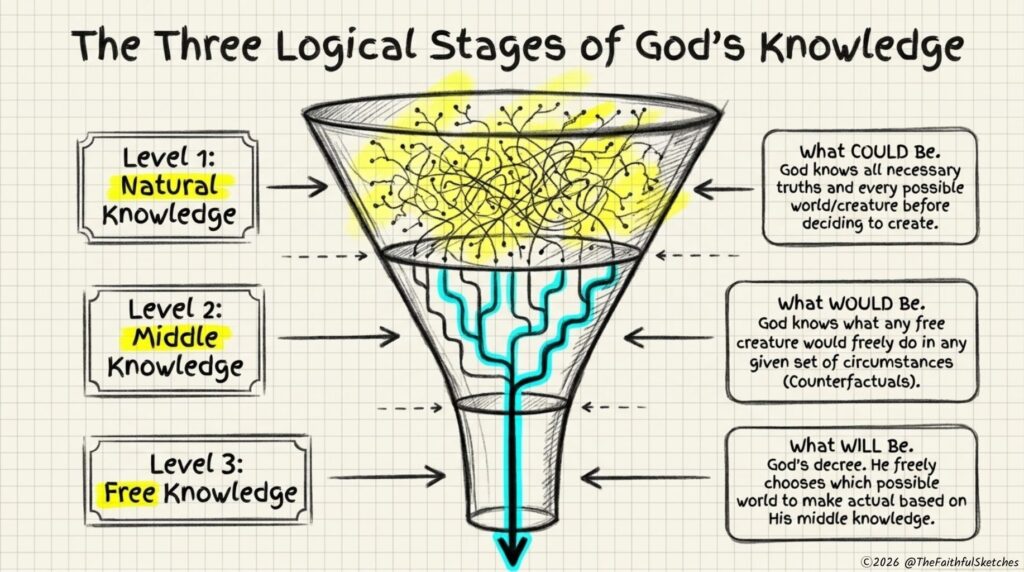
To grasp Molinism explained properly, you need to understand how Molina described God’s knowledge. He divided it into three distinct logical stages.
Natural Knowledge
Natural Knowledge is God’s awareness of all necessary truths and all possible worlds. Before God decides to create anything, He knows every conceivable combination of events, every potential creature, and every possible scenario. This covers everything that could exist or occur.
Middle Knowledge
Middle Knowledge is the groundbreaking and controversial category. It describes God’s knowledge of what any free creature would do in any possible set of circumstances. Crucially, this goes beyond what creatures could do, which Natural Knowledge already covers. Middle Knowledge captures what they would freely choose in specific situations.
Molina called these truths “counterfactuals of creaturely freedom.” They are facts about how free beings would actually choose when placed in particular circumstances, and God knows all of them completely.
Free Knowledge
Free Knowledge is God’s knowledge of the actual world He decides to create. Based on His Middle Knowledge of what free creatures would choose in various situations, God freely selects which possible world to make actual. This constitutes His plan or decree.
The logical sequence runs as follows: Natural Knowledge covering all possibilities, then Middle Knowledge revealing what creatures would freely choose within those possibilities, then God’s decree selecting which world to actualize, then Free Knowledge of the actual world that results.
Part 4: The Biblical Case for Molinism
Supporters of Molinism point to specific biblical texts that appear to describe exactly the kind of knowledge Molina theorized.
David and Keilah
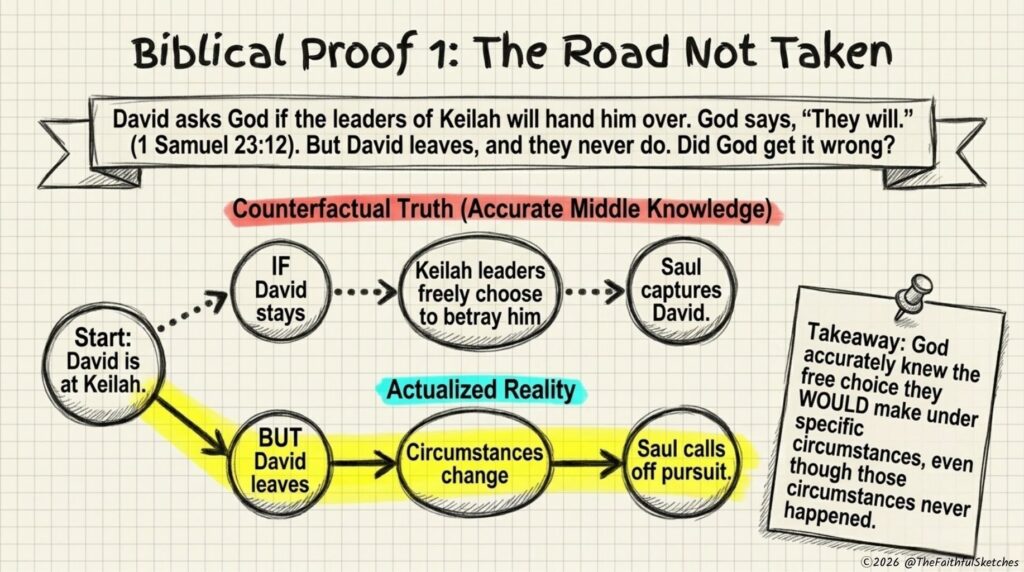
The most compelling example appears in 1 Samuel 23. David is fleeing King Saul and asks God directly: “Will the leaders of Keilah surrender me to Saul?” God answers that they would hand him over. David then flees Keilah, Saul abandons his pursuit, and the leaders of Keilah never actually surrender anyone.
Notably, God’s answer was not wrong. God knew a counterfactual truth: if David remained in Keilah, the men would freely hand him over. When David changed the circumstances by leaving, the predicted event never occurred, but God’s knowledge was perfectly accurate throughout. This is precisely what Molinism describes as Middle Knowledge in action.
Jesus and the Cities of Galilee
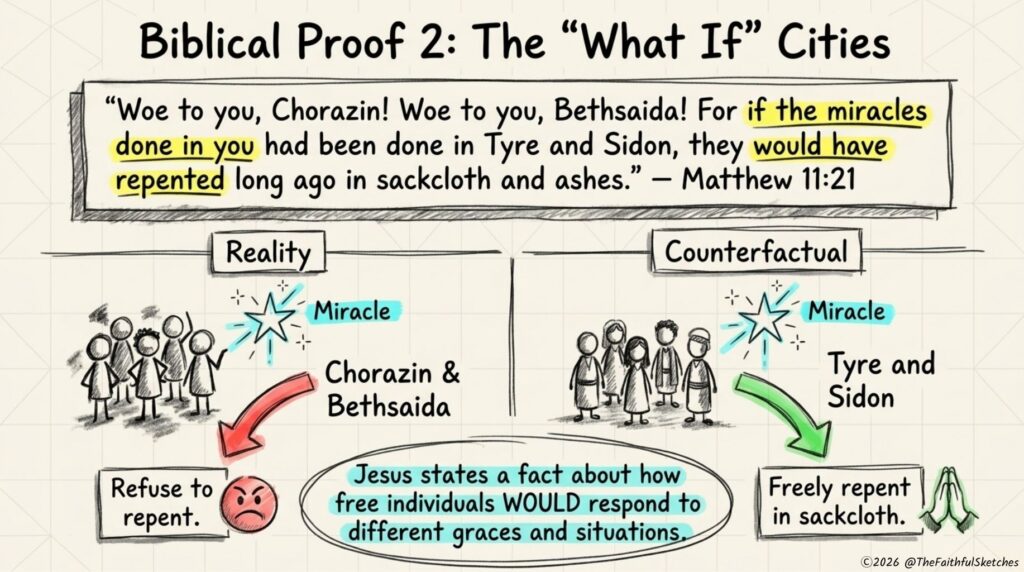
A second powerful example comes from Matthew 11:21, where Jesus declares: “Woe to you, Chorazin! Woe to you, Bethsaida! If the miracles done among you had been done in Tyre and Sidon, they would have repented long ago in sackcloth and ashes.”
Jesus states a counterfactual of creaturely freedom directly. He asserts that given different circumstances, specifically the powerful miracles performed in Galilee, the people of Tyre and Sidon would have freely repented. This implies God knows precisely how free individuals would respond to different situations, revelations, and forms of grace, which is exactly what Middle Knowledge describes.
Part 5: The Three Pillars of Molinism
Molinism explained in its strongest form rests on three core claims that its supporters find compelling.
Pillar 1: Libertarian Freedom Is Preserved
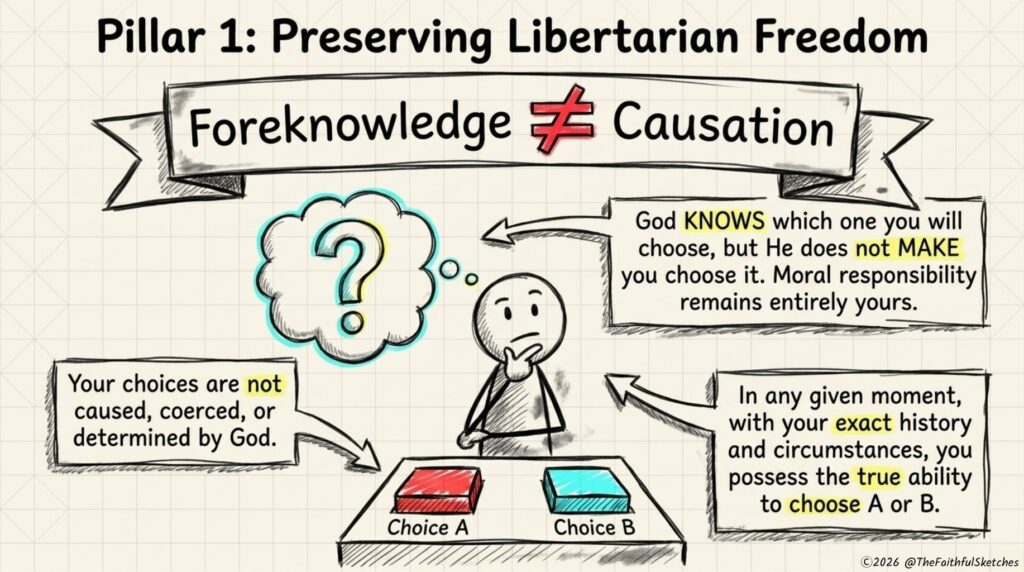
Human choices are not caused or determined by God. In any given moment, with your exact history and circumstances, you genuinely could choose differently. God knows which option you would freely select, but He does not make you select it. This preserves genuine moral responsibility and makes human choices authentically meaningful.
Pillar 2: God’s Meticulous Sovereignty Is Defended
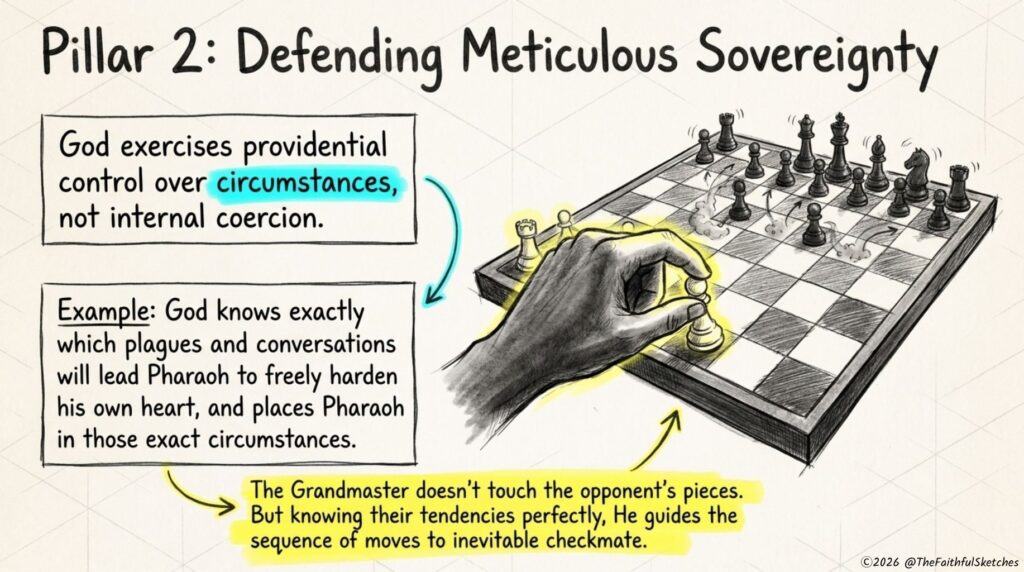
God does not need to override human freedom to accomplish His purposes. Consider Pharaoh in Exodus. God does not force Pharaoh to harden his heart. However, from His Middle Knowledge, God knows exactly which circumstances, which plagues and which conversations, would lead Pharaoh to freely harden his own heart. God then sovereignly places Pharaoh in those exact circumstances and achieves the outcome He intends through Pharaoh’s free choices.
Philosopher William Lane Craig, one of Molinism’s most prominent modern defenders, compares this to a grandmaster chess player. The grandmaster does not control the opponent’s pieces. Nevertheless, knowing the opponent’s tendencies and what they would do in response to any move, the grandmaster selects a sequence that guides the game toward checkmate while the opponent moves entirely freely.
Pillar 3: The Problem of Evil Receives a Response
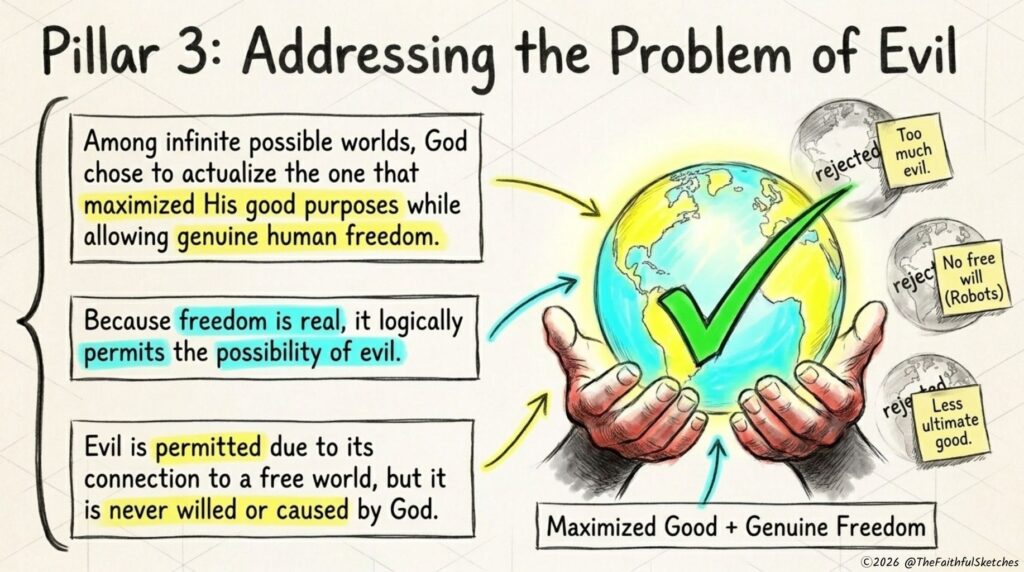
Among all possible worlds God could have created, each containing its own unique set of free choices and consequences, God selected the world that best maximizes His good purposes while allowing for genuine human freedom. Evil exists in this world because of its logical connection to a creation containing significant freedom. Critically, God permits that evil without willing or causing it directly.
Part 6: The Major Objections
Molinism is not without serious critics. Two objections in particular deserve honest engagement.
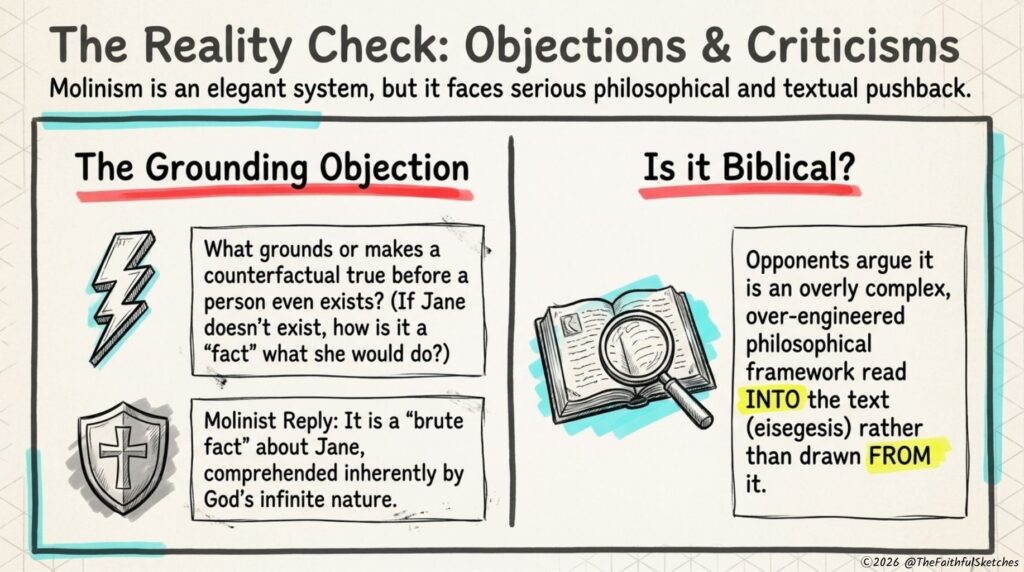
The Grounding Objection
Critics ask a pointed question: what makes counterfactuals of creaturely freedom true? If God knows that “in circumstance C, Jane would freely choose X,” what grounds that fact as true before Jane even exists?
Molinists respond that these truths are simply brute facts about how free creatures would choose. Just as God’s Natural Knowledge of possibilities is grounded in His own infinite nature, the truths about creaturely choices in specific circumstances belong to the infinite set of truths God comprehends as part of who He is. Critics find this answer unsatisfying. The debate continues actively in academic philosophy and theology.
Is It Biblical?
A second objection questions whether Molinism is a genuinely biblical framework or an overly complex philosophical system read into the text. Critics, including many Calvinist theologians, argue the biblical authors never envisioned the elaborate logical machinery Molinism requires. They favor a view where God’s knowledge operates more simply, or where human freedom is compatible with a stronger form of divine causation.
Interesting fact: Molinism has experienced a significant revival over the past 30 years, particularly among evangelical Protestant philosophers. Scholars including William Lane Craig and Alvin Plantinga, whose “possible worlds” semantics provided rigorous philosophical tools, have given the system a serious modern defense. Molinism is no longer exclusively a Catholic theological position.
Conclusion: What Molinism Actually Offers
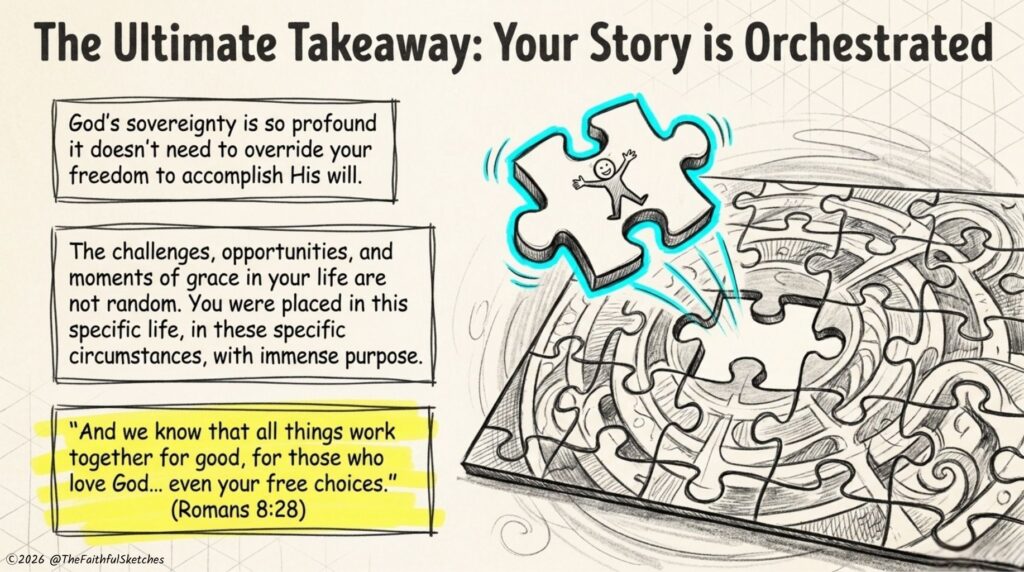
Molinism suggests that God’s sovereignty is so profound it does not need to override human freedom to accomplish His will. Furthermore, it offers a framework for understanding your own life: the circumstances you face, the challenges, the opportunities, the moments of grace, are not random. A God who knows you with absolute intimacy, who knows what you would choose across a million different lives, has placed you in this specific one with specific purpose.
That conviction finds its clearest biblical expression in Romans 8:28: “And we know that all things work together for good for those who love God, who are called according to his purpose.” All things. Including your free choices.
Whether or not Molinism fully resolves the tension between divine sovereignty and human freedom, it offers something genuinely valuable: a framework that takes both truths seriously without collapsing one into the other.
Do you think Molinism solves the puzzle? Leave a comment below.
This post connects directly to our broader series on how Christians understand God’s sovereignty and human responsibility. For the foundational framework, read Predestination and Free Will: Untangling Christianity’s Biggest Puzzle. For the theological systems that shape this debate, see Covenant Theology vs Dispensationalism: 5 Biblical Frameworks Every Christian Should Know.
Click Below to Download The Full PDF Summary Visual Guide:
*Free for personal use only. Please don’t resell or redistribute commercially.