
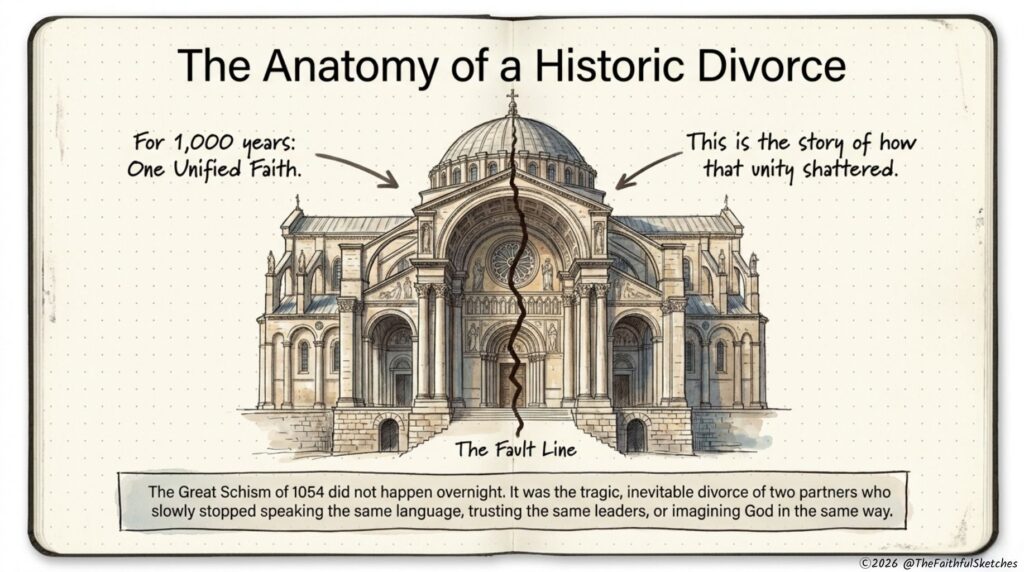
For nearly a thousand years, what we now call the Roman Catholic Church and the Eastern Orthodox Church were a single, unified body. One faith. One communion. One church.
So what could drive two branches of the same faith to become such bitter enemies? The answer involves explosive politics. A single forbidden word added to a creed, and a betrayal so deep its consequences still shape the world today.
The Great Schism of 1054 is one of the most significant events in the history of Christianity. And most people know almost nothing about what actually caused it.
This post traces not just when it happened, but why — following the political, cultural, theological, and deeply personal forces that tore the ancient church in two.
Chapter 1: The Cracks in the Foundation
To understand 1054, you have to go back centuries. The roots of the Great Schism reach into the very structure of the late Roman Empire itself.
The Two Capitals
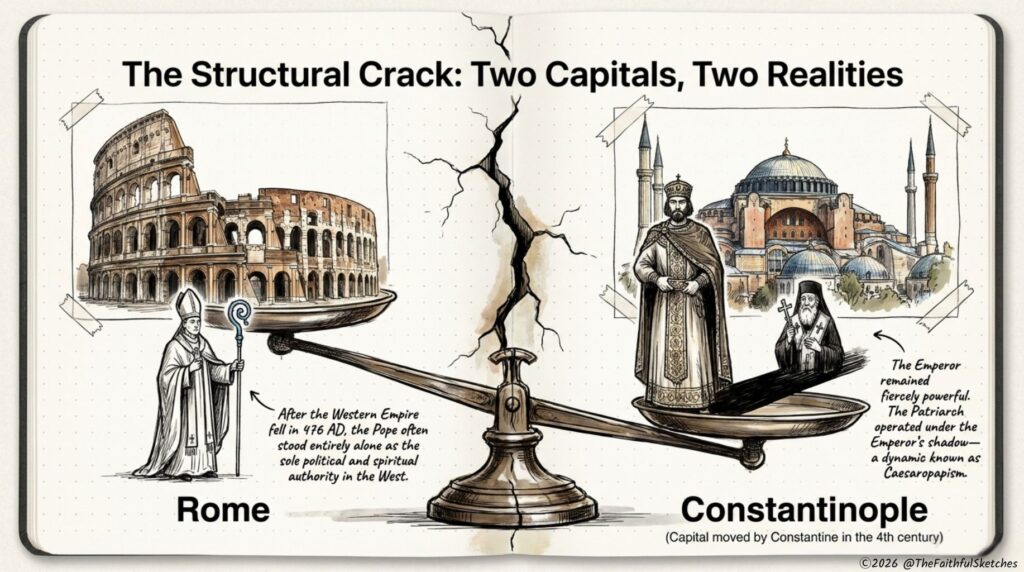
Emperor Constantine moved the imperial capital to Constantinople, modern Istanbul, in the 4th century. This decision created a powerful new center in the Greek-speaking East while Rome remained the historic heart of the Latin-speaking West. After the fall of the Western Roman Empire in 476 AD, the Pope in Rome frequently stood alone as a political authority in the West. In the East, meanwhile, the Emperor in Constantinople remained dominant, and the Patriarch of Constantinople operated under the emperor’s considerable shadow — a political arrangement historians call Caesaropapism.
Two capitals. Two power structures. Two increasingly separate worlds.
Cultural and Linguistic Drift
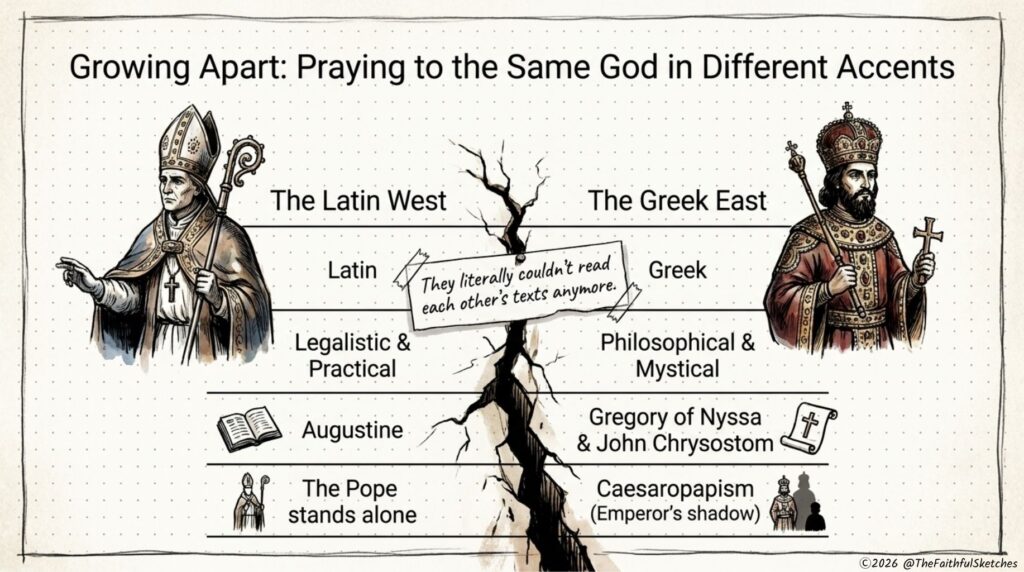
The West spoke Latin, read Latin theology through figures like Augustine, and developed a legalistic and practical theological mind. The East spoke Greek, read the Greek Fathers including Gregory of Nyssa and John Chrysostom, and approached faith with a more philosophical and mystical sensibility.
Over centuries, East and West were slowly becoming two different civilizations, praying to the same God but thinking about faith in entirely different registers. Consequently, what felt like orthodox tradition in one half of the church felt like innovation or error in the other.
Growing Rivalry Over Authority
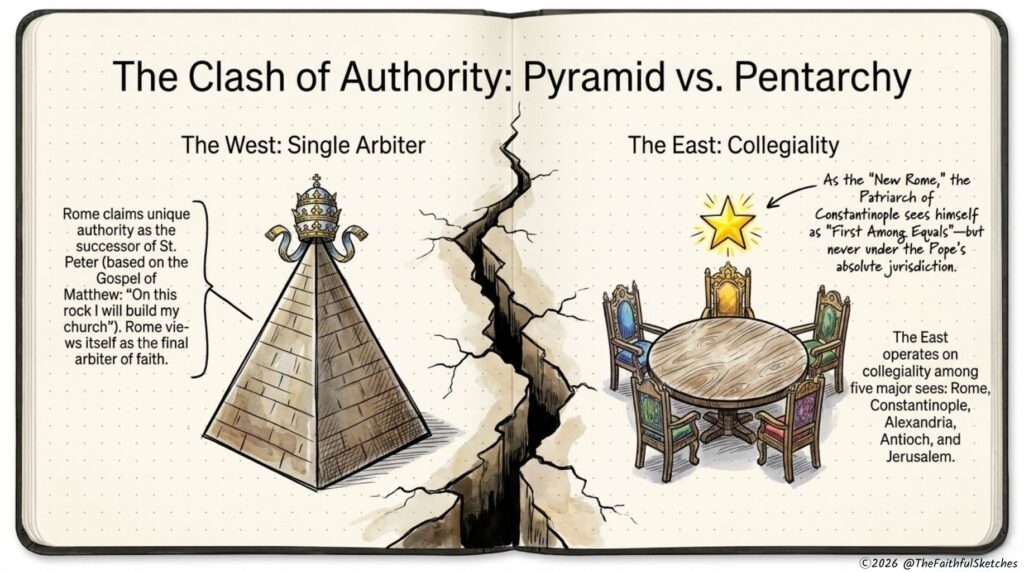
The Pope, as Bishop of Rome, claimed unique authority as the successor of Saint Peter, grounding that claim in Matthew 16:18: “You are Peter, and on this rock I will build my church.” Rome increasingly positioned itself as the final arbiter of Christian faith and practice for the entire church.
The East operated on a fundamentally different model. They recognized a Pentarchy — the shared leadership of five major sees: Rome, Constantinople, Alexandria, Antioch, and Jerusalem. The Patriarch of Constantinople, as head of the “New Rome,” considered himself first among equals, but not under the Pope’s jurisdiction.
That tension between Roman supremacy and Eastern collegiality was a slow-burning fuse. Eventually, something would light it.
Chapter 2: The Fracture Widens
With centuries of mistrust as the foundation, specific disputes provided the sparks.
The Filioque Controversy
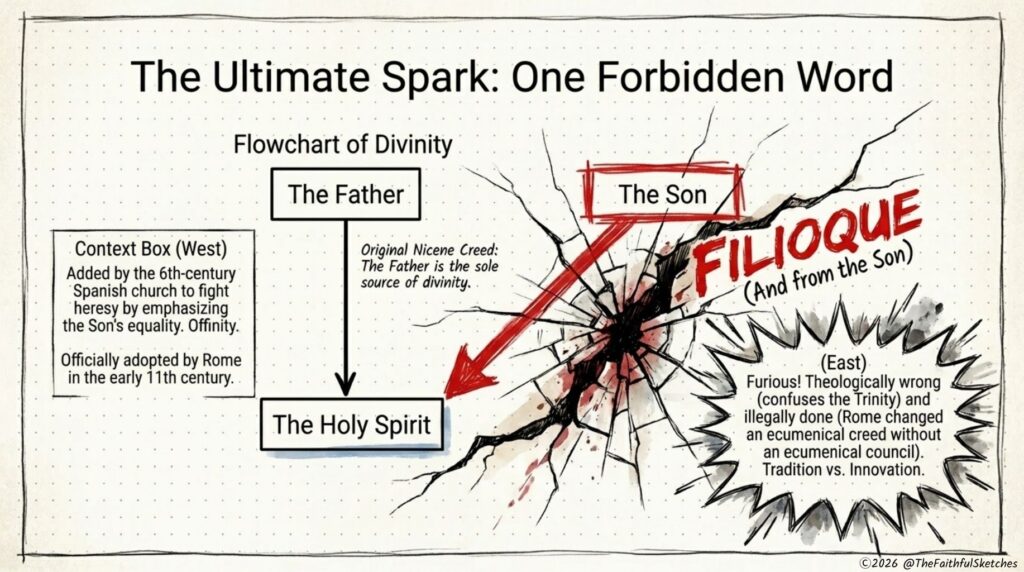
The biggest theological conflict centered on a single Latin word: Filioque, pronounced “fill-ee-OH-kway,” meaning “and from the Son.”
The original Nicene Creed, which defined Trinitarian theology for the whole church, stated that the Holy Spirit “proceeds from the Father.” In the 6th century, the Spanish Church added “and from the Son” to clarify the Son’s equality with the Father against a local heresy. That addition gradually spread westward, and by the early 11th century Rome officially adopted it.
The East was furious on two distinct grounds. Theologically, they believed the addition confused the persons of the Trinity and undermined the Father’s unique role as the sole source of divinity. Procedurally, they argued that nobody possessed the authority to alter an ecumenical creed without convening a full ecumenical council of the entire church. This was not merely a doctrinal dispute. It was a direct conflict over authority, tradition, and who had the right to define Christian belief.
The Photian Schism
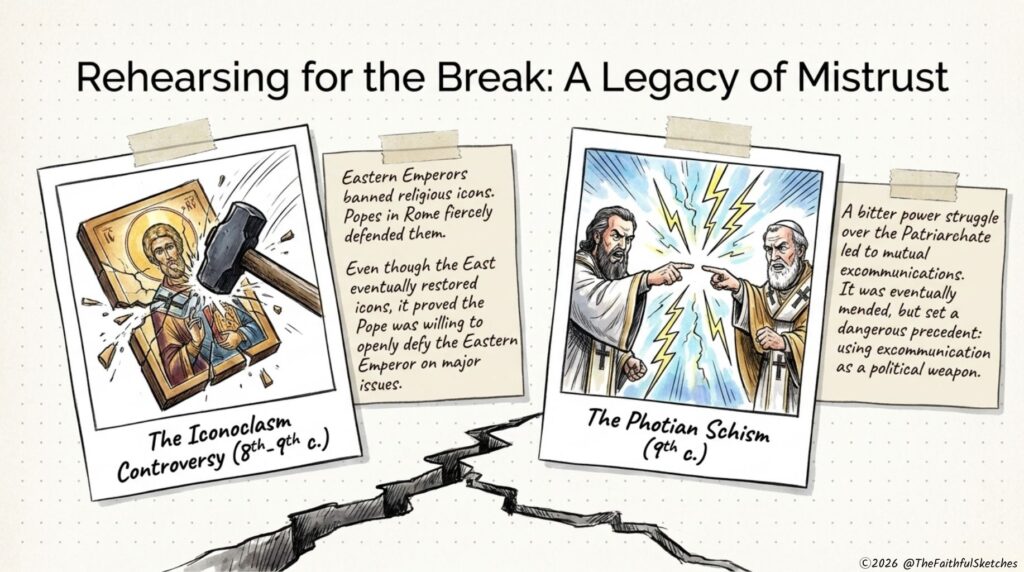
In the 9th century, a power struggle over the Patriarchate of Constantinople between Patriarch Photios and Pope Nicholas I produced mutual excommunications. Although the conflict was eventually resolved, it established a dangerous precedent: using excommunication as a political weapon. Furthermore, it deepened the personal animosity between East and West in ways that never fully healed.
The Iconoclasm Controversy
During the 8th and 9th centuries, Eastern Emperors banned religious icons, images of Christ and the saints, ordering their destruction across the empire. The Popes in Rome strongly opposed this policy and supported the use of icons throughout. Although the Eastern church eventually restored icons, the episode demonstrated the Pope openly defying the Eastern Emperor on a major religious question, straining relations further.
The Political Re-Alignment
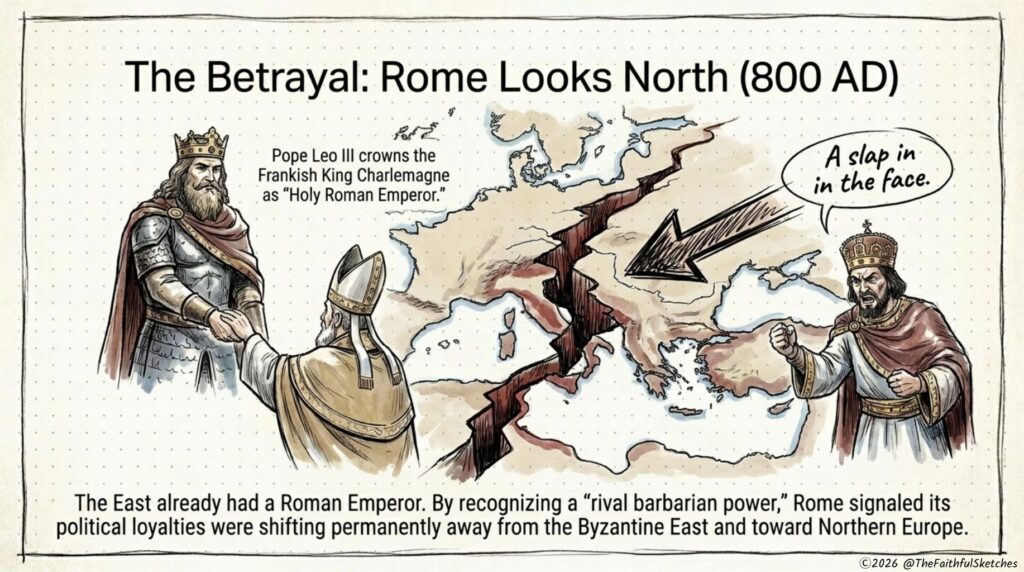
In 800 AD, Pope Leo III crowned Charlemagne, the Frankish king, as “Holy Roman Emperor.” To Constantinople, this was an open insult. There was already a Roman Emperor — in Constantinople. By recognizing a rival western power, Rome signaled clearly where its political loyalties were moving: away from the Byzantine East and toward the rising kingdoms of northern Europe.
Chapter 3: 1054 — The Final Break
By the mid-11th century, the relationship between Rome and Constantinople was hanging by a thread.
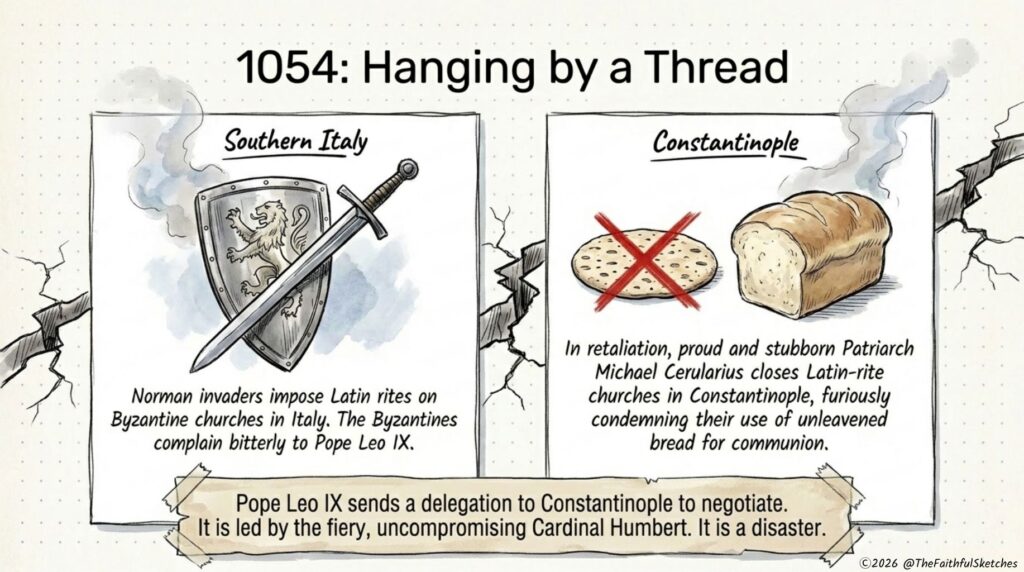
The immediate flashpoint was southern Italy. Norman invaders were imposing Latin liturgical rites on Byzantine churches in the region, and the Byzantines complained directly to Rome. Pope Leo IX responded by sending a delegation to Constantinople in 1054, led by Cardinal Humbert of Silva Candida, a fiery and uncompromising figure, to negotiate with Patriarch Michael I Cerularius.
The talks collapsed immediately. Cerularius was equally proud and equally stubborn. He had recently closed Latin-rite churches in Constantinople, accusing them of using unleavened bread for communion — yet another liturgical difference that had hardened into a symbol of deeper division.
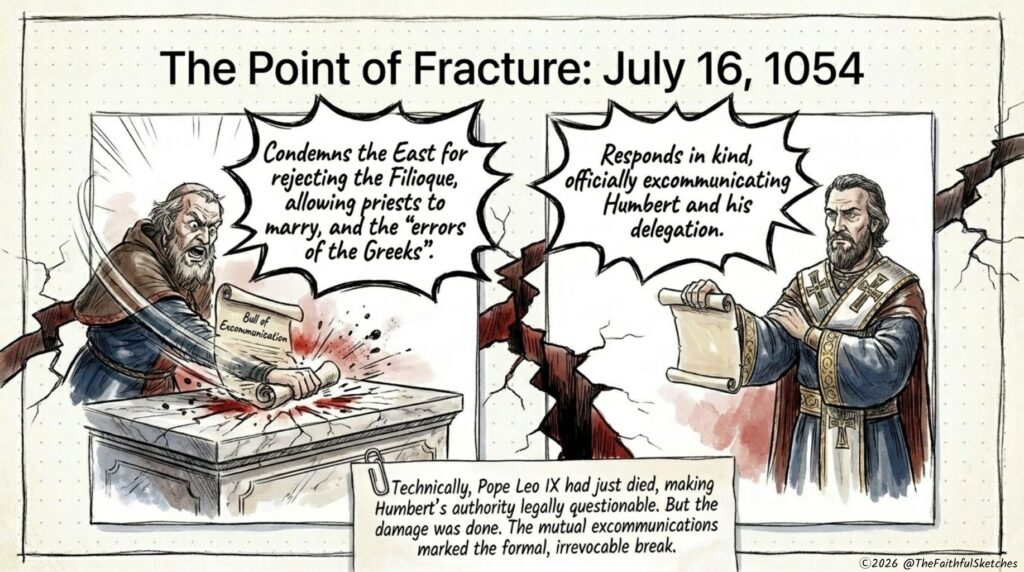
On July 16, 1054, Cardinal Humbert and his colleagues marched into the Hagia Sophia, the greatest church in Christendom, during a worship service. They placed a Bull of Excommunication on the high altar, formally excommunicating Patriarch Michael and his supporters. The Bull condemned the Eastern church for, among other charges, rejecting the Filioque, allowing priests to marry, and what it called the “errors of the Greeks.” It was the ultimate public humiliation.
Patriarch Michael responded in kind, excommunicating Humbert and his delegation. The mutual excommunications marked the formal and irrevocable break. Notably, the legal standing of Humbert’s action was already questionable since Pope Leo IX had died before the Bull was issued, leaving Humbert’s authority uncertain. Nevertheless, the damage was complete.
Chapter 4: Aftermath and Legacy
At first, many ordinary believers barely noticed. Trade continued. People interacted across the divide. However, the schism hardened into permanence with devastating speed.
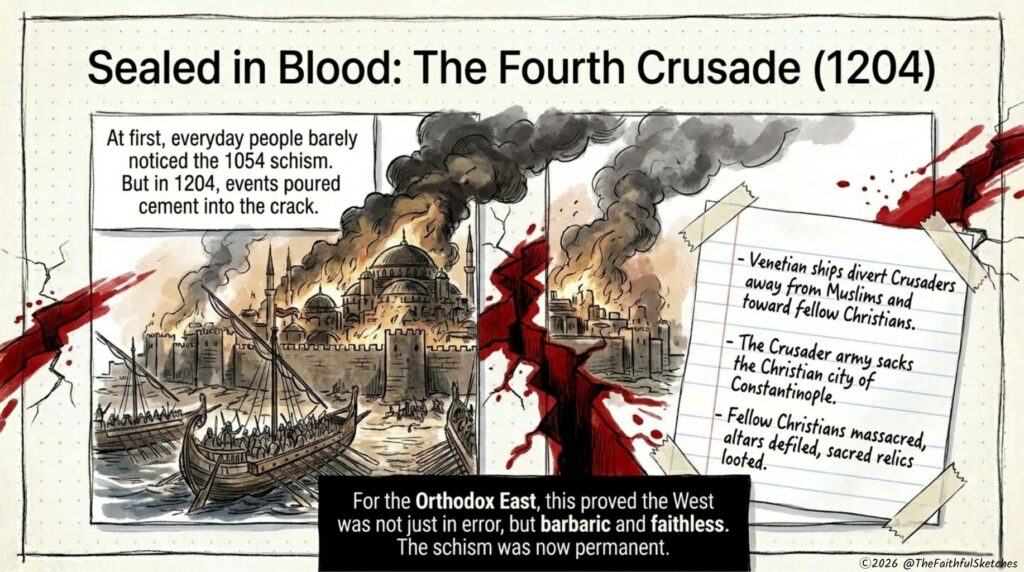
The Fourth Crusade: Sealing the Break With Blood
The most catastrophic event came in 1204, during the Fourth Crusade. Instead of fighting Muslims in the Holy Land, the Crusader army was diverted by Venetian political interests and sacked Constantinople, a Christian city. The Crusaders massacred fellow Christians, desecrated altars, and looted sacred relics. For the Orthodox East, this proved conclusively that the West was not merely theologically mistaken but barbaric and faithless. The Great Schism of 1054 was now sealed with blood and betrayal.
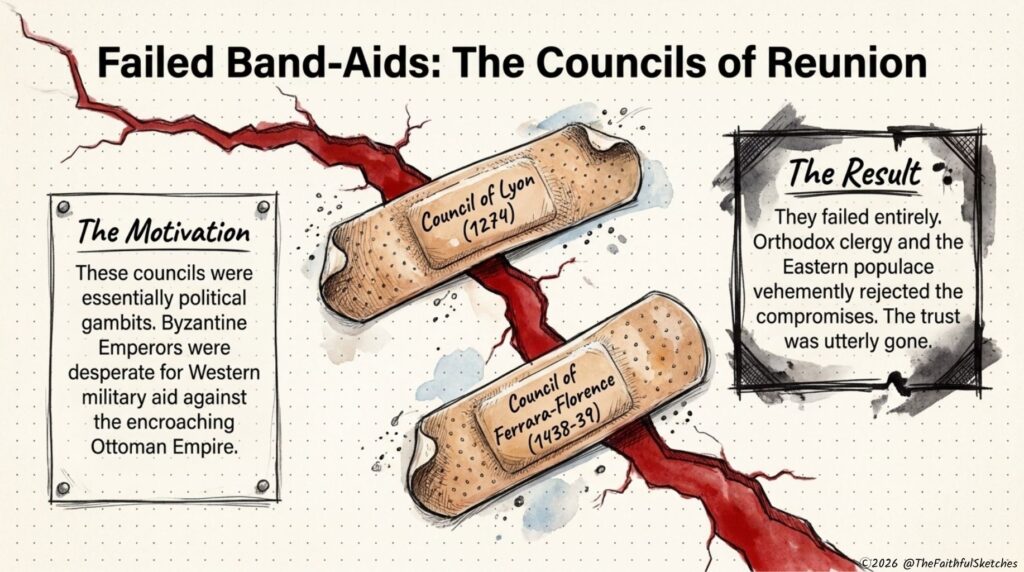
Failed Reunions
Subsequent attempts at reunion, including the Councils of Lyon in 1274 and Ferrara-Florence between 1438 and 1439, failed completely. Most reunion efforts were politically motivated, driven by Byzantine emperors desperate for western military aid against Ottoman expansion. The Orthodox clergy and people consistently rejected them as capitulations rather than genuine reconciliation.
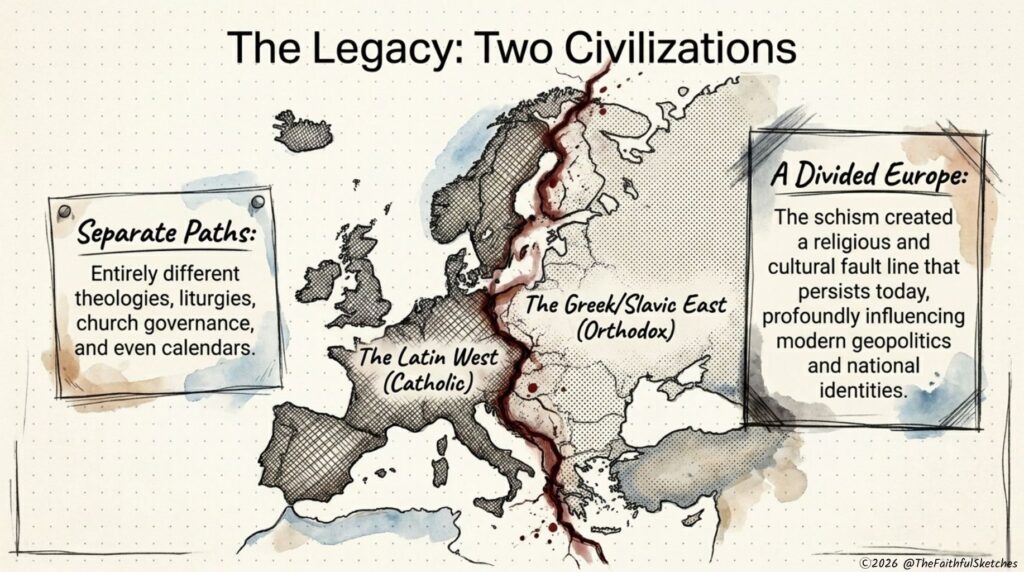
Two Christian Civilizations
The lasting results of the Great Schism of 1054 shaped the entire subsequent history of the Western world.
The split produced two distinct Christian civilizations: a Latin West centered on Rome, spreading through Europe and eventually into the Americas, and a Greek and Slavic East centered on Constantinople, spreading into Russia and the Balkans. These two traditions developed separate theologies, separate liturgies, separate models of church governance, and even separate calendars. The religious and cultural fault line the schism created continues to influence geopolitics, conflicts, and national identities to this day.
Conclusion: An Unhealed Wound
The Great Schism of 1054 was not caused by any single issue. It resulted from a perfect storm: centuries of cultural separation, political rivalry, competing models of church authority, and specific theological disputes culminating in the Filioque crisis. It was the tragic breakdown of two partners who had grown apart, developed different languages, different instincts, and ultimately lost the trust that made unity possible.
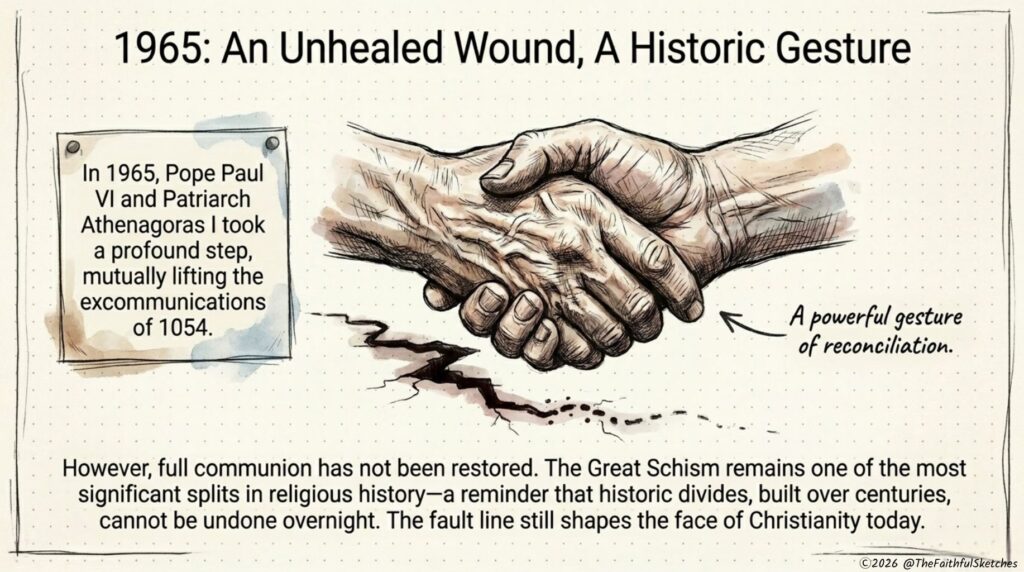
In 1965, Pope Paul VI and Patriarch Athenagoras I took a historic step, mutually lifting the excommunications of 1054 in a powerful gesture of reconciliation. Nevertheless, the schism itself remains. Full communion between the Roman Catholic and Eastern Orthodox Churches has not been restored.
The Great Schism teaches something that remains relevant far beyond church history: divisions rarely have simple causes. They build over time through an accumulating web of faith, power, culture, and human failure. Understanding that process is the first step toward taking reconciliation seriously.
What are your thoughts on the Great Schism? Leave a comment below.
To understand how these theological divisions connect to broader debates about church authority and biblical interpretation, read our post on Covenant Theology vs Dispensationalism: 5 Biblical Frameworks Every Christian Should Know.
For background on how the Catholic and Protestant traditions diverged further, see our post on Why Catholics, Orthodox, Ethiopian and Protestants Have Different Bibles.
Click Below to Download The Full PDF Summary Visual Guide:
*Free for personal use only. Please don’t resell or redistribute commercially.