
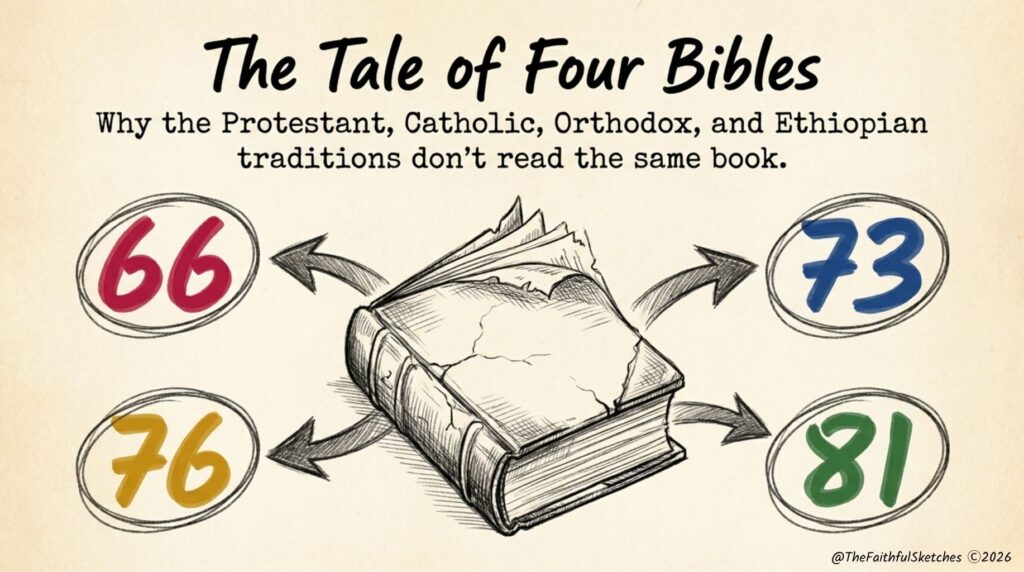
Most people assume every Christian reads the same Bible. But why do Christians have different Bibles? The answer goes back centuries. Protestant, Catholic, Orthodox and Ethiopian traditions each use a different Bible with a different number of books, and the story of how that happened is one of the most fascinating in religious history.
- The Protestant Bible has 66 books
- The Catholic Bible has 73 books
- The Eastern Orthodox Bible has 76 books
- The Ethiopian Bible has 81 books
So who decided what goes in? And why are some books left out?
Part 1: The Foundation: Why Do Christians Have Different Bibles?
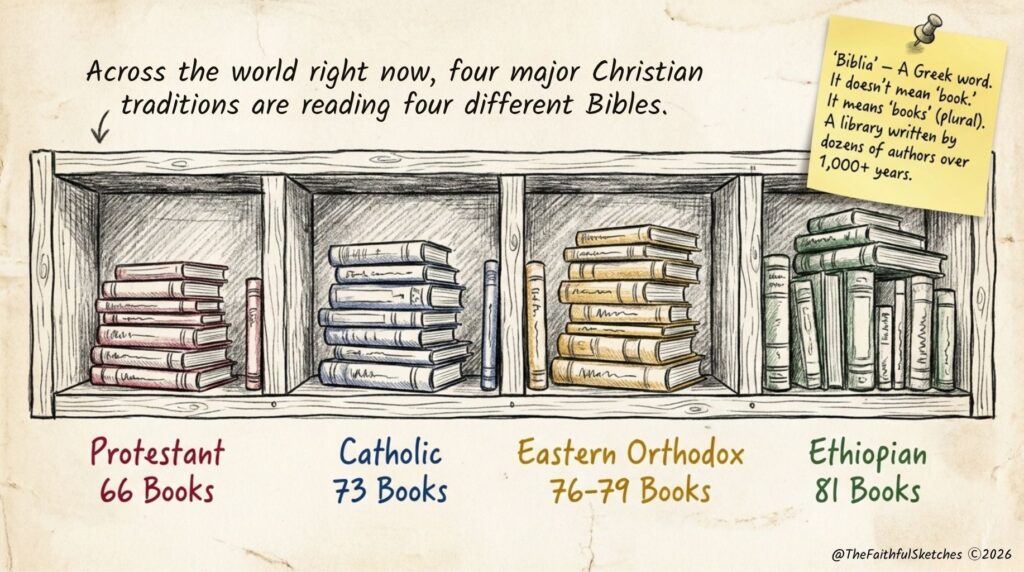
The word Bible comes from the Greek word biblia. It does not mean book. It means books, plural. The Bible was never written as one single text. It is a collection of dozens of individual writings produced across more than a thousand years by many different authors.
The process of deciding which texts belong in the collection is called canonization, from the Greek word kanon, meaning a measuring rod or rule. It was not a quick or clean decision. It was messy, political, and took centuries. Different communities in Ethiopia, Rome, Constantinople, and later Protestant Europe each reached their own conclusions.
Did You Know? Many people believe the Council of Nicaea in 325 AD decided which books go in the Bible. This is one of the most repeated myths in history, popularized by The Da Vinci Code. The Council of Nicaea was actually called to settle a debate about the nature of Jesus Christ, not the biblical canon.
Part 2: The Protestant Bible — 66 Books
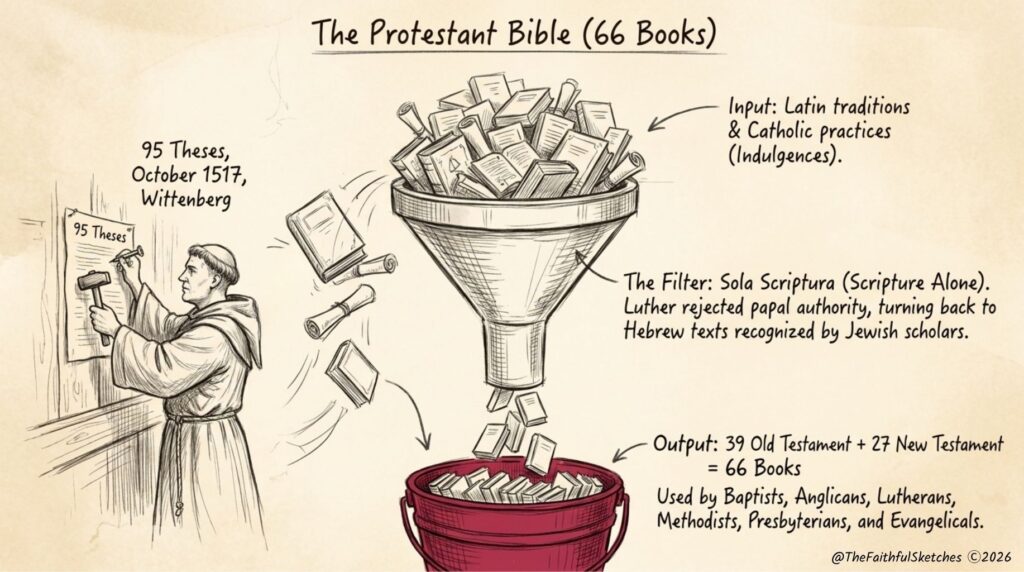
The Protestant Bible is used by Baptists, Anglicans, Lutherans, Methodists, Presbyterians, Evangelicals, Pentecostals, and the majority of Protestant denominations worldwide. In one crucial sense, it is the newest of the four.
In October 1517, a German monk named Martin Luther nailed his 95 Theses to the door of a church in Wittenberg. His challenge to the Catholic Church went to the root question of authority: who decides what is true? The Pope and the church, or the Bible? Luther’s answer was Scripture alone, or in Latin, Sola Scriptura.
But, that raised an immediate question: which Bible?
Luther went back to the Hebrew scriptures, the texts that Jewish scholars themselves recognized as authoritative. Those texts did not include the Deuterocanonical books, so Luther moved those seven books out of the Old Testament entirely. Later Protestant traditions removed them completely.
The result: a Protestant Old Testament of 39 books and a New Testament of 27, for a total of 66.
Did You Know? Luther’s protest might have faded quickly, but one thing changed everything. The printing press, invented by Johannes Gutenberg around 1440, allowed Luther’s ideas to spread faster than the church could react. Within two weeks his theses were across Germany. Within two months they had reached all of Europe. The Reformation became the first viral media event in history.
Part 3: The Catholic Bible — 73 Books
The Catholic Bible contains 73 books, seven more than the Protestant one. Those seven books are called the Deuterocanon, a word meaning second canon in Greek. Protestants sometimes call them the Apocrypha, meaning hidden things. Catholics consider these books fully canonical.
The seven additional books are:
- Tobit
- Judith
- 1 Maccabees
- 2 Maccabees
- The Book of Wisdom
- Sirach (also called Ecclesiasticus)
- Baruch
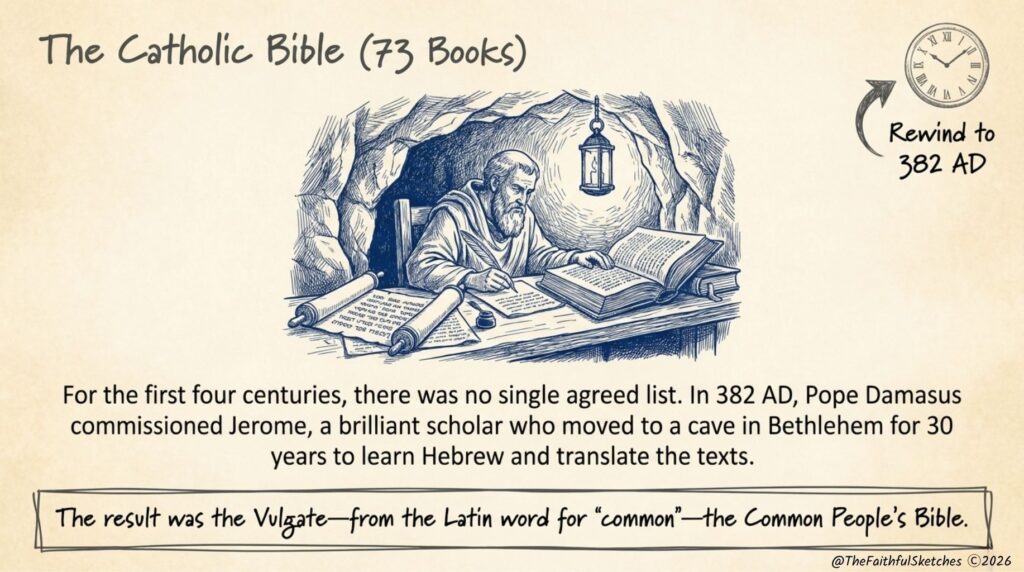
In 382 AD, Pope Damasus commissioned a scholar named Jerome to produce a single authoritative Latin translation of the Bible. Jerome learned Hebrew specifically for this project and spent 30 years in Bethlehem completing it. His translation became known as the Vulgate, from the Latin word for common, meaning the people’s Bible.
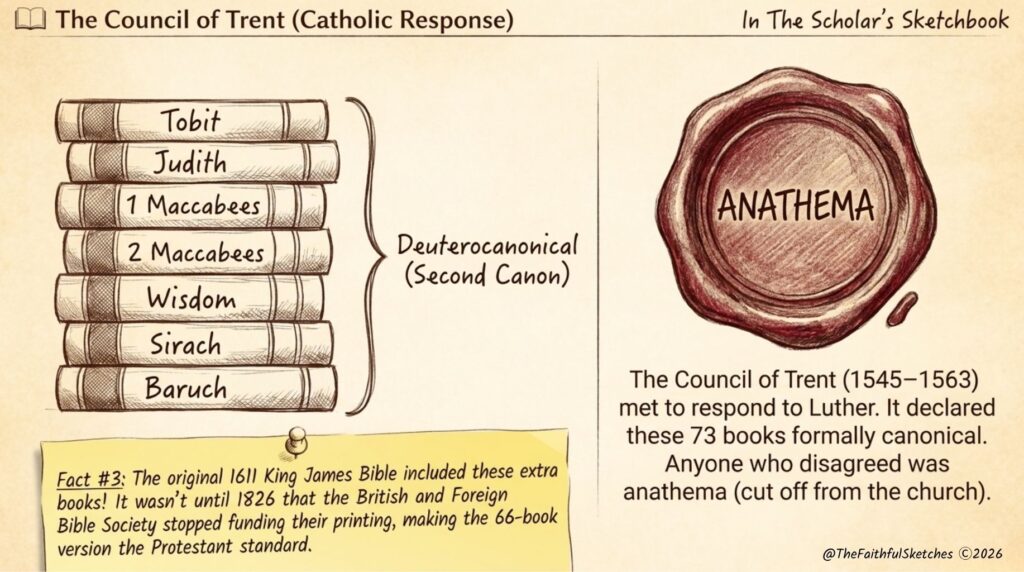
The Council of Trent, which met from 1545 to 1563, formally defined the Catholic canon in response to the Reformation. It issued a list of 73 books and declared these and only these as the canonical scriptures of the Catholic Church.
Did You Know? The King James Bible, published in 1611, originally included the Apocrypha between the Old and New Testaments. In 1826, the British and Foreign Bible Society stopped funding editions that included it. If you own a King James Bible published before the 19th century, it likely contains books that modern Protestant Bibles do not.
Part 4: The Eastern Orthodox Bible — 76 to 79 Books
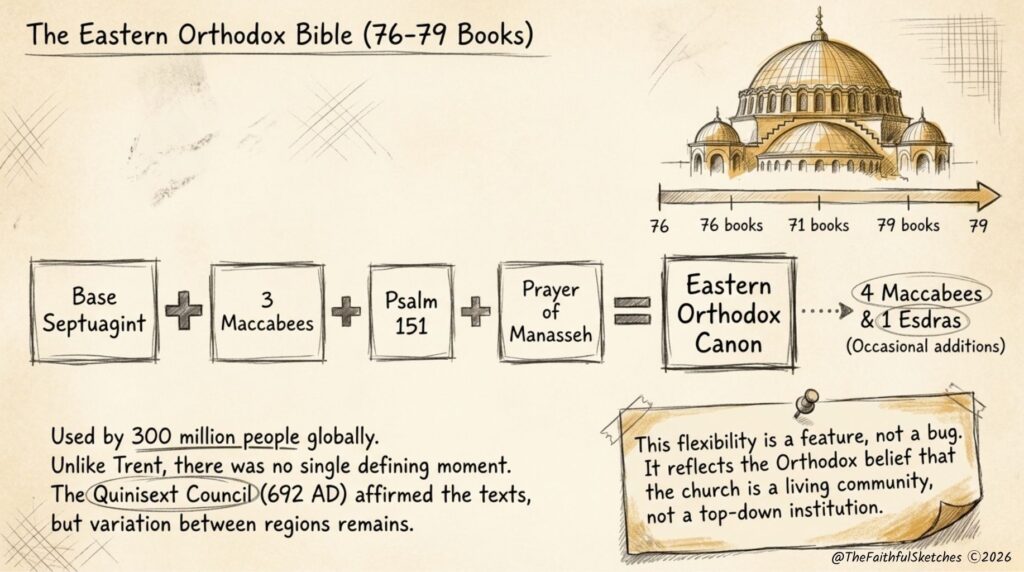
Around 300 million people belong to Eastern Orthodox churches, making them the third largest Christian grouping in the world after Catholics and Protestants.
The Orthodox Bible is based on the Septuagint, the same Greek translation that influenced the Catholic Bible. This means it includes the Deuterocanonical books that Protestants removed, However, the Orthodox Bible goes slightly further. Most Orthodox churches also include:
- 3 Maccabees
- Psalm 151, a psalm not found in the Hebrew Bible
- The Prayer of Manasseh
The exact number of books varies slightly between Greek, Russian, Serbian, Romanian and other Orthodox traditions, which is why the canon is listed as 76 to 79 books rather than a fixed number.
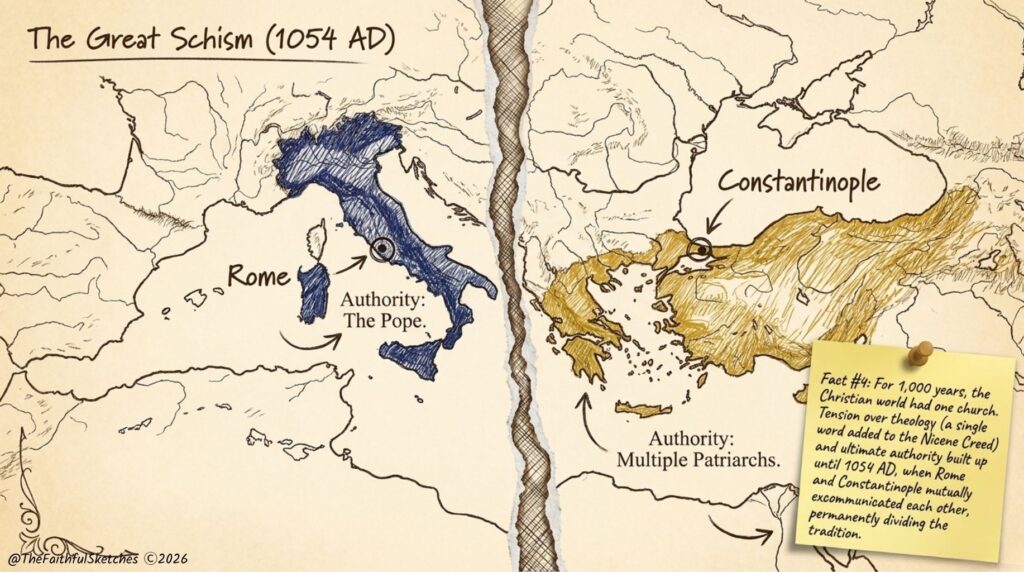
In 1054 AD, the Great Schism permanently divided the Christian world. The Catholic Church in Rome and the Eastern Orthodox Church in Constantinople excommunicated each other after centuries of disagreement over theology and authority. That split is why these two traditions, while similar in many ways, developed separately.
Did You Know? The split between Rome and Constantinople built up over centuries. They disagreed on theology, including a single word added to the Nicene Creed, and on whether authority belonged to the Pope alone or to multiple Patriarchs. Both sides excommunicated each other in 1054, creating the permanent division we see today.
Part 5: The Ethiopian Bible — 81 Books
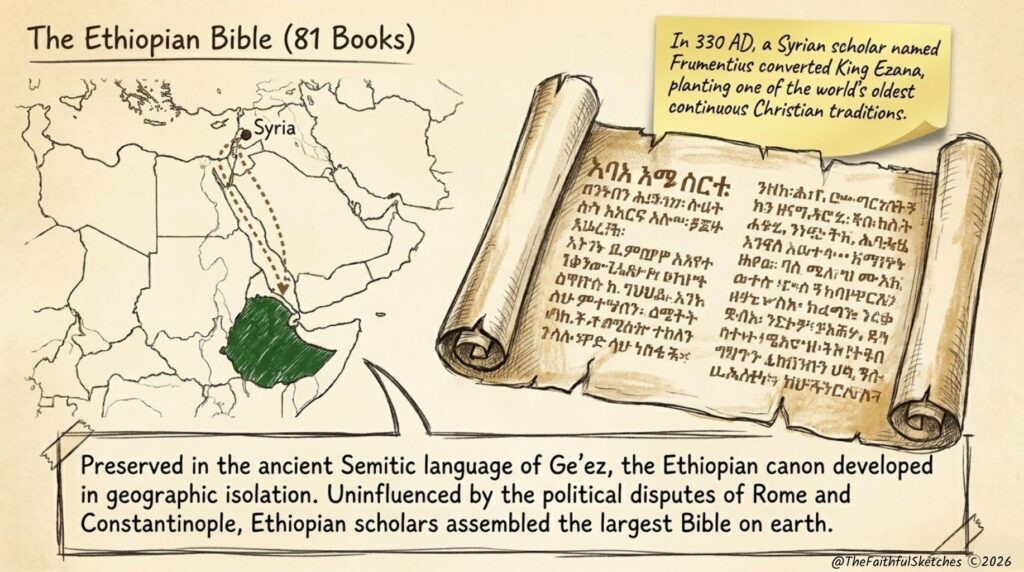
The Ethiopian Orthodox Tewahedo Church has one of the oldest continuous Christian traditions in the world. Christianity arrived in Ethiopia around 330 AD when a Syrian scholar named Frumentius converted the Ethiopian king Ezana and became the first bishop of the Ethiopian church.
Their Bible contains 81 books, 15 more than the Protestant Bible and 8 more than the Catholic one. Some of these books are extraordinary and virtually unknown outside of Ethiopia:
- The Book of Enoch
- The Book of Jubilees
- The Shepherd of Hermas
- 1 to 3 Maccabees (Ethiopian versions)
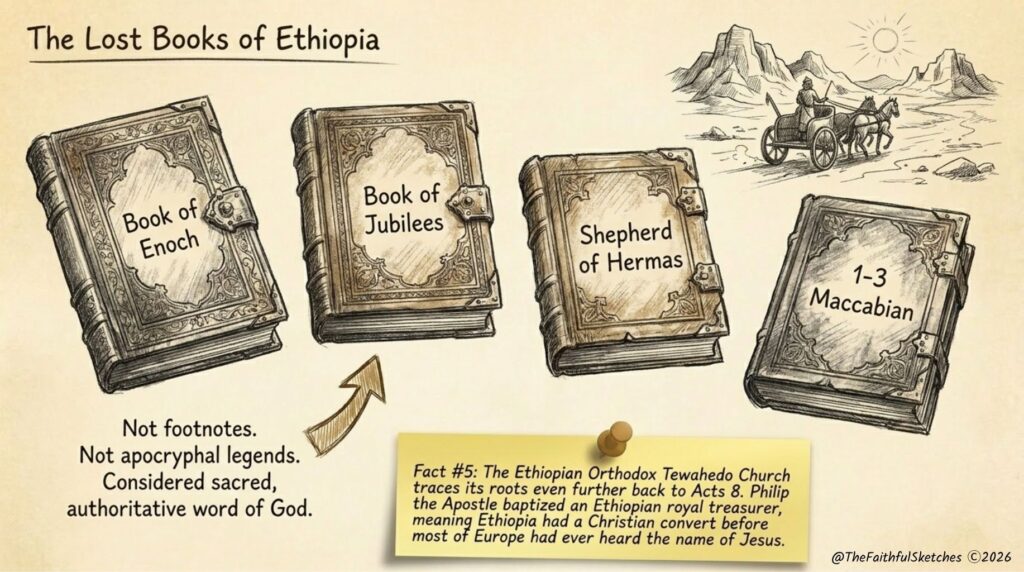
For Ethiopian Christians, these are not footnotes or legends. They are Scripture, sacred and authoritative.
Furthermore, the Ethiopian canon was not assembled carelessly. It was the product of centuries of scholarship and debate within a church that developed largely in geographical isolation from Rome and Constantinople, free from the political disputes that shaped the western church.
Did You Know? The Ethiopian Orthodox Church traces its spiritual roots to Acts chapter 8, which describes Philip the Apostle baptizing an Ethiopian official who was treasurer to the queen of Ethiopia. If that account is historical, Ethiopia had a Christian convert before most of Europe had ever heard the name of Jesus.
What This All Means
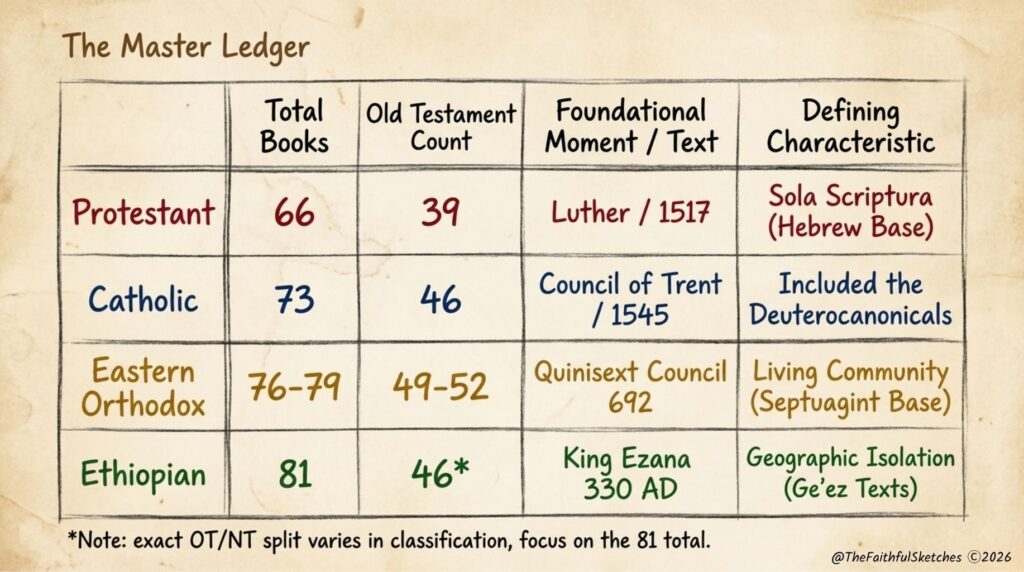
Despite their differences, all four traditions share the same New Testament of 27 books. The Gospels, the letters of Paul, Acts, and Revelation are consistent across all four. Every difference is in the Old Testament.
The reason goes back to a tension that existed from the very beginning of Christianity: which version of the Jewish scriptures should Christians use? The Hebrew Bible used in Palestine, or the Septuagint, the Greek translation that included more books and was used by Jews throughout the wider Greek-speaking world?
Did You Know? Many Old Testament quotes in the New Testament match the Greek Septuagint, not the Hebrew text. This strongly suggests that the earliest Christians, including the apostles themselves, were using the Greek version of scripture.
Every one of these Bibles is sacred to millions of people. Each one tells us something different about how our ancestors understood God and preserved their faith through centuries of history.
Which Bible do you read? Did anything here surprise you? Let us know in the comments below.
Click Below to Download Your Free Visual PDF Summary Guide:
*Free for personal use only. Please don’t resell or redistribute commercially.
Good Work!