
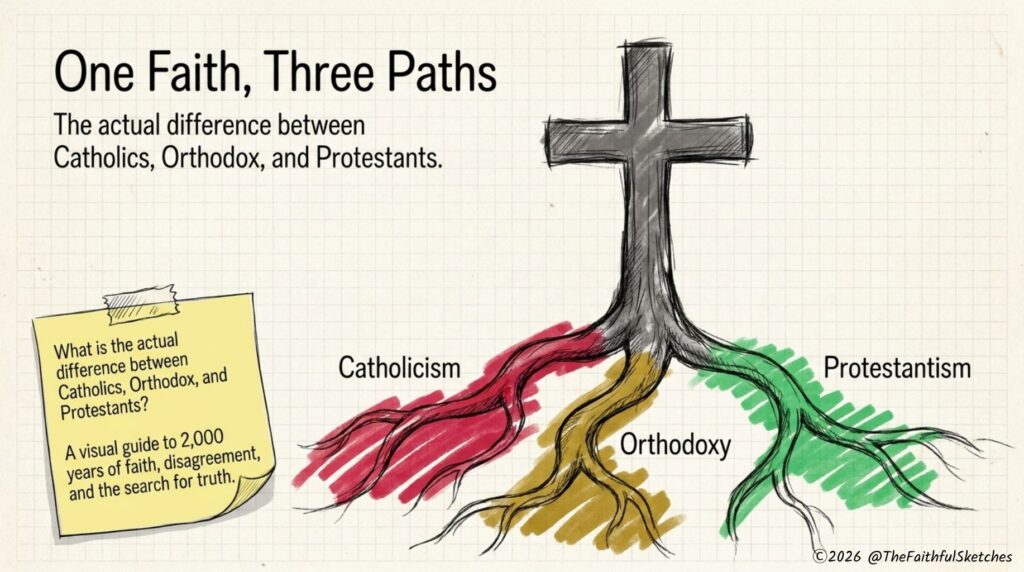
For the first thousand years, Christianity was one united church. Then a disagreement over authority and a single line in a creed began to pull that unity apart. Five hundred years later, another conflict shattered the West again.
Today there are three major branches of Christianity that all follow Jesus yet answer the most fundamental questions very differently. How did that happen, and why does it still matter?
Part 1: The First Thousand Years
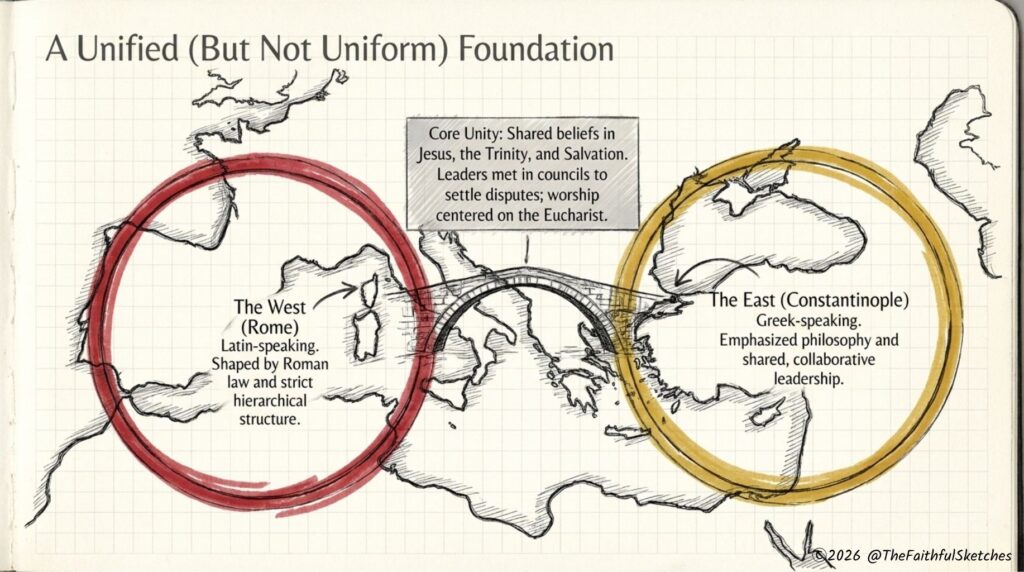
For a thousand years Christianity was one united church. Today the Catholic, Orthodox and Protestant differences divide over three billion believers. This post examines the key moments, theological splits, and contrasting beliefs that created three distinct Christian traditions from one shared faith.
But unity on the surface did not mean uniformity underneath.
The western part of the church developed in a Latin-speaking world shaped by Roman law and structure. The eastern part grew in a Greek-speaking world that emphasised philosophy and shared leadership. Over time, these differences began to affect how Christians understood authority, theology, and worship. Eventually, those differences led to the first major split.
Part 2: The Day the Church Split in Two
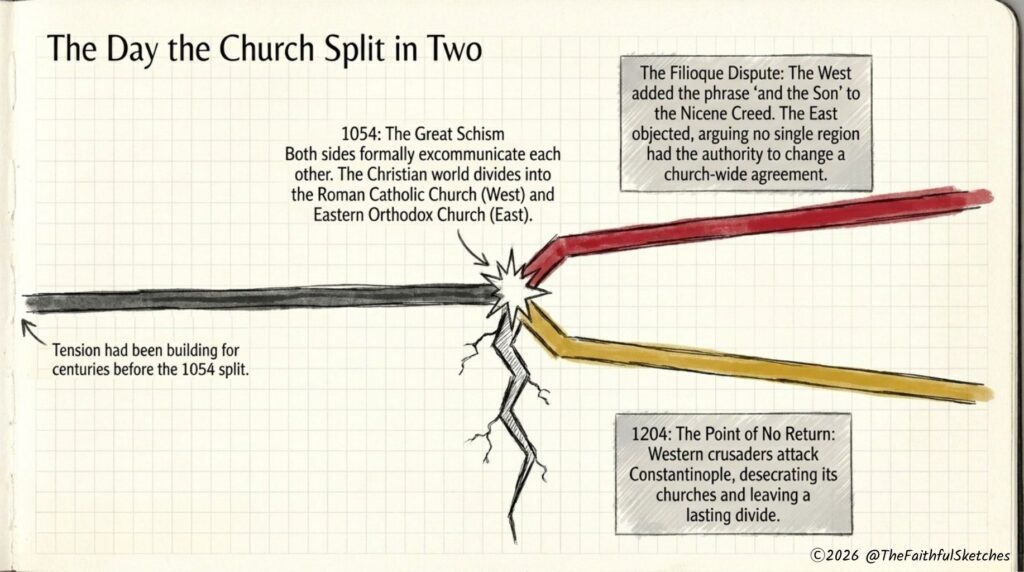
In 1054, the Christian world formally divided into what we now call the Roman Catholic Church in the West and the Eastern Orthodox Church in the East.
At the centre of this split was one decisive question: who has the final authority in the church?
In the West, the Pope as bishop of Rome claimed universal authority over all Christians. In the East, church leaders rejected that claim and held that authority should remain shared among bishops meeting in councils.
At the same time, a theological dispute intensified the conflict. The western church added the word filioque, meaning “and the Son,” to the Nicene Creed. The eastern church objected, arguing that no single region had the right to change a statement agreed upon by the whole church.
Tensions escalated until both sides excommunicated each other. The division became far deeper in 1204 when Western crusaders attacked Constantinople and desecrated its churches. That event left a wound that still affects relations between the two traditions today.
Did You Know? The split wasn’t sudden. 1054 marks a key moment, but tension had been building for centuries before that date.
Part 3: East Meets West at the Altar
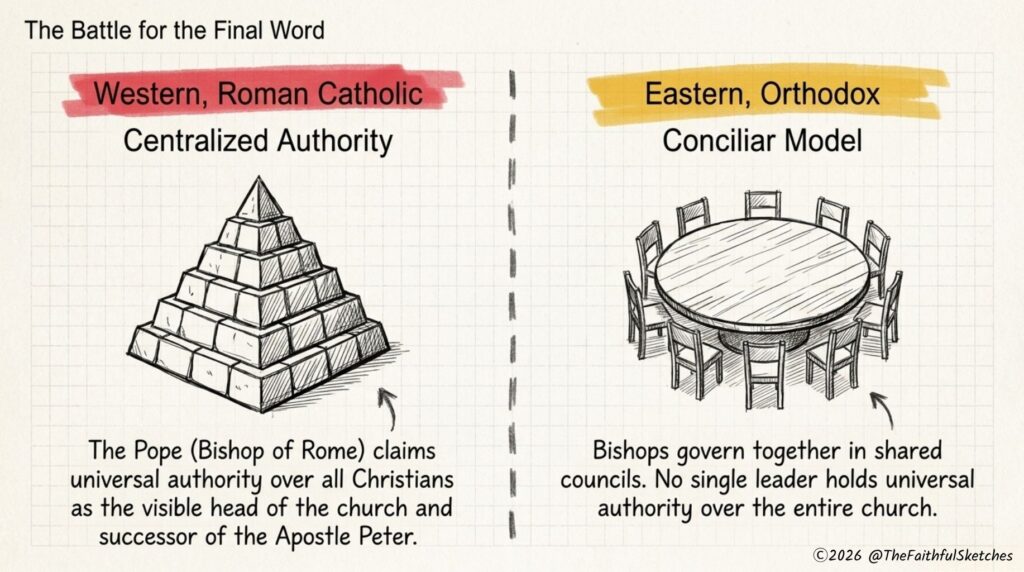
Even though Catholics and Orthodox Christians share many beliefs, their differences become clear when you look at authority, salvation, and worship.
Authority: In the Catholic Church, authority is centralised in the Pope, who is seen as the successor of the Apostle Peter and the visible head of the church. The Orthodox Church follows a conciliar model where bishops govern together and no single leader holds universal authority.
Salvation: In Western theology, sin is often described in legal terms, focusing on guilt and the need for forgiveness. In Eastern theology, sin is more often understood as a sickness, and salvation is seen as a process of healing and transformation, commonly described as theosis, or becoming more like God.
Worship: Catholic liturgy is structured and globally consistent. Orthodox worship emphasises continuity with ancient practices, using icons, incense, and chanting to create a strong sense of reverence and mystery.
Both traditions believe that the Eucharist truly becomes the body and blood of Christ. Catholics define this change precisely as transubstantiation, while the Orthodox accept it as a mystery without attempting to explain how it occurs.
Did You Know? Many elements of Orthodox worship today are very close to early Christian worship practices. The centralised structure of the Catholic Church, meanwhile, makes it possible to maintain consistent teaching across the globe.
Part 4: The West Splits Again
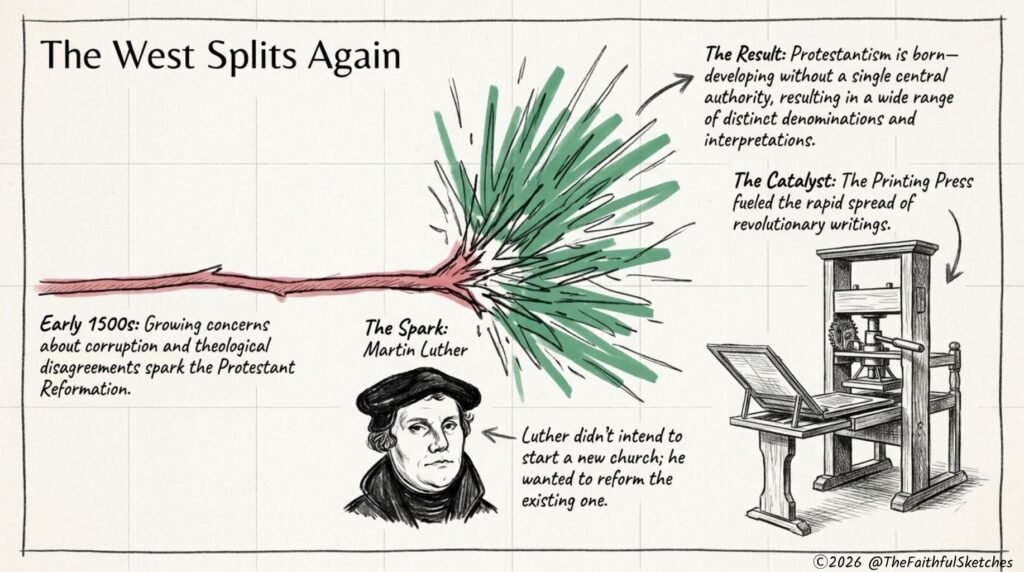
In the early 1500s, growing concerns about corruption and theological disagreements led to the Protestant Reformation. A central figure was Martin Luther, who challenged certain practices of the Catholic Church. What began as a call for reform quickly became a break.
The core issue shifted from who leads the church to what defines truth.
Protestant reformers argued for Sola Scriptura, meaning Scripture alone is the highest authority for Christian belief and practice, rather than Scripture together with church tradition. This also reshaped the understanding of salvation. Many Protestant traditions emphasised Sola Fide, teaching that a person is justified by faith alone rather than through a combination of faith, works, and sacramental life.
Another major shift was the idea that every believer has direct access to God without needing a priest as a mediator, often described as the priesthood of all believers.
As the movement spread, it led to the formation of many different denominations. Unlike the Catholic and Orthodox churches, Protestantism developed without a single central authority, resulting in a wide range of interpretations and practices across hundreds of denominations worldwide.
Did You Know? Martin Luther did not intend to start a new church. He wanted to reform the existing one. His writings spread rapidly because of the printing press, something earlier reformers never had access to.
Part 5: One Faith, Three Paths
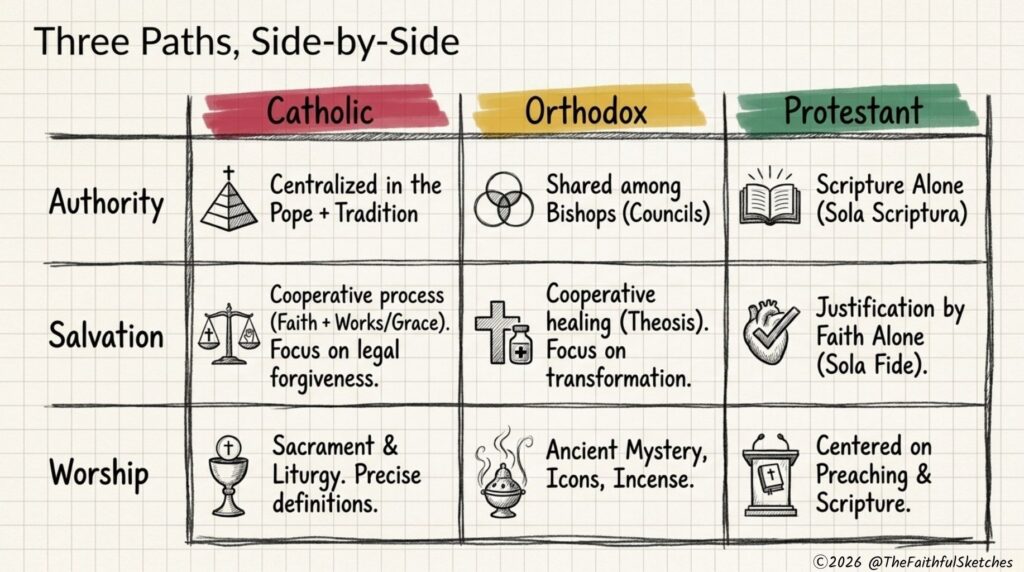
At a high level, the differences between these three traditions can be understood through three areas:
Authority: Catholicism maintains a centralised authority in the Pope. Orthodoxy emphasises shared leadership among bishops. Protestantism places primary authority in Scripture alone, with significant weight given to personal faith and interpretation.
Salvation: Catholic and Orthodox traditions generally teach a cooperative process involving both God’s grace and human response. Many Protestant traditions emphasise justification by faith alone as the primary basis of salvation.
Worship: Catholic and Orthodox services are centred on sacrament and liturgy. Many Protestant services centre on preaching and Scripture, with less emphasis on ritual and ceremony.
Why This Story Matters
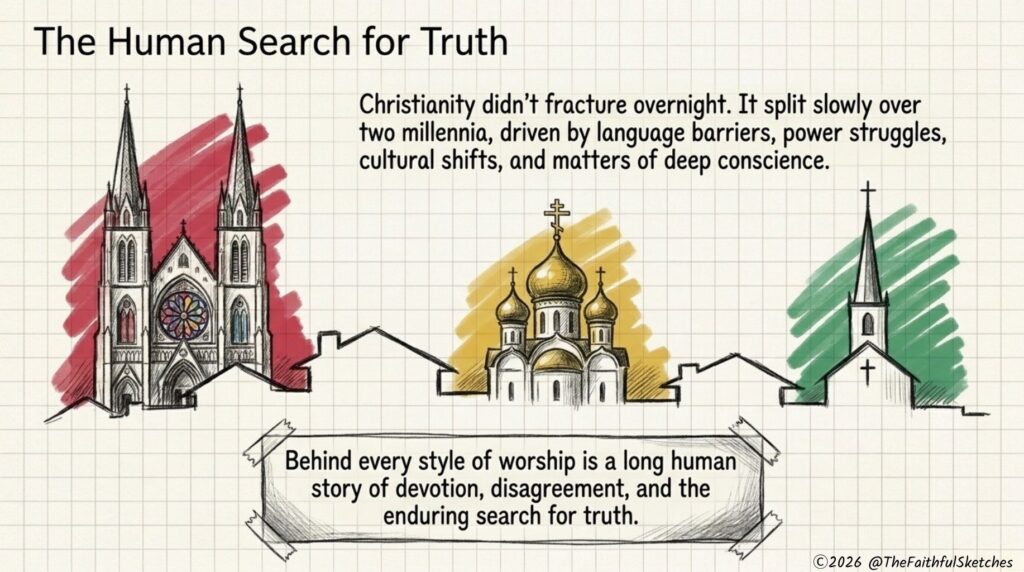
Understanding these differences is not about choosing sides. It is about understanding how we got here.
Christianity did not split overnight. It fractured slowly through language, power, culture, and conscience. Those fractures still shape how hundreds of millions of people experience God today.
The next time you walk past a cathedral, an Orthodox church, or a Protestant gathering, you will know that behind every style of worship is a long human story of faith, disagreement, devotion, and the search for truth.
That story is still being written.
Which tradition do you come from? Is there a specific denomination you would like us to explore in depth? Let me know in the comments below.
Click Below to Download The Full PDF Summary Guide:
*Free for personal use only. Please don’t resell or redistribute commercially.