
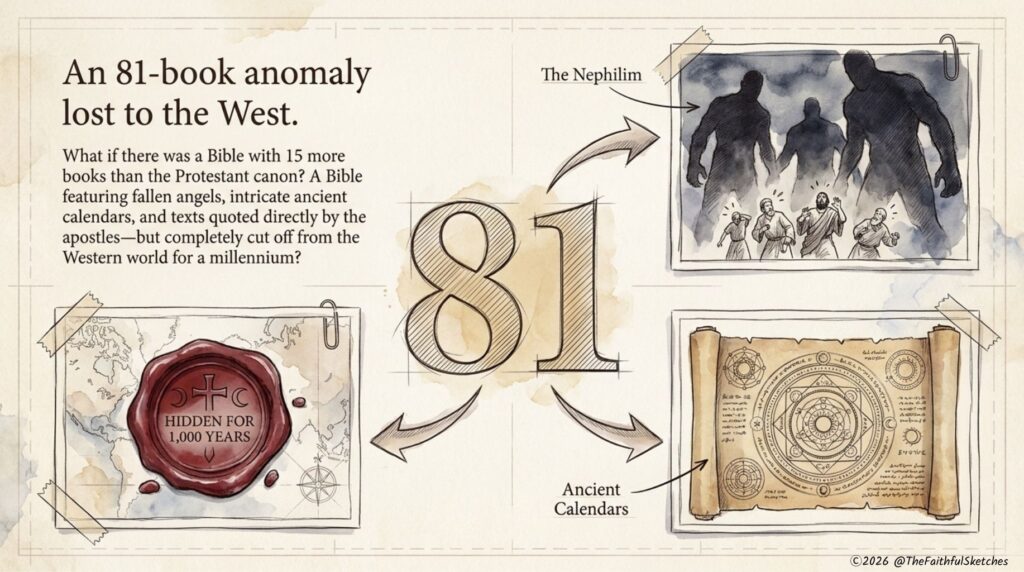
The Ethiopian Bible contains 81 books — 15 more than the standard Protestant Bible. Learn what’s in it, why those books disappeared from the West, and what makes this 1,600-year-old tradition unique.
Most people grow up knowing one Bible. 66 books if you’re Protestant. 73 if you’re Catholic. But there’s a third version — one that’s been read continuously for over 1,600 years — that contains 81 books.
This is the Ethiopian Bible. It’s the largest Christian biblical canon on Earth. It includes texts like the Book of Enoch, the Book of Jubilees, and the Meqabyan books that exist nowhere else in Christianity. And it belongs to a church that was Christian before most of Europe.
Here’s what it contains, how it got here, and why those extra books disappeared from your Bible.
Ethiopia Was Christian Before Rome
To understand the Ethiopian Bible, you need to understand Ethiopian Christianity — and it starts much earlier than most people expect.
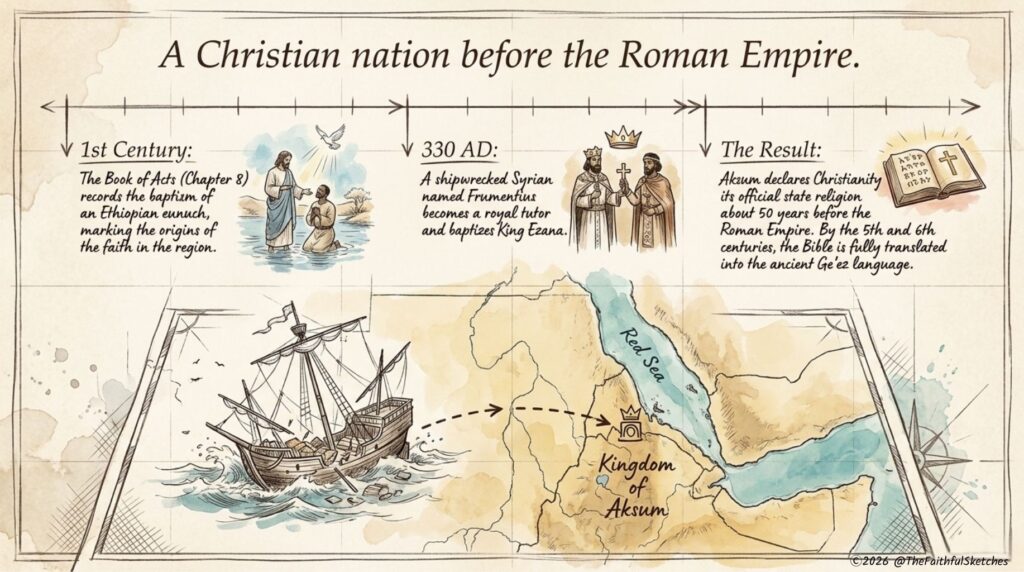
The Kingdom of Aksum, located in modern-day Ethiopia and Eritrea, was one of the great civilizations of the ancient world. It was a trading empire connecting Africa, Arabia, and the Mediterranean.
The Book of Acts (chapter 8) describes an Ethiopian official — a eunuch serving the Queen of Ethiopia — who was baptized by Philip the Evangelist. Ethiopian tradition holds that this man returned home and spread the Gospel in the 1st century AD.
The decisive moment came around 330 AD. A young man named Frumentius was shipwrecked on the Eritrean coast and taken to the royal court in Aksum. He became tutor to the young prince Ezana. When Ezana became king, Frumentius baptized him, and King Ezana declared Christianity the official state religion of Aksum.
That was roughly 50 years before the Roman Empire made the same declaration.
While Europe was still worshipping pagan gods, the Ethiopian highlands were building churches and translating Scripture into Ge’ez, the ancient language of Aksum. Scholars believe the Ethiopian biblical canon was finalized sometime in the 5th or 6th century AD. That translation has been the liturgical Bible of the Ethiopian church ever since.
Why the Ethiopian Church Split from the West
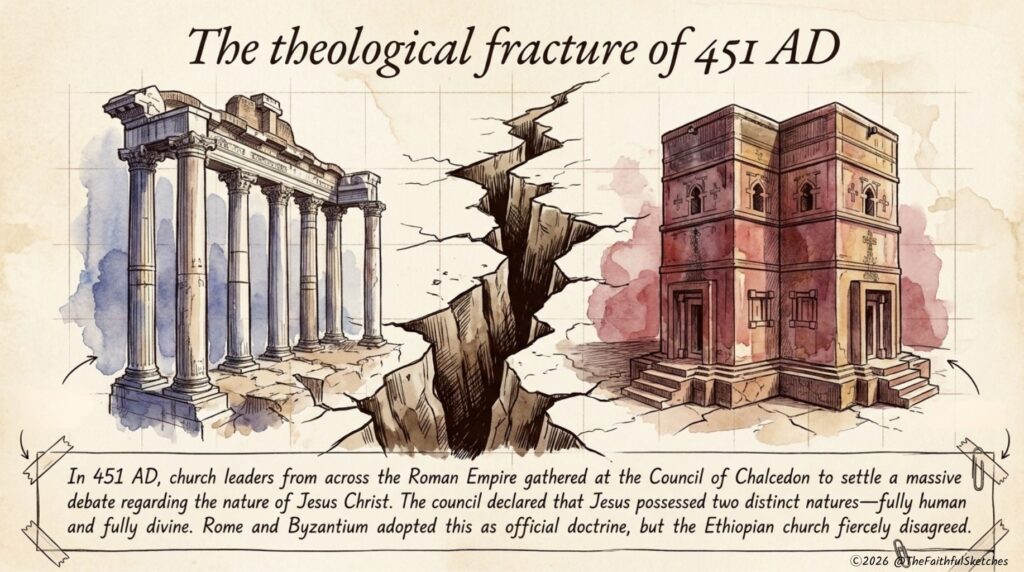
In 451 AD, church leaders gathered at the Council of Chalcedon to settle a theological debate about the nature of Jesus Christ. The council declared that Jesus had two distinct natures — fully human and fully divine — united in one person.
The Ethiopian church disagreed. Along with the Coptic church in Egypt, they held to a position called miaphysitism. In Ge’ez, the word is Tewahedo, meaning “united as one.” The Ethiopian church believed Christ’s divinity and humanity were so perfectly unified they formed a single nature.
The Council of Chalcedon condemned these churches as heretics. The consequence was enormous: Ethiopia was cut off from Rome and Byzantium.
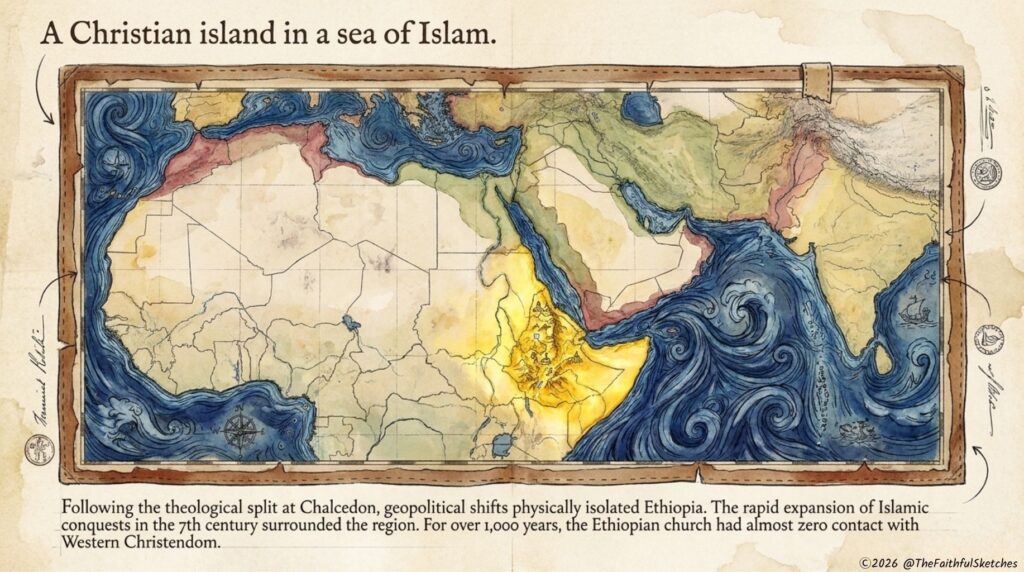
Then in the 7th century, Islamic expansion swept across North Africa and the Middle East. Ethiopia became geographically isolated — a Christian nation surrounded by a region that was rapidly becoming Muslim. This isolation lasted for over a thousand years.
And isolation preserves.
While the West was debating which books belonged in the Bible, Ethiopia kept everything. They kept the texts that Western churches eventually removed. They kept books that had been part of their tradition since the 4th century. That’s why, today, their Bible contains books you won’t find anywhere else.
The 81 Books: What Your Bible Is Missing
Here’s a breakdown of how the canons compare:
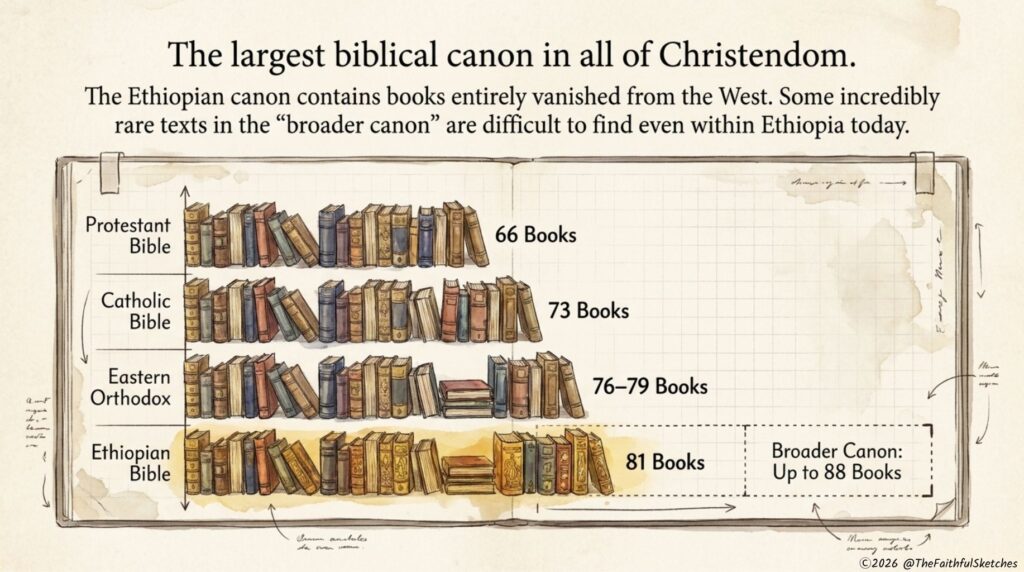
| Bible Version | Number of Books |
|---|---|
| Protestant Bible | 66 |
| Catholic Bible | 73 |
| Eastern Orthodox | 76–79 |
| Ethiopian Bible | 81 |
Some Ethiopian sources count a broader canon of up to 88 books, including texts so rare they’re difficult to find even within Ethiopia.
The Book of Enoch
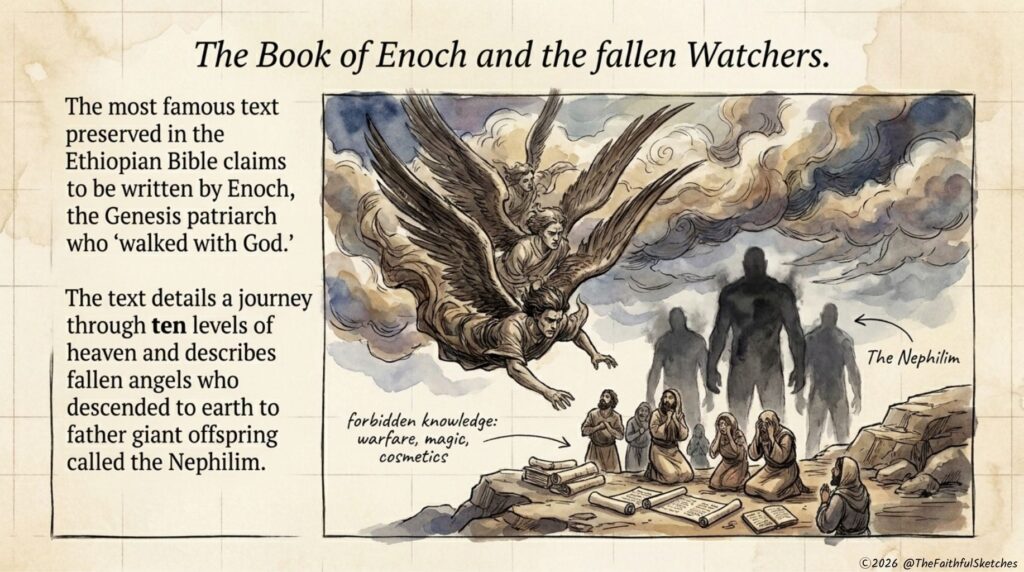
This is the text most people ask about. The Book of Enoch claims to be written by Enoch, the patriarch from Genesis who “walked with God and was not, because God took him.”
In the book, Enoch describes the “Watchers” — fallen angels who descended to earth, taught humanity forbidden knowledge including warfare and magic, and fathered giant offspring called the Nephilim.
Here’s the part that surprises most readers: the New Testament book of Jude directly quotes the Book of Enoch in verses 14 and 15. At least one New Testament writer treated Enoch as prophetic Scripture.
So why isn’t it in the standard Bible? Western church leaders in the 4th century decided it didn’t meet their criteria for canonicity. In Ethiopia, they never stopped reading it.
The Book of Jubilees
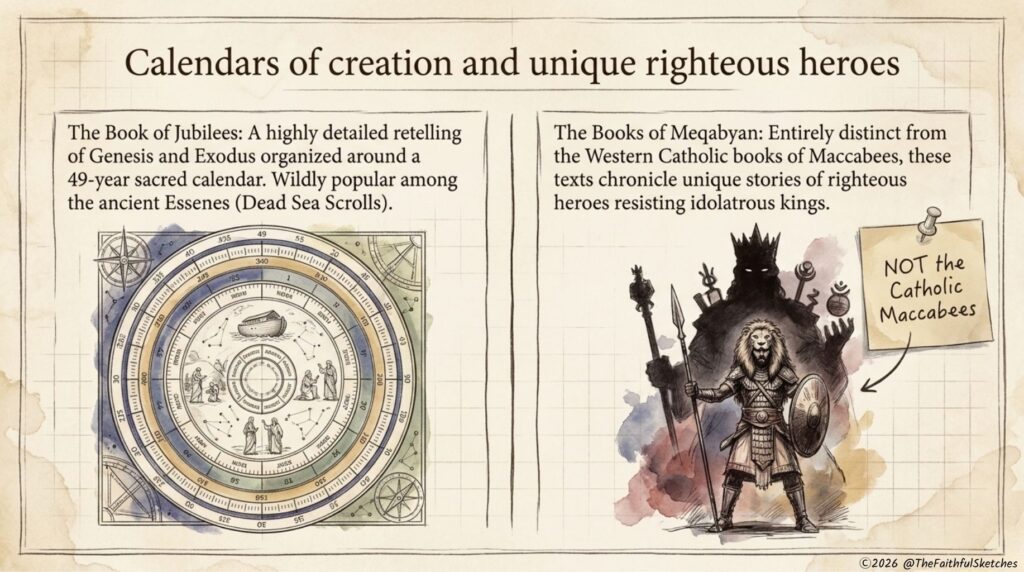
Jubilees retells the stories of Genesis and Exodus with significantly more detail. It’s organized around a sacred calendar of 49-year intervals. It includes additional stories about Abraham, Jacob, and Moses that Genesis doesn’t contain.
The book was extremely popular among the community that produced the Dead Sea Scrolls. Multiple copies of Jubilees were found at Qumran. But it was lost to the Western church until the 19th century.
The Books of Meqabyan
This is where it gets interesting. The Catholic and Orthodox Bibles include books called 1, 2, and 3 Maccabees. The Ethiopian Bible has Meqabyan — and they are not the same books.
The Meqabyan texts tell stories of righteous heroes resisting idolatrous kings. They are unique to Ethiopia and hold the same canonical weight as any other book in the Ethiopian Bible.
Other Unique Texts
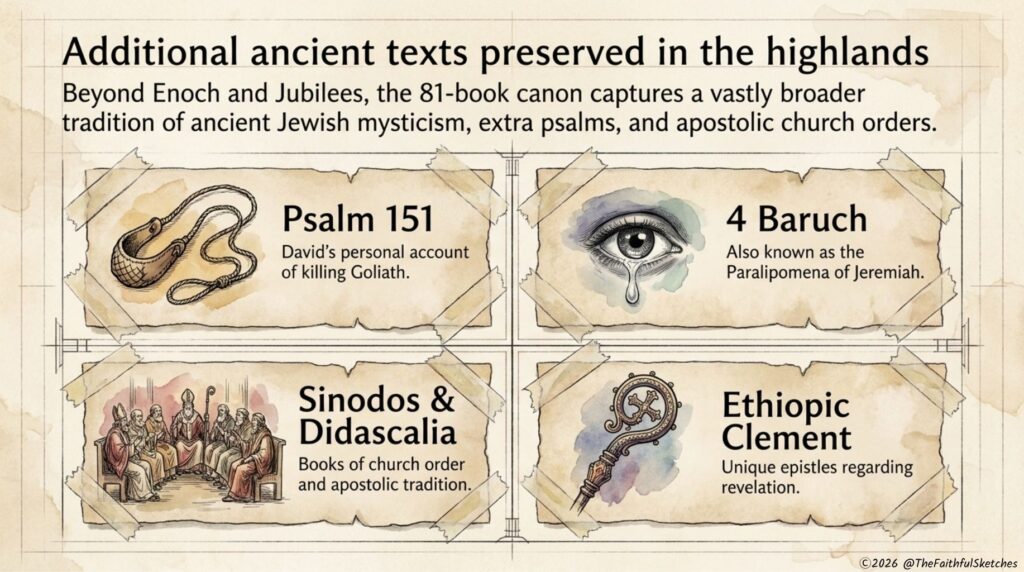
The Ethiopian canon also includes:
- 4 Baruch (also called the Paralipomena of Jeremiah)
- Psalm 151 — David’s personal account of killing Goliath, also found in some Orthodox Bibles
- Sinodos, Didascalia, and Ethiopic Clement — part of a broader canon rarely found in print
The Ark of the Covenant Claim
No discussion of Ethiopian Christianity is complete without this.
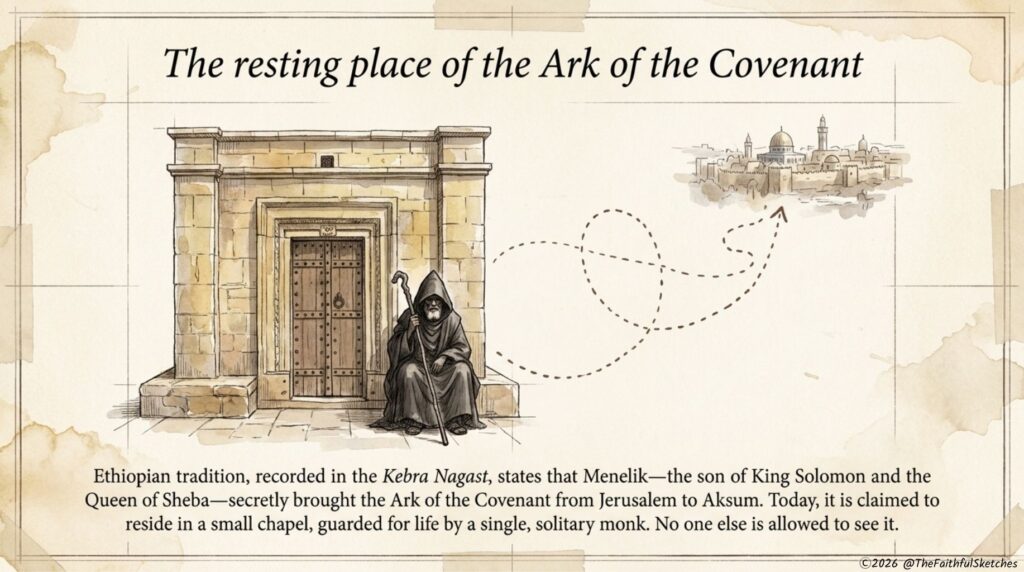
According to Ethiopian tradition recorded in the Kebra Nagast (the “Glory of the Kings”), the Queen of Sheba visited King Solomon in Jerusalem and returned to Ethiopia pregnant with his son, Menelik. When Menelik grew up, he visited his father Solomon. According to tradition, he secretly brought the Ark of the Covenant back to Ethiopia with him.
The Ethiopian Orthodox Church claims the Ark is currently housed in a small chapel next to the Church of Our Lady Mary of Zion in Aksum. A single guardian monk is appointed for life to protect it. No one else is permitted to see it.
Whether it’s actually the Ark is impossible to verify. But for Ethiopian Christians, this tradition is central to their identity — linking their faith directly to Solomon, Jerusalem, and the heart of biblical history.
Is the Ethiopian Bible the “Forbidden” or “Original” Bible?
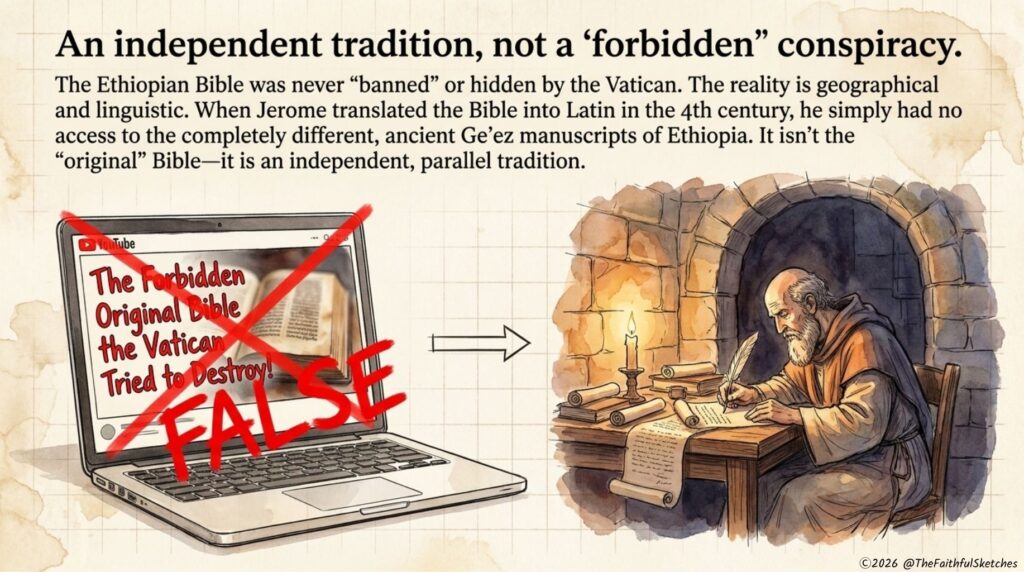
If you’ve searched for the Ethiopian Bible online, you’ve probably seen titles like “The Bible the Vatican Tried to Destroy” or “The Lost Original Bible.”
These claims are not historically accurate.
The Ethiopian Bible was not banned or suppressed by the Vatican. There was no conspiracy. The reality is simpler: when the Ethiopian church was cut off after the Council of Chalcedon in 451 AD, the West simply didn’t have access to their texts. Ge’ez is completely different from Greek and Latin. When Jerome translated the Bible into Latin in the 4th century, he was working with Hebrew and Greek scrolls in Bethlehem. He didn’t have access to Ethiopian manuscripts.
The Ethiopian Bible is also not the “original” Bible that all others came from. It’s a different tradition — one that developed independently and preserved texts the West eventually lost.
That doesn’t make it more “authentic.” It makes it ancient and unique. It’s an invaluable record of how early Christians read and understood Scripture before the great councils made their decisions.
The Ethiopian Bible is the living Scripture of a church with over 35 million members today. It has been read, chanted, and studied continuously for over 1,600 years. That’s more remarkable than any conspiracy theory.
What the Ethiopian Bible Gives Us
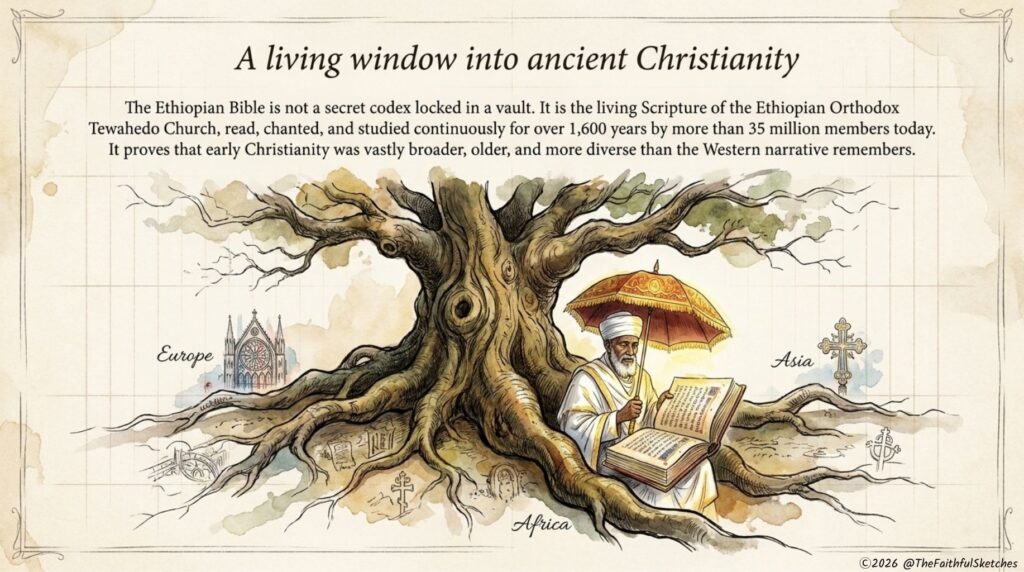
The Ethiopian Bible matters for a specific reason: it shows that Christianity didn’t begin and end in Europe. It spread south into Africa and east into Asia, developing distinct traditions that scholars are still studying.
Concretely, the Ethiopian canon gives us:
- The Book of Enoch — a window into ancient Jewish mysticism and the context behind New Testament references to fallen angels
- The Book of Jubilees — a deeper understanding of how early communities read Genesis, backed by Dead Sea Scrolls evidence
- The Meqabyan books — stories of faith and resistance that Ethiopian Christians have passed down for centuries
- A scriptural tradition broader and older than most Western Christians ever encountered
The next time you consider what the Bible contains, it’s worth knowing that another version exists — one with 15 additional books, a history stretching back to the apostles, and a continuous reading tradition that predates European Christianity. It’s still being read in the Ethiopian highlands today.
Want to go deeper? Watch our full video breakdown of the Ethiopian Bible, including animated explanations of the Book of Enoch, the Council of Chalcedon, and the Ark of the Covenant claim.
Click Below to Download The Full PDF Summary Guide:
*Free for personal use only. Please don’t resell or redistribute commercially.