
Romans 8:28 (ESV)
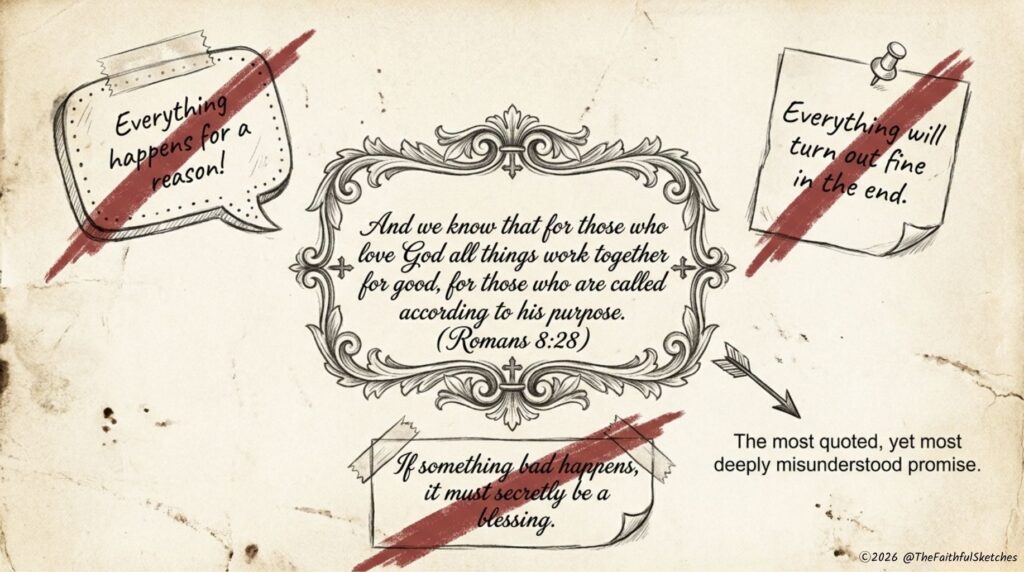
“And we know that for those who love God all things work together for good, for those who are called according to his purpose.”
This is one of the most quoted verses in the Bible, but it is also one of the most misunderstood.
Many people read it as:
“Everything happens for a reason.”
Or:
“Everything will turn out fine.”
Or:
“If something bad happens, it must secretly be good.”
Paul is not saying any of those things.
The Context Matters
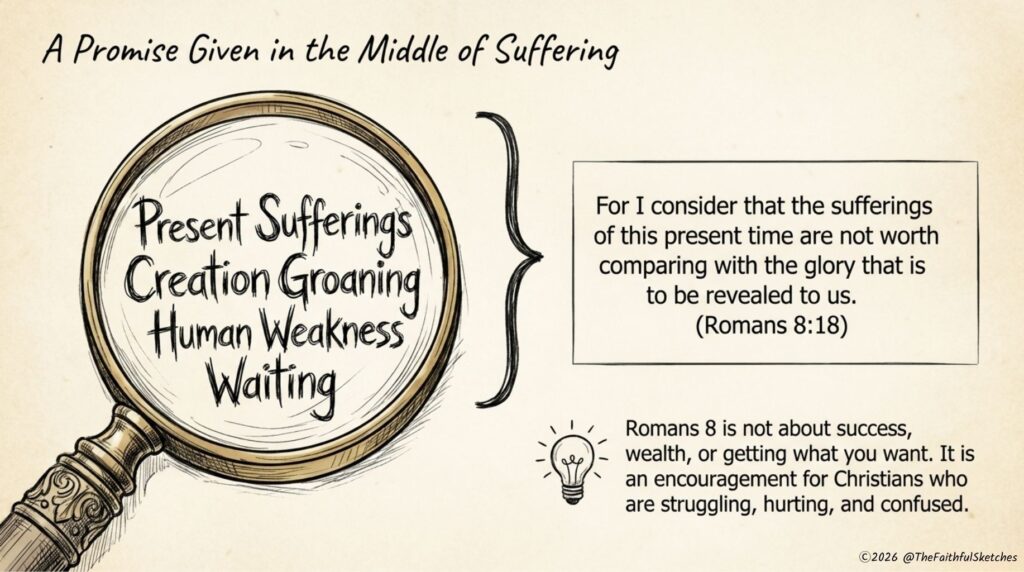
Romans 8 is not about success, wealth, comfort, or getting what you want.
It is about suffering.
Just before verse 28, Paul talks about:
- Present sufferings (Romans 8:18)
- Creation groaning under the curse (Romans 8:22)
- Believers groaning as they wait for redemption (Romans 8:23)
- Human weakness (Romans 8:26)
Romans 8:18 (ESV)
“For I consider that the sufferings of this present time are not worth comparing with the glory that is to be revealed to us.”
Romans 8:26 (ESV)
“Likewise the Spirit helps us in our weakness.”
Then Paul says:
“And we know that for those who love God all things work together for good…”
So Romans 8:28 is not a promise given in the middle of comfort.
It is a promise given in the middle of suffering.
Paul is encouraging Christians who are struggling, hurting, confused, and waiting for God to fulfill His promises.
What Does “All Things” Mean?
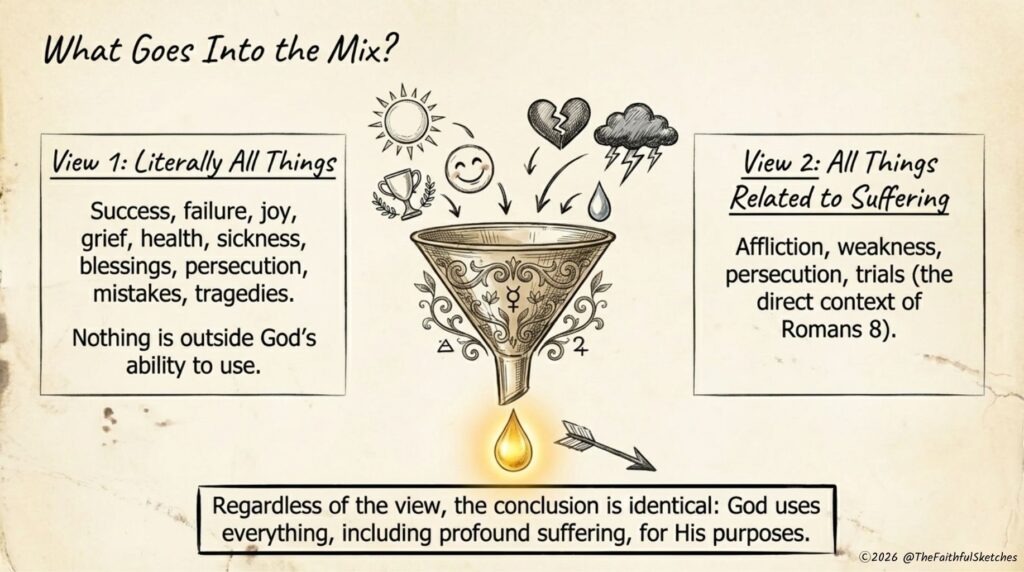
The phrase “all things” has been interpreted in two main ways.
View 1: Literally All Things
Most Christians throughout history have understood “all things” to mean everything that occurs in a believer’s life.
That includes:
- Success
- Failure
- Joy
- Grief
- Health
- Sickness
- Blessings
- Persecution
- Mistakes
- Tragedies
Nothing is outside God’s ability to use for His purposes.
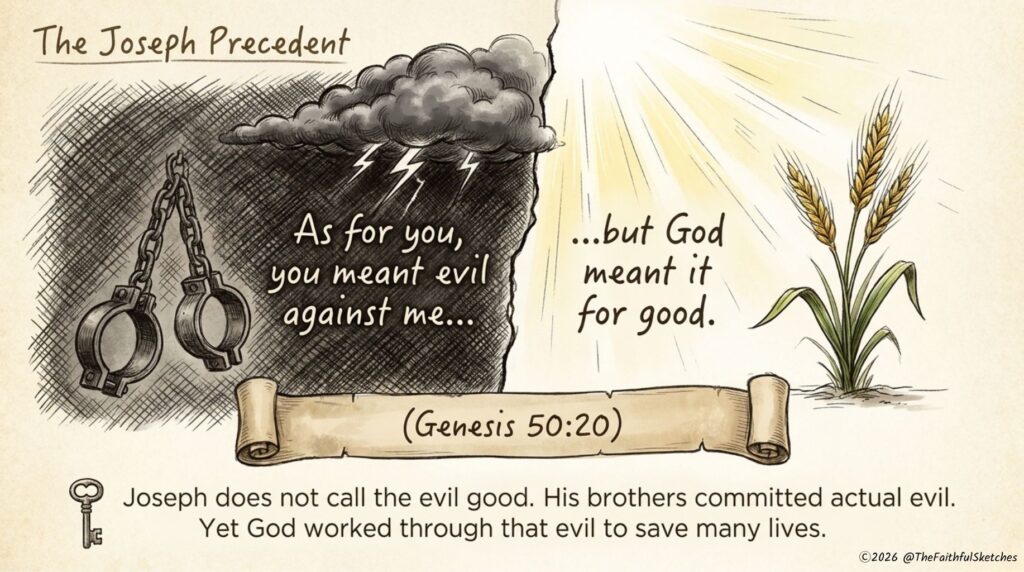
Joseph’s story is often used as an example.
After being betrayed by his brothers, sold into slavery, falsely accused, and imprisoned, Joseph told them:
“As for you, you meant evil against me, but God meant it for good.”
Genesis 50:20 (ESV)
Notice Joseph does not call the evil good.
His brothers committed evil.
Yet God worked through that evil to save many lives.
View 2: All Things Related to Suffering
Some scholars believe Paul is specifically referring to the sufferings and hardships mentioned throughout Romans 8.
In this view, “all things” primarily refers to:
- Affliction
- Weakness
- Persecution
- Trials
Even if this interpretation is correct, the practical conclusion is very similar:
God uses suffering for His purposes.
What Is the “Good”?
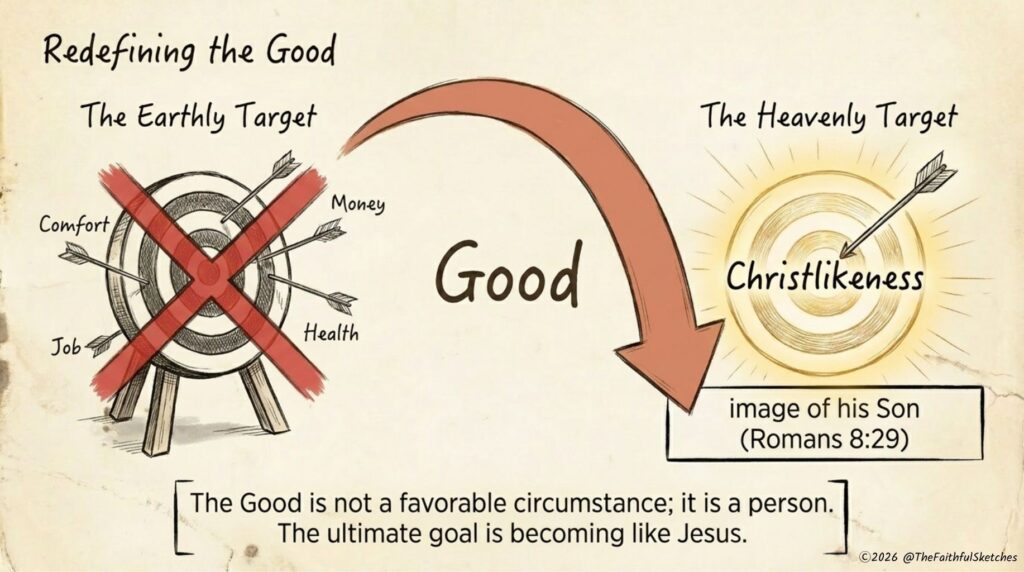
This is the most important question.
Many people assume the “good” means:
- Getting the job you wanted
- Being healed from every illness
- Finding financial success
- Living a comfortable life
But Paul defines the “good” in the very next verse.
Romans 8:29 (ESV)
“For those whom he foreknew he also predestined to be conformed to the image of his Son…”
The word “for” connects verse 29 to verse 28.
Paul is explaining what he means by “good.”
The good God is ultimately working toward is:
Making believers more like Jesus Christ.
The goal is not primarily comfort.
The goal is Christlikeness.
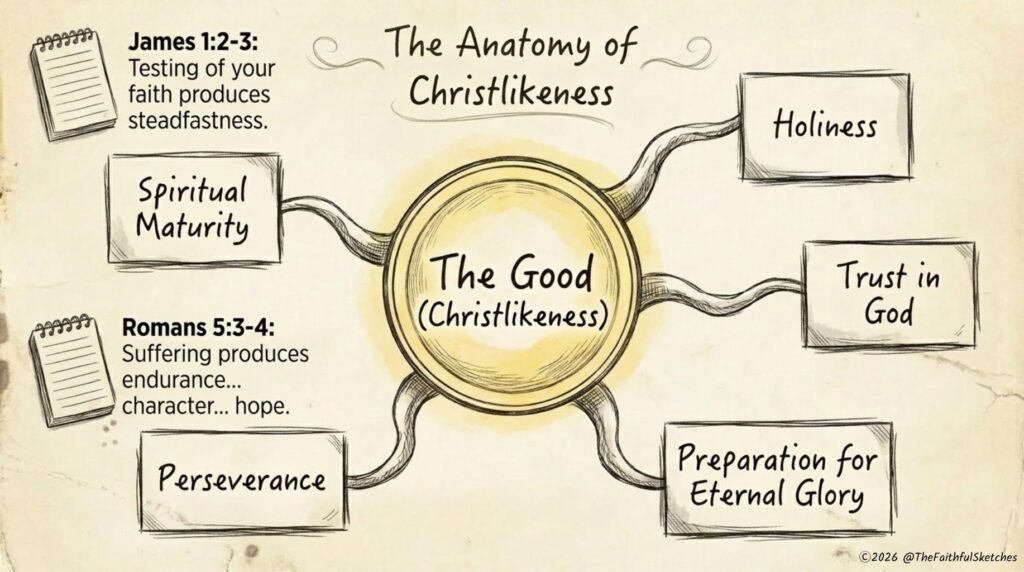
This includes:
- Spiritual maturity
- Holiness
- Trust in God
- Perseverance
- Preparation for eternal glory
This fits with other passages.
James 1:2-3 (ESV)
“Count it all joy, my brothers, when you meet trials of various kinds, for you know that the testing of your faith produces steadfastness.”
Romans 5:3-4 (ESV)
“We rejoice in our sufferings, knowing that suffering produces endurance, and endurance produces character, and character produces hope.”
The Bible repeatedly teaches that God often uses trials to shape His people.
What the Verse Does NOT Mean
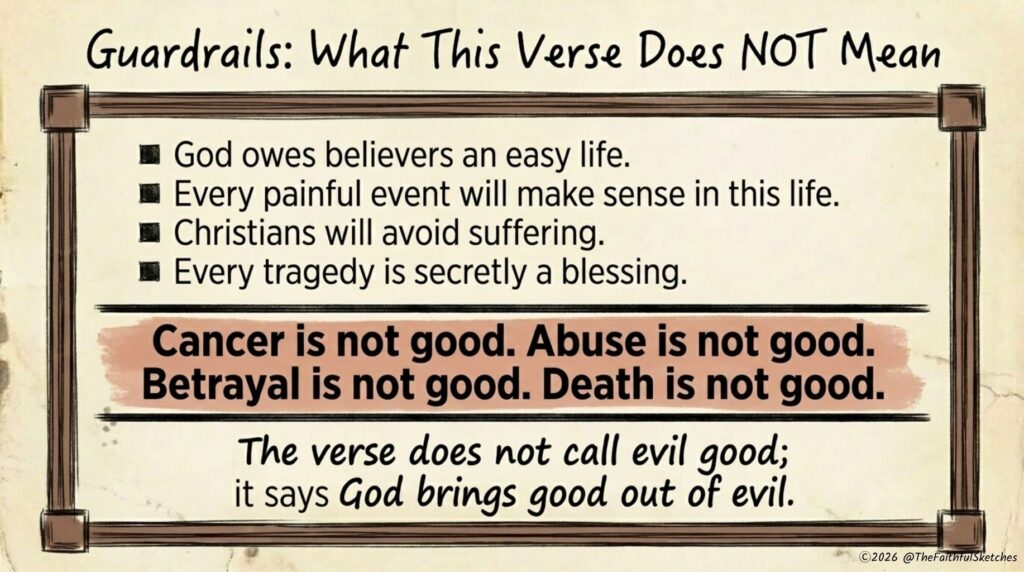
Romans 8:28 does not mean:
- Everything that happens is good.
- Every tragedy is secretly a blessing.
- Christians will avoid suffering.
- Every painful event will make sense in this life.
- God owes believers an easy life.
Cancer is not good.
Abuse is not good.
Betrayal is not good.
Death is not good.
The verse does not call evil good.
Instead, it says God can bring good out of evil.
The greatest example is the cross.

The crucifixion was humanity’s greatest act of evil.
Yet through it God accomplished salvation.
Acts 2:23 (ESV)
“This Jesus, delivered up according to the definite plan and foreknowledge of God, you crucified and killed by the hands of lawless men.”
Human beings acted wickedly.
God used that wickedness to accomplish redemption.
Does God Cause Evil?
This is where different Christian traditions begin to disagree. All orthodox Christians agree on the starting points:
1 John 1:5 (ESV)
“God is light, and in him is no darkness at all.”
And:
James 1:13 (ESV)
“God cannot be tempted with evil, and he himself tempts no one.”
Here’s how the major traditions approach it.
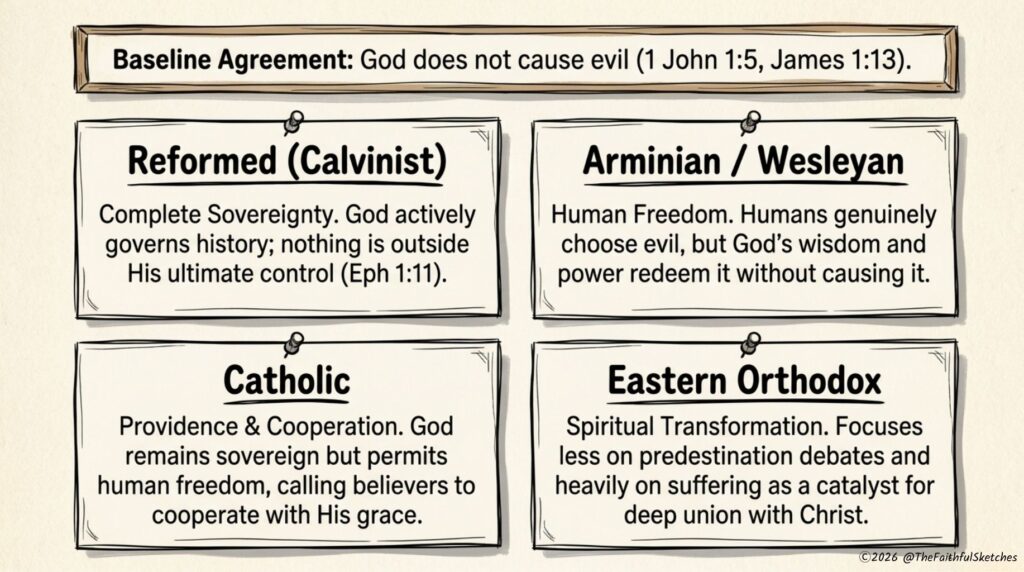
Reformed (Calvinist) Understanding
Many Reformed Christians believe Romans 8:28 teaches God’s complete sovereignty over all events.
Nothing happens outside God’s ultimate control.
They often point to:
Ephesians 1:11 (ESV)
“He works all things according to the counsel of his will.”
In this view, God does not merely react to events.
He actively governs history and works through every circumstance for His purposes.
Romans 8:28 is often seen as evidence that every event in a believer’s life is part of God’s sovereign plan.
Arminian and Wesleyan Understanding
Many Arminians agree that God works all things for good but emphasize human freedom.
They generally believe:
- God does not determine every sinful act.
- Humans genuinely choose evil.
- God can redeem evil without causing it.
Under this view, Romans 8:28 demonstrates God’s wisdom and power.
No matter what humans do, God can still bring about His purposes.
Catholic Understanding
The Catholic view is similar in many respects.
God remains sovereign while permitting human freedom.
God works through circumstances for the good of believers, but believers are also called to cooperate with His grace.
The emphasis is often on trusting God’s providence even when His purposes are not immediately visible.
Eastern Orthodox Understanding
Eastern Orthodox Christians tend to focus on transformation.
The “good” in Romans 8:28 is primarily understood as spiritual growth and becoming more like Christ.
Suffering becomes an opportunity for deeper dependence on God and greater spiritual maturity.
The focus is less on debates about predestination and more on being transformed into Christ’s likeness.
Who Is This Promise For?
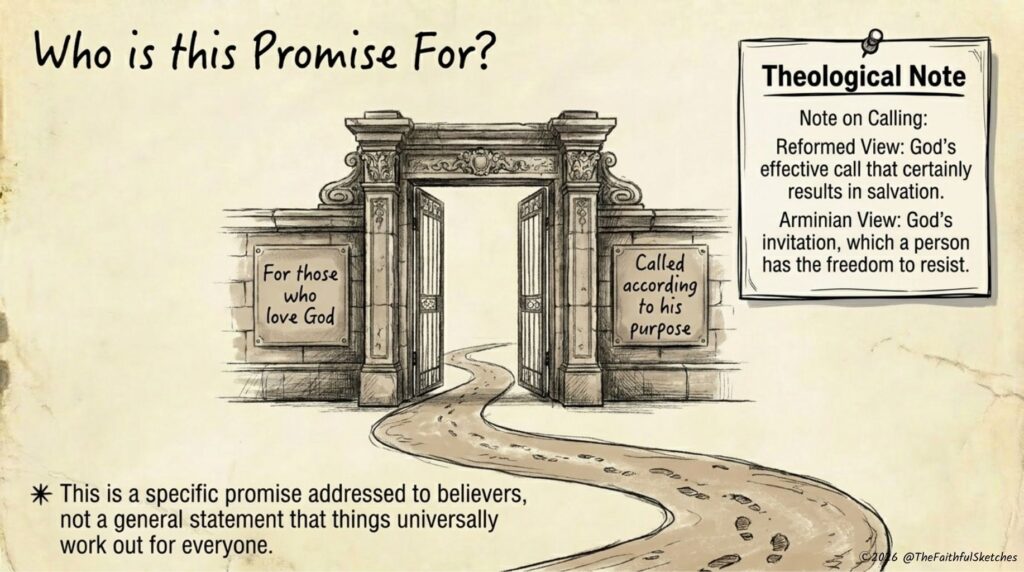
Notice Paul does not say this promise applies to everyone.
He says:
“for those who love God”
and
“for those who are called according to his purpose.”
The promise is specifically addressed to believers.
Reformed View
Many Reformed Christians understand “called” as God’s effective call that certainly results in salvation.
They connect it to Romans 8:30:
“those whom he called he also justified…”
Arminian View
Many Arminians distinguish between God’s invitation and a person’s response.
God calls people, but people may resist that call.
If you want to go deeper on the Reformed and Arminian divide specifically, see my post on predestination and free will.
The Bigger Message of Romans 8
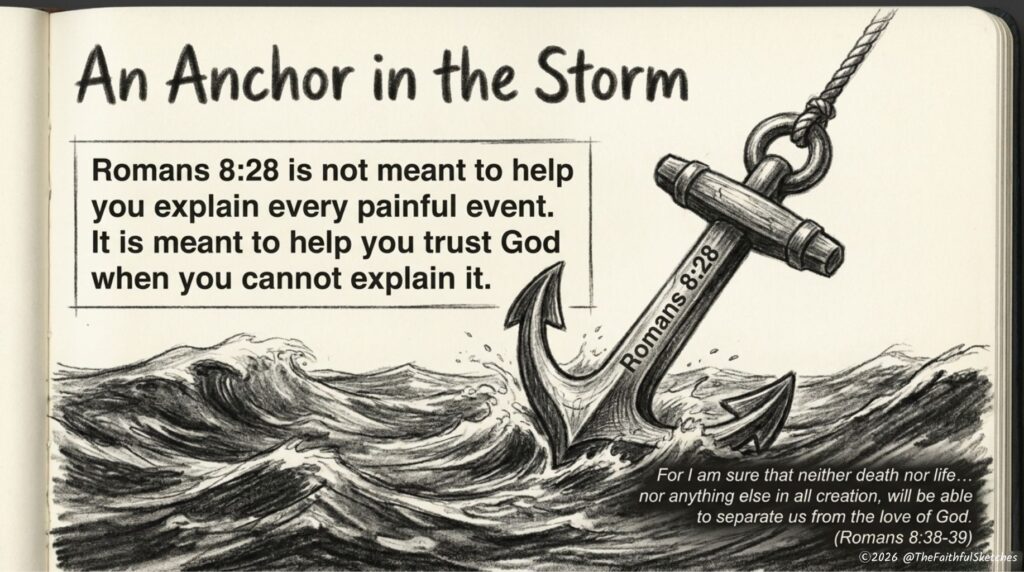
Romans 8:28 is not meant to help you explain every painful event.
It is meant to help you trust God when you cannot explain it.
Paul’s argument throughout Romans 8 is:
- Christians suffer.
- Creation is broken.
- The Spirit helps believers in weakness.
- God is working through circumstances.
- God is shaping believers into Christ’s image.
- God’s purposes cannot ultimately fail.
- Nothing can separate believers from God’s love.
Paul concludes:
Romans 8:38-39 (ESV)
“For I am sure that neither death nor life… nor anything else in all creation, will be able to separate us from the love of God in Christ Jesus our Lord.”
A Simple Summary
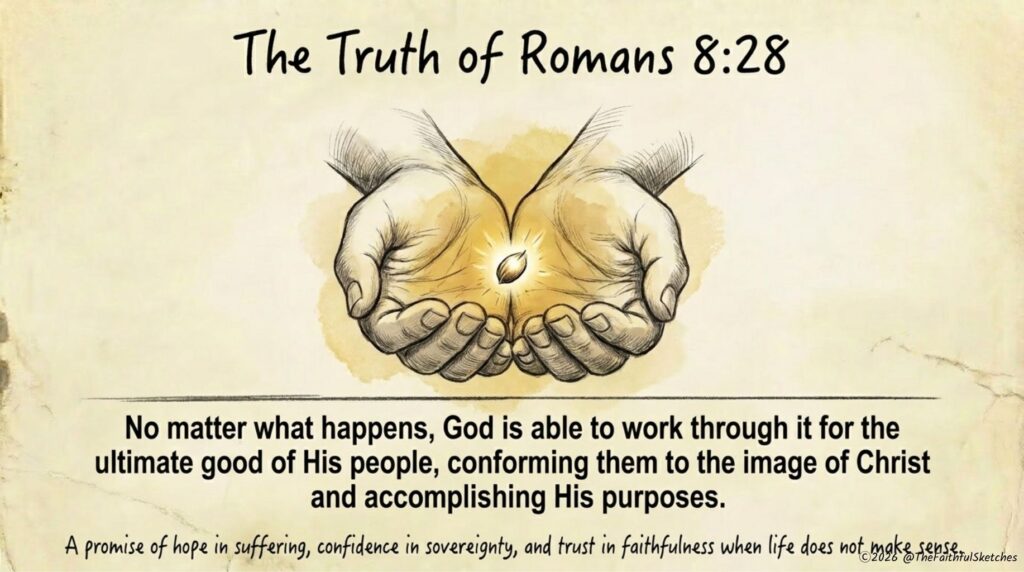
Romans 8:28 does not mean:
“Everything that happens is good.”
It means:
“No matter what happens, God is able to work through it for the ultimate good of His people, conforming them to the image of Christ and accomplishing His purposes.”
The verse is ultimately about hope in suffering, confidence in God’s sovereignty, and trust in His faithfulness when life does not make sense.
Click Below to Download The Full PDF Summary Visual Guide:
*Free for personal use only. Please don’t resell or redistribute commercially.