
Did you know Catholics and Protestants both call themselves Christians, yet they don’t even agree on how someone is saved? One side says faith plus works. The other says faith alone. One side prays to Mary and the saints. The other calls that idolatry. Both read the Bible, but they don’t even use the same one.
So today, let’s uncover the real difference between Catholics and Protestants, and the surprising amount they still share. By the end, you’ll understand exactly where the two traditions split and where they remain united.
How the Divide Began
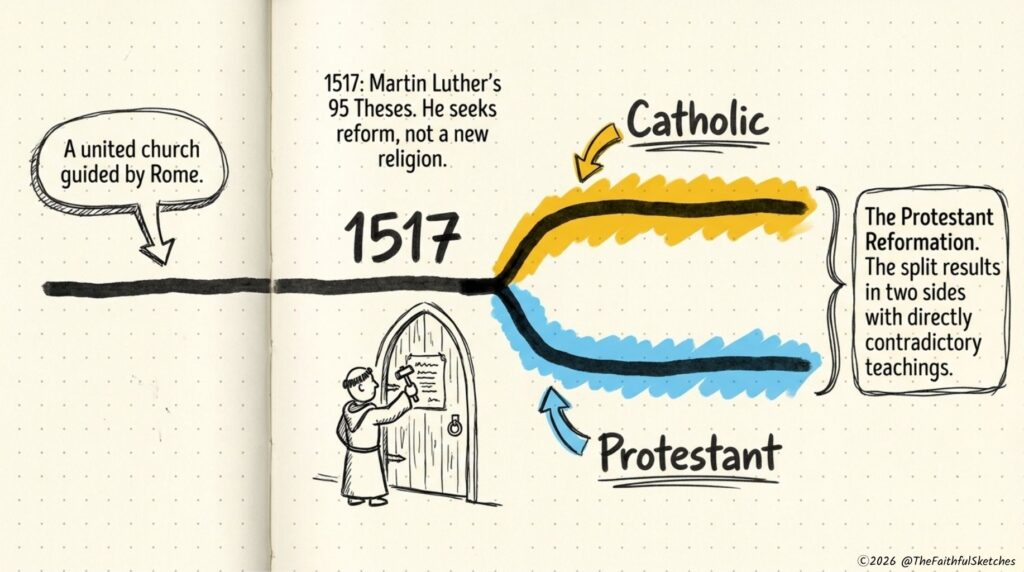
Christianity began united. For centuries, the Church in Rome guided Western Europe. But in 1517, Martin Luther nailed his Ninety-Five Theses to a church door in Germany. He wasn’t trying to start a new religion. He wanted reform. That’s how the Protestant Reformation was born.
From then on, Christians split: Catholics on one side, Protestants on the other. The question ever since has been simple. Who’s right? Because both can’t be correct when their teachings directly contradict each other. This isn’t the only major split in church history, either. For an earlier one, see my post on the Great Schism of 1054.
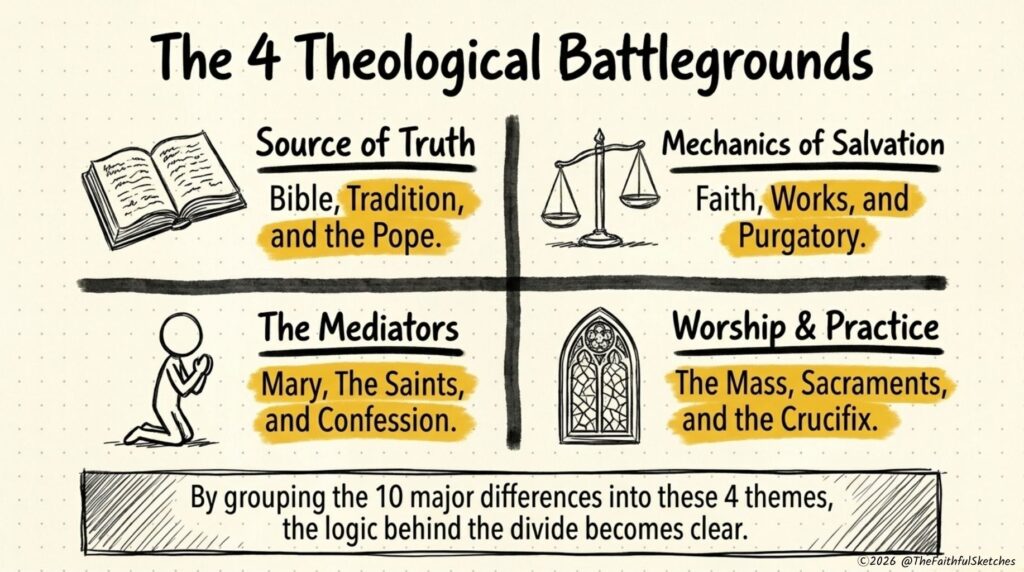
1. The Bible Itself
The first difference between Catholics and Protestants shows up before you even open the book. Catholic Bibles have seventy-three books. Protestant Bibles have sixty-six.
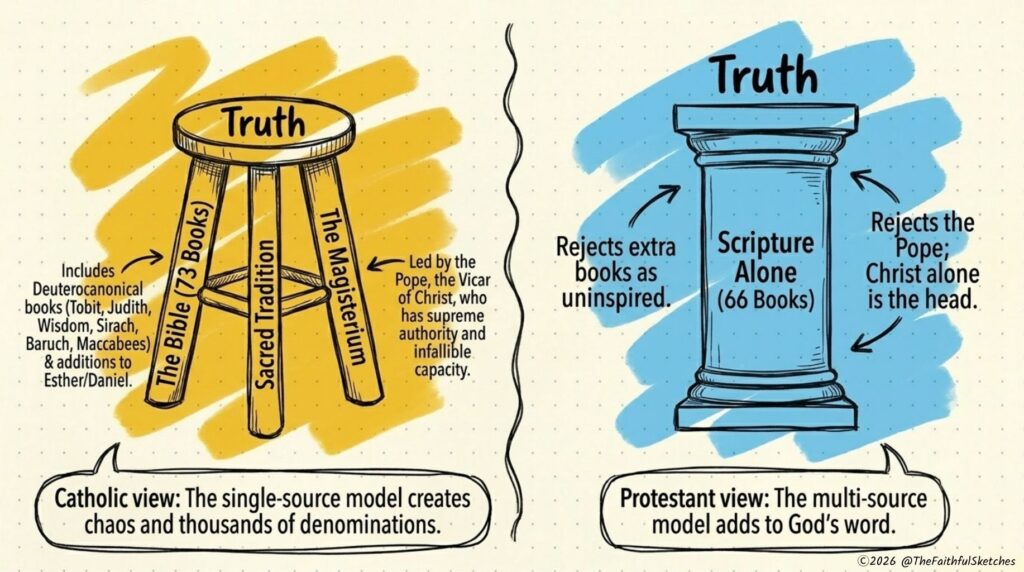
The difference comes down to the Deuterocanonical books: Tobit, Judith, Wisdom, Sirach, Baruch, and Maccabees. The Catholic Old Testament also includes extra sections in Esther and Daniel. Catholics argue those books were part of the Church’s tradition from early on. Protestants argue they aren’t inspired, noting that the Jewish Scriptures didn’t include them either. For a deeper look at how this happened, read my post on why Christians have different Bibles.
2. Salvation: Faith and Works, or Faith Alone?
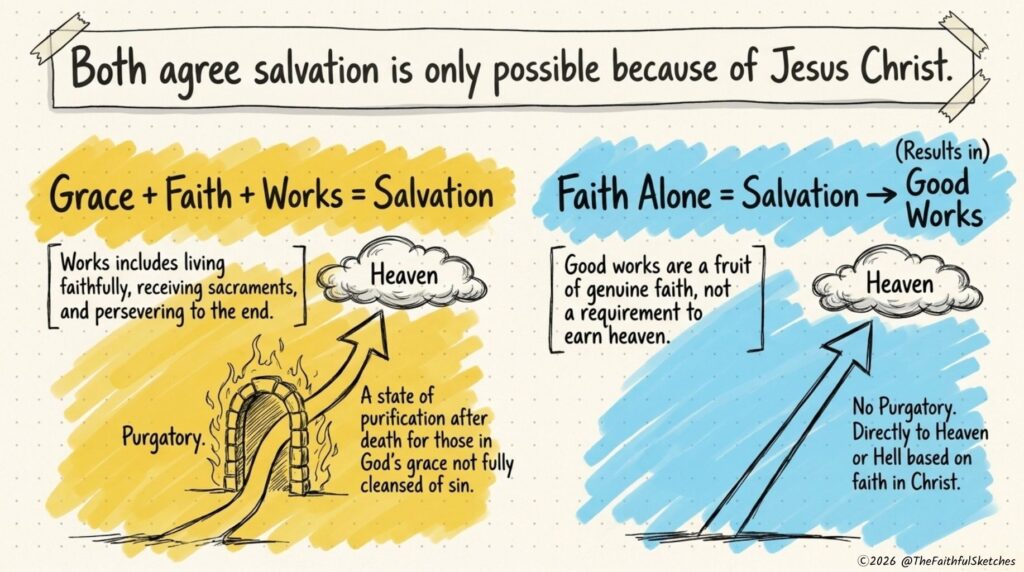
This is the biggest difference, though both sides agree that salvation is only possible because of Jesus Christ.
Catholics teach that salvation comes by grace, but through faith and works together: living faithfully, receiving the sacraments, and persevering to the end. Protestants emphasize Sola Fide, faith alone. Good works are the fruit of genuine faith, not a requirement for salvation. Protestants believe the Catholic system risks confusing people into thinking they must earn their way to heaven, which they argue is not the gospel.
3. The Sacraments and the Mass
Catholics believe in seven sacraments: Baptism, Eucharist, Confirmation, Confession, Marriage, Holy Orders, and Anointing of the Sick. Protestants recognize only two: Baptism and Communion.
Here’s another major clash. Catholics believe in transubstantiation, that during Mass the bread and wine literally become Christ’s body and blood, and the sacrifice of the cross is made present again. Protestants say Christ’s sacrifice was once for all. For them, the Lord’s Supper is a remembrance, not a new sacrifice, pointing to Hebrews 10:10. That difference is huge, because it shapes how each side sees the cross itself.
4. Mary and the Saints
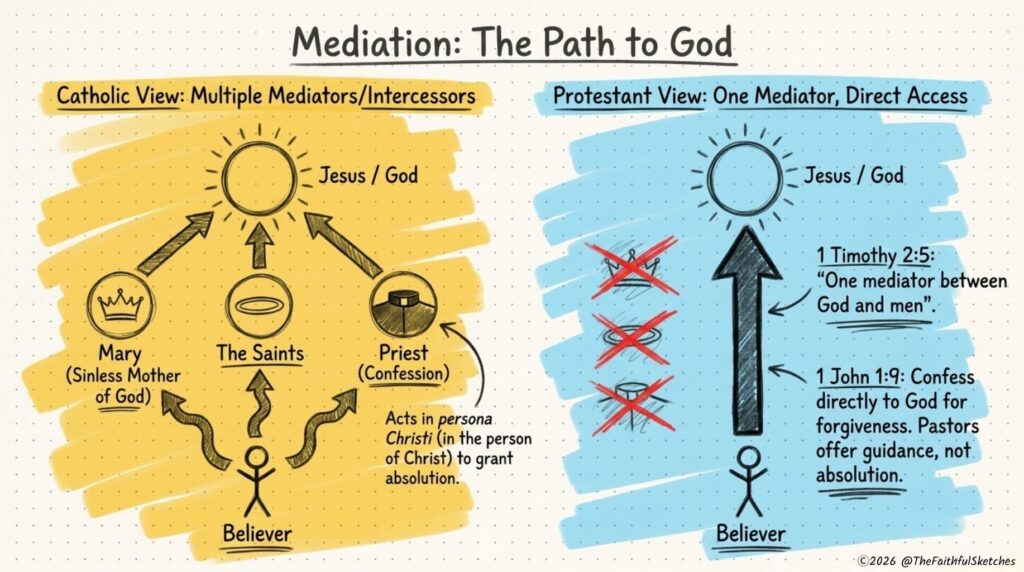
Catholics honor Mary as the Mother of God. They believe she was without sin and remained a virgin her whole life. They also pray to her and to the saints for intercession.
Protestants say Scripture is clear on this. 1 Timothy 2:5 states, “there is one God, and there is one mediator between God and men, the man Christ Jesus.” Praying to Mary or the saints, even with good intentions, diverts prayer away from the one true Mediator. Protestants see this practice as undermining the central role of Christ.
5. Authority: Who Decides Truth?
Catholics say truth comes from three sources working together: the Bible, Sacred Tradition, and the Magisterium, the church leaders led by the Pope.
Protestants believe Scripture alone is God-breathed and authoritative, citing 2 Timothy 3:16. Catholics accuse Protestants of creating chaos, pointing to thousands of denominations that each interpret the Bible differently. Protestants respond that the messiness is real, but submitting to traditions and leaders who add to God’s Word is worse.
6. Worship and Daily Practice
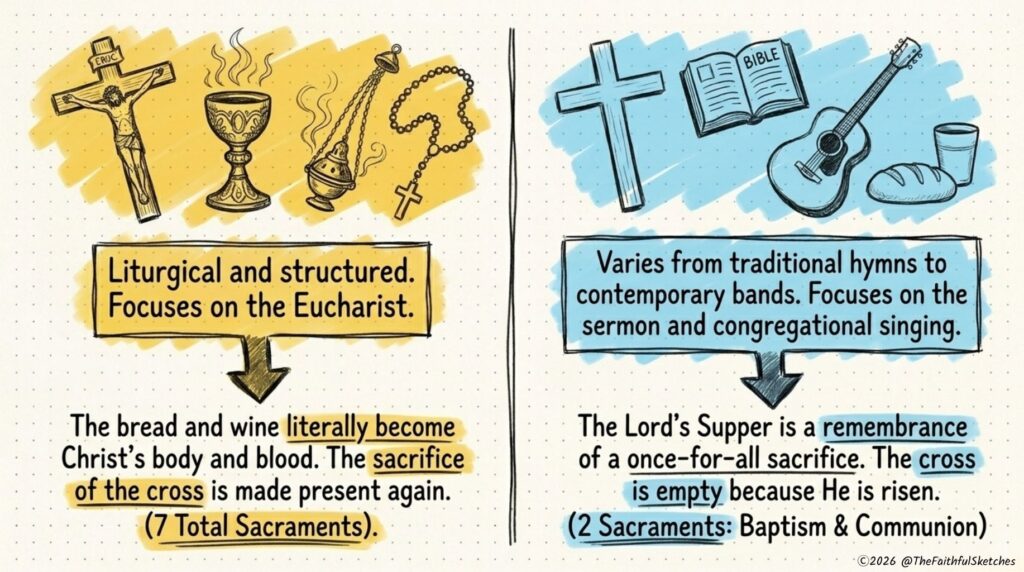
Catholic worship is liturgical, structured with ritual, incense, vestments, and quiet reverence. The focus is the Eucharist.
Protestant worship varies widely. Some churches are traditional, with hymns and creeds. Others are contemporary, with guitars and bands. Either way, the focus usually rests on preaching and congregational singing. In daily life, Catholics often pray the Rosary, attend daily Mass, and observe feast days, while Protestants emphasize personal Bible study, spontaneous prayer, and evangelism.
7. Purgatory
The Catholic Church teaches about Purgatory, a state of purification after death for those who die in God’s grace but are not yet fully cleansed of sin.
Protestants generally do not believe in Purgatory. They believe that after death, a person goes directly to Heaven or Hell, based on their faith in Jesus Christ.
8. The Pope
Catholics believe the Pope is the Vicar of Christ, the spiritual leader of the Church, and the successor of Peter. He holds supreme authority over Catholics, and under specific conditions, he can speak infallibly on matters of faith and morals.
Protestants reject the Pope’s authority, arguing that Scripture does not give one human universal control over the Church. They emphasize Christ alone as the head of the Church and Scripture alone as the final authority.
9. Confession
Catholics practice Confession, also called the Sacrament of Reconciliation, where a priest hears sins and grants absolution. The priest acts in persona Christi, “in the person of Christ,” to forgive sins.
Protestants reject confession to a priest as necessary for forgiveness. They emphasize direct confession to God, based on 1 John 1:9: “If we confess our sins, he is faithful and just to forgive us our sins.” Pastors may offer guidance or accountability, but forgiveness comes directly from God, not through a human mediator.
10. The Crucifix
Catholics use the crucifix, a cross with Jesus’ body on it, which is required in the celebration of Mass as a vivid reminder of Christ’s suffering and sacrifice.
Protestants usually prefer an empty cross to focus on the resurrection rather than the crucifixion. They argue that Jesus is no longer on the cross. He is risen.
Catholics vs Protestants: A Side-by-Side Comparison
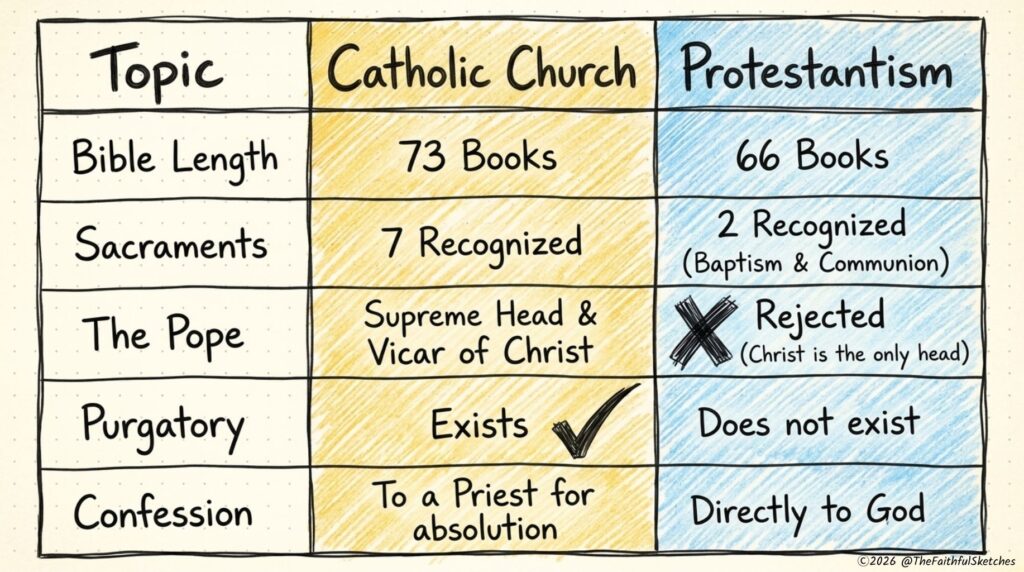
Here’s the full difference between Catholics and Protestants in one place.
| Issue | Catholic View | Protestant View |
|---|---|---|
| Bible | 73 books, includes Deuterocanon | 66 books |
| Salvation | Grace through faith and works | Grace through faith alone |
| Sacraments | Seven | Two (Baptism and Communion) |
| The Mass | Transubstantiation, sacrifice made present | Remembrance, sacrifice once for all |
| Mary and saints | Honored, prayed to for intercession | Christ is the only mediator |
| Authority | Bible, Tradition, and Magisterium | Scripture alone |
| Purgatory | Affirmed | Rejected |
| The Pope | Vicar of Christ, can speak infallibly | No universal human authority |
| Confession | To a priest, who grants absolution | Directly to God |
| Cross | Crucifix with Christ’s body | Empty cross |
What Catholics and Protestants Share
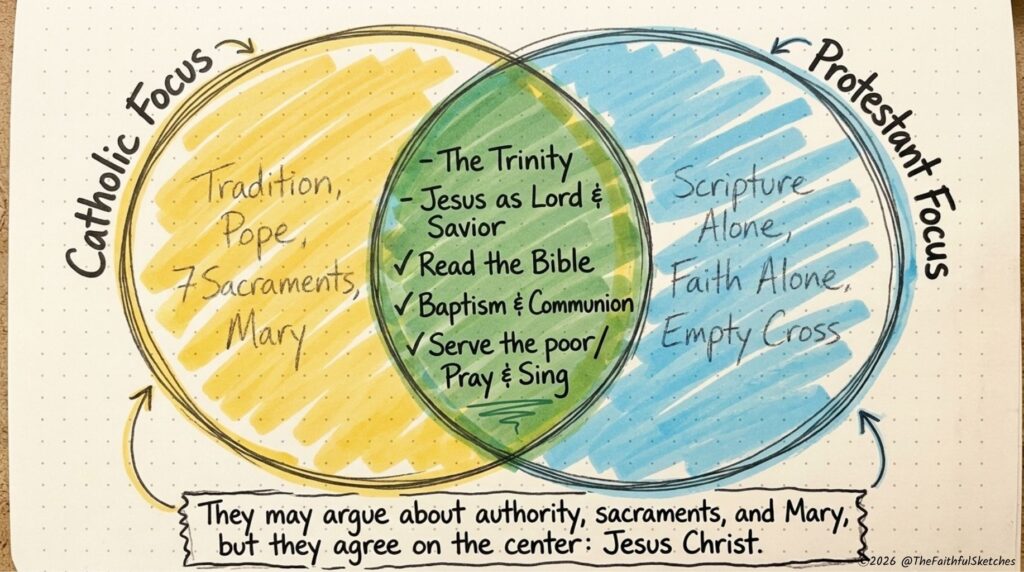
Despite the differences, it’s important to remember that Catholics and Protestants share many fundamental beliefs. They both believe in the Trinity. Both proclaim Jesus as Lord and Savior. Both read the Bible, baptize, and celebrate Communion. And Both pray, sing, and serve the poor.
They may argue about authority, sacraments, and Mary. But they agree on the center, Jesus Christ.
Steps Toward Unity
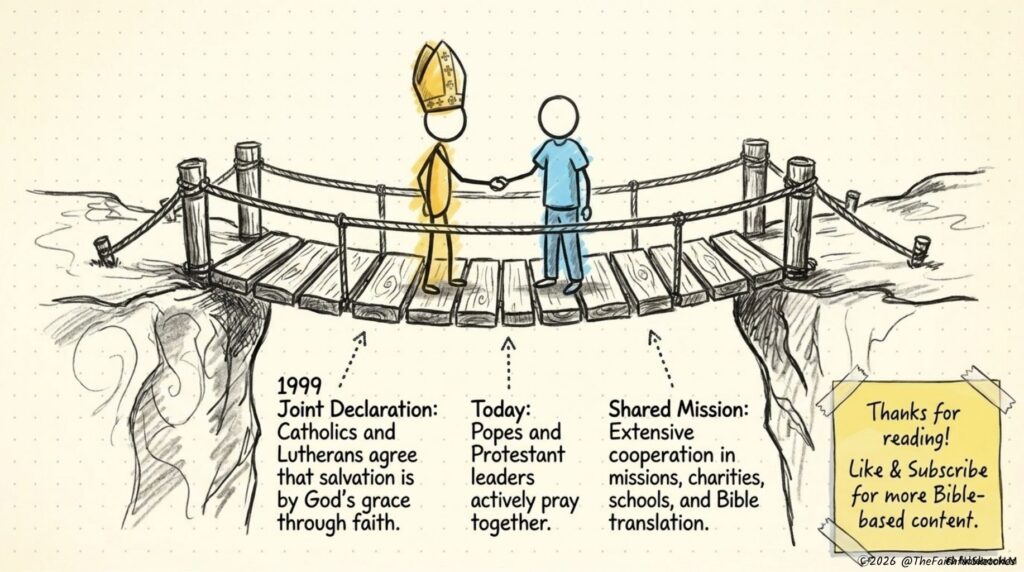
There has been real movement, too. In 1999, Catholics and Lutherans signed the Joint Declaration on the Doctrine of Justification, agreeing that salvation comes by God’s grace through faith. That was a major step after roughly 500 years of disagreement, and it was later affirmed by Methodist, Anglican, and Reformed churches as well.
Today, Popes and Protestant leaders pray together. Churches cooperate in missions, charities, schools, and Bible translation. The divide remains real, but so does the shared center. For a wider view of the three main branches of Christianity, see my post comparing Catholic, Orthodox, and Protestant differences.
Click Below to Download The Full PDF Summary Visual Guide:
*Free for personal use only. Please don’t resell or redistribute commercially.