
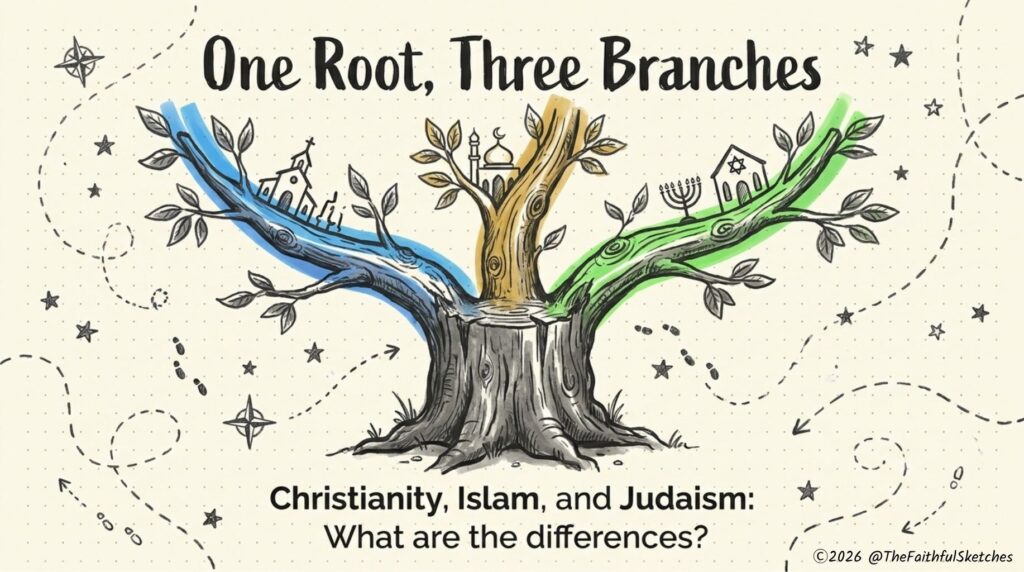
Over three billion people, nearly half the world’s population, identify with one of three major religions: Judaism, Christianity, or Islam. Across vastly different cultures, languages, and borders, these billions of people share a common heritage. They are known as the Abrahamic faiths, tracing their spiritual roots back to a single ancient patriarch named Abraham.
But if they all stem from the same root, why has their shared history been marked by both deep connection and fierce conflict? How did one family tree branch into three entirely different worldviews?
This post is not here to debate. It is here to examine the origins, the sacred texts, the rituals, and the deeply contrasting beliefs about God, Jesus, and the afterlife that separate Judaism, Christianity, and Islam.
Part 1: The Family Tree and the Timeline
To understand the differences, you first have to understand the timeline.
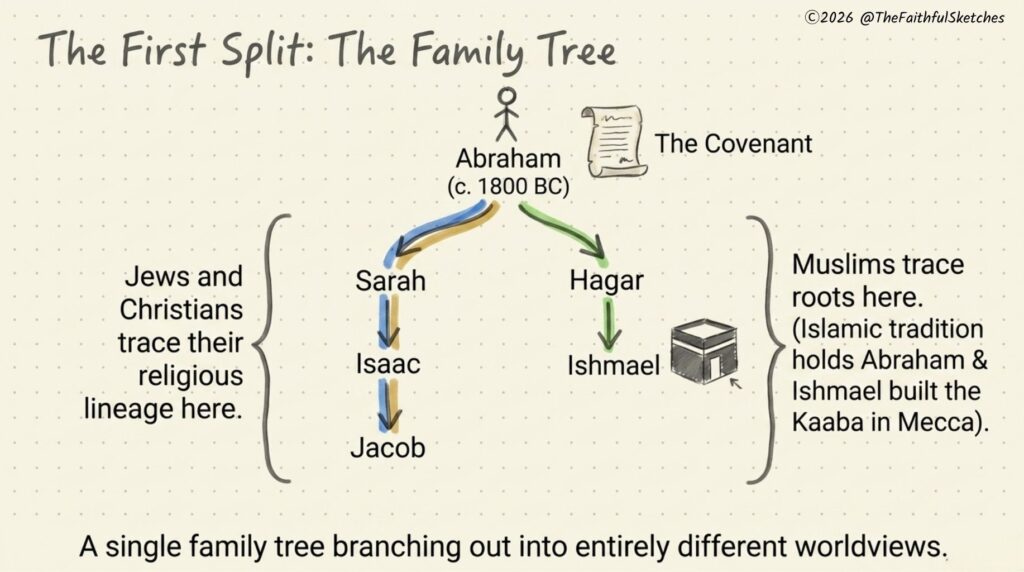
Around 1800 BC, Jewish tradition states that God made a covenant with Abraham. Both the biblical and Quranic narratives agree that Abraham had two sons: Ishmael, born to his servant Hagar, and Isaac, born miraculously to his wife Sarah.
Here is where the first major split happens.
Jews and Christians trace their religious lineage through Isaac and his son Jacob. Muslims trace their religious roots through Abraham’s firstborn son Ishmael. Islamic tradition holds that Abraham and Ishmael together built the Kaaba in Mecca, the holiest site in Islam.
The timeline continues from there:
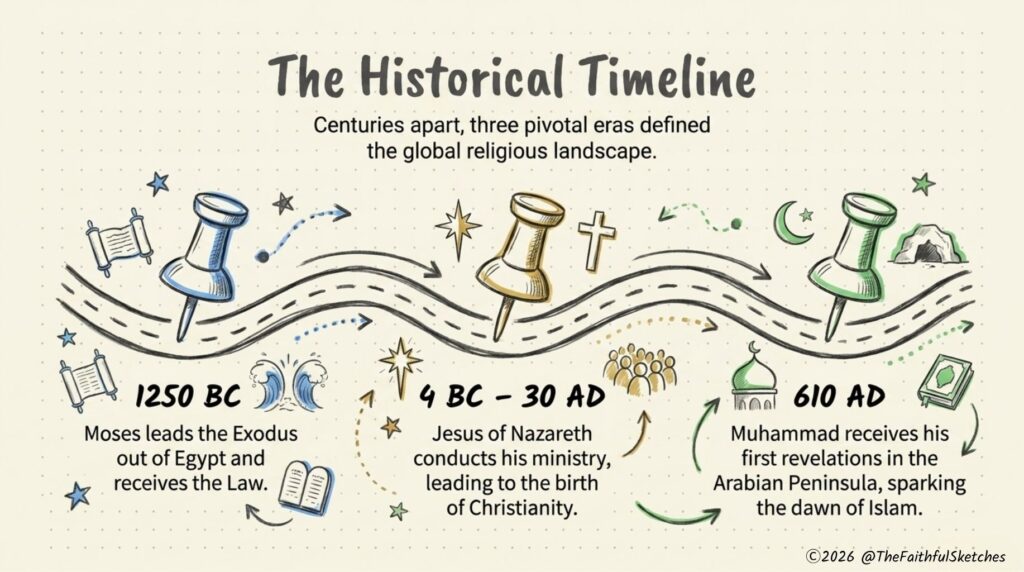
- Around 1250 BC, Moses leads the Jewish people out of Egypt and receives the Law from God
- Around 4 BC to 30 AD, a Jewish preacher named Jesus of Nazareth conducts his ministry, leading to the birth of Christianity
- Around 610 AD, in the Arabian Peninsula, Muhammad receives his first revelations, sparking the dawn of Islam
Three religions. One shared ancestor. Centuries of divergence.
Part 2: The Sacred Texts — People of the Book
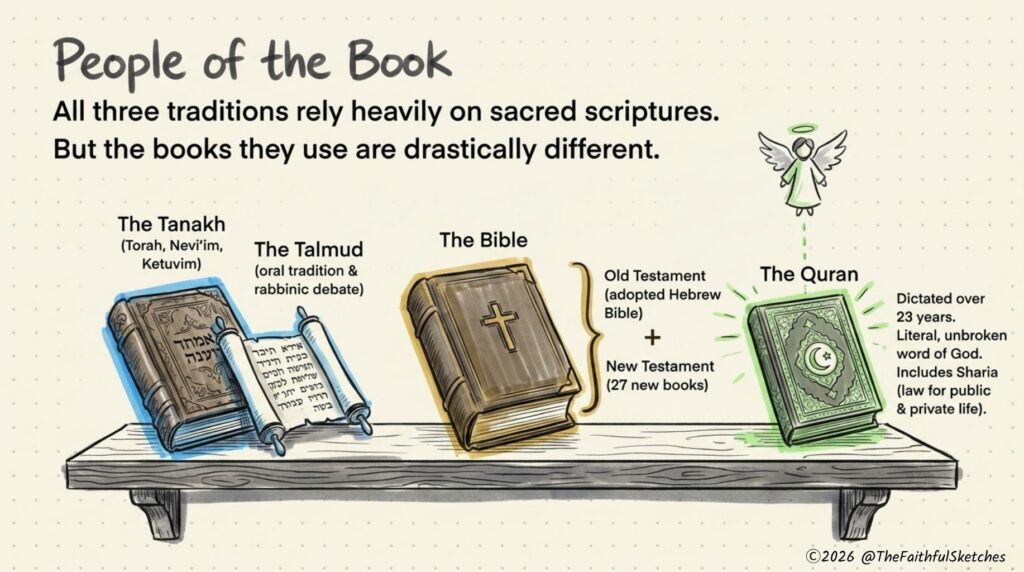
Muslims, Christians, and Jews are often called the People of the Book because all three traditions rely heavily on sacred scriptures. But the books they use, and how they view them, are drastically different.
Judaism centres on the Hebrew Bible, known as the Tanakh. It is divided into three parts: the Torah (the first five books of Moses), the Nevi’im (the Prophets), and the Ketuvim (the Writings). Alongside written scripture, Judaism relies on centuries of oral tradition and rabbinic debate compiled in the Talmud, which guides daily religious life in great detail.
Christianity emerged from within Judaism and adopted the Hebrew Bible, calling it the Old Testament. Christians then added 27 new books written in the first and second centuries AD, creating the New Testament. Christians interpret the Old Testament through the lens of Jesus, seeing its laws, prophecies, and narratives as foreshadowing that culminates in his arrival. To Jews, those same texts do not point to Jesus at all, but anticipate a future Messiah who has yet to come.
Islam teaches that God sent revelations to many prophets, including the Torah to Moses and the Gospel to Jesus. However, Muslims believe that over time, humans distorted and altered these original texts, a concept known as tahrif. Because of this corruption, Muslims believe God sent a final, perfect, and uncorrupted revelation to the Prophet Muhammad: the Quran. Unlike the Bible, which was written by various human authors over centuries, Muslims consider the Quran to be the literal and direct word of God, dictated by the Angel Gabriel over 23 years. The Quran also does not separate religion from state. It provides comprehensive laws governing both private devotion and public life.
Part 3: The Nature of God
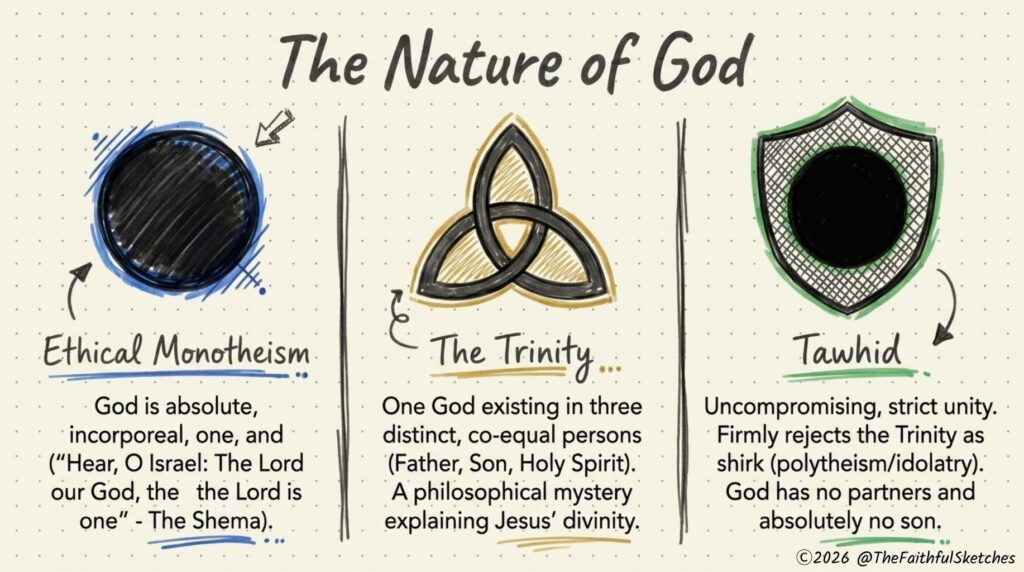
All three faiths are monotheistic. They all believe in one God. But how they define that one God is one of the greatest sources of theological conflict between them.
Judaism holds to an absolute and incorporeal monotheism. The central prayer, the Shema, declares: “Hear, O Israel: The Lord our God, the Lord is one.” God is the singular creator of the universe and the ultimate source of moral guidance. He is strictly one, eternal, and possesses no physical body.
Christianity is also strictly monotheistic, but understands the nature of God through the doctrine of the Trinity. Christians believe that the one God exists in three distinct but co-equal persons: God the Father, God the Son (Jesus Christ), and God the Holy Spirit. The Trinity is a complex theological mystery that developed over the early centuries of the church to explain how Jesus could be divine while God remains one.
Islam firmly rejects the Trinity. Islamic theology asserts an uncompromising form of monotheism known as Tawhid. The Quran explicitly addresses the Christian concept of the Trinity, viewing the attribution of divinity to anyone alongside God as a grave sin called shirk. In Islam, God (Allah) is an absolute, indivisible unity with no partners, and he does not have a son.
Part 4: The Ultimate Divide — Who Is Jesus?
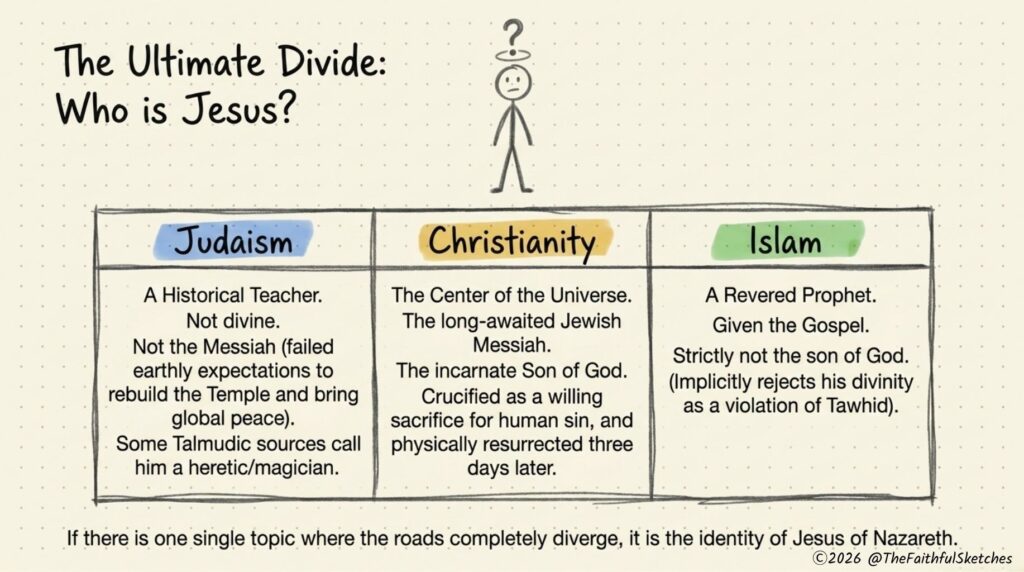
If there is one question where these three religions completely diverge, it is the identity of Jesus of Nazareth.
In Judaism, Jesus is viewed as a historical figure, a Jewish teacher who lived in the first century. He is not divine and he is not the Messiah. The Jewish expectation of the Messiah was an earthly king who would rebuild the Temple and usher in an era of global peace. Jesus, a preacher who died by crucifixion, did not fulfil those expectations. Some early Rabbinic sources in the Talmud treat Jesus as a figure who led people away from Jewish teaching, reflecting the tension that existed between early Jewish and Christian communities.
In Christianity, Jesus is the centre of everything. Christians believe he is the long-awaited Jewish Messiah, the incarnated Son of God, fully human and fully divine. The core belief of Christianity is that Jesus was crucified as a willing sacrifice to pay the penalty for the sins of humanity. Three days later, he physically rose from the dead, conquering death and offering eternal salvation to all who believe in him.
In Islam, Jesus (known as Isa) is one of the most honoured prophets in the Quran. He is born of a virgin, performs miracles, and is described as the Messiah. However, Muslims firmly reject the belief that Jesus is the Son of God or that he was crucified. Islamic tradition holds that God raised Jesus to heaven before the crucifixion could occur and that someone else died in his place. Muslims believe Jesus will return at the end of times, but as a Muslim prophet, not as a divine saviour.
Part 5: Heaven, Hell, and Salvation
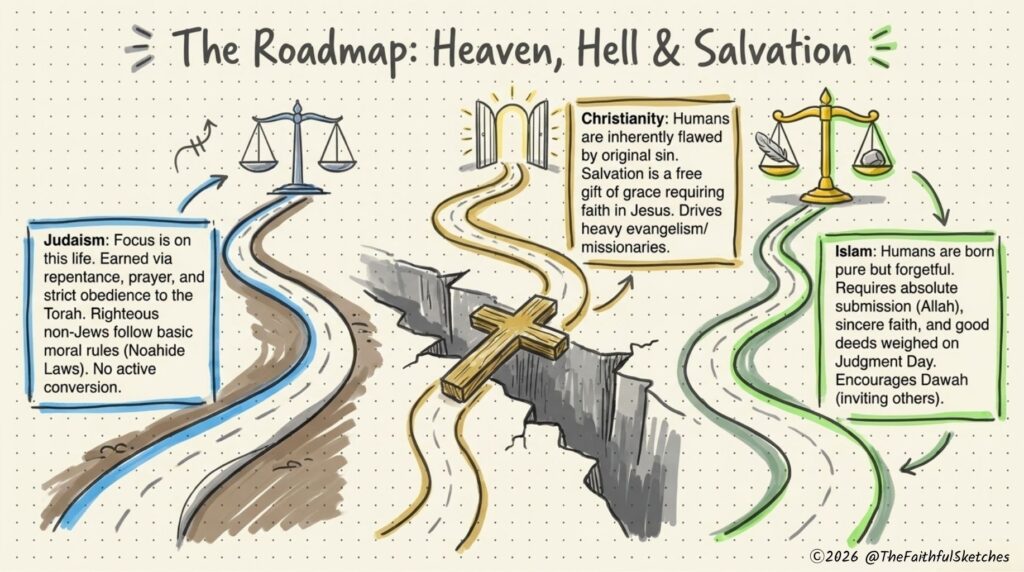
Because these three religions understand God and Jesus differently, their paths to salvation and their views on the afterlife are also distinct.
Judaism focuses primarily on living a just and ethical life in the present rather than on the afterlife. Salvation is achieved through repentance, prayer, and obedience to God’s law, the Torah. While Judaism does hold concepts of resurrection and a world to come, views on the afterlife vary widely. Notably, Judaism does not actively seek converts, believing that righteous non-Jews can still achieve a place in the world to come by following basic moral imperatives known as the Noahide Laws.
Christianity teaches that all humans are born flawed by original sin, making it impossible to earn a place in heaven through good deeds alone. Salvation is a free gift of grace. To be saved and granted eternal life in heaven, a person must place their faith in Jesus Christ as their saviour. Because faith in Jesus is seen as the only path to salvation, Christianity actively encourages evangelism and missionary work worldwide.
Islam teaches that humans are born pure but are forgetful and prone to sin. Salvation, entry into Paradise, and avoidance of Hell are achieved through sincere faith, submission to Allah, and good deeds. On the Day of Judgment, every person’s deeds will be weighed. Islam also actively encourages Dawah, the practice of inviting others to understand and embrace the faith.
Part 6: Rituals, Ethics, and Daily Life
All three religions share deep ethical roots. The Ten Commandments in Judaism and Christianity find almost identical parallels in the Quran: honouring parents, caring for the poor, and prohibitions against murder, theft, and dishonesty are central to all three.
But their defining rituals are unique to each tradition.
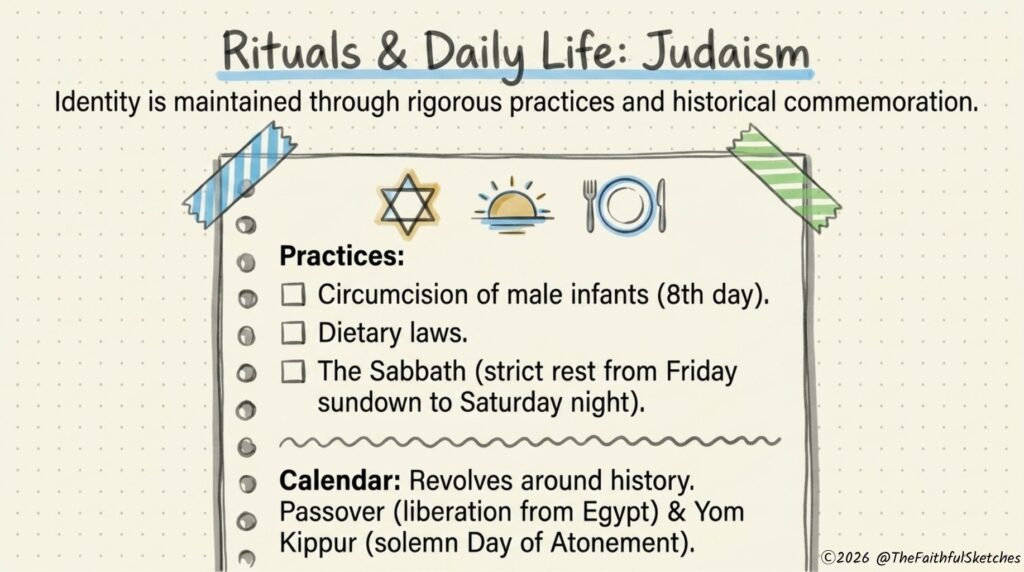
Judaism maintains its identity through specific practices: circumcision of male infants on the eighth day, observing the Sabbath from Friday sundown to Saturday night as a day of complete rest, and following detailed dietary laws. The Jewish calendar revolves around major festivals including Passover, commemorating liberation from Egypt, and Yom Kippur, the solemn Day of Atonement.
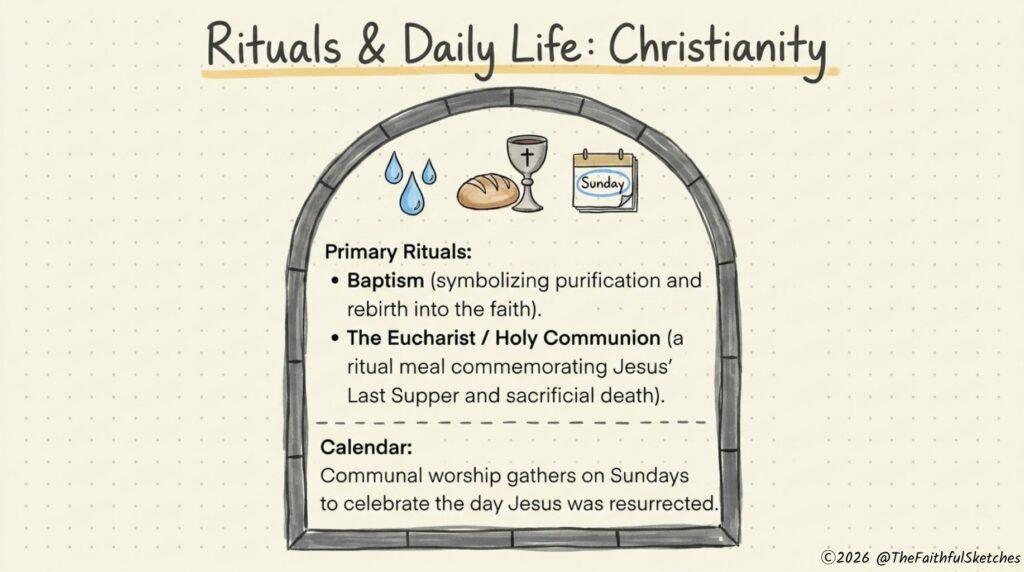
Christianity centres its ritual life on two primary practices. Baptism symbolises purification and rebirth into the faith. The Eucharist, or Holy Communion, is a ritual meal commemorating Jesus’ Last Supper and his sacrificial death. Christians typically gather for worship on Sundays, marking the day of the resurrection.
Islam structures daily life around the Five Pillars:
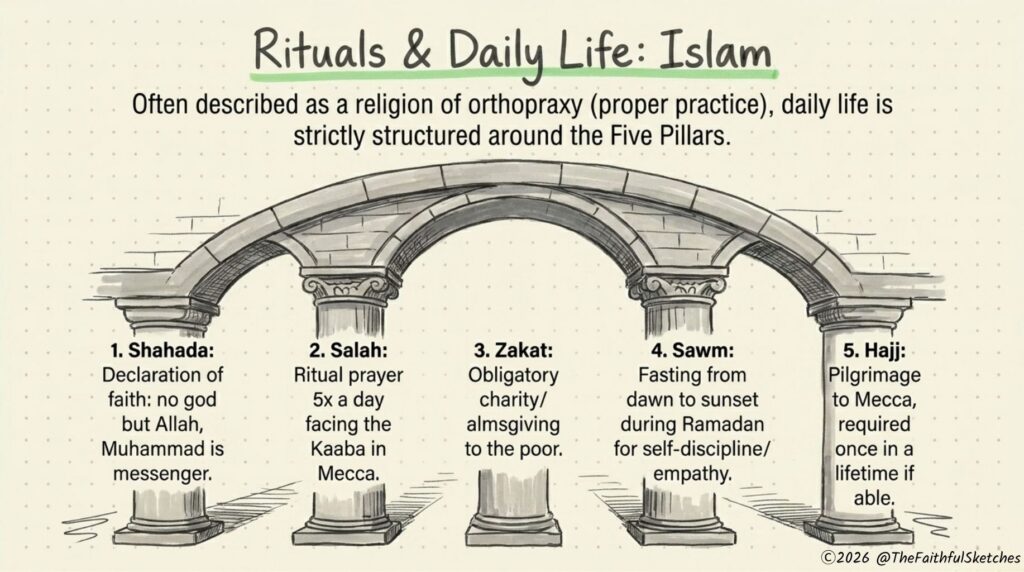
- The Shahada — the declaration that there is no god but Allah and that Muhammad is his messenger
- Salah — ritual prayer performed five times daily facing the Kaaba in Mecca
- Zakat — obligatory giving of a portion of one’s wealth to those in need
- Sawm — fasting from dawn to sunset throughout the holy month of Ramadan
- Hajj — the pilgrimage to Mecca, required at least once in a lifetime for every able Muslim
What Unites Them and What Divides Them
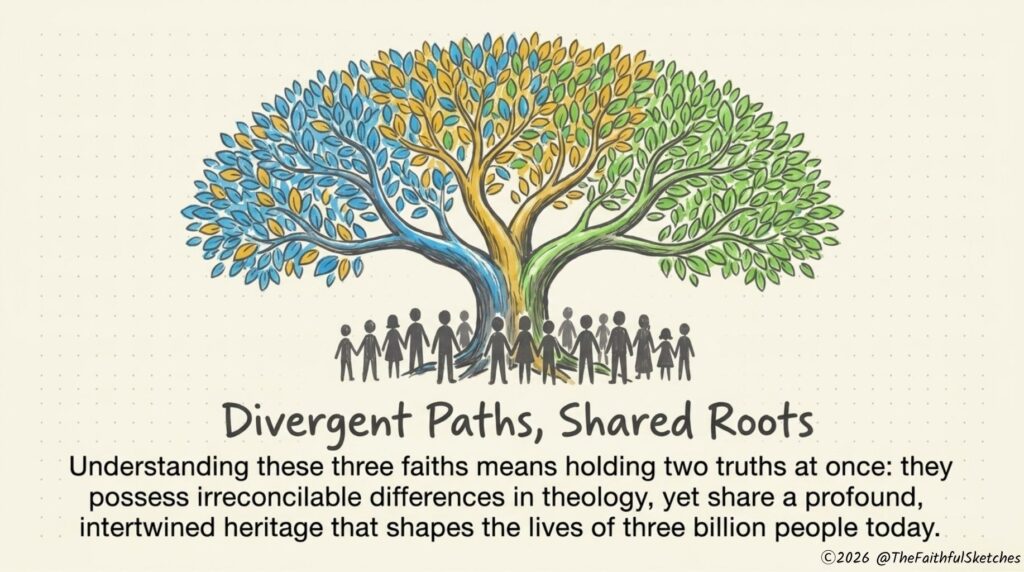
The Abrahamic religions are undisputed pillars of human history and culture. They overlap in remarkable ways: sharing ancient prophets, a reverence for the holy city of Jerusalem, a belief in angels, and the command to love God and care for the poor.
Yet they are not the same. Their theological frameworks clash over the nature of God, the identity and death of Jesus, and the path to eternal salvation.
Each of these three faiths offers a distinct, deeply held answer to the oldest questions human beings have ever asked: Why are we here? How should we live? And what happens when we die?
Understanding where they agree, and where they fundamentally differ, is one of the most important things any person can do to make sense of the world we live in.
Which of these three faiths do you come from? Is there a specific belief or practice you would like us to explore in more depth? Let us know in the comments below.
Click Below to Download The Full Visual PDF Summary Guide:
*Free for personal use only. Please don’t resell or redistribute commercially.