

If you’ve ever met a Seventh-day Adventist, you’ve probably noticed something different. Understanding Seventh-day Adventist beliefs means looking at why they worship on Saturday instead of Sunday, avoid certain foods, take health seriously, and talk about prophecy and the end times more than most Christians do. At some point, you’ve likely wondered: are Seventh-day Adventists just Christians with extra rules, or something else entirely?
Some Christians consider them fellow believers with unusual doctrines. Others think their teachings stray too far from mainstream Christianity. That debate has been running for over 150 years, and it still isn’t settled.
This post covers the history, core Seventh-day Adventist beliefs, practices, similarities, and controversies surrounding the SDA Church. The goal is straightforward: help you understand what Seventh-day Adventists actually believe, how they began, why they became controversial, and how they compare to mainstream Christianity.
A Quick Word on Christianity’s Diversity

Before getting into Seventh-day Adventist beliefs specifically, it’s worth noting how diverse Christianity already is. Roman Catholics, Eastern Orthodox, Baptists, Methodists, Lutherans, Pentecostals, Anglicans, Presbyterians. They all identify as Christian. All read the same Bible, but disagree on baptism methods, church governance, the role of Mary, whether salvation can be lost, and what communion actually means.
At Christianity’s core is one central claim: Jesus of Nazareth was the Son of God, he died for humanity’s sins, and he rose from the dead. Build your faith around that, and you’re inside the Christian tent. That baseline matters a lot when you get to the question of where SDAs fit.
Interesting fact: Adventism is one of the fastest-growing Christian denominations on earth. It grew from roughly 1 million members in 1955 to over 22 million today, with most of that growth happening in sub-Saharan Africa and South America.
The Origins of the SDA Church

To understand Seventh-day Adventist beliefs, you have to start in the 1840s in upstate New York.
A Baptist preacher named William Miller studied the book of Daniel and concluded that Jesus Christ would return to earth around 1844. Tens of thousands believed him. People sold their farms, gave away their possessions, and waited.
October 22, 1844 came and went. Nothing happened.
This became known as the Great Disappointment. Most followers walked away entirely. But a small group went back to their Bibles and concluded that something had happened in heaven in 1844, even if nothing visible occurred on earth. That distinction became a defining theological feature of the movement.
The Seventh-day Adventist Church formally organized in 1863. One of its most influential founders was Ellen G. White, who claimed visions and dreams from God and wrote over 100,000 pages of material during her lifetime. Her writings remain deeply authoritative within the church today.
Notably, the name itself tells you a lot. “Seventh-day” refers to Saturday worship. “Adventist” refers to their belief in the imminent second coming of Christ.
Today the church runs over 170 hospitals, one of the largest Protestant school systems in the world, and operates in over 200 countries. This is not a small fringe group.
Where Seventh-day Adventist Beliefs Align With Mainstream Christianity
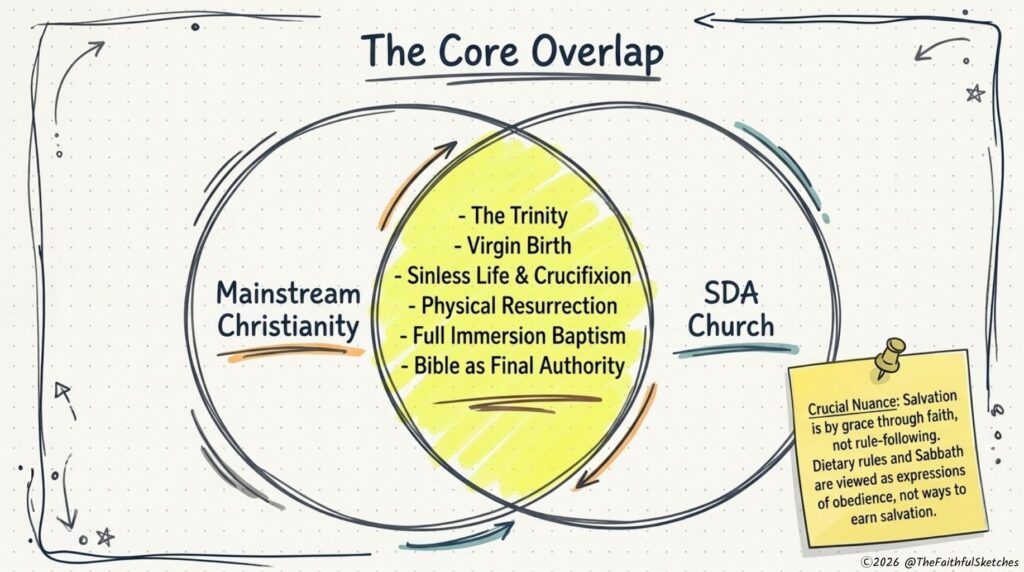
However, the differences tend to get more attention than the agreements. But the common ground is substantial.
SDAs believe Jesus Christ is the Son of God, born of a virgin, sinless, crucified, and physically raised from the dead. They hold the Trinity, treat the Bible as the inspired, final authority on faith and practice and they affirm salvation by grace through faith, not by works or rule-following.
In fact, this is a point people often get wrong about Adventists. The dietary rules and Sabbath observance are not ways to earn salvation in their theology. They’re expressions of obedience to a God they already believe has saved them.
They baptize by full immersion, practice communion, affirm the Ten Commandments as morally binding, and await the literal, physical return of Jesus Christ. If you read the SDA Church’s 28 Fundamental Beliefs, you would recognize the vast majority as standard Protestant theology.
Interesting fact: Ellen G. White is the most translated female writer in the history of literature. Her book Steps to Christ alone has appeared in over 140 languages, yet most people outside SDA circles have never heard her name.
The Key Differences in Seventh-day Adventist Beliefs
The differences between SDAs and mainstream Christianity are not trivial. They’re specific, documented, and in some cases, they’ve generated real theological controversy for more than 150 years. Here are the five most significant ones.
1. The Sabbath: Saturday, Not Sunday
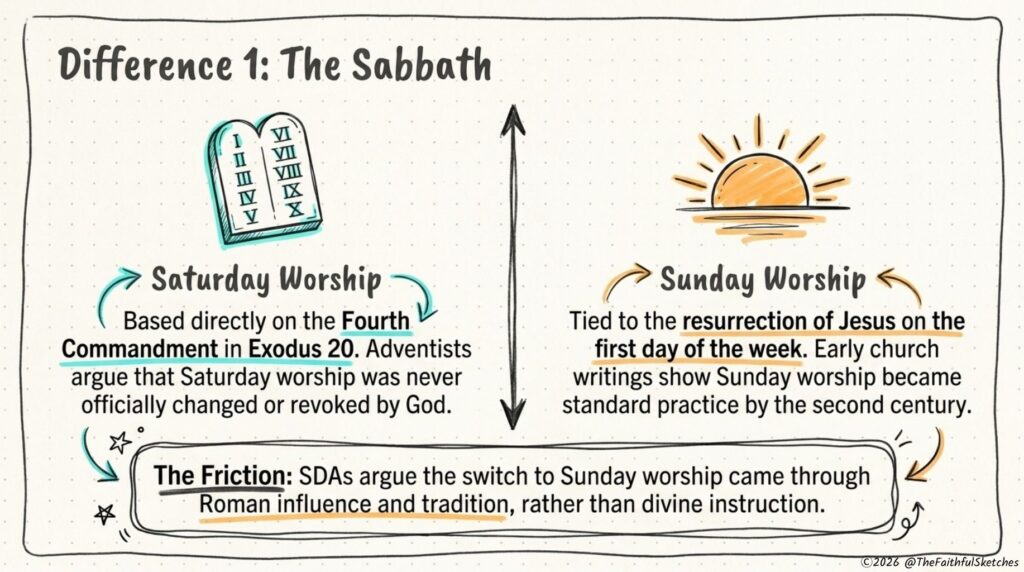
SDAs worship on Saturday. For SDAs, the reasoning is direct: the Bible says the seventh day is the Sabbath, Saturday is the seventh day, and God never officially changed that. They point to the Fourth Commandment in Exodus 20.
Most Protestant churches worship on Sunday, tied to the resurrection of Jesus on the first day of the week. Early church writings show Sunday worship becoming standard by the second century. SDAs argue that switch came through church tradition and Roman influence, not divine instruction.
Some SDA teachers have historically linked Sunday worship to the “mark of the beast” in Revelation, arguing a future law enforcing Sunday worship will be the mark. It’s not part of the official 28 Fundamental Beliefs, but it has complicated interfaith relationships.
2. Ellen G. White’s Prophetic Authority

Crucially, no other mainstream Protestant denomination has a post-biblical prophet whose writings carry ongoing institutional authority the way Ellen White’s do within the SDA Church.
SDAs say her writings are subordinate to the Bible, and White said the same herself. In practice, though, her books are quoted in sermons, studied in schools, and used to interpret scripture. For many Christians outside the SDA Church, this is the single biggest sticking point. The Protestant tradition from Luther onward holds that scripture alone is the final authority. A 19th-century prophetess whose writings guide church doctrine feels to many evangelicals like adding to scripture. SDAs dispute that framing, but the tension is real.
3. Soul Sleep: What Happens When You Die?
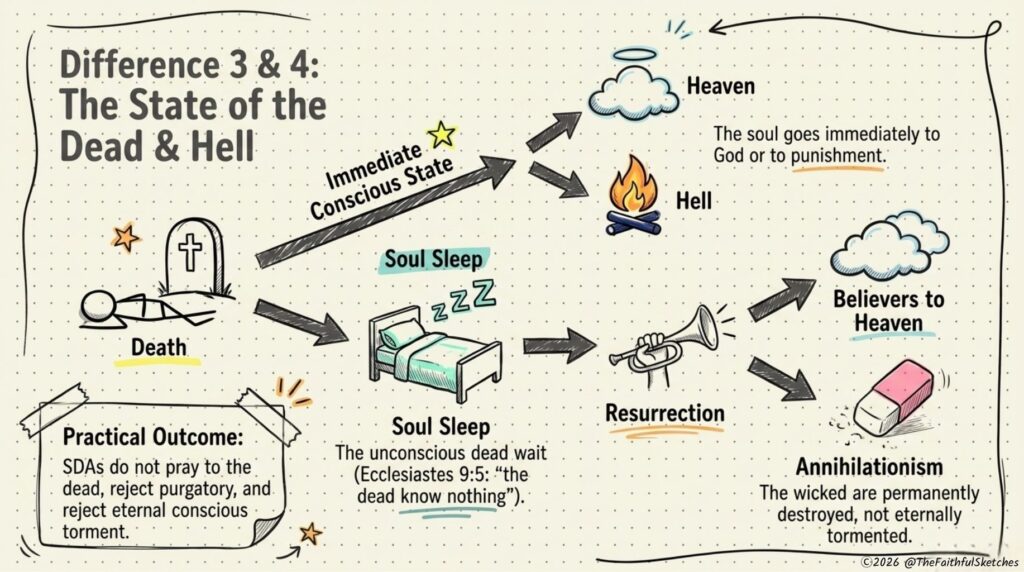
Most Catholics and Protestants teach that the soul goes immediately to conscious existence after death. SDAs disagree. They believe the soul enters an unconscious state at death until the resurrection at Christ’s return. The dead are not in heaven watching over loved ones. They’re not in hell being punished yet. They’re waiting.
They base this on Ecclesiastes 9:5 and John 11, where Jesus describes Lazarus as “sleeping” before raising him. Practically, this means SDAs don’t pray to the dead, reject purgatory, and are skeptical of claims about communicating with the deceased.
4. Annihilationism: No Eternal Hell
SDAs reject eternal conscious torment in hell. Their position, called annihilationism, is that the wicked are resurrected at the end of time, face judgment, and are permanently destroyed. They cease to exist. This is the “second death” described in Revelation.
This puts them at odds with Catholicism and much of Protestant evangelicalism, though annihilationism has quietly gained ground among some evangelical scholars in recent decades.
Interesting fact: The SDA Church officially rejected the prosperity gospel decades before it became a major controversy in evangelical circles, consistently teaching that material wealth is not a sign of God’s favor.
5. Diet and Lifestyle
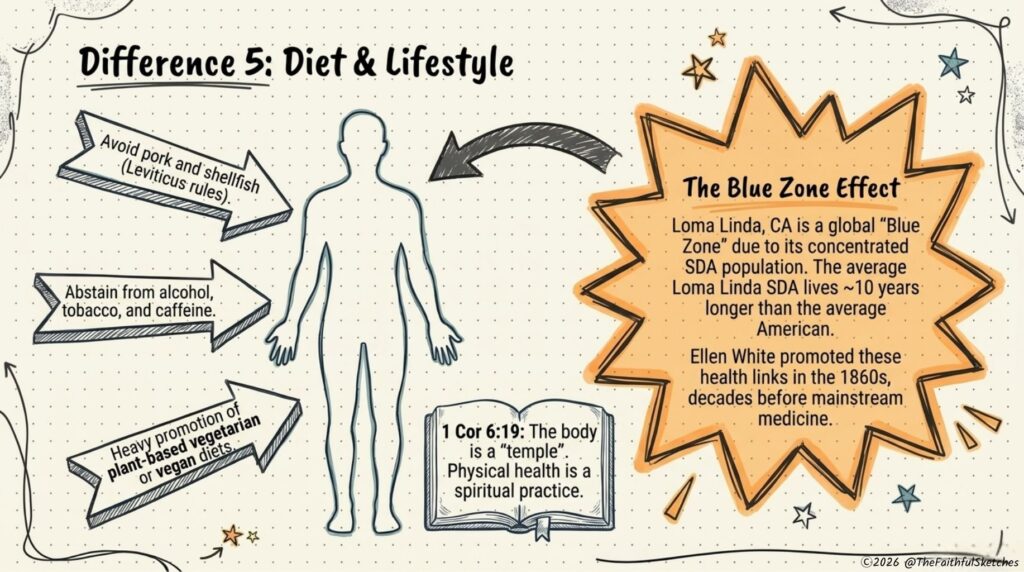
SDAs avoid pork and shellfish, following Leviticus. Many are vegetarian or vegan. They also abstain from alcohol, tobacco, and caffeine, including coffee and tea in more conservative circles.
This is theological, not just cultural. The body is a “temple of the Holy Spirit” per 1 Corinthians 6:19, and physical health is part of their spiritual practice. Ellen White promoted plant-based diets, fresh air, and exercise in the 1860s, decades before mainstream medicine confirmed those benefits.
The results are measurable. Loma Linda, California, one of the most concentrated SDA communities in the US, is one of Dan Buettner’s five global Blue Zones. The average Loma Linda Adventist lives about 10 years longer than the average American.
The Three Major Controversies
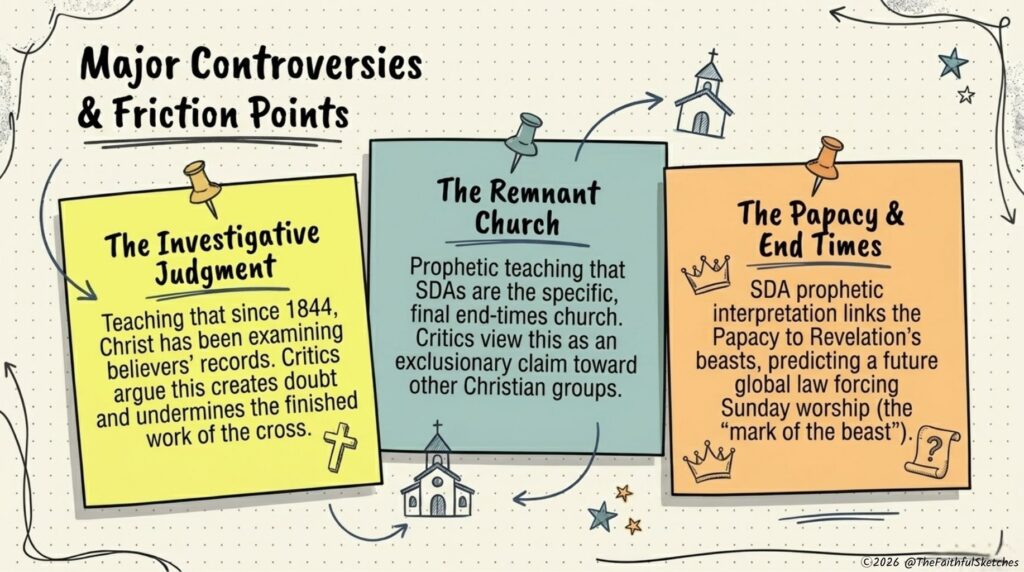
Three areas of Seventh-day Adventist beliefs generate the most friction with other Christians.
The Investigative Judgment. SDAs teach that since 1844, Christ has been examining the records of believers in heaven before confirming their salvation. Critics argue this undermines the finished work of Christ on the cross and creates unnecessary doubt about whether a believer is truly saved.
The Remnant Church. SDAs have historically taught that their organization is the specific end-times church described in prophecy. Critics read that as an exclusionary claim that positions every other Christian group as spiritually incomplete.
The Papacy and End Times. Traditional SDA prophetic interpretation links the Roman Catholic Papacy to the beasts in Revelation and teaches that a future global crisis will produce a law forcing Sunday worship, identified as the mark of the beast. Both Catholics and most Protestants find this teaching deeply divisive.
Are Seventh-day Adventists Considered Christian by Other Christians?
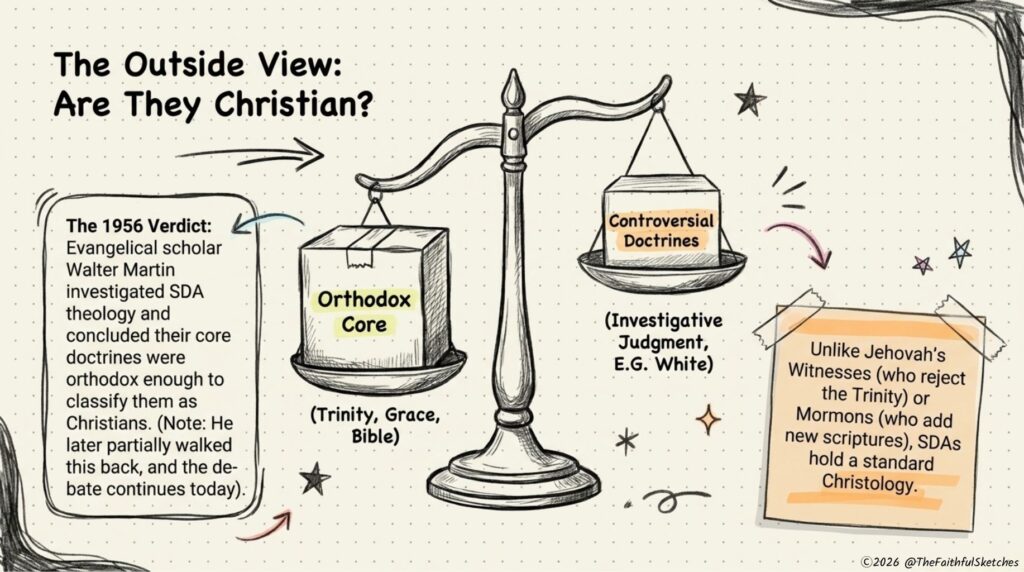
This question has a documented history, and the answer has shifted over time.
In 1956, evangelical scholars Walter Martin and Donald Barnhouse met with Adventist theologians. Martin had planned to label SDAs a cult in his book Kingdom of the Cults. After those discussions, he changed his mind, concluding their core doctrines were orthodox enough to classify them as Christians.
That decision remains contested. Critics still point to the Investigative Judgment and Ellen White’s prophetic authority as crossing theological lines.
Compare SDAs to Jehovah’s Witnesses and Mormons, two groups almost universally considered outside mainstream Christianity. Jehovah’s Witnesses reject the Trinity entirely. Mormons add additional scriptures and teach a God who was once human. SDAs do neither. They affirm the Trinity, use only the Bible as their canonical text, and hold a standard Christology. That’s a significant distinction.
Interesting fact: Walter Martin later partially walked back his 1956 conclusion, expressing renewed concern about Ellen White’s authority. The debate he started has never fully settled. Serious theologians still land on both sides of it today.
How Seventh-day Adventists See Themselves
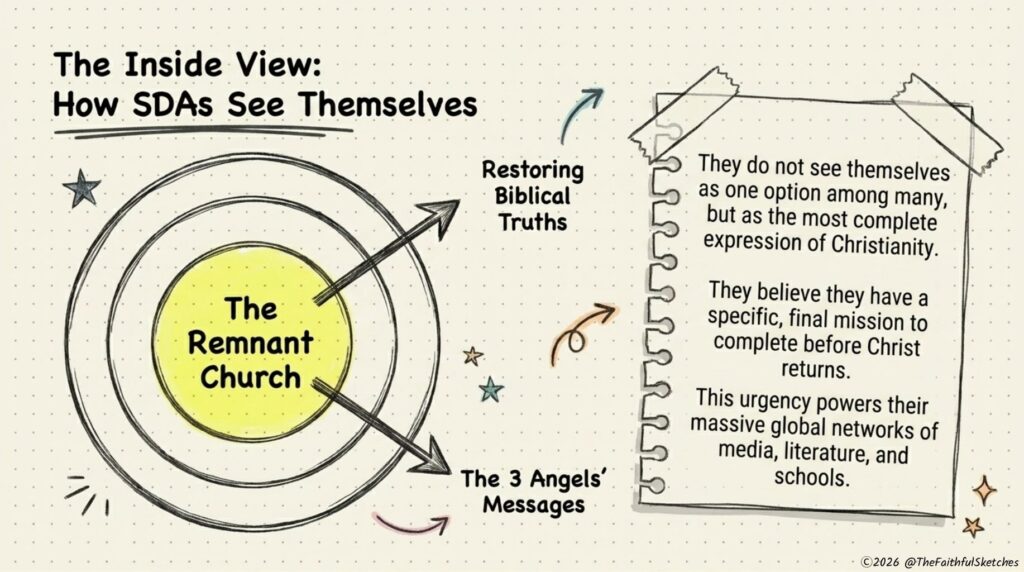
Seventh-day Adventists don’t see themselves as separate from Christianity. They see themselves as the most complete expression of it.
They use the language of the “remnant church,” drawn from Revelation 12:17, describing a final group of believers who keep God’s commandments and hold to the testimony of Jesus. Their mission, as they understand it, is to carry restored biblical truths to the world before Christ returns.
Central to that mission are the Three Angels’ Messages from Revelation 14, which include calls to worship God, announcements of coming judgment, and warnings against a corrupt religious system.
This is not a denomination that sees itself as one option among many. That self-understanding explains the schools, the hospitals, the global media network, and the literature distribution. They believe they have a specific job to do before time runs out.
Interesting fact: The SDA Church runs the largest Protestant educational system in the world, with over 8,000 schools across 145 countries.
Final Thoughts
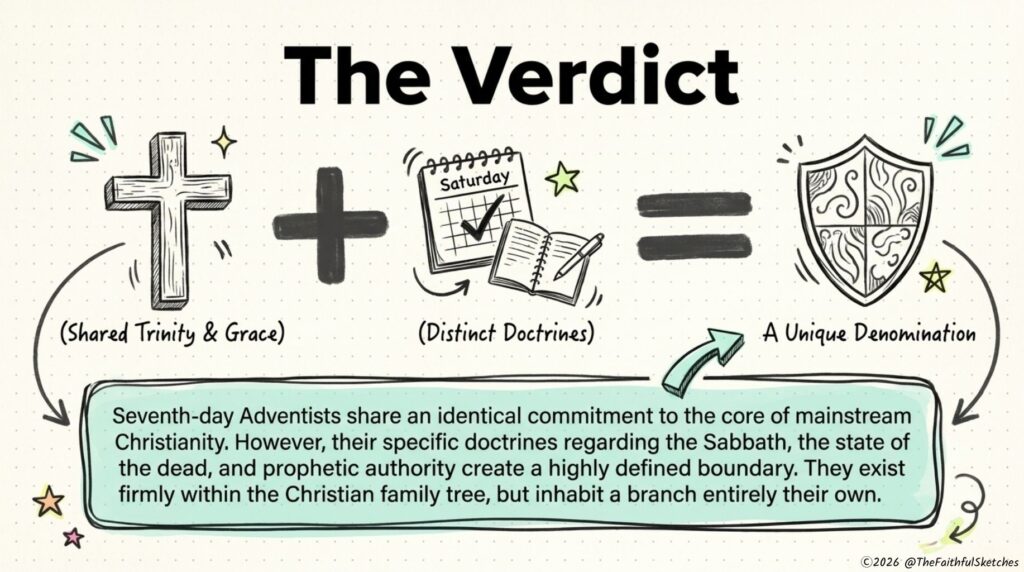
Seventh-day Adventists and mainstream Christians share a commitment to the Trinity, the authority of the Bible, and salvation through Jesus Christ. Their deep differences regarding the Sabbath, the state of the dead, the Investigative Judgment, and Ellen White’s prophetic status create a distinct theological identity that mainstream denominations view in different ways, ranging from unorthodox peers to something outside traditional Christian boundaries.
Where you land depends largely on how much doctrinal deviation you think disqualifies someone from the Christian label.
What are your thoughts on Seventh-day Adventist beliefs? Drop a comment below.
Want to go deeper on similar questions? Check out my post on What Do Jehovah’s Witnesses Actually Believe? for another detailed look at a group that frequently gets mislabeled.
Click Below to Download The Full Visual PDF Summary:
*Free for personal use only. Please don’t resell or redistribute commercially.