
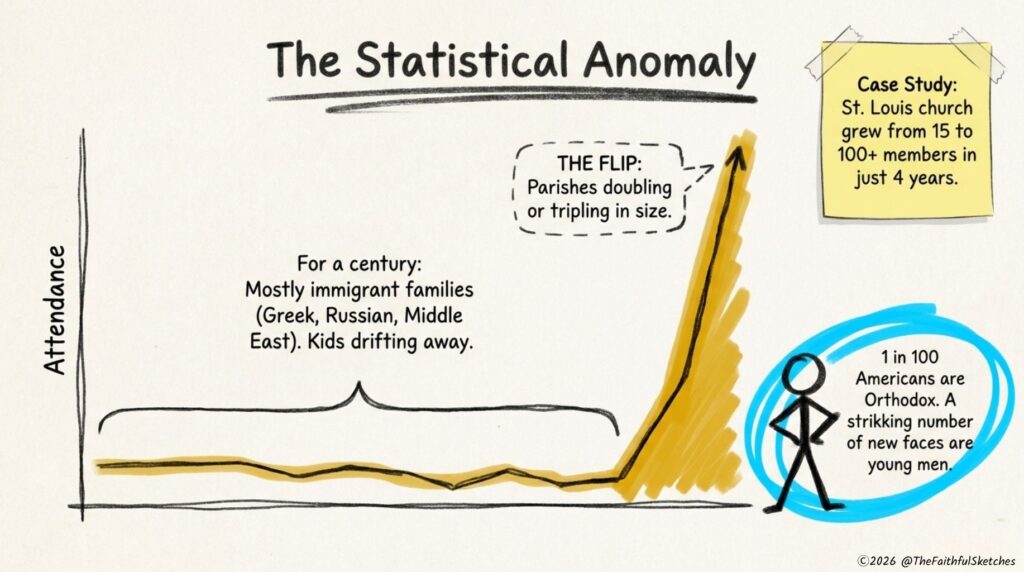
It’s the smallest of the three big branches of Christianity. Only about one in a hundred Americans belongs to it. For most of the last century, its pews held immigrant families from Greece, Russia, and the Middle East, and many of their kids drifted off to other churches. Then something flipped.
Priests across the United States started reporting record crowds. Some parishes doubled or tripled in size. One small church in St. Louis grew from 15 members to over 100 in just four years, and a striking number of the new faces are young men. So here’s the Eastern Orthodox Church explained from the ground up, including what it believes, how it worships, and why so many people are converting to it right now. Let’s draw it out.
What Is the Eastern Orthodox Church?
Christianity has three main branches: Roman Catholic, Protestant, and Eastern Orthodox. Orthodoxy is the one most people in the West know least about. The Orthodox Church claims to be the original church, the one the apostles started, passed down without ever breaking.
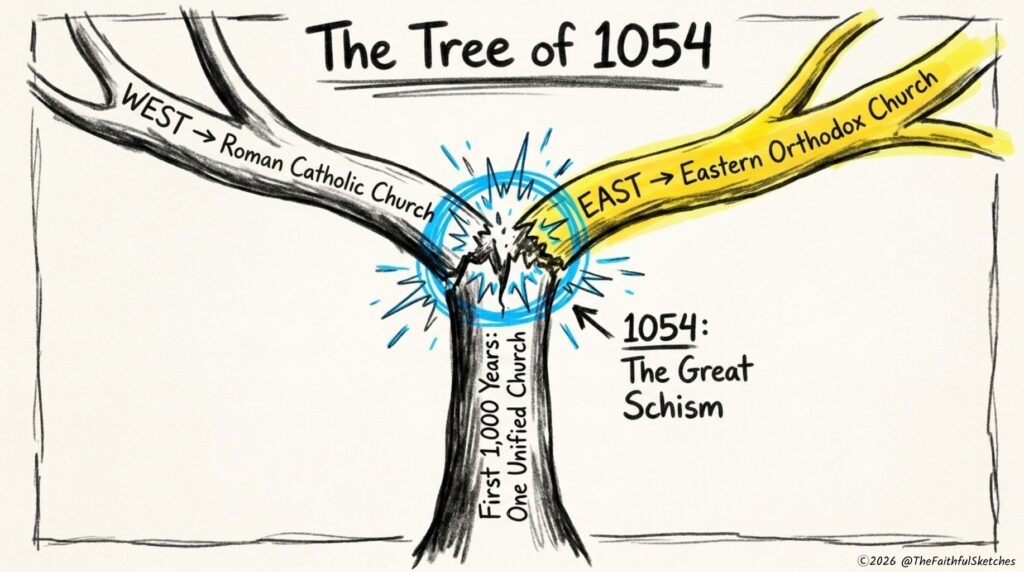
For the first thousand years, East and West were one church. Then in 1054 they split. The West became the Roman Catholic Church, and the East became the Eastern Orthodox Church. If you want the full story of how that happened and why the two sides never reunited, see my post on the Great Schism of 1054.
What Orthodoxy Looks Like Today
So what does Orthodoxy look like now? There’s no single pope. Instead there are self-governing churches: Greek, Russian, Serbian, Romanian, Antiochian, and more. The Patriarch of Constantinople is honored as first among equals, but he can’t give orders to the rest.
The worship is ancient and physical. Services are long and mostly conducted standing, with heavy incense and chanting instead of a worship band. The walls are covered in icons, painted images of Christ and the saints that worshippers kiss and bow before. And the whole point has a name: theosis. It’s the belief that a person can grow so close to God that they begin to share in God’s own life. It doesn’t mean becoming God. It means being changed by God, little by little, your whole life long.
The Orthodox View of Salvation
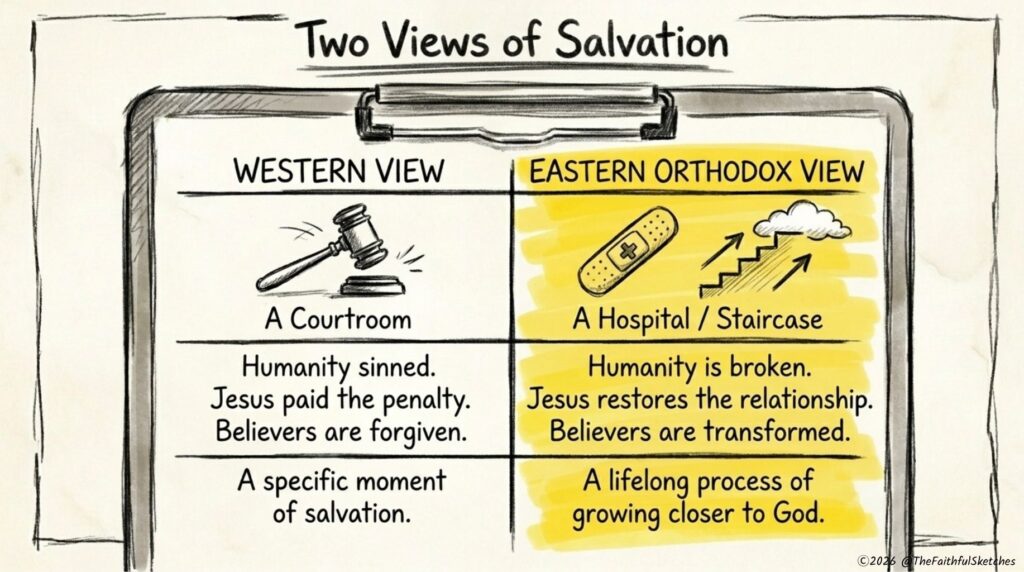
Many Christians describe salvation primarily in legal terms: humanity sinned, Jesus paid the penalty, and believers are forgiven. Orthodox Christians agree that forgiveness is essential, but they often emphasize another aspect of salvation, namely transformation. The Orthodox Church teaches that Christ came not only to forgive sinners but also to restore humanity’s relationship with God.
A famous statement from the early church father Athanasius of Alexandria captures it: “God became man so that man might become god.” That can sound shocking at first. Orthodox Christians don’t mean humans become gods by nature. Instead, they teach theosis, or deification, the idea that believers are gradually transformed by God’s grace to become more like Christ. They often connect this to 2 Peter 1:4, which speaks of becoming “partakers of the divine nature.”
For Orthodox Christians, then, salvation isn’t simply a single moment. It’s a lifelong process of growing closer to God, in which prayer, repentance, participation in the sacraments, and acts of love are all part of the journey. This differs in emphasis from the Reformed and Protestant views I cover in my post on Reformed theology and Calvinism.
How Orthodox Worship Differs
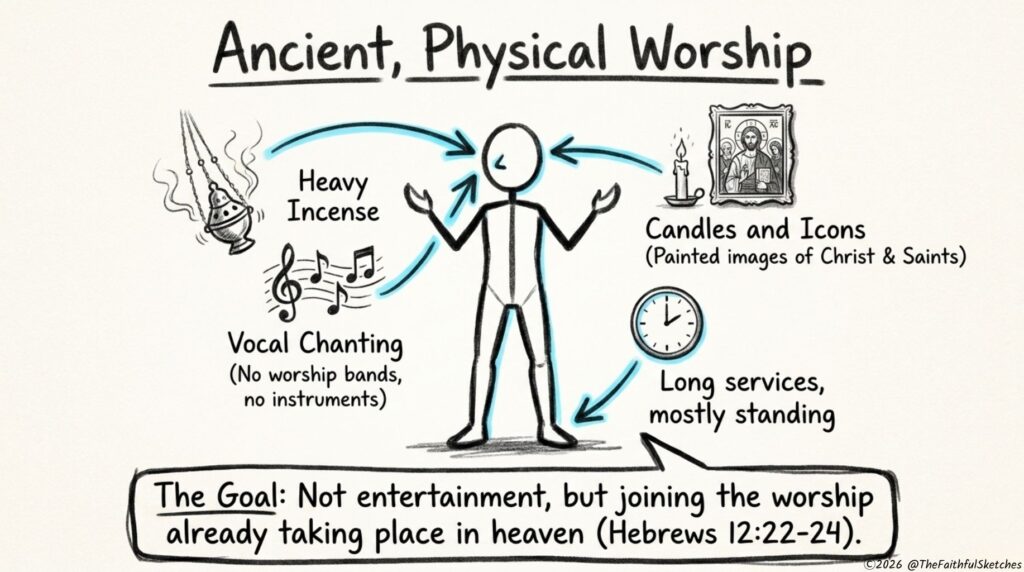
One of the first things visitors notice is that Orthodox worship feels very different from many modern churches. Services are often filled with chanting, incense, icons, candles, ancient prayers, and a liturgy with roots stretching back centuries. Many Orthodox churches use no instruments at all, so the music is entirely vocal.
The goal isn’t entertainment. It’s reverence and participation in heavenly worship. Orthodox Christians frequently point to Hebrews 12:22-24, believing that worship joins them with the worship already taking place in heaven. Another feature that attracts newcomers is the use of icons, sacred images of Christ, biblical figures, and saints. Orthodox Christians don’t worship icons. They view them as visual reminders of spiritual realities and as teaching tools, a distinction critics have often misunderstood.
Why Are People Converting to Orthodoxy?
Now we reach the question that has generated so much attention lately. Why are people converting? The reasons vary, but several themes appear over and over.
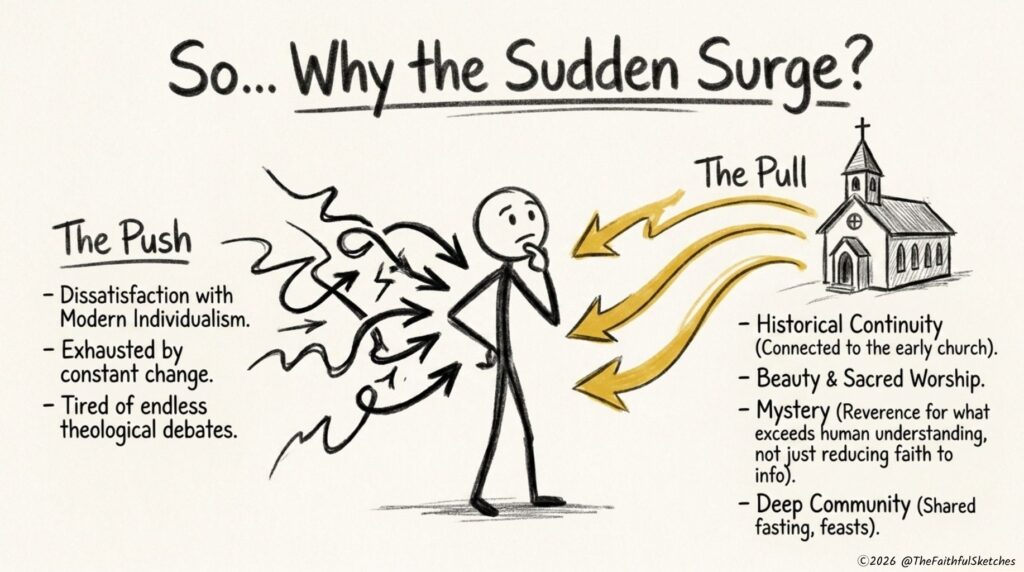
1. A Desire for Historical Continuity
Many converts say they wanted a faith deeply connected to the early church. They began studying Christian history and became convinced that Orthodoxy preserved ancient beliefs and practices more faithfully than other traditions. Whether or not you agree with that conclusion, the appeal of historical continuity is a major draw.
2. Dissatisfaction With Modern Individualism
Many people feel overwhelmed by a culture that constantly changes. Some Christians also feel exhausted by endless theological debates and church divisions. Orthodoxy offers a tradition that emphasizes continuity, stability, and collective wisdom rather than personal interpretation alone.
3. Beauty and Sacred Worship
Many converts describe their first Orthodox service as profoundly moving. The combination of chant, incense, icons, Scripture readings, and ancient prayers creates an experience that feels worlds apart from contemporary worship environments.
4. A Strong Sense of Mystery
Modern culture often reduces everything to information. Orthodoxy instead places strong emphasis on mystery, not mystery as ignorance, but mystery as reverence before truths that exceed human understanding. Many converts say this approach feels spiritually refreshing.
5. The Search for Community
Orthodox parishes often emphasize shared worship, fasting seasons, feast days, and communal life. For people starved of real connection, that sense of belonging is a powerful pull.
Common Criticisms and Questions
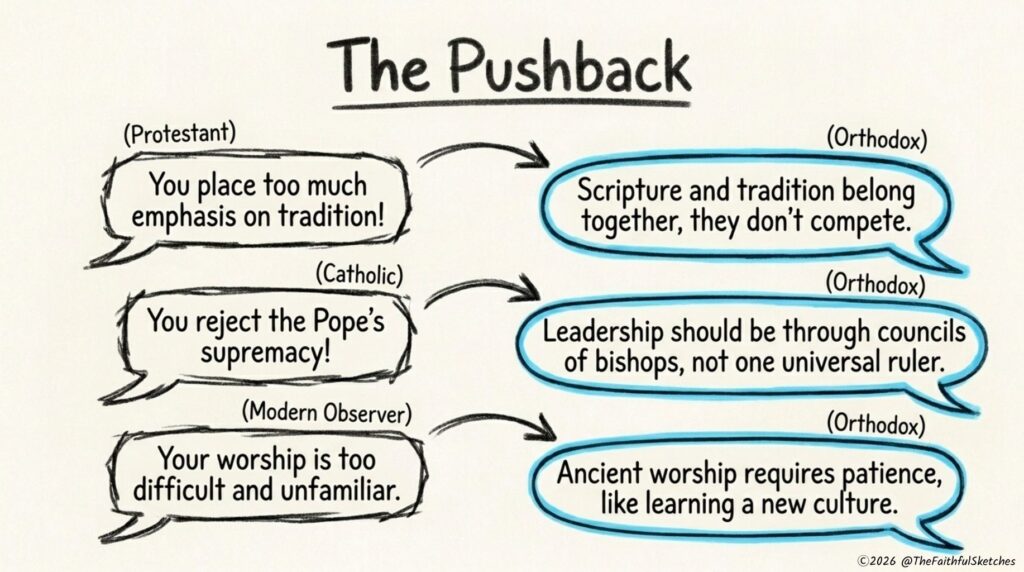
No Christian tradition is without criticism, and Orthodoxy faces several common objections. Some Protestants argue that it places too much emphasis on tradition. Orthodox Christians respond that Scripture and apostolic tradition belong together rather than competing. Some Catholics question the Orthodox rejection of papal supremacy. Orthodox Christians maintain that church leadership should operate through councils and bishops rather than a single universal bishop.
Others simply find Orthodox worship unfamiliar or hard to follow. In response, Orthodox Christians often argue that ancient worship requires patience and learning, much like entering a different culture. These debates have existed for centuries and remain active discussions within Christianity today.
What Orthodox and Other Christians Share
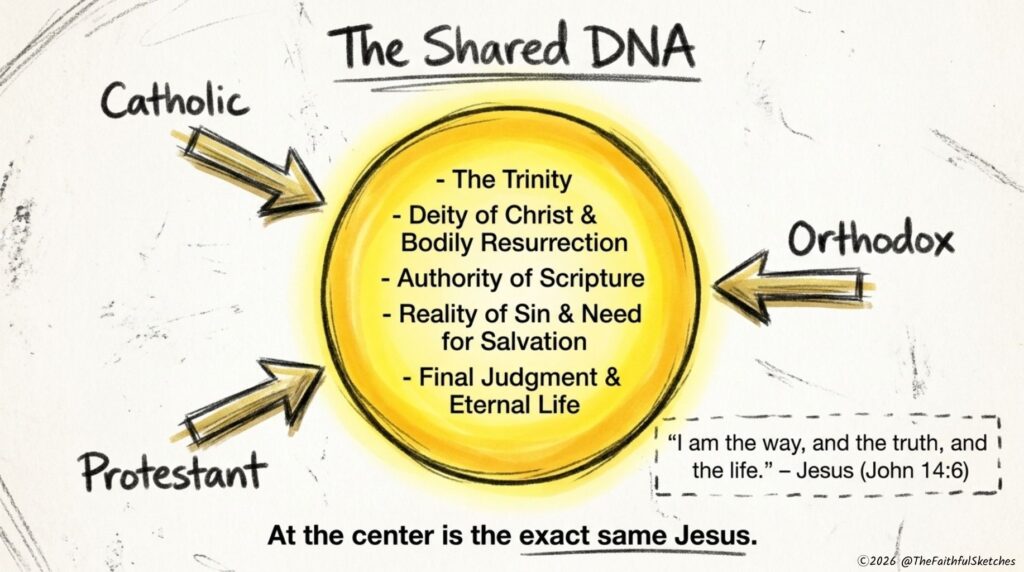
Despite real differences, Orthodoxy shares many core beliefs with Catholics and Protestants. Orthodox Christians affirm the Trinity, the deity of Christ, the bodily resurrection of Jesus, the authority of Scripture, the reality of sin, the need for salvation, the final judgment, and the hope of eternal life. At the center stands the same Jesus who declares in John 14:6, “I am the way, and the truth, and the life.” For a wider comparison of all three branches, see my post on Catholic, Orthodox, and Protestant differences.
The Eastern Orthodox Church Explained at a Glance
Here’s a quick side-by-side to see where Orthodoxy sits among the three branches.
| Feature | Eastern Orthodox | Roman Catholic | Protestant |
|---|---|---|---|
| Leadership | Self-governing churches, no single pope | Pope as universal head | Varies by denomination |
| Salvation emphasis | Theosis, transformation | Grace through faith and works | Grace through faith alone |
| Worship style | Ancient liturgy, chant, icons, incense | Liturgical, the Mass | Ranges from traditional to contemporary |
| Authority | Scripture and apostolic tradition together | Scripture, Tradition, Magisterium | Scripture alone |
| Icons | Venerated as windows to heaven | Statues and images used | Usually minimal or none |
Conclusion: A Reality Check
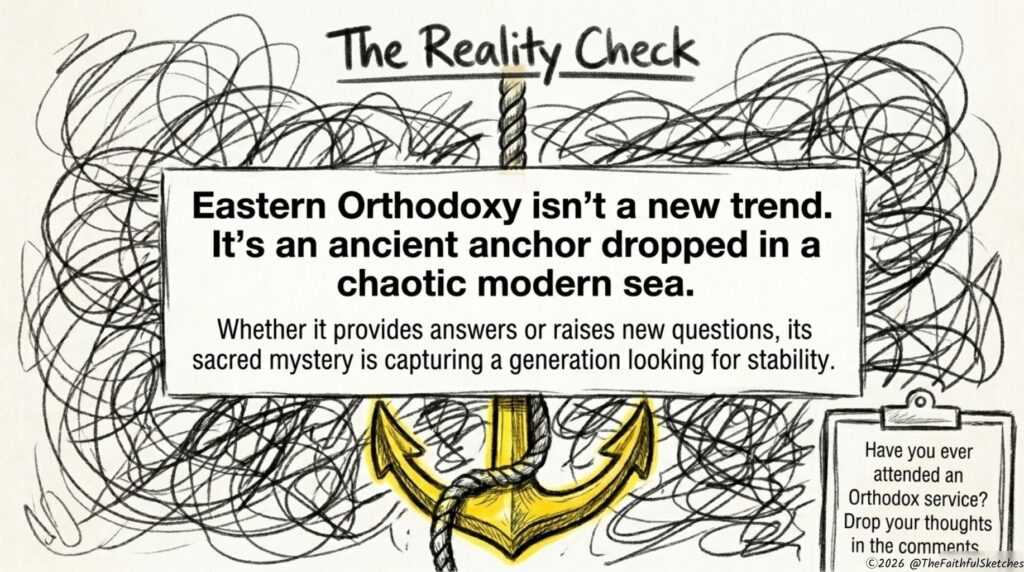
With the Eastern Orthodox Church explained branch by branch, one thing stands out. This isn’t a new movement. It’s one of the oldest surviving Christian traditions in history. Its ancient worship, emphasis on spiritual transformation, connection to the early church, and sense of sacred mystery continue to attract people from many backgrounds. For some, it provides answers they feel they couldn’t find elsewhere. For others, it raises new questions.
Either way, understanding Orthodoxy helps us better understand the wider story of the Christian faith, whether you’re Orthodox, Catholic, Protestant, or simply curious. Have you ever attended an Orthodox service, or are you considering visiting one? Share your thoughts in the comments below.
Click Below to Download The Full PDF Summary Visual Guide:
*Free for personal use only. Please don’t resell or redistribute commercially.