
Turn on certain Christian TV channels and you’ll hear a familiar promise. Have enough faith, speak the right words, give the right amount, and God will make you healthy, wealthy, and successful. It sounds appealing, even biblical at first. But what is the prosperity gospel actually teaching, and does it line up with Scripture?
This is a question worth taking seriously, because millions of people build their faith on it. In this post, we’ll define the prosperity gospel clearly, look at why so many theologians consider it dangerous, name its most influential teachers, and then test its 15 core claims against what the Bible actually says. I’ll also share something personal near the end, since this topic isn’t abstract for me.
What Is the Prosperity Gospel?
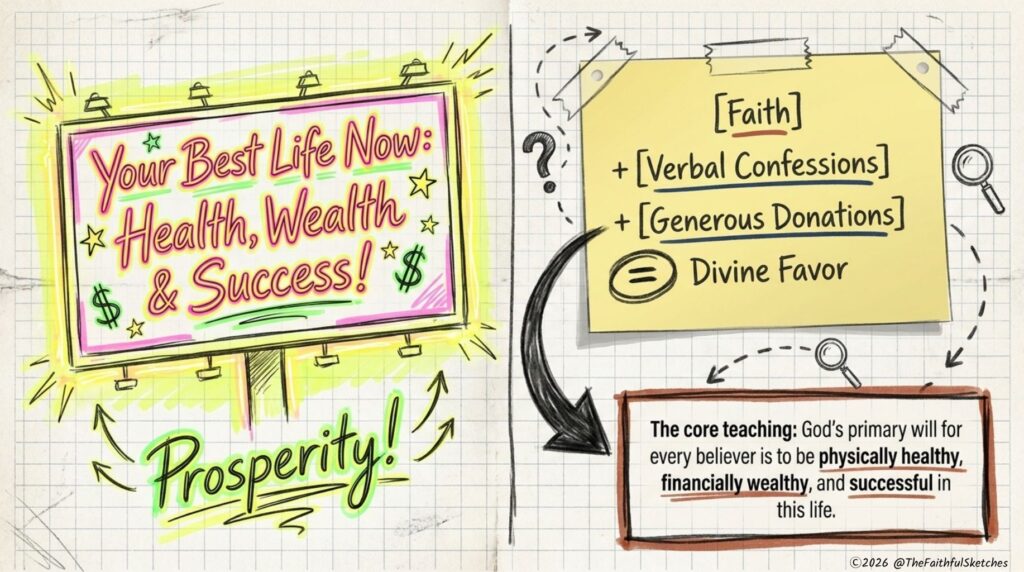
The prosperity gospel teaches that God’s primary will for every believer is to be physically healthy, financially wealthy, and successful in this life. It often promises that through specific actions you can unlock divine favor and live your “best life now.”
Those actions usually include having enough faith, making positive verbal “confessions” (often summarized as “name it and claim it” or “believe it, receive it”), and giving generously to a ministry. In this framework, the right inputs are believed to produce guaranteed material outputs. That transactional logic is exactly where the trouble begins.
Why Is the Prosperity Gospel Considered Dangerous?
Critics, including many orthodox Christian theologians, argue the prosperity gospel is perilous for several reasons. It’s worth walking through each one.
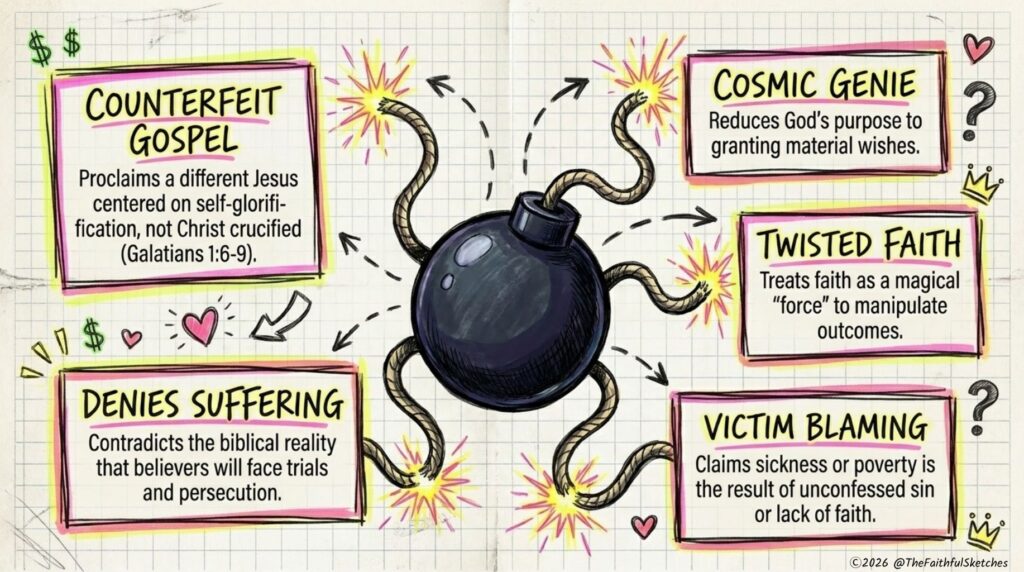
First, it presents a counterfeit gospel. Paul warns in Galatians 1:6-9 against any “different gospel,” and critics say this teaching proclaims a different message centered on self-glorification rather than Christ crucified. Second, it reduces God to a cosmic genie, portraying Him as someone whose main job is to grant material wishes rather than being the sovereign Lord who is Himself our greatest treasure. Third, it twists the nature of faith, treating it as a magical force or formula to manipulate God rather than a trusting relationship with Him.
Fourth, it blames the victim. Under this teaching, poverty or sickness signals a lack of faith or unconfessed sin, which heaps guilt on people who are already suffering. Fifth, it denies the reality of Christian suffering. The Bible consistently teaches that believers will face trials and persecution, as in John 16:33, Acts 14:22, and 2 Timothy 3:12. A promise of a pain-free life directly contradicts this.
Key Figures and Their Specific Criticisms
The prosperity gospel is promoted by several high-profile televangelists and authors. While often popular, their teachings draw specific critiques.
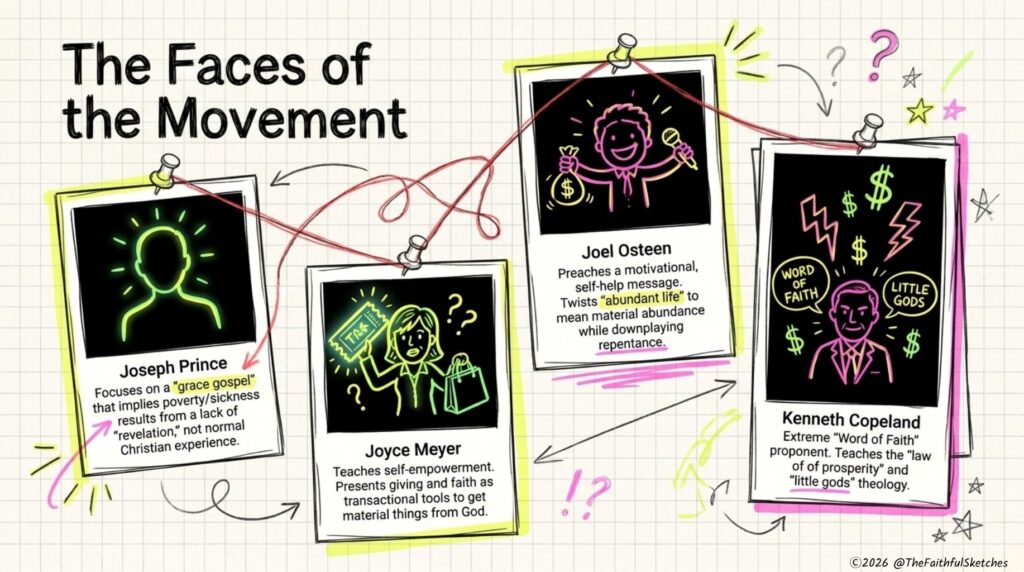
Joseph Prince teaches a “grace gospel” that critics say repackages prosperity doctrine. He often implies that poverty and sickness result from a lack of “revelation” of Christ’s finished work, rather than being a normal part of Christian experience.
Joel Osteen preaches a self-help, motivational message focused on personal success and happiness. Critics argue he downplays sin, repentance, and the cross, and reframes the “abundant life” of John 10:10 to mean material abundance.
Joyce Meyer teaches practical, self-empowerment Christianity. Critics say she presents giving, obedience, and faith as transactional tools to get material things from God, though she has admitted her earlier views on prosperity were “out of balance.”
Kenneth Copeland is an extreme proponent of the “Word of Faith” movement. He teaches a “law of prosperity,” where giving compels God to give back more, alongside a “little gods” theology claiming humans are divine beings of the same spiritual class as God Himself.
A Personal Note
I don’t write about this from the outside. I actually left New Creation Church after sitting under Joseph Prince’s teaching for 15 years. Walking away from something you’ve invested that long in is not simple, and I understand why people stay. If you’d like me to share why I left, or if you’ve had a similar experience, let me know in the comments below.
The Prosperity Gospel vs the Bible: 15 Deceptions
The prosperity gospel offers a counterfeit version of Christianity that appeals to our natural desires but falls far short of the true gospel’s eternal hope. The authentic biblical message calls believers to find their ultimate treasure in Christ alone, not in the temporary riches of this world. Here are the top 15 deceptions side by side with what Scripture actually says.
| # | The Prosperity Claim | What the Bible Says |
|---|---|---|
| 1 | God’s will is for you to be rich in money and possessions | “Godliness with contentment is great gain” (1 Timothy 6:6-7); the camel and the needle (Matthew 19:24) |
| 2 | Poverty is a curse or a lack of faith | God chose the poor “to be rich in faith” (James 2:5); Paul learned contentment in need (Philippians 4:12) |
| 3 | “Sow a financial seed” to release a harvest | Give “not reluctantly or under compulsion, for God loves a cheerful giver” (2 Corinthians 9:7); giving is grace, not an investment |
| 4 | “Name it and claim it” into existence | “You ask with wrong motives” (James 4:3); Jesus prayed “not my will, but yours” (Luke 22:42) |
| 5 | Jesus was physically rich, so you can be too | “The Son of Man has no place to lay his head” (Matthew 8:20); “sell everything” (Luke 18:22) |
| 6 | Enough faith always brings physical healing | Paul left Trophimus sick (2 Timothy 4:20); his thorn remained, “my grace is sufficient” (2 Corinthians 12:9) |
| 7 | A Christian should never suffer or lose | “Consider it pure joy… when you face trials” (James 1:2-3); suffering produces character (Romans 5:3-4) |
| 8 | The atonement guarantees health and wealth now | “By his wounds we are healed” is primarily spiritual (Isaiah 53:5); full healing comes at the resurrection (Revelation 21:4) |
| 9 | The “abundant life” means money and things | The full life is knowing God through Christ (John 10:10; John 17:3) |
| 10 | You’re a child of the King, so live like royalty | Christ “became poor, so that you… might become rich” in grace, not money (2 Corinthians 8:9) |
| 11 | Give $100, God returns $1,000 | “Give, and it will be given to you” is about mercy and forgiveness in context (Luke 6:38) |
| 12 | Angels are your servants to bring you wealth | Angels are “ministering spirits” serving God’s purposes (Hebrews 1:14); Jesus refused to summon them (Matthew 26:53-54) |
| 13 | Avoid the poor; associate with the wealthy | “Speak up… for the destitute” (Proverbs 31:8); the widow’s coins were the greatest gift (Mark 12:41-44); favoritism rebuked (James 2:1-6) |
| 14 | Faith is a force to get things | Faith is trust in God’s character, not a tool to manipulate outcomes (Hebrews 11:1) |
| 15 | God’s main goal is your earthly prosperity | The goal is God’s glory and our eternal joy (1 Corinthians 10:31); treasures in heaven (Matthew 6:19-21) |
Why This Matters
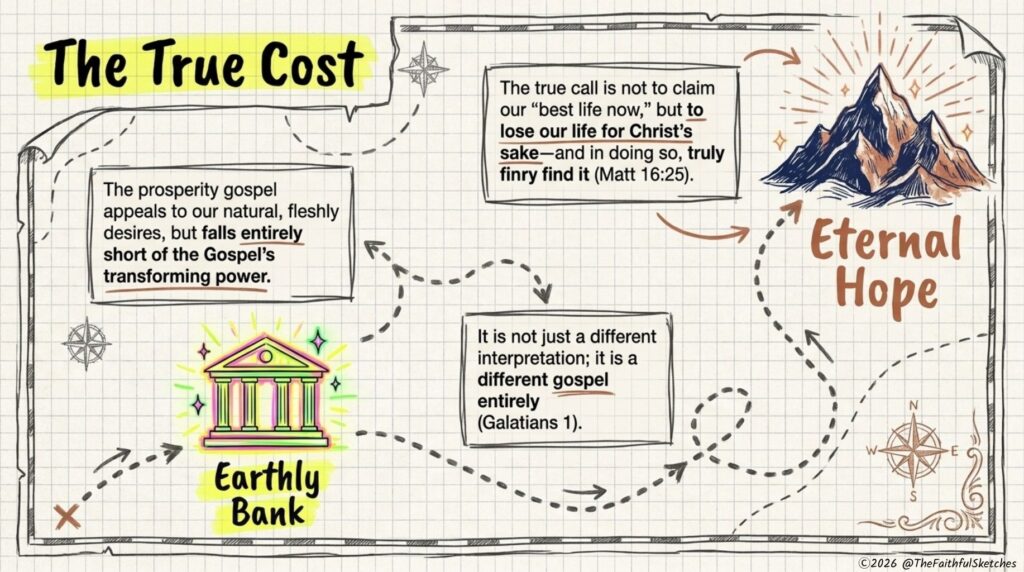
Step back and the pattern is clear. The prosperity gospel replaces the cross with a ledger, faith with a formula, and God with a vending machine. The true gospel promises something very different: suffering in this life in Acts 14:22, contentment in any circumstance in Philippians 4:11-13, and treasure that cannot be lost or stolen in Matthew 6:19-20.
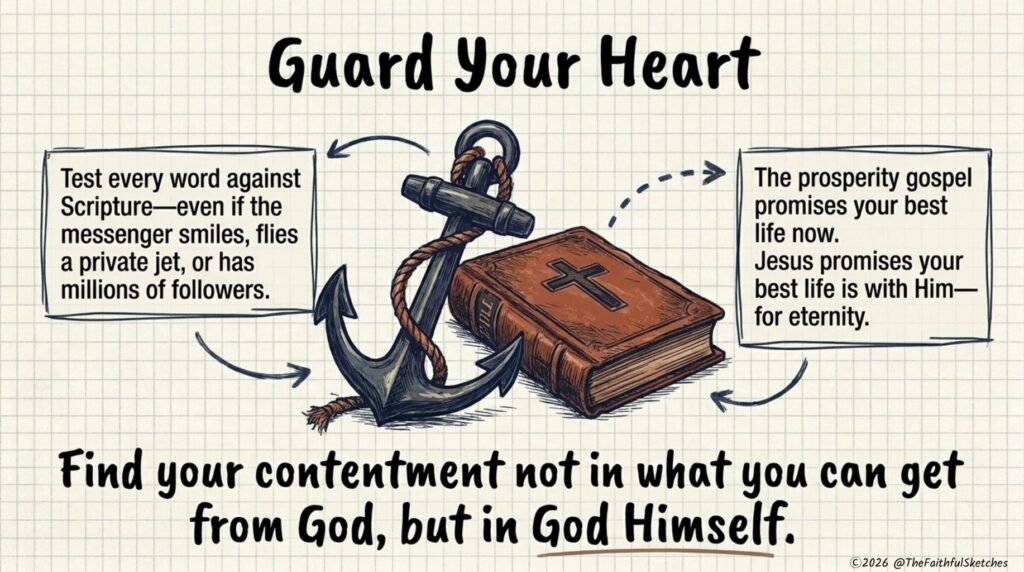
It calls us not to claim our “best life now” but to lose our life for Christ’s sake, and in doing so truly find it, as Jesus says in Matthew 16:25. This is why so many argue the prosperity gospel isn’t just a different interpretation. It’s a different gospel, and Paul said anyone who preaches another gospel stands under God’s curse, even if they smile, fly private jets, or have millions of followers. If you want to see how related half-truths slip into church culture, see my post on the Top Lies Christians Believe.
Conclusion
So what is the prosperity gospel? In the end, it’s a message that promises your best life now, while Jesus promises your best life with Him for eternity. The two are not the same, and the difference matters for how you pray, give, and walk through hardship.
So guard your heart. Test every word against Scripture. And find your contentment not in what you can get from God, but in God Himself. If this resonated, my post on what Romans 8:28 actually means digs into how God uses even suffering for good, which is the exact opposite of the pain-free life this teaching sells. Have you encountered prosperity teaching yourself? Let me know in the comments below.
Click Below to Download The Full PDF Summary Visual Guide:
*Free for personal use only. Please don’t resell or redistribute commercially.