
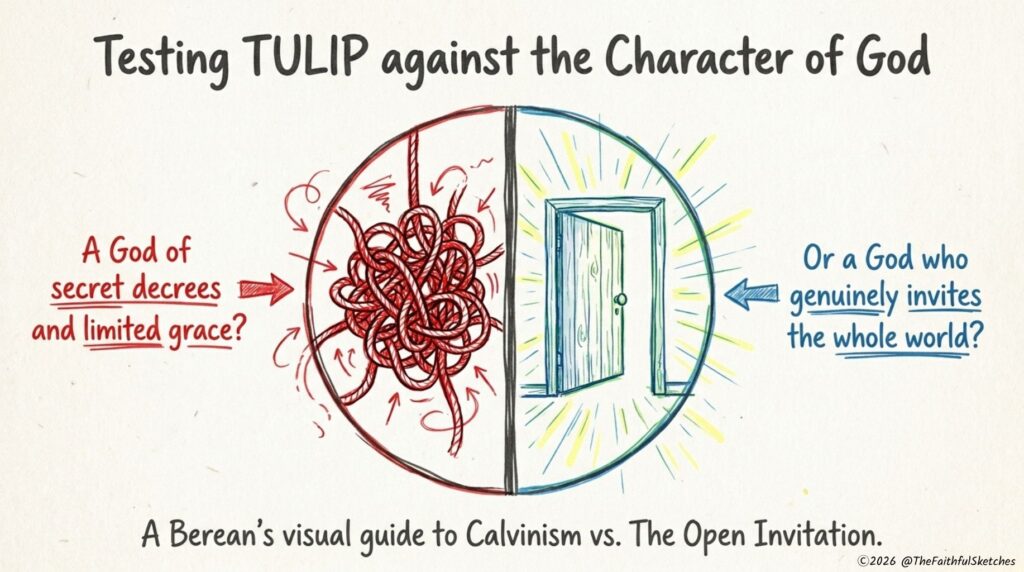
Have you ever heard a teaching that sounded logical but just felt off in your spirit? For me, that was Calvinism. So let’s ask the real question head-on: is Calvinism biblical? The deeper I searched Scripture, the more the five points of TULIP painted a portrait of God I couldn’t reconcile with the Jesus I read about in the Gospels. A picture where God’s love seems limited, where the cross feels conditional, and where our choices don’t seem to matter at all.
Today, we’re not attacking people. We’re testing a theology according to the Bible.
The Core Problem With Calvinism
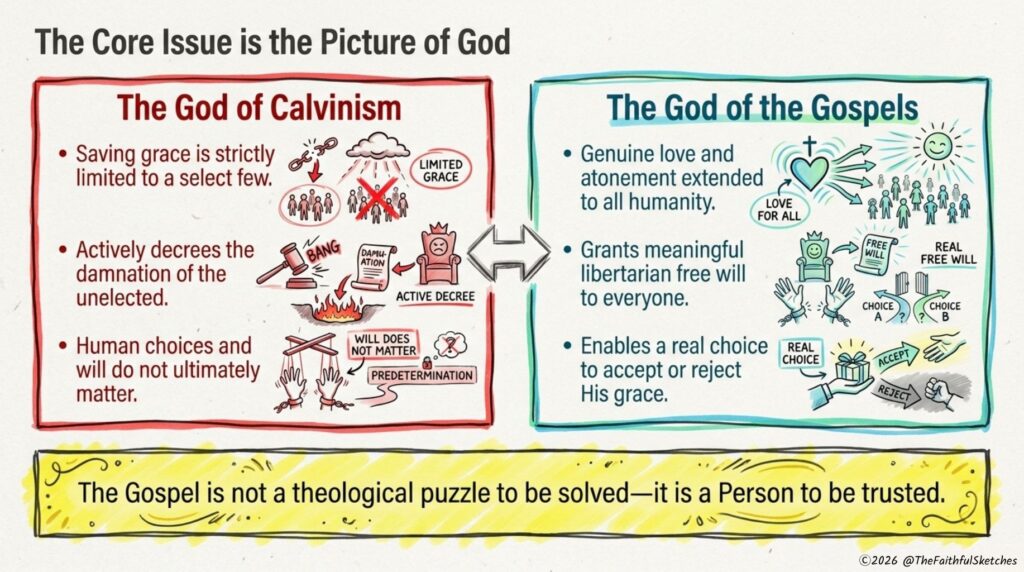
The central issue is God’s character. At its core, Calvinism presents a God whose saving grace reaches only a select few and who actively decrees the sin and damnation of everyone else. This post will show that the Bible presents a God whose love, atonement, and desire to save extend genuinely to all humanity. Furthermore, it shows a God who grants every person a meaningful, libertarian free will to accept or reject His grace.
If you want the wider background first, my post on Reformed theology and Calvinism sets the historical scene. The TULIP acronym itself dates to around 1905 and summarizes the Reformed reply to Jacobus Arminius at the Synod of Dort in 1618 to 1619. With that context in place, let’s test each letter.
T: Total Depravity, Are We Really Just Puppets?
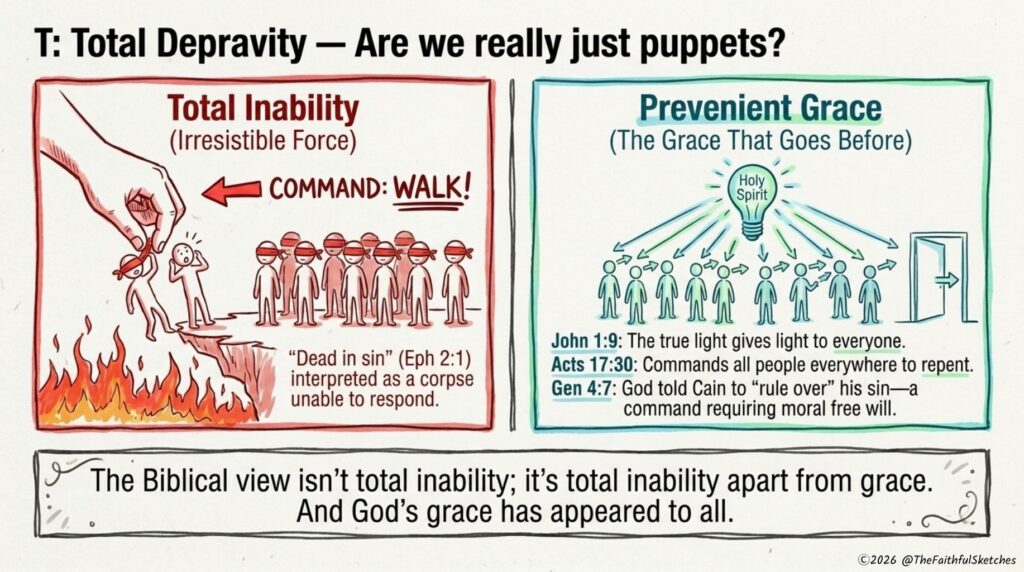
Let’s start with the T, Total Depravity. I actually agree with this point. But Calvinists add something more. They argue that humanity is so spiritually dead and so corrupted by sin that we cannot even respond to God. We have no free will in salvation. We’re like a corpse that can’t respond to a command to live.
They use verses like Ephesians 2:1, “And you were dead in the trespasses and sins,” and Romans 3:11, “no one seeks for God.” And they’re right. On our own, we are utterly lost.
But Calvinists then conclude that because we are dead, God must specifically regenerate the hearts of the elect, forcing spiritual life on them without any response. They call this Irresistible Grace, which we’ll reach in Part 4.
Prevenient Grace Changes the Picture
Now imagine this. Ten people are blindfolded, spiritually dead. God in His sovereignty removes the blindfolds from two people so they can see the exit, which is salvation. He then decrees that the remaining eight walk into the pit of lava, which is Hell. No. The Bible presents a different picture. It shows a God who doesn’t just command corpses to live. He enables them to respond.
This is what we call Prevenient Grace, the grace that goes before. It’s the Holy Spirit illuminating the truth and enabling our dead spirits to respond.
Think of the very first story of human failure. God came to Cain, who was angry and sinning, and told him in Genesis 4:7, “If you do well, will you not be accepted? And if you do not do well, sin is crouching at the door. Its desire is contrary to you, but you must rule over it.” God didn’t treat Cain as a spiritually dead puppet. He held him responsible and commanded him to rule over his sin. That command would be meaningless if Cain had no God-given capacity to choose.
Universal Grace and Resistible Drawing
Look at John 1:9, which says of Jesus, “The true light, which gives light to everyone, was coming into the world.” That is universal grace. Then consider John 12:32, where Jesus says, “And I, when I am lifted up from the earth, will draw all people to myself.” The word “draw” is the same word used in John 6:44. It’s a real, genuine drawing.
But a drawing can be resisted. Hebrews 10:26 warns about sinning willfully after receiving the knowledge of the truth. You can turn away and reject God’s grace.
This is why the Bible is filled with commands that presume our ability to respond. Acts 17:30 says God “commands all people everywhere to repent.” It would be the ultimate cruelty for God to command a spiritually dead person to do something they cannot do, then condemn them for failing. So the biblical view isn’t total inability. It’s total inability apart from grace. God’s grace has appeared to all, enabling a real, meaningful choice.
U: Unconditional Election, Is God Playing Favorites?
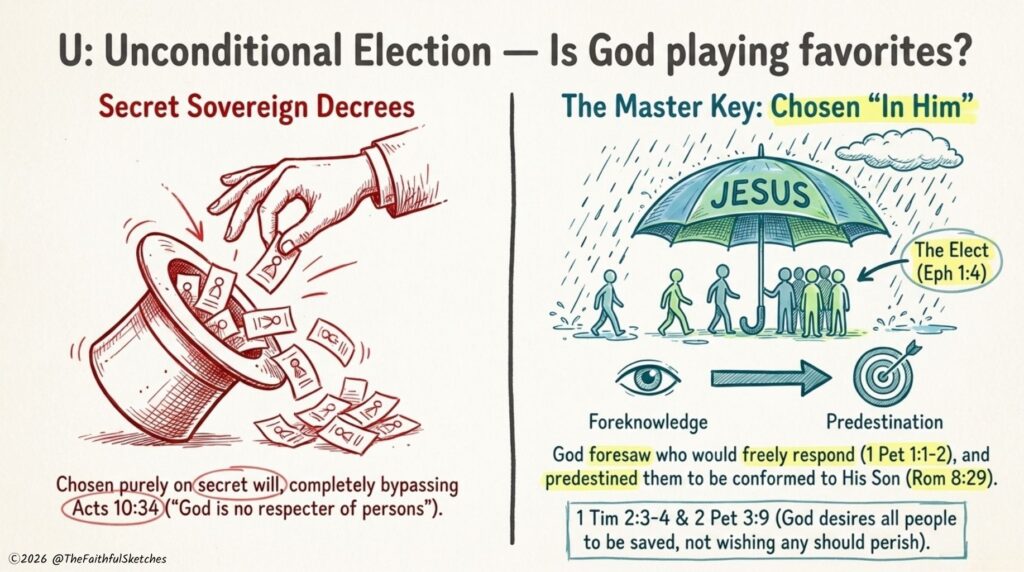
Next comes the U, Unconditional Election. This is the idea that before the foundation of the world, God chose specific individuals to be saved. Not based on anything He foresaw in them, not even their faith, but purely on His own secret, sovereign will. Everyone else is passed over.
This is presented as the ultimate example of grace. But it creates a massive problem. It makes God a respecter of persons, which Acts 10:34 explicitly says He is not.
Election Is “In Christ”
The Calvinist points to Ephesians 1:4-5, “he chose us in him before the foundation of the world.” But did you catch the key phrase? “He chose us in him.” That’s the master key. God’s primary election is of Jesus Christ, and we become the elect when we are in Christ by faith. Election is not God picking individual names out of a hat. It’s God choosing a plan, salvation through Jesus, and everyone in that plan is elect.
So how does God decide who is in Christ? 1 Peter 1:1-2 says we are elect “according to the foreknowledge of God the Father.” And Romans 8:29 is even clearer: “For those whom he foreknew he also predestined.” The logical order is foreknowledge, then predestination. God looked down the corridor of time, saw who would freely respond to His prevenient grace, and predestined them to be conformed to the image of His Son. That’s conditional election, and the condition is being in Christ through faith.
Otherwise, how do we explain 1 Timothy 2:3-4, where God “desires all people to be saved”? Or 2 Peter 3:9, where He is “not wishing that any should perish, but that all should reach repentance”? If God unconditionally elects only some, then He does wish the majority to perish, and His desire for all becomes a hollow, insincere wish. For more on how this connects to God’s eternal knowledge, see my posts on predestination and free will and Molinism explained.
L: Limited Atonement, Did Jesus’s Death Have Limits?
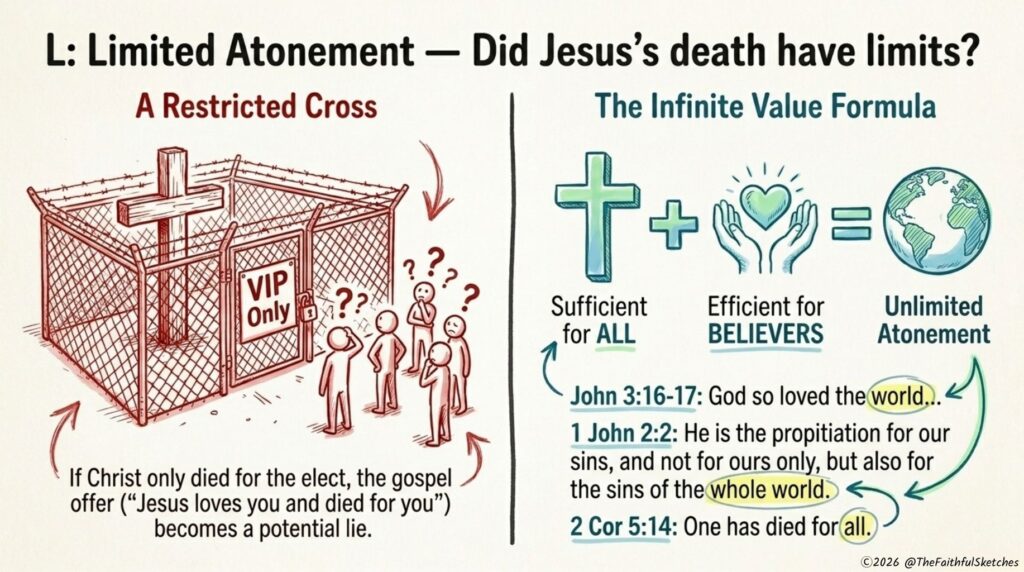
The L, Limited Atonement, is the logical conclusion of Unconditional Election, and for me it’s the most biblically devastating. It says Jesus died only for the sins of the elect. His blood was not shed for the whole world. This does the greatest violence to the character of God and the message of the gospel. So let’s listen to the Bible speak for itself.
John 3:16-17 says God “so loved the world” and sent His Son so “the world might be saved through him.” 1 John 2:2 is a direct refutation: Christ is “the propitiation for our sins, and not for ours only but also for the sins of the whole world.” John writes to believers, then explicitly extends the atonement to the whole world. And 2 Corinthians 5:14-19 repeats the universal language: “one has died for all.”
Sufficient for All, Efficient for Believers
The biblical position is not that the atonement is limited in scope, but in application. The classic phrase puts it well: Christ’s death was sufficient for all, but efficient for those who believe. The value of Jesus’s blood is infinite, enough to pay for every sin ever committed. But that payment is applied to your account only when you place your faith in Him.
To say Christ died only for the elect turns the genuine offer of the gospel into a potential lie. How can I tell a friend or a stranger on the street “Jesus loves you and died for you” if He may not have? The biblical message is confident: Christ died for sinners, you are one, so He died for you. Come to Him.
I: Irresistible Grace, Does God Force Us to Love Him?
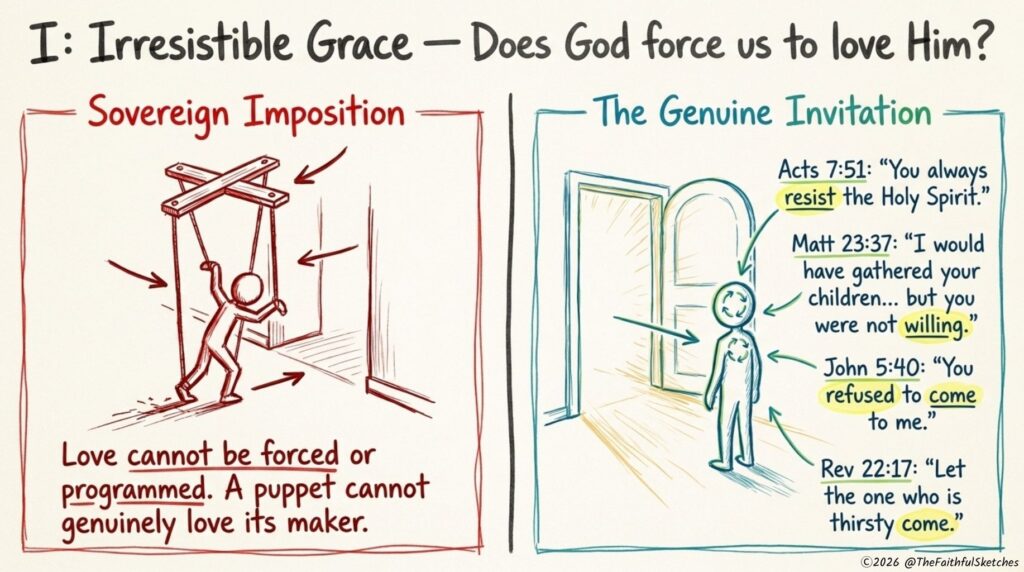
The I in TULIP is Irresistible Grace. This says that when God decides to save one of the elect, He effectually calls and regenerates them in a way they cannot resist. He makes the choice for them.
This is presented as the ultimate display of God’s power. But I see it as the ultimate violation of God-given dignity. God created us in His image, as relational beings capable of love. And love, by its very nature, cannot be forced or programmed. It must be chosen.
The Bible Shows Grace Being Resisted
Scripture is filled with people resisting God’s grace. In Acts 7:51, Stephen confronts the Jewish leaders: “You stiff-necked people… you always resist the Holy Spirit.” If grace were irresistible, how could they resist? Then there’s Matthew 23:37, perhaps the most heartbreaking verse in Scripture, where Jesus laments over Jerusalem: “How often would I have gathered your children together… and you were not willing!” Jesus desired to save them. Their will was the deciding factor.
In John 5:40, Jesus says, “you refuse to come to me that you may have life.” And the whole Bible ends with an invitation, not a sovereign imposition. Revelation 22:17 says, “let the one who desires take the water of life without price.” The Parable of the Great Banquet in Luke 14:15-24 teaches the same thing. The kingdom is open to everyone, especially the overlooked, and it warns those who reject the invitation. God draws and enlightens, but He does not drag us kicking and screaming into the kingdom. He invites us, and we must willingly come.
P: Perseverance of the Saints, Can We Lose Our Salvation?
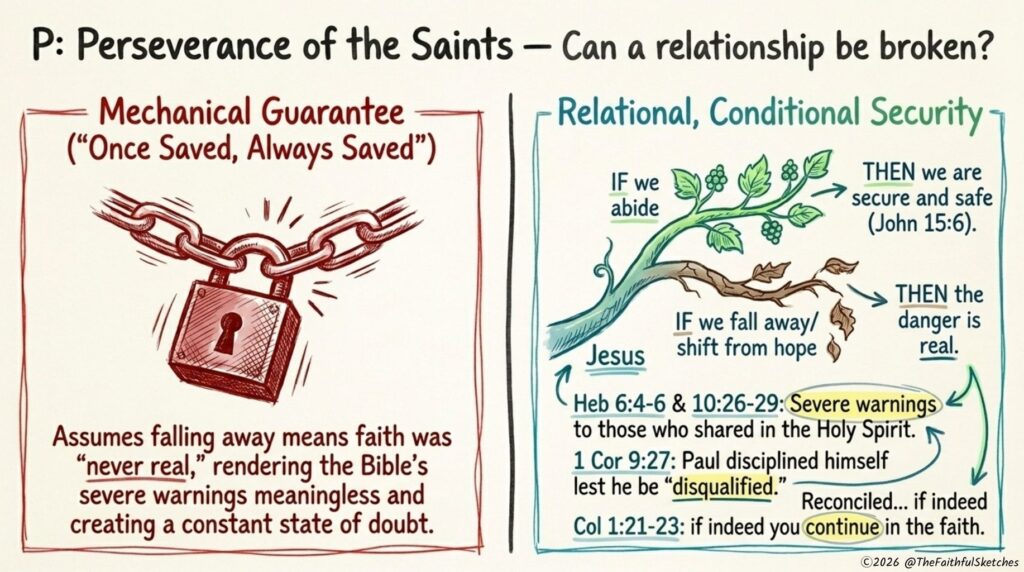
Finally, the P, Perseverance of the Saints. This is the idea that those who are truly elect cannot finally fall away from grace. They will persevere to the end. I believe God is mighty to save and holds us securely. But the Calvinist version often slides into “Once Saved, Always Saved” in a way that ignores the Bible’s severe warnings.
The Calvinist argues that if someone falls away, they were never truly saved. But that makes the warnings meaningless and creates a constant state of doubt: “Was my faith ever real?”
The Warnings Are Real Because the Danger Is Real
I know this part will trouble people who hold to the assurance of salvation. But the Bible speaks to genuine believers and warns them in the strongest terms not to fall away. Hebrews 6:4-6 describes people who were “enlightened,” “tasted the heavenly gift,” and “shared in the Holy Spirit.” That sounds like genuine conversion, yet it warns it’s impossible to restore them if they fall away. Hebrews 10:26-29 gives another severe warning about willful sin.
Even the Apostle Paul didn’t claim false assurance. In 1 Corinthians 9:27, he says, “I discipline my body… lest after preaching to others I myself should be disqualified.” Paul believed disqualification was possible.
So the biblical view is not a mechanical perseverance guaranteed regardless of our actions. It’s a conditional security. We are secure in Christ as we abide in Him. John 15:6 warns about the branch that does not abide. Colossians 1:21-23 adds, “if indeed you continue in the faith.” Salvation is initiated by God and sustained by God, but it remains a relationship, and a relationship can be neglected or broken by unbelief.
Calvinism vs the Biblical View: A Side-by-Side Comparison
So is Calvinism biblical when we lay it next to Scripture point by point? This table summarizes the contrast.
| TULIP Point | Calvinist Claim | The Biblical View |
|---|---|---|
| Total Depravity | We are so dead we cannot respond at all | Total inability apart from grace; prevenient grace enables a real response |
| Unconditional Election | God picks individuals by secret will | Election is “in Christ,” conditioned on foreseen faith |
| Limited Atonement | Christ died only for the elect | Christ died for all; sufficient for all, efficient for believers |
| Irresistible Grace | God overrides the will of the elect | Grace can be genuinely resisted; love must be chosen |
| Perseverance of the Saints | The truly saved cannot fall away | Real security in Christ, conditioned on abiding faith |
For a closely related debate, my post comparing Calvinism vs Hyper-Calvinism shows where these ideas can lead when pressed further.
Conclusion: The God of Unbounded Love
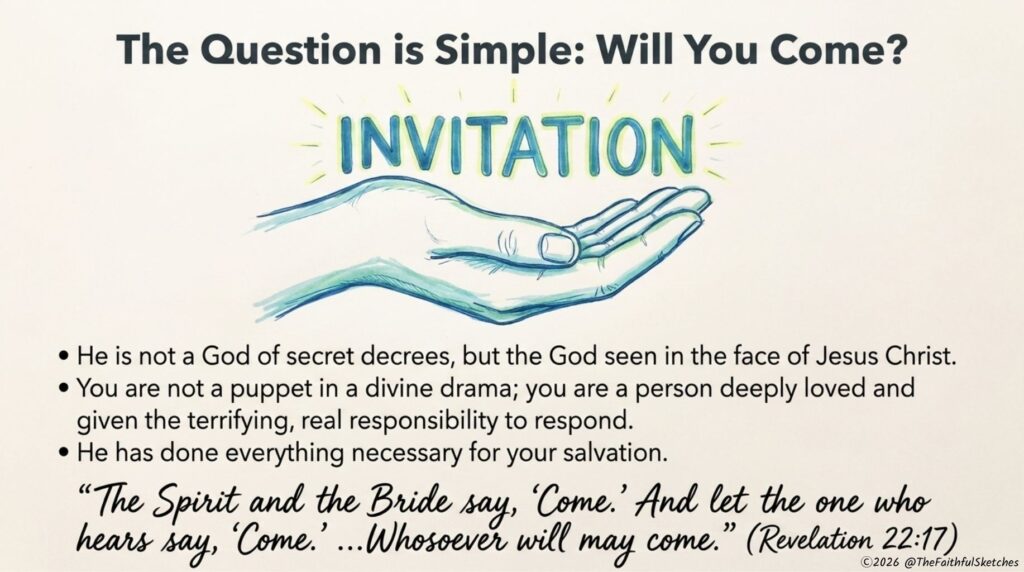
So where does this leave us? After walking through TULIP and asking honestly whether Calvinism is biblical, I’m left not with a God of secret decrees and limited grace, but with the God I see in the face of Jesus Christ. I see a God whose love is for the whole world, whose Son is the atoning sacrifice for the sins of the whole world, who genuinely desires all people to be saved, and who draws all people to Himself.
The gospel isn’t a puzzle to be solved. It’s a person to be trusted, and the offer is open to all. As the old hymn says, whosoever will may come. You are not a puppet in a divine drama. You are a person, deeply loved by God, invited into a real relationship with Him. He has done everything necessary for your salvation. The question He asks is simple: will you come?
My goal here wasn’t to divide but to encourage all of us to be like the Bereans in Acts 17:11, who searched the Scriptures daily to test whether what they were taught was true. For more on how grace and human choice fit together, you can read predestination and free will next.
Click Below to Download The Full PDF Summary Visual Guide:
*Free for personal use only. Please don’t resell or redistribute commercially.