
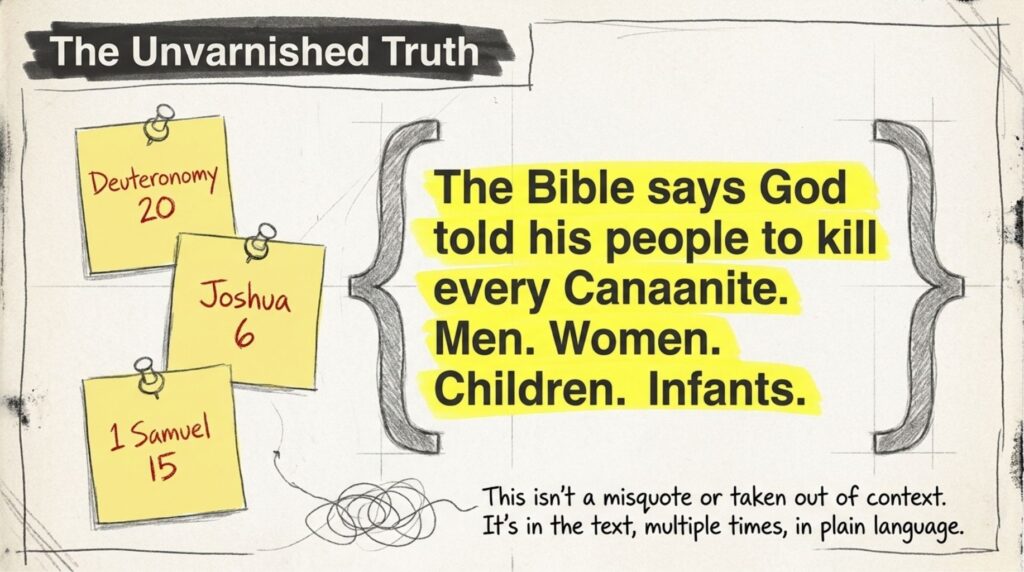
The Bible says God told His people to kill every Canaanite. Men. Women. Children. Infants. That’s not a misquote, and it’s not a verse pulled out of context by an atheist online. It’s Deuteronomy 20, Joshua 6, and 1 Samuel 15. It’s stated multiple times, in plain language.
This is one of the hardest questions in the entire Bible, and honest readers feel its weight. So rather than explain it away, let’s take it seriously. Why did God command genocide against the Canaanites? Below are the three main positions Christian scholars hold, the objection that troubles almost everyone, and where the larger biblical story ultimately leads. See where you land.
Part 1: The World of the Canaanites
Let’s start with who the Canaanites actually were, because this context matters more than most people realize. Canaan was the region roughly covering modern-day Israel, Palestine, Lebanon, and parts of Jordan and Syria. Around 1400 to 1200 BC, it was home to a collection of tribes: the Hittites, the Amorites, the Perizzites, and a dozen others.
Biblically, Canaan was the land God promised to Abraham’s descendants. But it wasn’t empty. It had people in it, and according to the text, God told the Israelites to go in and leave nothing alive. To understand why, we need to look at what the Bible says about Canaanite religion.
A Culture Built Around Child Sacrifice
The biblical text gives reasons. The Canaanites centered their religion on gods like Baal and Asherah, believing these gods controlled the rain and the harvest. To keep them satisfied, they practiced rituals the Bible calls detestable, including ritualized sexual violence as part of worship.
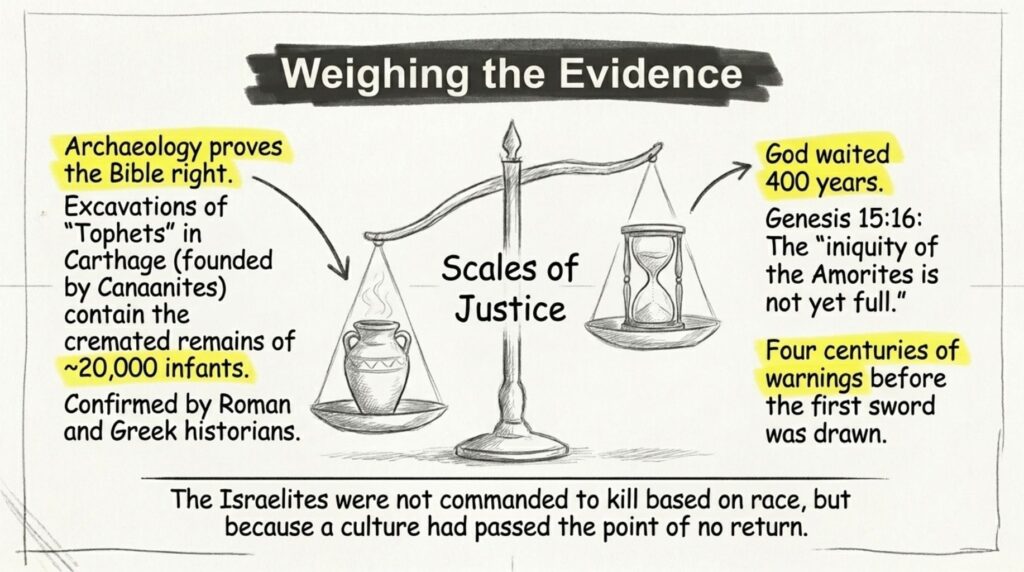
Their most infamous ritual was child sacrifice. The Canaanites would burn infants alive as offerings to the god Molech. When Canaanite culture later migrated and founded the city of Carthage in North Africa, it carried these practices along. Archaeologists have uncovered sites called “Tophets” containing the cremated remains of thousands of infants, and Greek and Roman historians documented the practice in detail.
The archaeological record strongly supports the Bible’s description of Canaanite child sacrifice, though a minority of scholars argue the Tophet sites were infant cemeteries rather than sacrificial grounds. Either way, the severe biblical language against these nations was rooted in God’s absolute rejection of sacrificing children.
A Culture at the Point of No Return
The Bible presents Canaanite culture not just as “different” but as a moral cancer. God says the land itself is “vomiting out” its inhabitants because of their actions. Crucially, the Israelites weren’t told to destroy the Canaanites because of their race. They were told to do it because their culture had reached a point of no return.
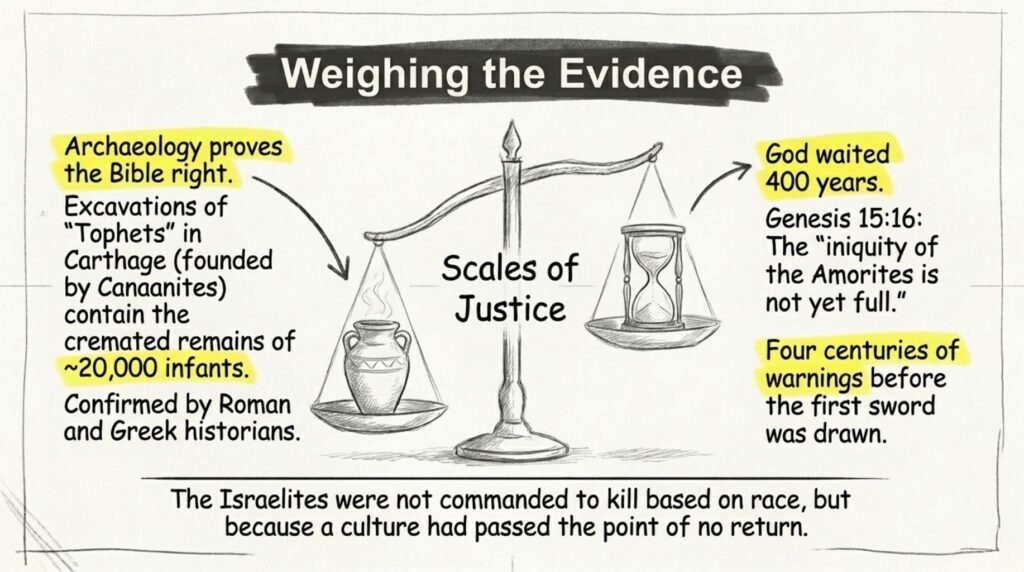
God also claims He waited. Centuries earlier, He told Abraham in Genesis 15:16 that “the iniquity of the Amorites is not yet complete.” In other words, He gave them roughly four centuries of warning before the first sword was drawn. Does that context make the command easy to accept? For most people, no. But it’s the starting point for every serious answer to this question.
Part 2: Three Responses From Christian Scholarship
Theologians, historians, and philosophers have wrestled with this for centuries. There’s no single agreed answer within Christianity, but there are at least three main positions worth understanding. Here’s how they compare before we walk through each one.
| Position | Core Claim | Main Strength | Main Weakness |
|---|---|---|---|
| Divine Command | God defines morality, so His command makes the act right | Takes God’s authority over life seriously | Seems to make any command good, even an atrocity |
| Judgment for Corruption | This was judicial judgment on a culture, not ethnic cleansing | Fits the text’s own reasons; explains spared Canaanites | Doesn’t fully explain the children or the use of swords |
| Progressive Revelation | The Bible records humanity’s unfolding understanding of God | Reconciles Joshua with Jesus | Raises hard questions about Scripture’s reliability |
Response 1: The Divine Command
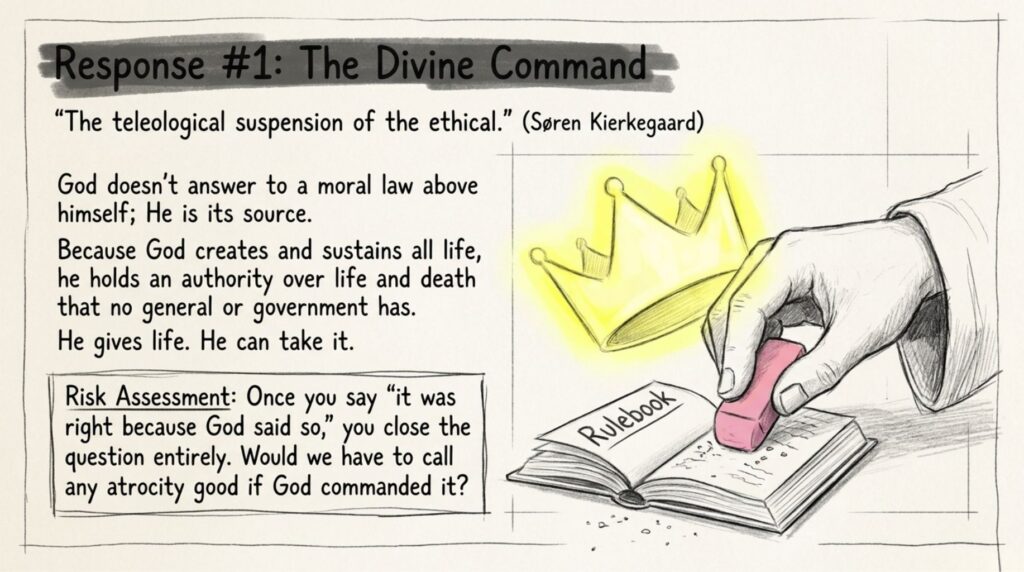
This position says morality comes from God. He doesn’t answer to a moral law above Himself; He is its source. So when God commands something, that act is moral by definition, precisely because He commanded it.
The philosopher Søren Kierkegaard called this the “teleological suspension of the ethical.” Big phrase, simple idea: God’s direct command can override what our normal moral sense would say. The classic example is Abraham told to sacrifice Isaac. The act looks like murder, yet because God commanded it and then stopped it, the biblical framework treats it as something else. Applied to the Canaanites, God created and sustains all life, so He holds an authority over life and death that no general or government has. This view carries real weight, but also a risk. Once you say “it was right because God said so,” you close the question entirely, which unsettles many people.
Response 2: Judgment for Moral Corruption
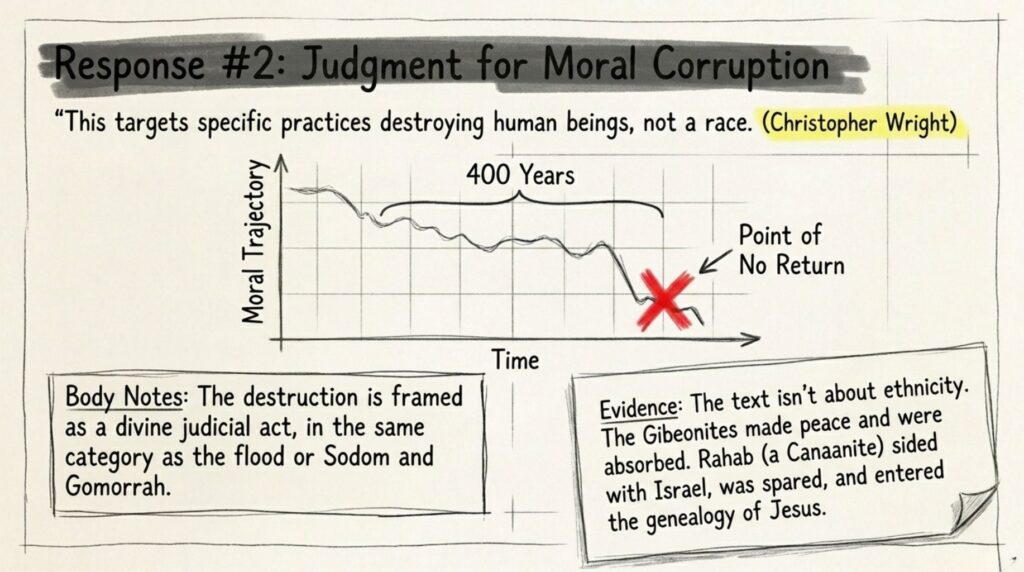
The second position says you have to look at what the text claims God is doing. That line in Genesis 15:16 about the Amorites’ sin not yet being complete suggests God watched a culture’s moral trajectory and held off until it passed the point of no return.
On this view, the destruction is a divine judicial act, the same category as the flood or Sodom and Gomorrah. It targets specific practices that were destroying human beings, especially children, not a race. Theologian Christopher Wright argues the text isn’t primarily about ethnicity at all. The Gibeonites made peace with Israel and were absorbed unharmed. Rahab, a Canaanite woman, sided with Israel, was spared, and ended up in the genealogy of Jesus, as shown in Joshua 6:25. So the destruction aimed at a system rather than a people. That doesn’t make the deaths easy to read, but it shifts the category from genocide, which runs on ethnic hatred, to what the text frames as judicial execution. Critics fairly ask why God hasn’t judged cultures this way since, and why it took swords in human hands.
Response 3: Progressive Revelation
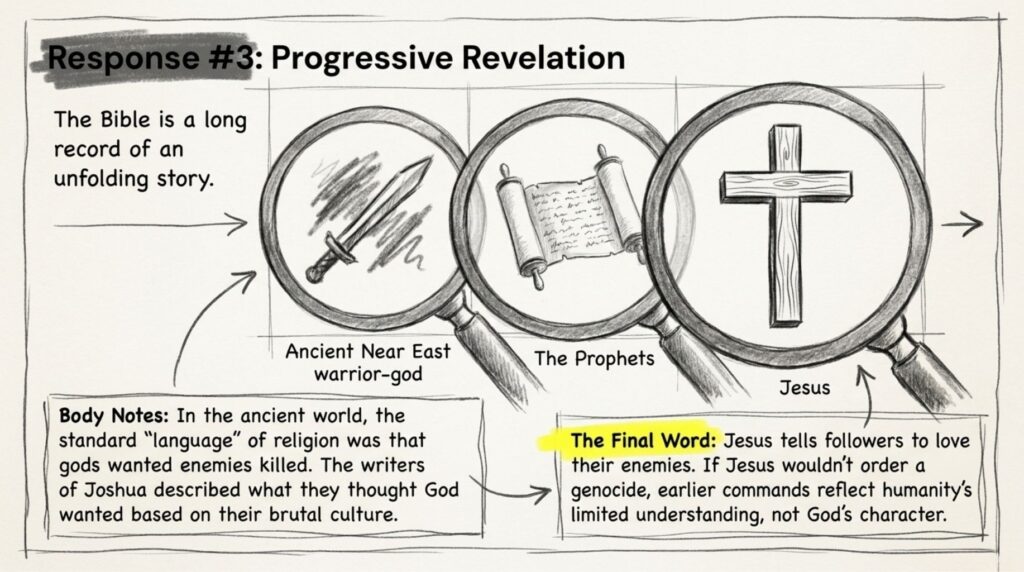
The third position is called Progressive Revelation. This view suggests God’s people didn’t understand Him perfectly all at once, and that the Bible is a long record of God slowly educating humanity. In the ancient world, nearly every nation believed their gods wanted them to destroy their enemies. It was the standard language of religion at the time.
This argument suggests the writers of Joshua were describing what they believed God wanted, shaped by the brutal culture they lived in. As the Bible unfolds, its picture of God shifts, moving from the warrior God of Joshua to the suffering servant of the prophets, and finally to Jesus, who tells His followers in Matthew 5:44 to love their enemies. Scholars who hold this view say Jesus is the “final word” on what God is like. If Jesus wouldn’t order a genocide, then perhaps the earlier commands reflected the people’s limited understanding rather than God’s actual character. The obvious cost of this view is what it implies about the reliability of those earlier texts.
Part 3: The Hardest Objection, What About the Children?
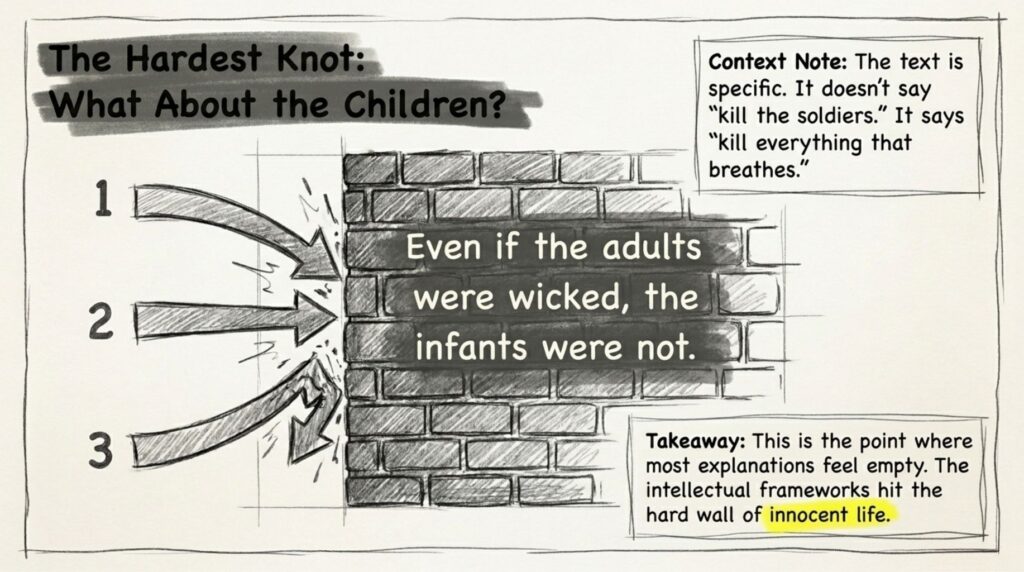
Even if you accept that the adults were wicked, the infants were not. This is where most explanations feel empty. The text is specific. It doesn’t say “kill the soldiers.” It says kill everything that breathes.
Some theologians try to soften this by pointing to “war talk.” In ancient Near Eastern military reports, phrases like “totally destroyed” or “left no survivor” were often deliberate exaggerations, their version of a sports headline saying a team “slaughtered” their opponents. They didn’t always mean literal extinction. But even if that’s true, the imagery remains, and we’re left asking why God would choose that kind of language at all.
Others argue that in a world without social safety nets, an infant left without family or tribe faced a slow, agonizing death by starvation or slavery, so a quick death was somehow more merciful. You likely find that explanation unsatisfying. Most people do. It can feel like an attempt to defend the indefensible, and it forces us to ask whether we can trust a God whose logic runs so foreign to our own. This is an honest tension, not a neat puzzle with a tidy solution.
Part 4: The Bigger Story, From Judgment to Grace
We often want the Bible to be a simple book with easy heroes. We want God to fit neatly into our modern categories of “good” and “kind.” But the Old Testament refuses to be tamed. The story of the Canaanites isn’t really about one nation. It’s part of a much larger story.
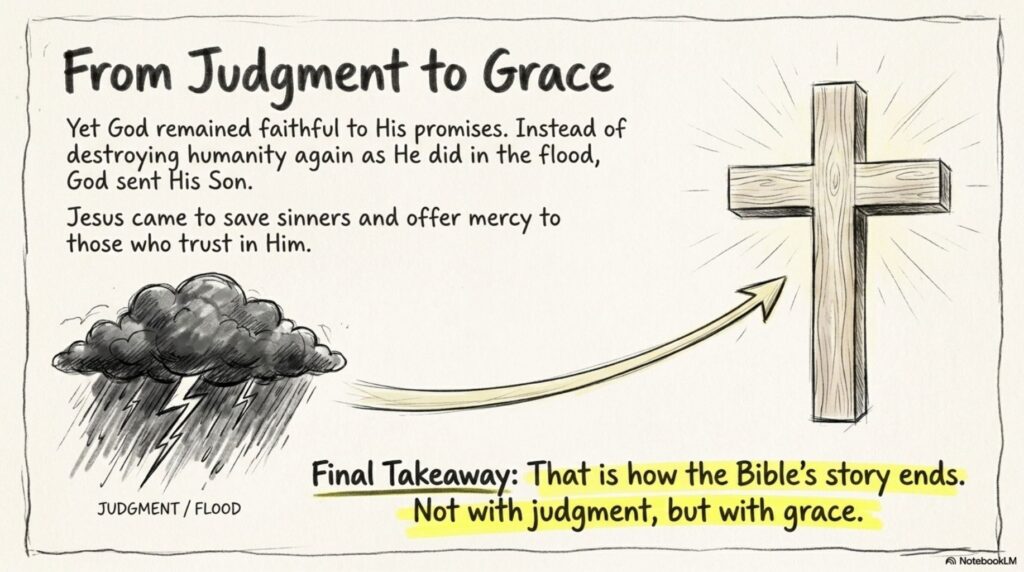
Throughout the Bible, people keep rebelling against God. The Canaanites did. Israel did. And we do too. Yet God remained faithful to His promises. Instead of wiping out humanity again as in the flood, He sent His Son. Jesus came to save sinners and offer mercy to all who trust in Him. That’s how the Bible’s story ultimately ends, not with judgment, but with grace. For more on how this fits the whole arc of Scripture, see my post on what the Bible is about, and for a related hard question, my post asking whether Calvinism is biblical.
Conclusion
So why did God command genocide in the Old Testament? Honestly, no single answer resolves every difficulty, and the three positions above each carry real strengths and real costs. The Divine Command view protects God’s authority but closes the question. The Judgment view fits the text’s own reasoning but struggles with the children. Progressive Revelation reconciles Joshua with Jesus but raises questions about Scripture itself.
What’s clear is that these passages deserve careful, honest wrestling rather than quick dismissal or easy defense. How do you understand these passages? Let me know in the comments below, and let’s discuss respectfully.
Click Below to Download The Full PDF Summary Visual Guide:
*Free for personal use only. Please don’t resell or redistribute commercially.