
What if a single religious organization held more money than some countries? Mormon Church wealth reached an estimated $293 billion by the end of 2024, according to independent analysts. That figure exceeds the annual GDP of New Zealand. It could buy every NBA team twice over with billions to spare. Yet The Church of Jesus Christ of Latter-day Saints discloses almost none of its finances to the public.
So where did the money come from? Where is it invested? And why has it become so controversial? This post pulls back the curtain.
How Much Money Does the Mormon Church Have?
Independent researchers estimate the church’s total net worth at approximately $293 billion as of the end of 2024. Moreover, that number grew by $28 billion in a single year, driven largely by investment returns.
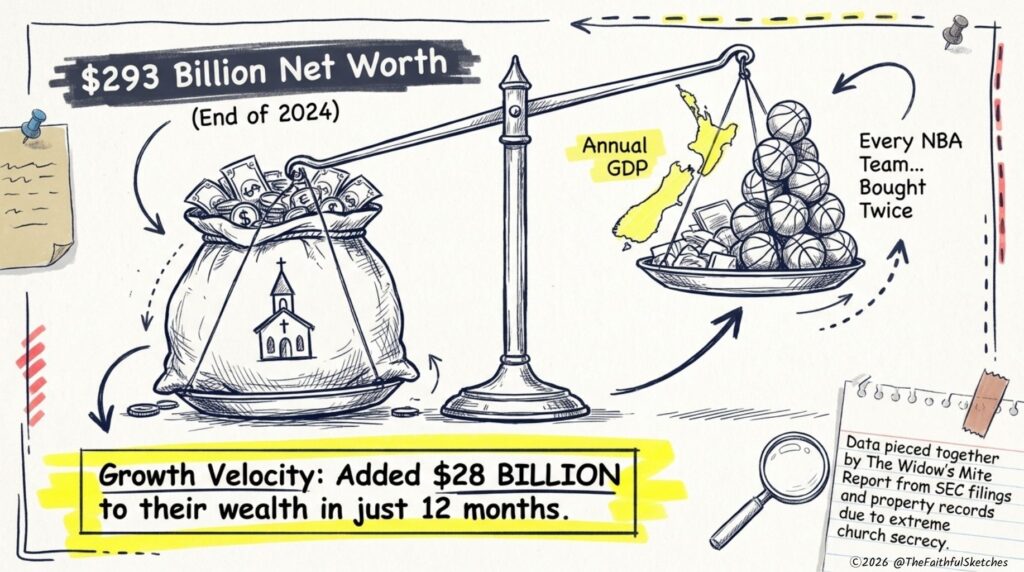
The investment portfolio alone sits at an estimated $206 billion. The church manages it through its in-house investment arm, Ensign Peak Advisors, plus a network of third-party funds.
However, here is the remarkable part: the church does not publish its finances. Unlike publicly traded companies, or even the Catholic Church in some countries, the LDS Church operates with very little financial transparency. Every figure above comes from independent researchers who piece together SEC filings, property records, and other public documents.
The leading research group is called The Widow’s Mite Report, named after the poor widow Jesus praised in Mark 12:41-44 (ESV). Their estimates are widely treated as the gold standard on this topic.
Where Does Mormon Church Wealth Come From?
The church has about 17.5 million members. Three income streams turned that membership into a financial empire.
Tithing: The Engine
Mormons pay 10% of their gross income to the church. In practice, this is not optional for active members. Without a full tithe, you cannot enter the temple. Furthermore, without temple ordinances, you cannot reach the highest level of salvation in Mormon theology.
The numbers are staggering. In 2024 alone, the church received an estimated $8 billion in tithes and offerings. Other estimates put annual tithing income closer to $6 billion. Either way, this steady stream has flowed for nearly two centuries.
For context, biblical tithing comes from passages like Malachi 3:10 (ESV), though most Christian denominations treat giving as voluntary, following 2 Corinthians 9:7 (ESV): “God loves a cheerful giver.”
Investment Returns: The Multiplier
The church does not sit on its cash. Instead, it invests aggressively, and it has done so for decades. In 2023, the church’s investments generated an estimated $24.5 billion in profits. That is more than three times what it collected in tithing the same year.
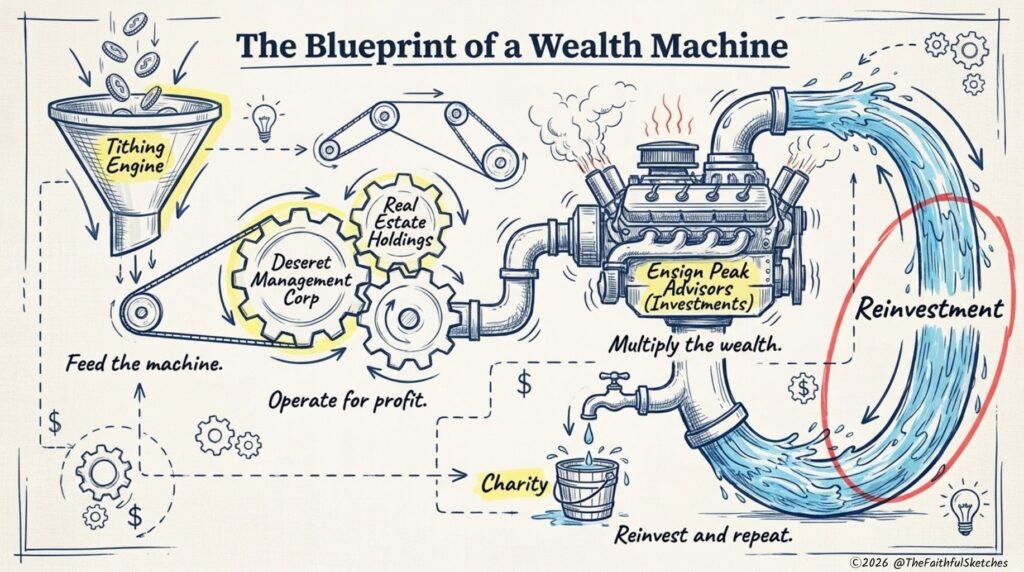
The result is a wealth machine that feeds itself. Tithing comes in, gets invested, produces returns, and those returns get reinvested. Year after year, decade after decade.
For-Profit Businesses: The Third Layer
Finally, the church owns a network of for-profit companies through a holding company called Deseret Management Corporation (DMC), established in 1966. Its portfolio includes:
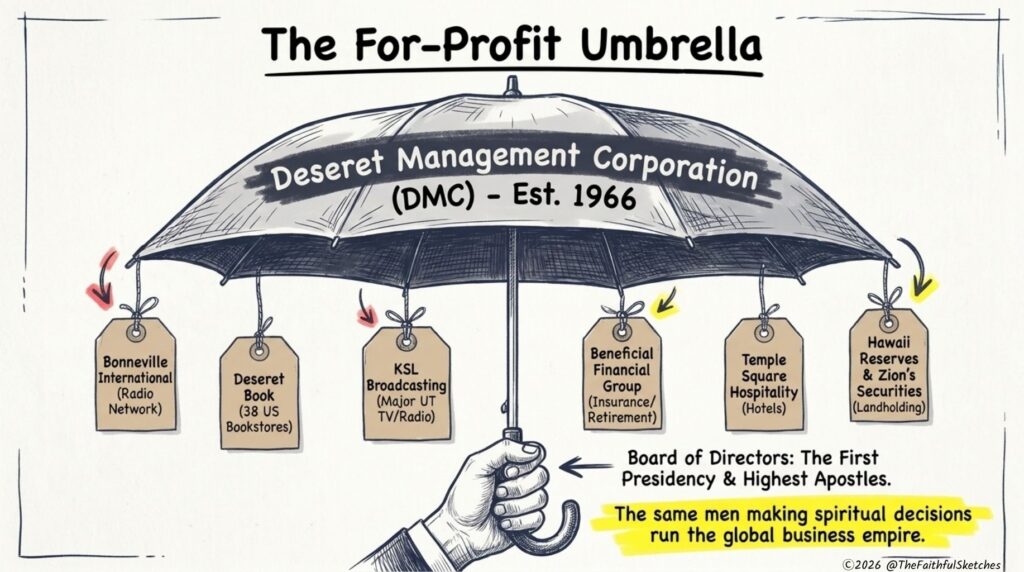
- Bonneville International, a large network of radio stations
- Deseret Book, a publisher with 38 bookstores across the United States
- KSL Broadcasting, a major television and radio broadcaster in Utah
- Beneficial Financial Group, an insurance, investment, and retirement services company
- Deseret News, one of Utah’s largest newspapers
- Temple Square Hospitality, which manages hotels
- Hawaii Reserves Inc. and Zion’s Securities, real estate and landholding companies
Notably, DMC’s board consists of the church’s highest leaders: the First Presidency, members of the Quorum of the Twelve Apostles, and the Presiding Bishopric. The same men who make spiritual decisions also oversee a global business empire.
Income Sources at a Glance
| Income Source | Estimated Annual Figure | Managed By |
|---|---|---|
| Tithing and offerings | $6 to $8 billion | Church headquarters |
| Investment returns | $24.5 billion (2023) | Ensign Peak Advisors and third-party funds |
| For-profit businesses | Not disclosed | Deseret Management Corporation |
| Humanitarian spending | $1.45 billion (2024) | Church welfare programs |
Ensign Peak Advisors: The Investment Machine
Ensign Peak Advisors is the crown jewel of the empire. Based in Salt Lake City, it manages the church’s investment reserves with a focus on long-term growth.
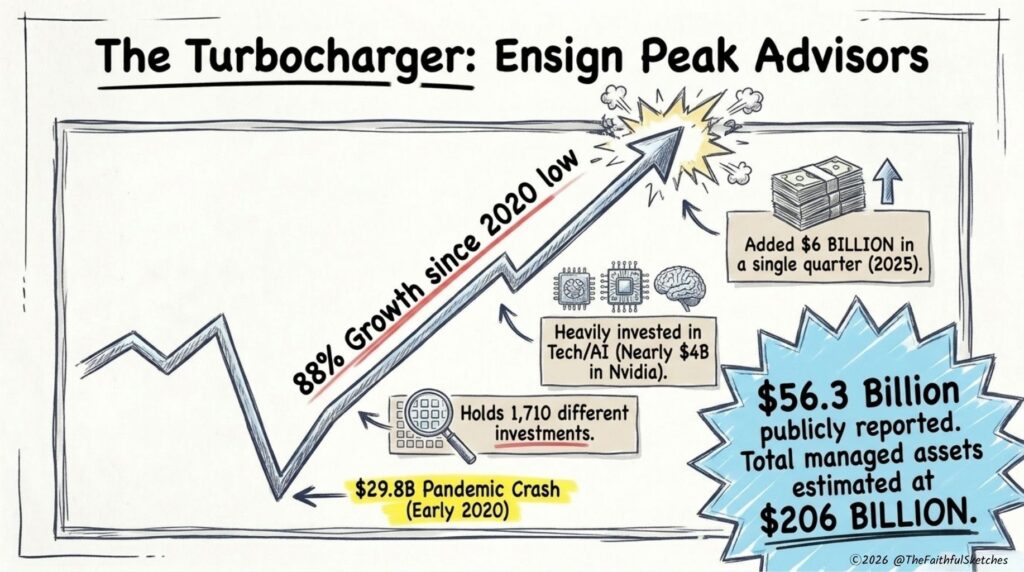
As of late 2024, Ensign Peak reported close to $56.3 billion in publicly disclosed assets. However, that is only the visible portion. The Widow’s Mite Report estimates that Ensign Peak and third-party funds manage $206 billion in total investments on the church’s behalf.
The portfolio holds shares in 1,710 different investments, including stocks, bonds, real estate trusts, and index funds. Recently, the fund held nearly $4 billion in a single artificial intelligence stock, likely Nvidia, which helped push the portfolio to record highs.
The growth has been dramatic. The reported portfolio plunged to $29.8 billion during the COVID crash in early 2020, then rebounded. Since that low, it has grown roughly 88% in dollar terms. In one quarter of 2025 alone, it added nearly $6 billion. That is more than many countries spend on their entire military in a year.
The Shell Company Scheme and the SEC Fine
Here is where it turns scandalous. For years, Ensign Peak did not report its full portfolio to the SEC. Instead, it created thirteen shell LLCs scattered across the United States. Each LLC filed its own reports, which made the total portfolio, then around $32 billion, appear far smaller than it was.
In 2023, the SEC charged both Ensign Peak and the church, calling it a deliberate scheme to evade reporting requirements. The church agreed to pay a $5 million fine: $4 million from Ensign Peak and $1 million from the church itself. That fine was 50 times larger than any previous fine of its kind. The SEC order implicated the First Presidency in an intricate effort to put institutional interests above compliance with the law.
Defenders called the fine a speeding ticket. Critics counter that it exposed a calculated, decades-long institutional effort to deceive regulators and the investing public.
The Real Estate Empire and City Creek Mall
Beyond stocks and bonds, the church owns enormous amounts of land. It is reportedly one of the largest private landowners in the United States, with over a million acres, including massive cattle ranches in Florida, Utah, and other states. Subsidiaries like Property Reserve Inc. and AgReserves manage these holdings. Because their names avoid any mention of the church, the true scale is difficult to track.
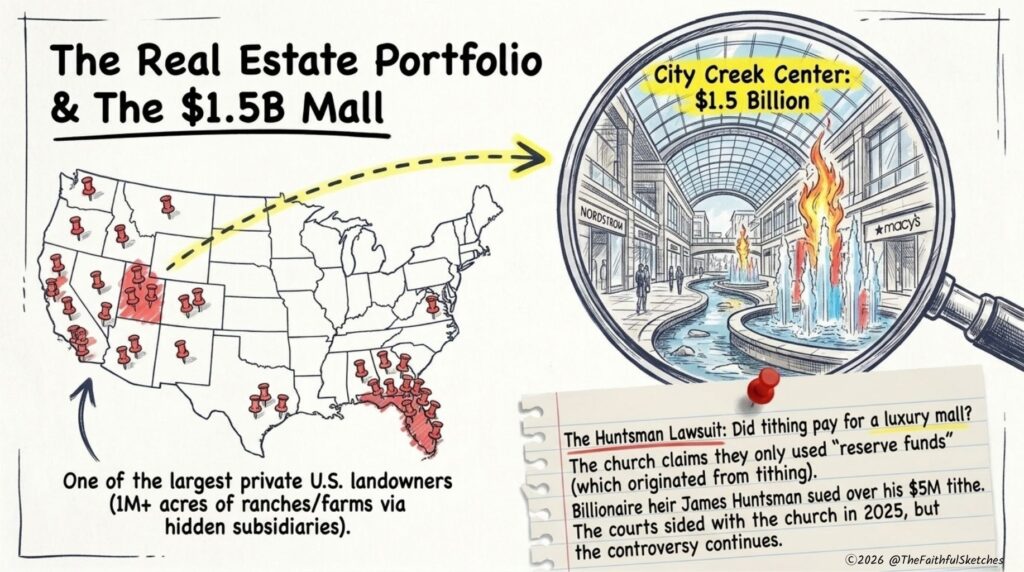
The most famous project is City Creek Center, a $1.5 billion shopping mall built directly south of Temple Square in Salt Lake City. It spans two city blocks and features a retractable glass roof, an artificial creek, and fountains that shoot fire and water. Nordstrom and Macy’s anchor it.
The church says no tithing funds built the mall. Critics respond that the church used reserve funds which originally came from tithing. A former member named James Huntsman sued, claiming the church misled him about how his $5 million in tithing would be used. In January 2025, an 11-judge panel of the Ninth Circuit ruled unanimously for the church, finding Huntsman had not shown the church did anything other than what it said it would do.
Even so, the litigation continues. Other lawsuits accuse church leaders of fraud and racketeering over claims about tithing and the origins of the Book of Mormon. One case may reach the U.S. Supreme Court.
Why Mormon Church Wealth Is So Controversial
Why should anyone care about a church’s bank account? Three reasons keep this debate alive.
The Transparency Problem
Members donate 10% of their income on faith and trust. Yet they do not know exactly where the money goes, because the church publishes no financial statements. Critics argue members deserve to know how their sacred tithes are used. The church responds that it is a religious organization, not a corporation, and that its finances are a matter between God and His leaders.
The Charity Question
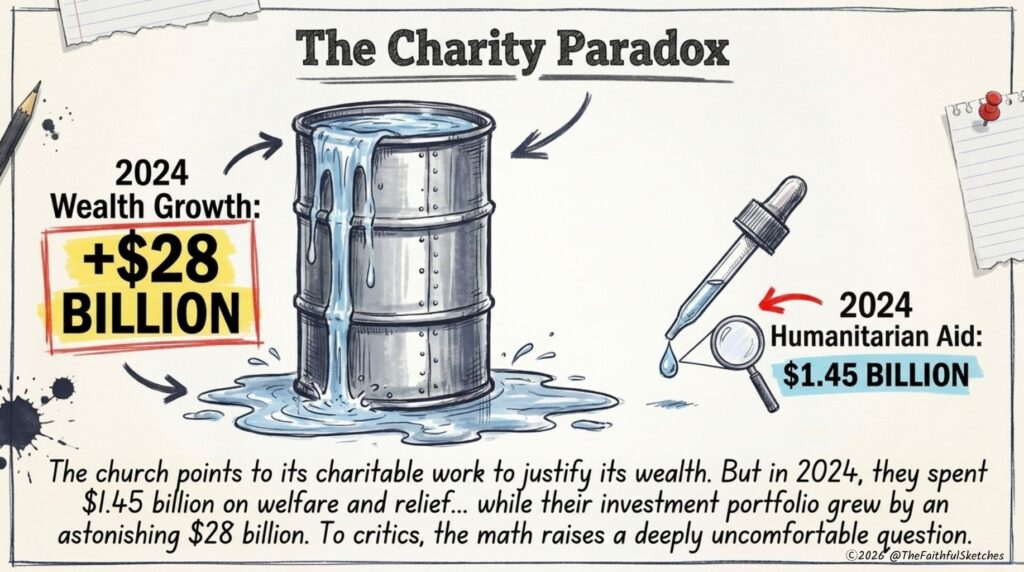
To be fair, the church does give. In 2024, it reported spending $1.45 billion on humanitarian aid, welfare, and relief. However, its portfolio grew by $28 billion that same year. In other words, the church spent about 5 cents on charity for every dollar it added to its wealth. Many observers find that ratio hard to square with the teaching of Matthew 6:19-21 (ESV) about storing up treasures on earth.
The Tax Exemption Debate
The church pays no property taxes on its churches and temples. Its investment income goes untaxed. Additionally, as a church, it does not have to file the public disclosures the IRS requires of other nonprofits. Critics argue a $293 billion organization should not get a free pass. Defenders argue religious liberty requires these exemptions and that the church’s good works justify the arrangement.
The Bigger Picture
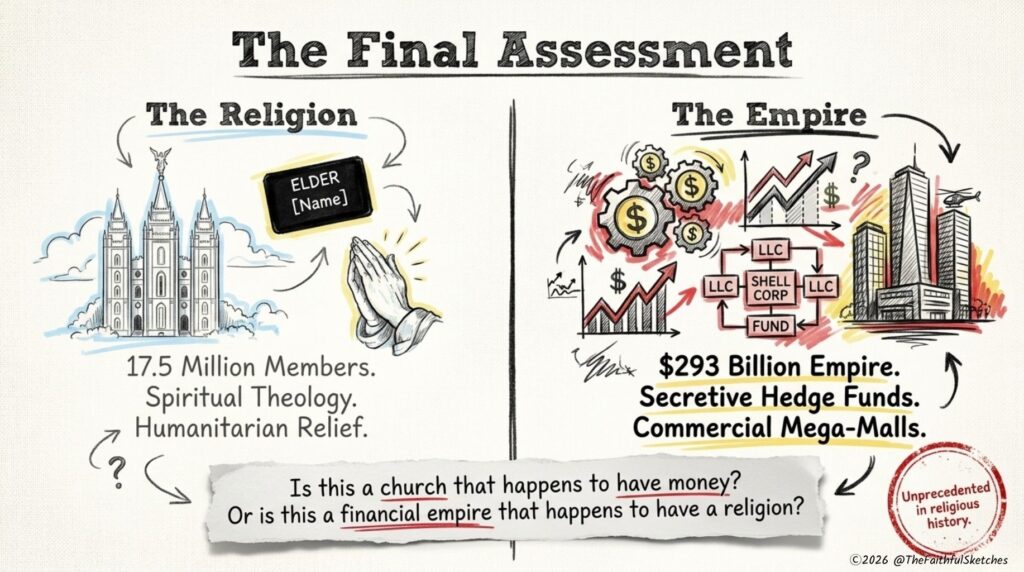
The Latter-day Saints have built something unprecedented in religious history: a $293 billion empire, a $206 billion investment portfolio, roughly $8 billion in annual tithing, and $24.5 billion in investment profits in a single year. This is a global financial powerhouse operating behind a level of secrecy most corporations could never get away with.
If you find groups like this fascinating, you may also want to read how other movements handle authority and money. Start with Jehovah’s Witnesses beliefs explained and how the Watchtower controls Jehovah’s Witnesses. For another group often asked about, see Seventh-day Adventist beliefs: are they Christian? And for the wider landscape, read Catholic, Orthodox, and Protestant differences.
So what do you think? Is this a church that happens to have money, or a financial empire that happens to have a religion? Share your view in the comments.
Click Below to Download The Full PDF Summary Visual Guide:
*Free for personal use only. Please don’t resell or redistribute commercially.