
Imagine someone walks up to you and says, “I believe in Jesus Christ. I’m a Christian.” Then they tell you that Jesus is the spirit brother of Satan. That God the Father was once a mortal man on another planet. That you can become a god and rule your own universe. Would you still call that person a Christian?
The Church of Jesus Christ of Latter-day Saints, the Mormons, uses Christian words. They say “God,” “Jesus,” “salvation,” and “heaven.” But they have redefined every one of those words to mean something completely different. In this post, we’ll examine Mormonism vs Christianity across five fundamental doctrines, using Mormon leaders’ own words, and then look at why many theologians and cult recovery specialists classify Mormonism as a theological cult. Let’s dive in.
Difference 1: Who Is God?
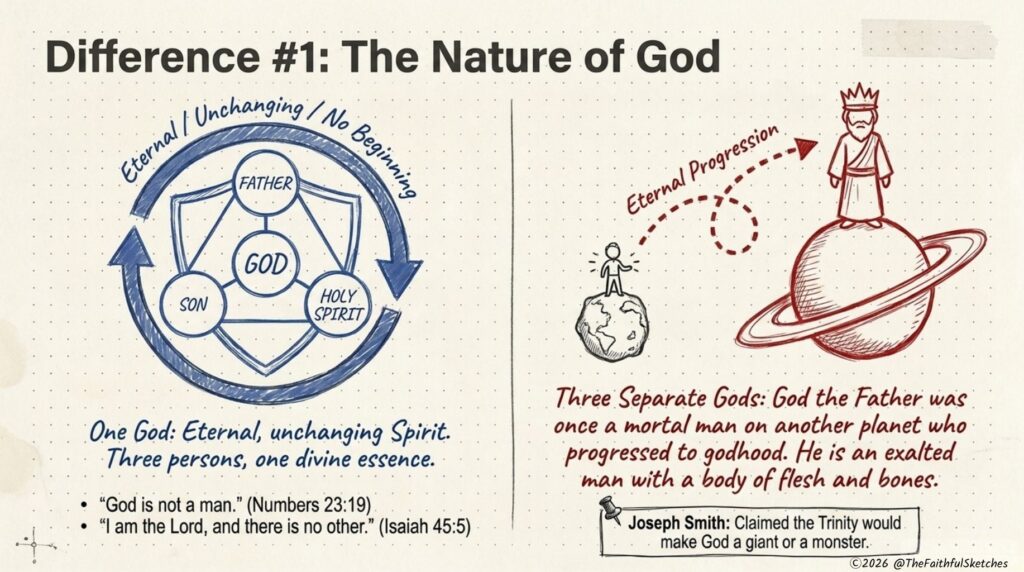
Start with the most fundamental question. The Bible is crystal clear: God is one. He is eternal, unchanging, and has always existed as Father, Son, and Holy Spirit, three persons in one divine essence. That is the Trinity. God is not a man. He has no beginning and no end.
Mormonism rejects this completely. Joseph Smith, the founder of Mormonism, mocked the Trinity openly, saying the idea of three in one would make God “a giant or a monster.” What does Mormonism teach instead? Three separate gods. The Father, the Son, and the Holy Spirit are three distinct beings, and the Father has a physical body “of flesh and bones as tangible as man’s.”
And here is the kicker. According to Mormon doctrine, God the Father was once a mortal man who lived on another planet, progressed through obedience, and eventually achieved godhood. He is an “exalted man.” This is not the God of the Bible. Numbers 23:19 says “God is not man,” and Isaiah 45:5 declares, “I am the LORD, and there is no other.” God has always been God. He did not progress to godhood.
Difference 2: Who Is Jesus?
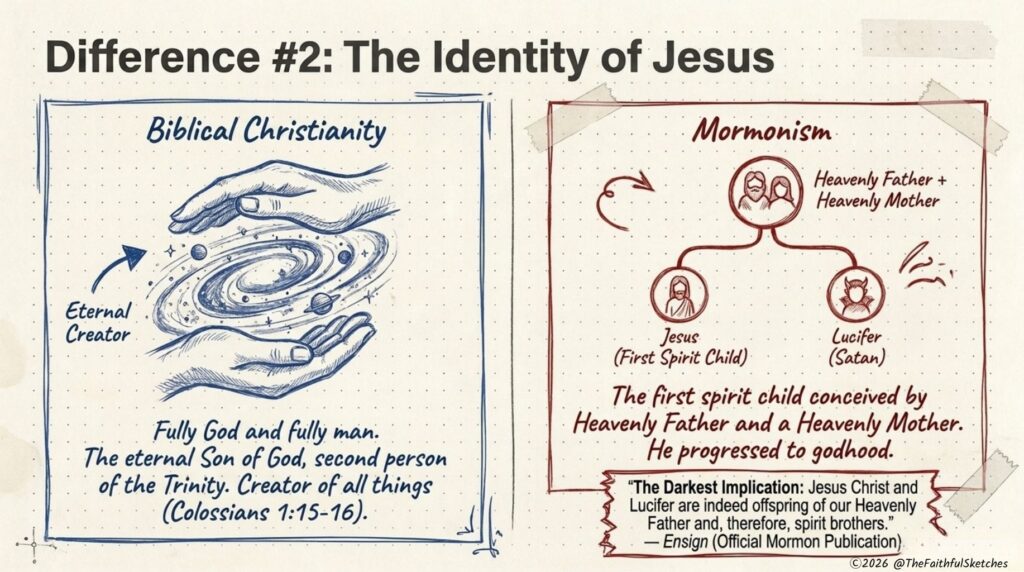
Biblical Christianity teaches that Jesus is the eternal Son of God, the second person of the Trinity, fully God and fully man. He existed with the Father from all eternity and is the Creator of all things, as John 1:1-3 and Colossians 1:15-16 declare.
Mormonism teaches something that would make first-century Christians recoil. According to Mormon doctrine, Jesus is the first spirit child begotten by Heavenly Father and a Heavenly Mother, who progressed through obedience to become a god before his incarnation. Mormons believe Heavenly Father had many more spirit children after Jesus, including us, which makes Jesus our “elder brother.”
And it gets worse. Mormons believe that Satan, Lucifer himself, is also a spirit child of Heavenly Father. That makes Jesus and Satan spirit brothers. The official Mormon publication Ensign admits this directly, affirming that Jesus Christ and Lucifer are “indeed offspring of our Heavenly Father and, therefore, spirit brothers.” Let that sink in. The Bible says Jesus is the Creator of all things, including the angelic being who became Satan. Jesus is Satan’s Creator, not his brother.
Difference 3: Salvation, Grace or Works?
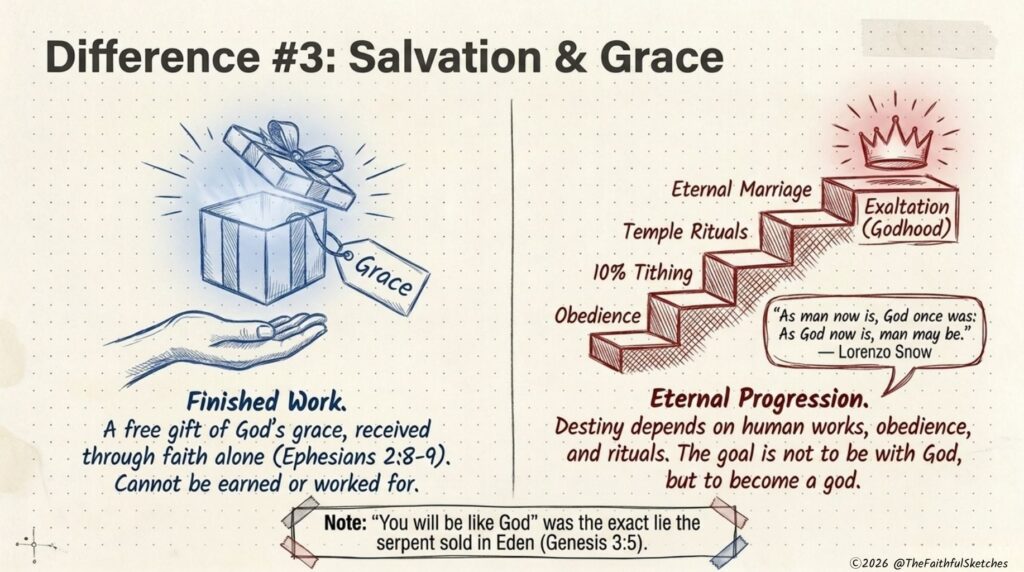
Biblical Christianity teaches that salvation is a free gift of God’s grace, received through faith in Jesus Christ alone, as Ephesians 2:8-9 states. You cannot earn it. It is finished.
Mormonism teaches a completely different gospel called exaltation, or eternal progression. Faithful Mormons who keep their temple covenants, pay their tithing, and are sealed in eternal marriage can eventually become gods themselves. This is not a metaphor. Joseph Smith said plainly: “God himself was once as we are now… you have got to learn how to be Gods yourselves.” The fifth Mormon president, Lorenzo Snow, coined the famous couplet: “As man now is, God once was: As God now is, man may be.”
This is the ultimate goal of Mormonism: not to be with God, but to become a god. Your eternal destiny depends on your obedience, your rituals, and your marriage status. And here is the theological nightmare. This doctrine of exaltation echoes exactly what the serpent promised in the Garden of Eden in Genesis 3:5: “you will be like God.” Mormonism is selling the same promise.
Difference 4: Scripture and Authority
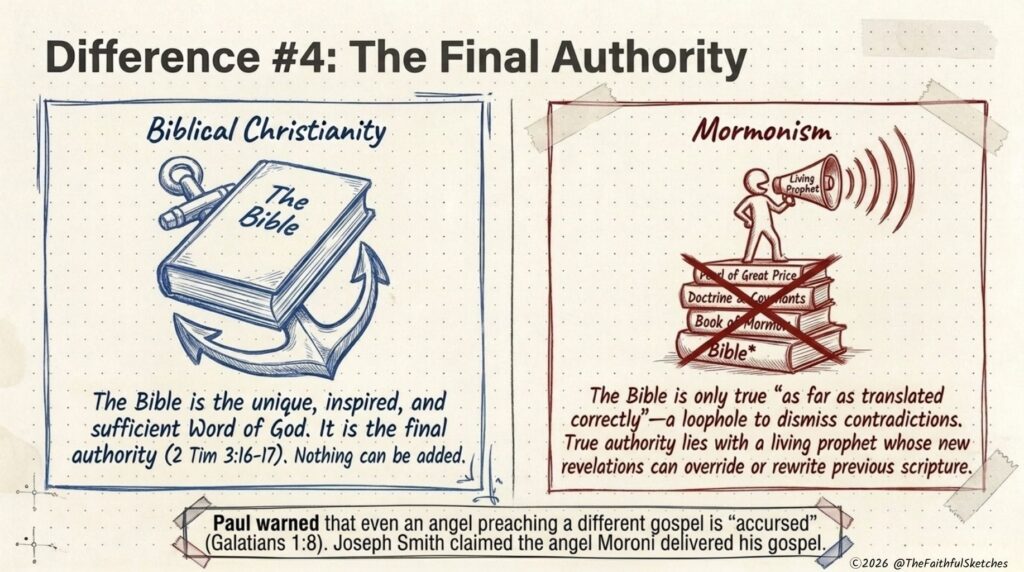
Biblical Christianity holds that the Bible is the unique, inspired, and sufficient Word of God, the final authority for faith and practice, per 2 Timothy 3:16-17.
Mormons believe the Bible is the word of God “as far as it is translated correctly,” a convenient loophole for dismissing any passage that contradicts their teachings. They then add three books of scripture: the Book of Mormon, supposedly translated from golden plates; the Doctrine and Covenants, containing modern revelations; and the Pearl of Great Price, Joseph Smith’s writings.
But here is the deeper issue. Mormonism has a living prophet who can receive new revelations at any time, and those revelations can override or contradict previous scripture. In Mormonism, the Bible is not the final authority. The living prophet is. And this is exactly how high-control religious groups operate: one man at the top claims to speak for God, and everyone must obey. Paul warned in Galatians 1:8 that even if an angel from heaven preaches a different gospel, “let him be accursed.” Joseph Smith claimed an angel named Moroni gave him the Book of Mormon.
Difference 5: The Afterlife, Two Destinations or Three Kingdoms?
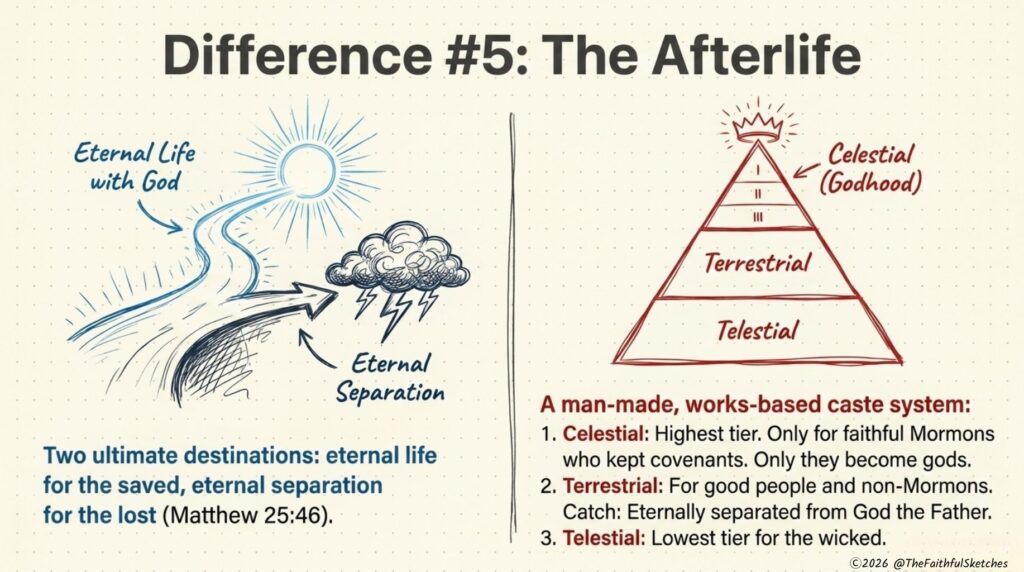
Biblical Christianity teaches two ultimate destinations: eternal life with God for the saved, and eternal separation for the lost, as in Matthew 25:46.
Mormonism has an elaborate system of three kingdoms of glory. The Celestial Kingdom is the highest, reserved for faithful Mormons who kept their covenants and were sealed in eternal marriage; only they can become gods, and even this kingdom has three internal levels. The Terrestrial Kingdom is the middle tier for good people who didn’t accept the full Mormon gospel. The Telestial Kingdom is the lowest, for the wicked.
Notice what this means. A good, sincere Christian who never became a Mormon cannot enter the Celestial Kingdom. The best they can hope for is the Terrestrial Kingdom, separated from God the Father for eternity. Your destiny depends on the covenants you make, the rituals you perform, and the tithing you pay. Critics argue this is a works-based system designed to keep members obedient, paying, and afraid.
Mormonism vs Christianity at a Glance
| Doctrine | Biblical Christianity | Mormonism |
|---|---|---|
| God | One eternal God in three persons (Trinity) | Three separate gods; the Father was once a mortal man |
| Jesus | Eternal Creator, fully God | First spirit child of Heavenly Father; spirit brother of Lucifer |
| Salvation | By grace through faith alone | Exaltation through covenants, rituals, and obedience |
| Scripture | The Bible alone, final authority | Bible “as far as translated correctly” plus three more books and a living prophet |
| Afterlife | Eternal life or eternal separation | Three kingdoms of glory; potential godhood |
Why Many Experts Call It a Cult
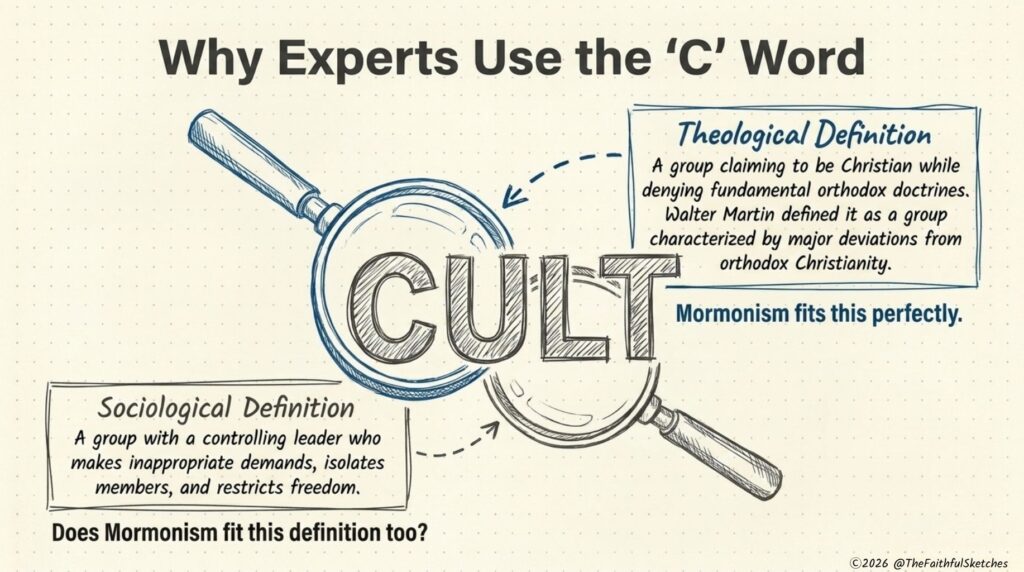
Now the elephant in the room. Why do so many experts classify Mormonism as a cult? Let’s be precise, because “cult” has two definitions.
A sociological cult is a group with controlling leadership that makes inappropriate demands, restricts information, and limits members’ freedom. A theological cult is a group that claims to be Christian while denying one or more fundamental doctrines of Christian orthodoxy. On the theological definition, the case is straightforward.
Walter Martin, author of the landmark book The Kingdom of the Cults, defined a cult as a group polarized around someone’s interpretation of the Bible and characterized by major deviations from orthodox Christianity. Mormonism deviates on God, Jesus, salvation, Scripture, and the afterlife, the very doctrines that define Christianity.
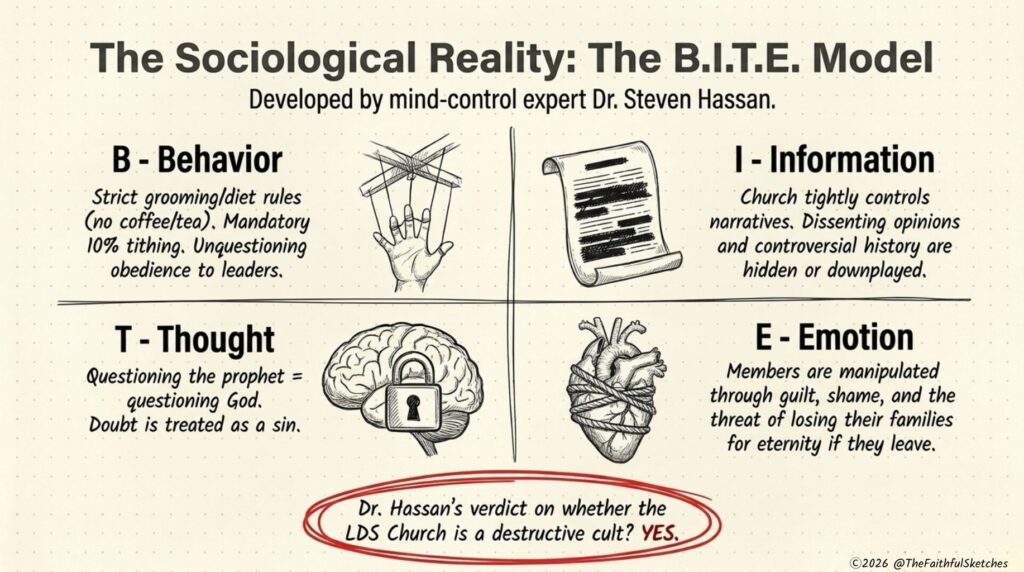
On the sociological side, critics point to the BITE Model developed by cult expert Dr. Steven Hassan, which measures Behavior, Information, Thought, and Emotional control. Applied to Mormonism, they cite behavior control through strict rules on dress, diet, and mandatory tithing of 10 percent of income; information control through a curated presentation of church history; thought control through teaching that questioning the prophet equals questioning God; and emotional control through the fear of losing your eternal family if you leave.
Hassan himself, when asked directly whether the Mormon Church is a destructive cult, answered yes. The same framework applies to another group I’ve covered in depth: see my post on Jehovah’s Witnesses and Watchtower control.
Why This Matters
Why does any of this matter? Because, from a biblical standpoint, eternal souls are at stake. Mormonism teaches a different Jesus, a different gospel, and a different God. Romans 8:9 says that anyone who does not have the Spirit of Christ does not belong to Christ, and Galatians 1:9 pronounces a curse on any contrary gospel.
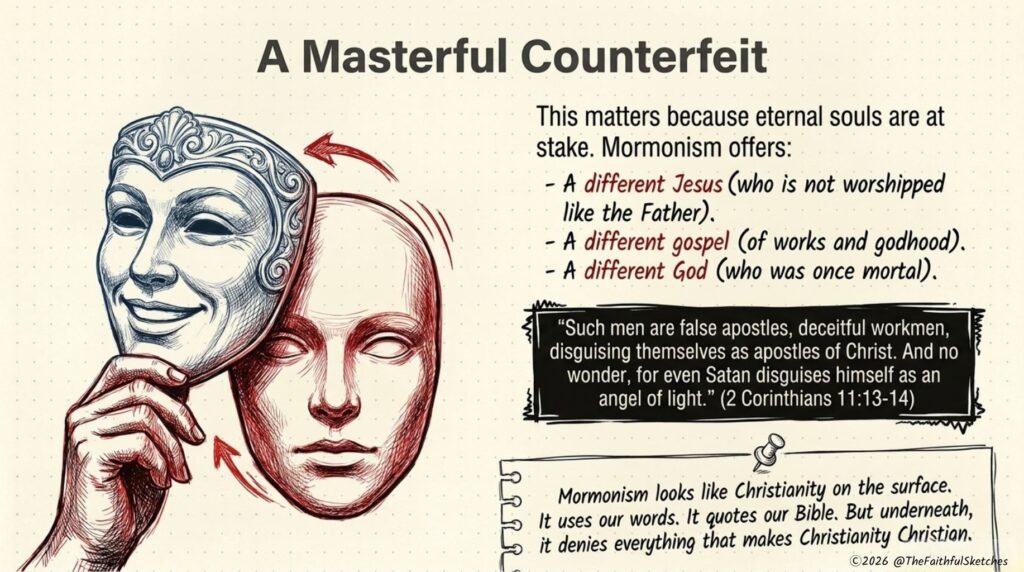
Paul also warned in 2 Corinthians 11:13-15 that false apostles disguise themselves as servants of righteousness, just as Satan disguises himself as an angel of light. That’s the heart of the Mormonism vs Christianity question. Mormonism looks like Christianity on the surface.
It uses Christian words and quotes the Bible. But underneath, it is a different religion wearing Christian vocabulary.
If this comparison helped you, my post on Seventh-day Adventist vs Mormon shows how two American-born movements went in opposite directions, and my post on Jehovah’s Witnesses beliefs covers another group that redefines Christian terms. Have you had conversations with Mormon missionaries or friends? Share your experience in the comments below.
Click Below to Download The Full PDF Summary Visual Guide:
*Free for personal use only. Please don’t resell or redistribute commercially.