
Two religions. Both founded in 19th-century America; call themselves Christian; have prophets, health codes, and a passion for missionary work. And yet they couldn’t be more different.
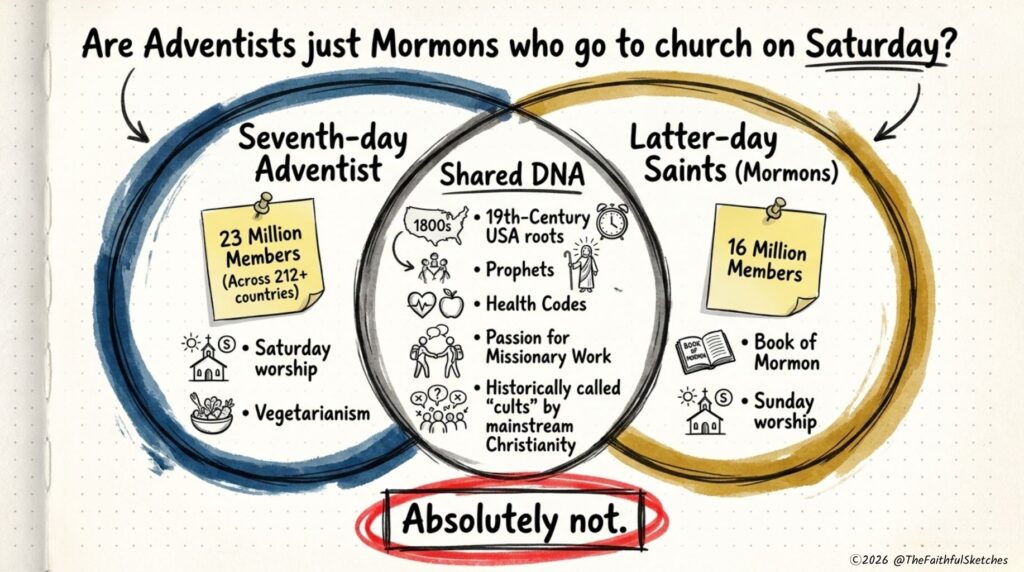
Here’s something that might surprise you. The Seventh-day Adventist Church has over 23 million members across more than 212 countries. The Church of Jesus Christ of Latter-day Saints has over 17 million. Together, that’s roughly 40 million people.
But the question most people ask is simpler: are Adventists just Mormons who go to church on Saturday? Short answer, absolutely not. This Seventh-day Adventist vs Mormon comparison will show you exactly what sets these two apart, including why one group believes humans can become gods and the other believes hell is not eternal. Let’s dive in.
The Great Disappointment vs the First Vision
Both movements were born in the fiery religious revival of 19th-century America, what historians call the Second Great Awakening. But their origin stories couldn’t be more different.
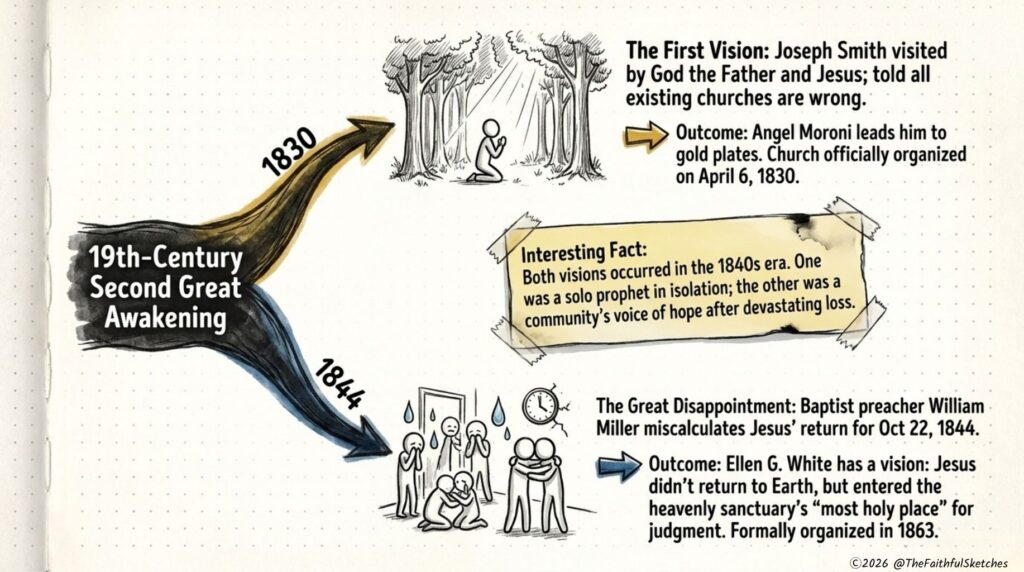
The Mormon story begins in 1830 in upstate New York. A young man named Joseph Smith claimed God the Father and Jesus Christ visited him in a grove of trees and told him all existing churches were wrong. Later, an angel named Moroni led him to buried gold plates, which he translated into the Book of Mormon. The church was officially organized on April 6, 1830.
The Adventist story begins with a prophecy that failed. A Baptist preacher named William Miller calculated that Jesus would return on October 22, 1844. Thousands of followers sold their possessions and waited, and nothing happened. It became known as the Great Disappointment. Most Millerites left in despair, but a small group stayed, believing Miller’s date was right and only the event was miscalculated. Among them was a young woman named Ellen G. White, whose visions explained that Jesus had actually entered the “most holy place” of the heavenly sanctuary to begin a work of judgment, not returned to Earth. By 1863, they formally organized as the Seventh-day Adventist Church.
👉 Interesting fact 1: Both Joseph Smith and Ellen G. White had early visions in the same era, but the settings differed sharply. Smith prayed alone in isolation, while White received her vision among grieving, disappointed Adventists. One was a solo prophet; the other was a community’s voice of hope after devastating loss.
God: One or Three?
Here’s where the two faiths diverge dramatically. Seventh-day Adventists believe in the Trinity: one God in three co-eternal, co-equal Persons, Father, Son, and Holy Spirit. This puts them squarely within historic Christian orthodoxy.
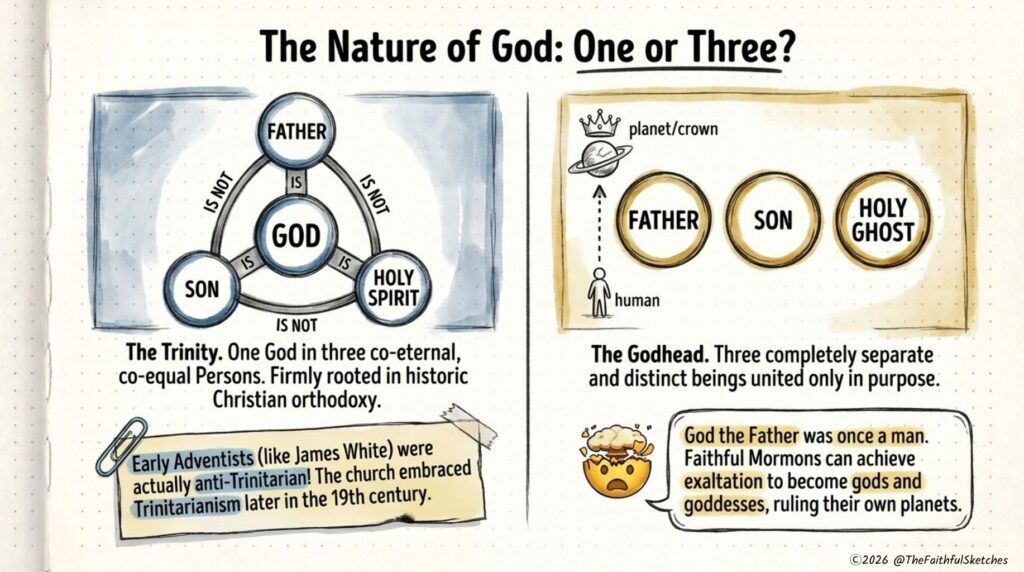
Mormons believe in the Godhead: three completely separate and distinct beings. God the Father, Jesus Christ, and the Holy Ghost are three individual Gods united in purpose but not in essence. And here’s the real mind-bender. Mormonism teaches that God the Father was once a man who progressed to godhood, and that faithful Mormons can themselves become gods and goddesses in the afterlife, ruling their own worlds and having spirit children.
👉 Interesting fact 2: The earliest Adventists actually weren’t Trinitarian. Many early leaders, including Ellen White’s husband James White, held anti-Trinitarian views. Adventists only fully embraced Trinitarian theology in the late 19th century.
The Bible: Closed Canon or Open Canon?
Seventh-day Adventists hold to sola scriptura, the Bible alone. The 66 books of the Old and New Testaments are their only creed and standard for doctrine. Ellen G. White is considered a prophet, but she called her own writings “a lesser light” meant to lead people back to the “greater light” of Scripture. Her authority points to the Bible and never replaces it.
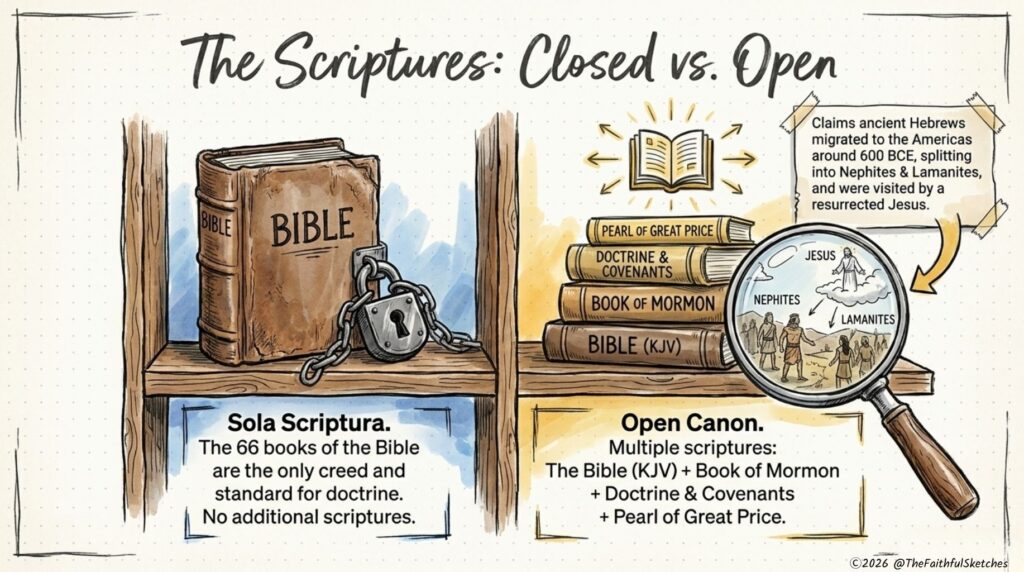
Mormons have an open canon. Their scriptures include the Bible (King James Version), the Book of Mormon, Doctrine and Covenants, and the Pearl of Great Price. And here’s the key difference: Joseph Smith didn’t see himself as a lesser light pointing to the Bible.
He saw his work as correcting Scripture’s errors and delivering God’s revelation for the current age, considering the Bible an insufficient guide on its own. In Mormon theology, the latest prophetic authority supersedes all that came before.
👉 Interesting fact 3: The Book of Mormon claims ancient Hebrews migrated to the Americas around 600 BC, split into two civilizations called the Nephites and Lamanites, and that Jesus appeared to them after His resurrection. Adventists believe none of this and hold no scriptures beyond the Bible.
Salvation: Grace or Exaltation?
Seventh-day Adventists believe salvation is a free gift of grace through faith in Jesus Christ alone, in line with Ephesians 2:8-9. Good works don’t save you; they’re the result of salvation, not the cause. When you die, you remain unconscious until the resurrection. There’s no immortal soul that flies to heaven immediately. You sleep until Jesus returns.
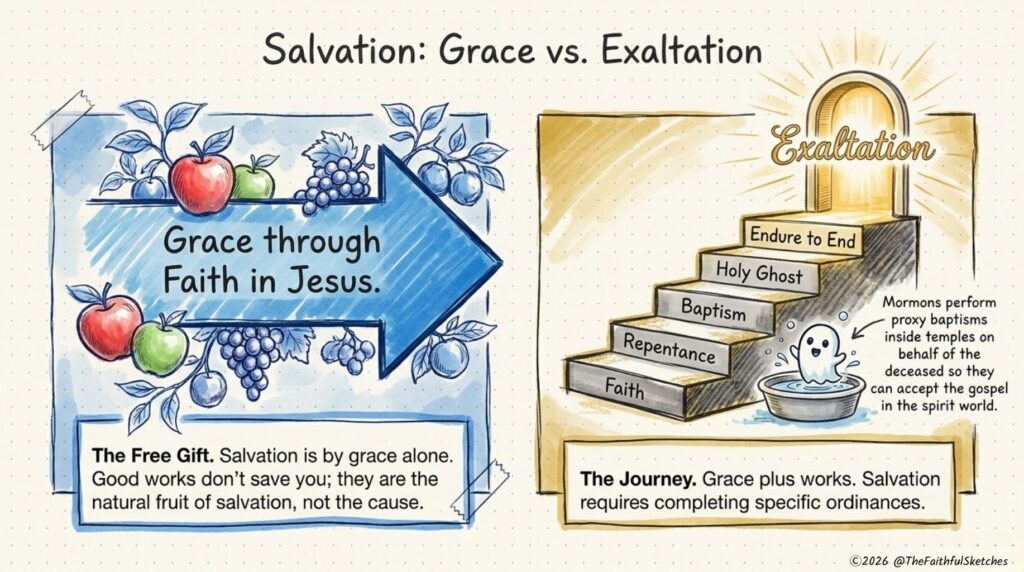
Mormons also speak of grace, but salvation in Mormonism works more like a journey than a gift. To achieve the highest salvation, called exaltation, you must have faith, repent, be baptized, receive the Holy Ghost, and endure to the end. It’s grace plus works.
Mormons also believe the dead are taught the gospel in the spirit world and can accept or reject it, which is why Mormons perform proxy baptisms inside temples on behalf of the deceased. And here’s the kicker: Mormonism has multiple levels of salvation.
After death, almost everyone reaches some kind of heaven across three kingdoms of glory: celestial, terrestrial, and telestial. The celestial kingdom is highest, where faithful Mormons can become gods. Even the lowest kingdom is said to surpass anything on Earth.
👉 Interesting fact 4: Adventists don’t believe in an eternally burning hell either. They teach the wicked are destroyed, annihilated rather than tortured forever, a view called conditional immortality. Mormons, by contrast, believe almost everyone receives some form of heaven. Two very different versions of “good news.”
The Sabbath vs Sunday
This is the most visible difference, and the one that confuses people most. Seventh-day Adventists worship on Saturday, the seventh day. They believe the Sabbath was instituted at Creation, reaffirmed in the Ten Commandments in Exodus 20:8-11, and never changed. Sunday worship, they argue, is a human tradition rather than a biblical command.
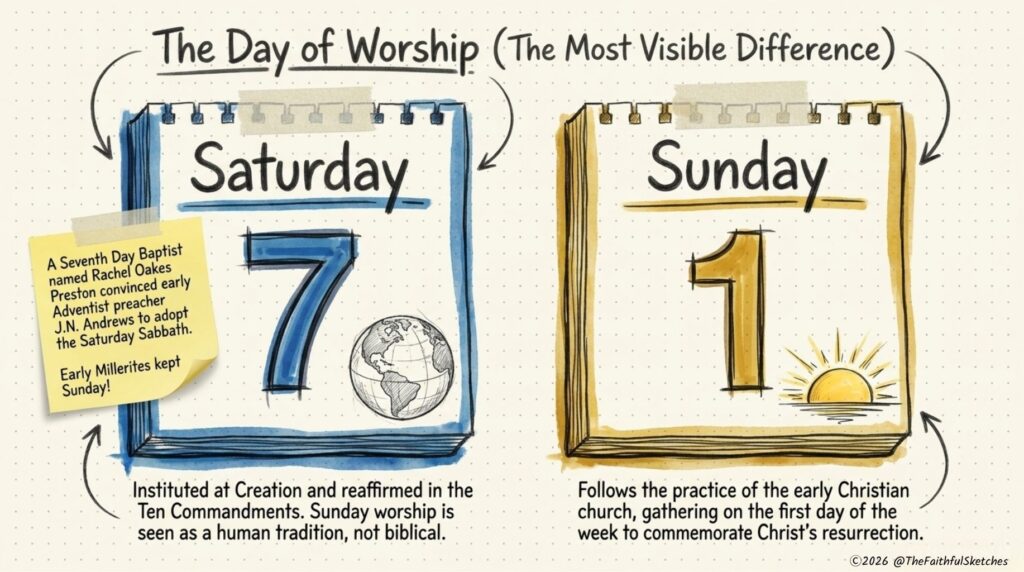
Mormons worship on Sunday like most Christians. They treat the Sabbath as a day of rest and worship but follow the practice of the early church, which gathered on the first day of the week to commemorate Christ’s resurrection.
👉 Interesting fact 5: The Adventist commitment to Saturday worship almost didn’t happen. Early Sabbatarian Adventists were a small minority, and most Millerites kept Sunday. A Seventh Day Baptist named Rachel Oakes Preston convinced a young Adventist preacher, J.N. Andrews, to adopt the Saturday Sabbath. The rest is history.
Health: Vegetarianism vs the Word of Wisdom
Both faiths are famous for their health codes, but they differ in origin and emphasis. Adventists are known for vegetarianism. Many follow a lacto-ovo vegetarian diet, avoiding meat, fish, poultry, alcohol, tobacco, and caffeine, and those who do eat meat avoid pork and other “unclean” foods from Leviticus 11.
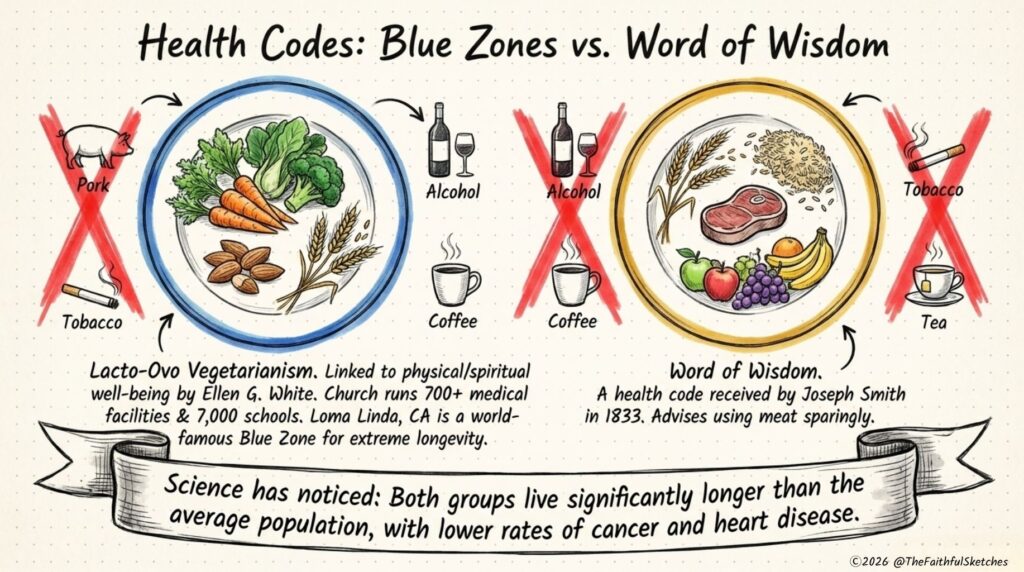
This health message came through Ellen G. White’s visions linking physical health to spiritual well-being. The Adventist Church now runs over 700 medical facilities and thousands of schools worldwide.
Mormons follow the Word of Wisdom, a health code Joseph Smith received in 1833. It prohibits alcohol, tobacco, coffee, and tea, and encourages grains, fruits, vegetables, and using meat sparingly.
👉 Interesting fact 6: Both groups live longer than average, and science has noticed. Mormon men live several years longer than non-Mormons, with significantly less cancer and heart disease. Adventist vegetarians rank among the longest-lived populations ever studied. The famous Loma Linda community in California, largely Adventist, is one of the world’s Blue Zones where people live years beyond the average.
The Prophets: Pointing to Scripture or Replacing It?
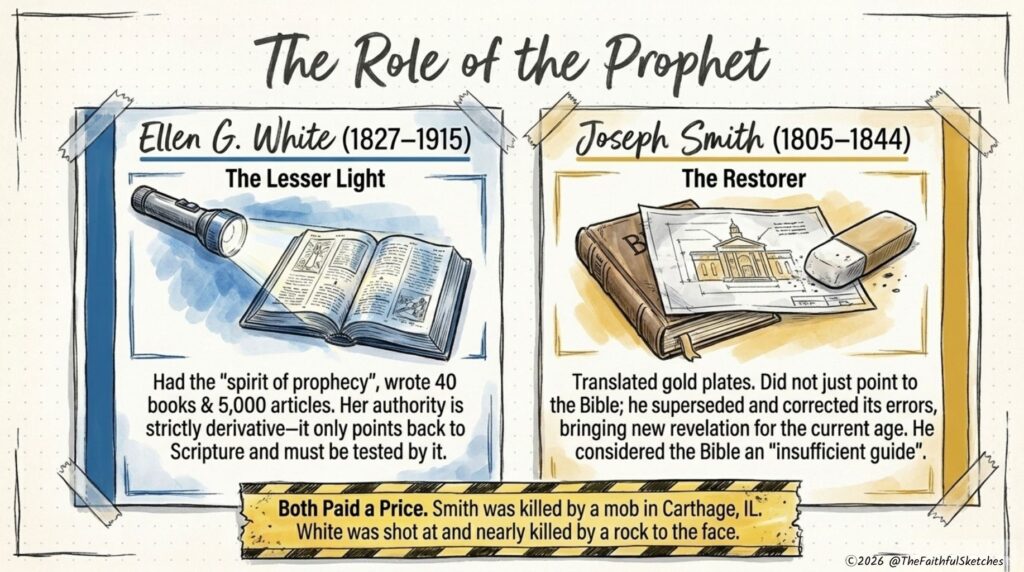
We’ve touched on this, but here’s the clearest picture. Ellen G. White (1827-1915) wrote over 5,000 articles and 40 books. Adventists believe she had the “spirit of prophecy,” but her writings are not considered equal to Scripture. She herself said the Bible is the standard by which all teaching, including her own, must be tested.
Joseph Smith (1805-1844) translated the Book of Mormon from gold plates he claimed an angel showed him. He founded a new religion with new scriptures, new doctrines, and a new organizational structure. Smith didn’t see himself as pointing back to the Bible. He saw himself as correcting it.
👉 Interesting fact 7: Both were persecuted. Smith was killed by a mob in Carthage, Illinois, in 1844. Ellen White lived to old age, dying in 1915, but she too was attacked, shot at, and once hit in the face with a rock that nearly killed her. Both paid a price for their prophetic claims.
Seventh-day Adventist vs Mormon: Side by Side
Here’s the whole comparison in one view.
| Issue | Seventh-day Adventist | Mormon (LDS) |
|---|---|---|
| Founded | 1863, after the Great Disappointment of 1844 | 1830, after Joseph Smith’s First Vision |
| Key figure | Ellen G. White, prophet pointing to Scripture | Joseph Smith, prophet with new scripture |
| View of God | Trinity: one God, three co-equal Persons | Godhead: three separate divine beings |
| Scripture | Bible alone, 66 books | Bible plus Book of Mormon and other texts |
| Salvation | Grace through faith alone | Grace plus ordinances and endurance (exaltation) |
| Afterlife | Soul sleep, then resurrection; wicked annihilated | Three kingdoms of glory; potential godhood |
| Worship day | Saturday (seventh-day Sabbath) | Sunday |
| Health code | Vegetarian emphasis, no alcohol, tobacco, caffeine | Word of Wisdom: no alcohol, tobacco, coffee, tea |
| Humans becoming gods | No | Yes, in the celestial kingdom |
Conclusion: Same Century, Different Directions
Here’s the thing most people still don’t realize. Despite all these differences, both groups consider themselves Christian. Both believe in Jesus, read the Bible, and send out missionaries. And both have been called “cults” by mainstream Christianity at various points in their history.
But they are not the same. They emerged from the same religious ferment, the same country, and the same century, yet went in completely different directions. One stayed within the Protestant tradition and reformed it. The other created something new, a restoration of what they believe was lost.
For deeper dives into each group, see my posts on Seventh-day Adventist beliefs and whether they are Christian and, for another American-born movement often compared with these two, Jehovah’s Witnesses beliefs. Which difference surprised you most? Let me know in the comments below.
Click Below to Download The Full PDF Summary Visual Guide:
*Free for personal use only. Please don’t resell or redistribute commercially.