
When you hear the word “Scientology,” what comes to mind? Tom Cruise? Mysterious buildings with strange symbols? Endless internet rabbit holes? Beneath all the headlines sits a question most people still can’t answer: what do Scientologists actually believe?
The short answer is this. They believe you are an immortal spiritual being, called a thetan, who has lived countless past lives across trillions of years. The longer answer involves a concept called the reactive mind, a process called auditing, a device called the E-meter, and a structured path to spiritual freedom called the Bridge to Total Freedom. This post starts with the basics every member knows and works up to the secret teachings most only encounter after years of dedication and significant financial investment. If you want the money, lawsuits, and government war instead, that’s covered in my companion post on the Scientology empire. Here, we focus purely on the beliefs.
The Foundation: Who Was L. Ron Hubbard?
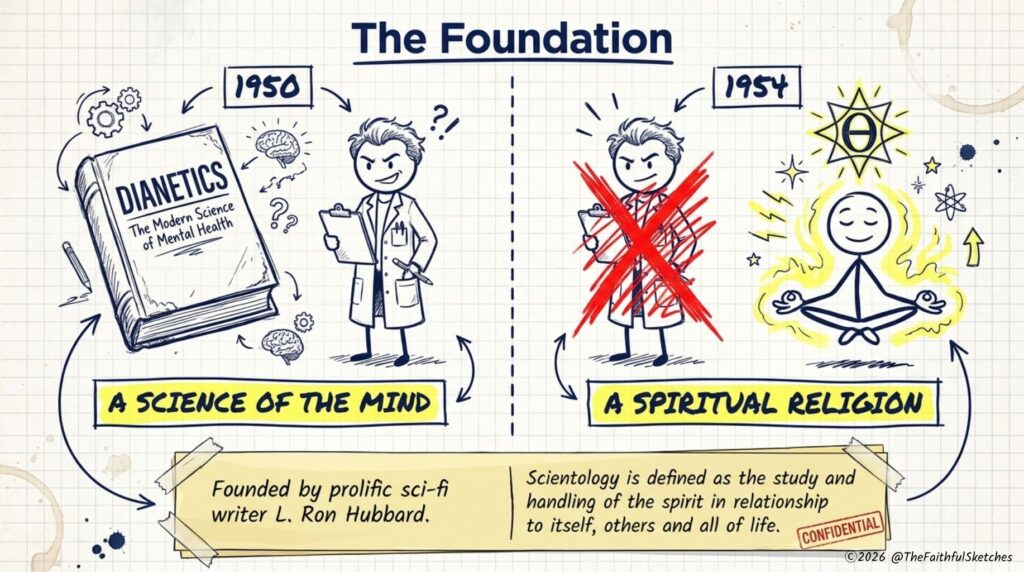
To understand Scientology, you have to start with its founder, L. Ron Hubbard. Hubbard was a prolific science fiction writer who had published countless stories about space travel, alien civilizations, and futuristic adventures. Then in 1950, he published the book that changed everything: Dianetics: The Modern Science of Mental Health. His stated goal was to analyze humankind’s mental problems and offer a method for overcoming them. The book became a massive success, and by 1954 Hubbard had founded the Church of Scientology.
Here’s the key distinction. Dianetics was presented as a science, a method for healing the mind. Scientology was presented as a religion, a complete spiritual philosophy. The church defines Scientology as the study and handling of the spirit in relationship to itself, others, and all of life. Followers believe we are spiritual beings whose existence spans more than one lifetime, endowed with abilities beyond our normal experience. The core beliefs center on the spiritual nature of humanity, the rehabilitation of the human spirit, the method for achieving it, and the inherent ability of people to change their conditions.
The Thetan: What You Really Are
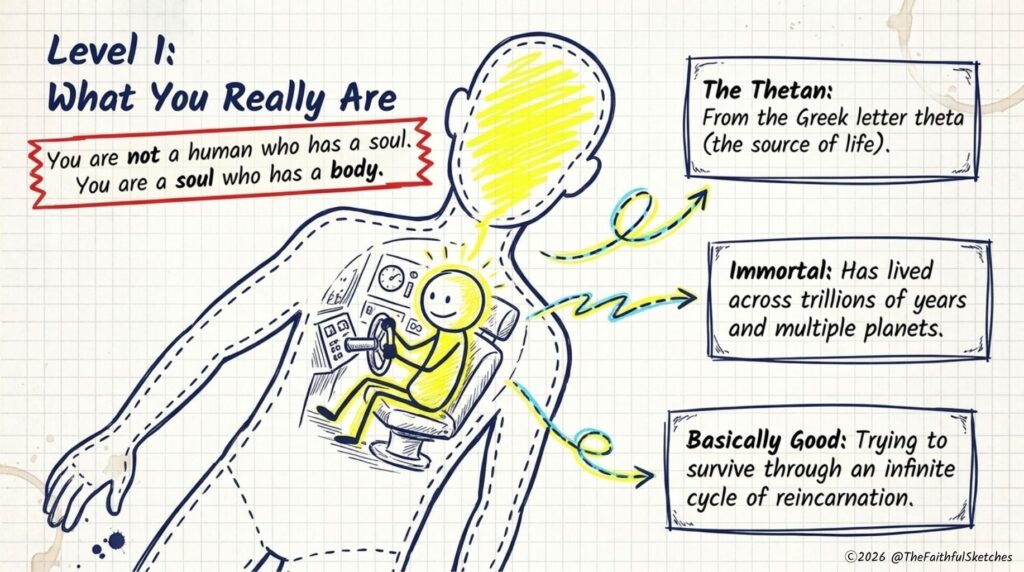
At the heart of Scientology is a single radical idea: you are not a human who has a soul. You are a soul who has a body. Scientologists call this immortal spiritual being a thetan. The term comes from the Greek letter theta, which they use to represent the source of life itself. A thetan is your true self, the being that inhabits a body and uses a mind but is identical with neither.
According to Scientology, thetans are basically good and are trying to survive. They have lived through countless past lives, on Earth, on other planets, across trillions of years, with each lifetime just another chapter in an infinite existence. Scientologists believe in reincarnation, the continuous cycle of being born, dying, and being born again. But unlike some Eastern traditions that see reincarnation as a cycle to escape, Scientology treats it as a series of lives to remember and learn from. The goal is to help members become aware that they are thetans and to restore their spiritual abilities. The problem is that most thetans have forgotten who they really are. They’ve become trapped, not just in bodies, but in something called the reactive mind.
The Reactive Mind and Engrams: The Problem
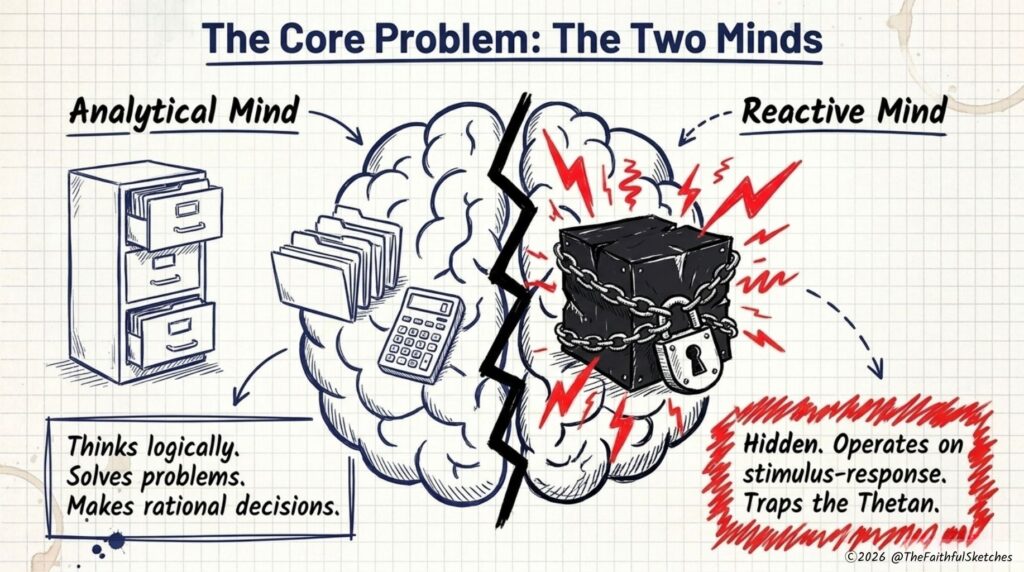
According to Hubbard, the human mind has two parts. The first is the analytical mind, the part that thinks logically, solves problems, and makes rational decisions. The second is the reactive mind, a hidden portion that operates on pure stimulus and response, storing exact impressions and charges from past traumatic events. These stored recordings are called engrams.
An engram is a complete recording of a moment of pain and unconsciousness, whether from a car accident, a surgery, or any moment the person was not fully conscious. The reactive mind records everything: the pain, the sounds, the words spoken, the emotions present. These engrams don’t sit harmlessly. They can be restimulated, triggered by current situations that resemble the original event, producing irrational emotional responses, psychosomatic illnesses, nightmares, and unreasonable fears. Scientologists believe engrams accumulate not just in this lifetime but across all past lives. The more engrams you carry, the more your reactive mind controls you, and the less you can function as your true self. The solution? Get rid of them.
Auditing and the E-meter: The Solution
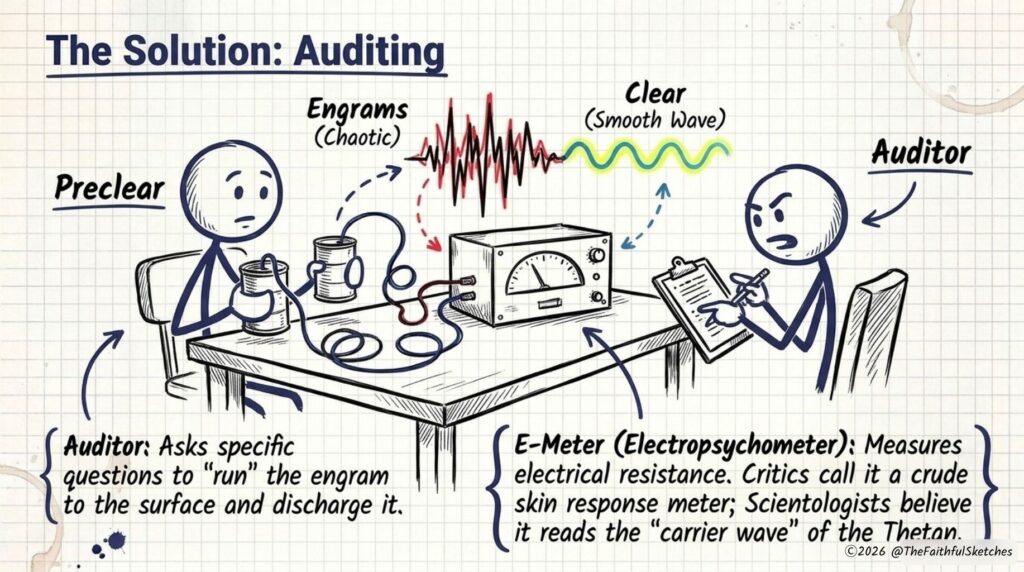
To remove engrams, Scientologists use a process called auditing. Auditing is a one-on-one session between a trained auditor and a person seeking help, called a preclear, meaning someone who has not yet reached the state of Clear. The auditor asks a series of questions designed to locate engrams, then “run” each one by bringing it to the surface of the conscious mind so it can be discharged.
But auditing isn’t just talking. It involves a device called the E-meter, short for Electropsychometer, which measures changes in electrical resistance through the body. You hold two metal cans connected to the device while the auditor asks questions, and Scientologists believe the E-meter reads the spiritual being and helps locate areas of upset. Critics describe it as a crude galvanic skin response meter, essentially a simple lie-detector component. Scientologists believe it measures spiritual energy. The key point is that auditing is not therapy. It’s a spiritual process designed to free the thetan from the reactive mind, and its ultimate goal is a state called Clear.
The State of Clear: The First Major Milestone
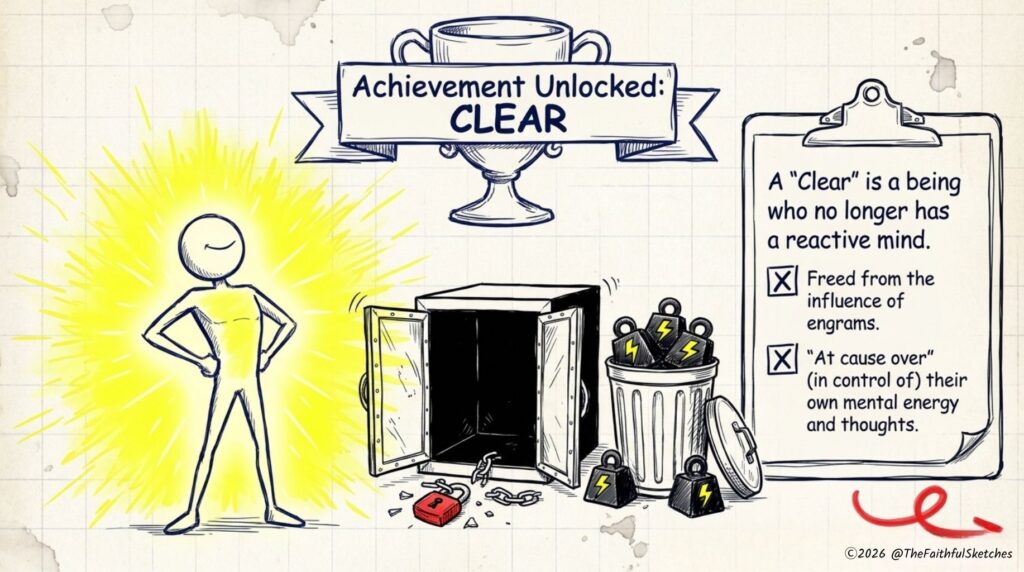
The Church of Scientology defines a Clear as a person who no longer has a reactive mind, someone completely freed from the influence of engrams. According to Hubbard, a Clear suffers none of the ill effects the reactive mind can cause, because they carry no engrams to be restimulated.
A Clear is said to be “at cause over” their own mental energy and thoughts, meaning in control of them. They can think clearly in situations that previously caused difficulty, and their individuality and creativity are strengthened. This is the first major milestone on the Scientology path. But it’s not the end. It’s just the beginning.
The Bridge to Total Freedom: The Path
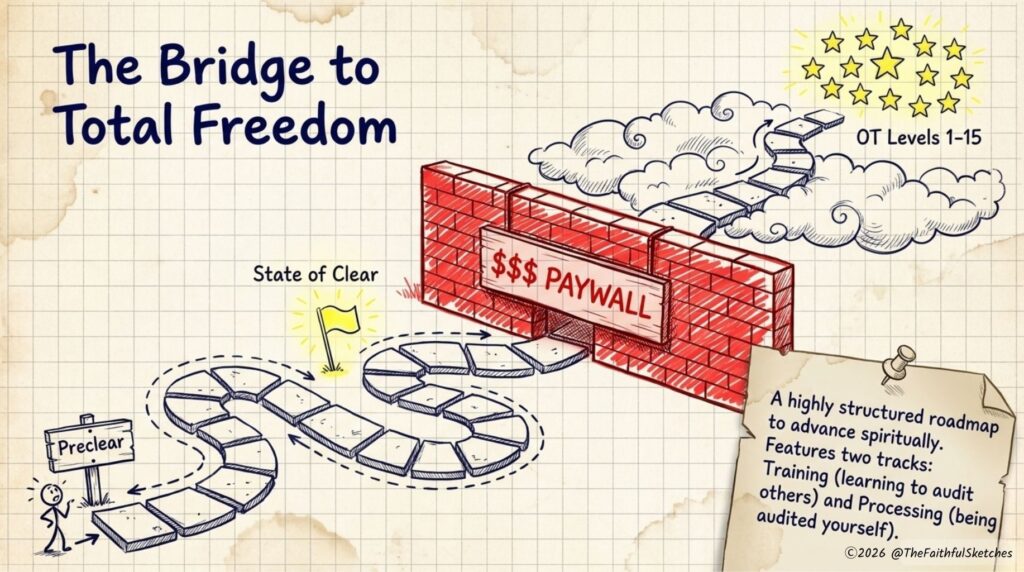
To progress, members follow a structured roadmap called the Bridge to Total Freedom, a massive color-coded chart displayed on the wall of every Scientology organization. It lists every course, every auditing action, and every step required to advance. The Bridge has two tracks: training, which means learning to audit others, and processing, which means being audited yourself.
After reaching Clear, members can continue to the upper levels, the Operating Thetan or OT levels. An Operating Thetan is described as a state of complete spiritual freedom in which one is “willing and knowing cause over life, thought, matter, energy, space and time.” Scientologists are taught they will gain near-godlike control over matter, energy, space, and time, known in Scientology jargon as MEST. The church offers 15 OT levels above Clear, each costing thousands of dollars. And here’s the catch: the OT levels are confidential. Members only learn what’s in each level once they reach it and pay for it. This is where things get truly strange.
The Secret Teachings: Xenu and Body Thetans
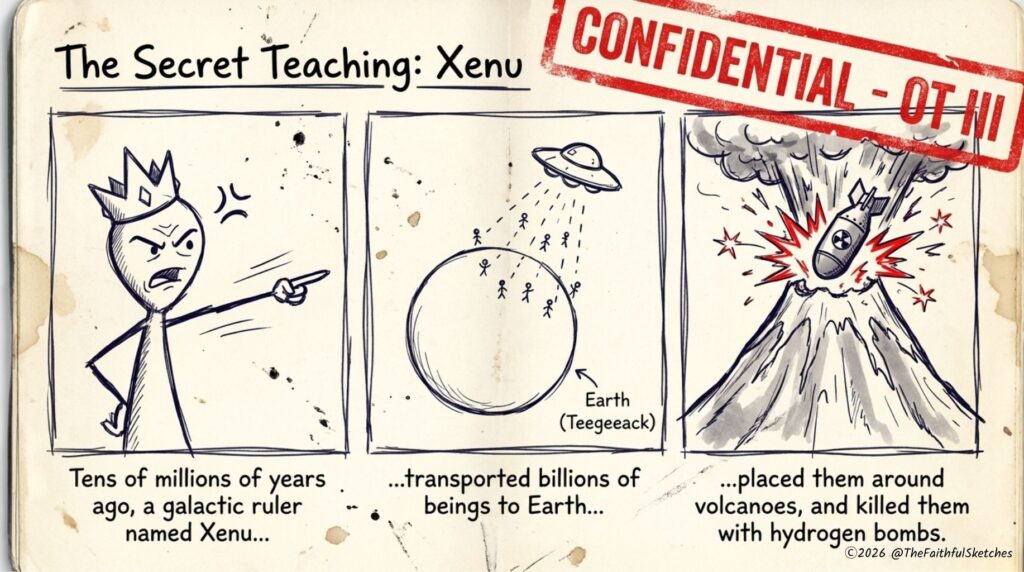
This is the part most people have heard of but don’t fully understand. At OT III, Operating Thetan Level Three, Scientologists learn the story of Xenu. According to the confidential OT III materials, Xenu was an extraterrestrial ruler of a galactic confederacy who, tens of millions of years ago, transported billions of beings to Earth, then called Teegeeack, placed them around volcanoes, and killed them with hydrogen bombs.
The disembodied spirits of the victims scattered and were captured, brainwashed, and forced to attach to surviving bodies. These are the body thetans, confused disembodied souls from other planets who, Scientologists believe, are still attached to humans today, including you, contributing to present-day psychological difficulties. The purpose of the OT levels is to identify and release them through specialized procedures.
The church regards the OT III material as strictly confidential and instructs members not to reveal it to anyone below the appropriate level. Church officials have often declined to discuss Xenu publicly, maintaining that the material can only be properly understood within the full training path. Despite these restrictions, the narrative has become widely known through court cases, leaked documents, and reporting by journalists and former members. But here’s what most people miss: the Xenu story is not the core teaching of Scientology. It’s an advanced doctrine that members reach only after years of progression, and most Scientologists never get there.
The Eight Dynamics: Scientology’s View of Survival
Beyond the thetan, the engrams, and the Bridge, there’s one more important concept: the Dynamics. Hubbard defined survival as eight areas of urge, which he called the eight Dynamics. Here they are in order.
| Dynamic | Area of Survival |
|---|---|
| 1 | The individual self |
| 2 | Family, children, and sex |
| 3 | Groups |
| 4 | Mankind |
| 5 | The animal kingdom |
| 6 | The physical universe |
| 7 | The spiritual being and spiritual world |
| 8 | Infinite reality |
These areas help members understand their lives and improve across every domain. Because Scientology teaches that furthering existence is the preferred spiritual path, a common phrase within the organization is “the greatest good for the greatest number of dynamics.” The idea implies a balance across all areas of life, and the belief that people can change, improve, and be helped.
Putting It All Together
So what do Scientologists actually believe? At the most basic level, they believe you are an immortal spiritual being, a thetan, who has lived countless past lives and can achieve extraordinary spiritual power. They believe your problems are caused by engrams, traumatic memories stored in your reactive mind, and by body thetans, the disembodied spirits of beings from other planets. They believe auditing, using the E-meter and a trained auditor, can identify and remove these obstacles. And they believe the Bridge to Total Freedom, a structured progression of courses and auditing, is the path to becoming an Operating Thetan, a being with complete control over life, matter, energy, space, and time.
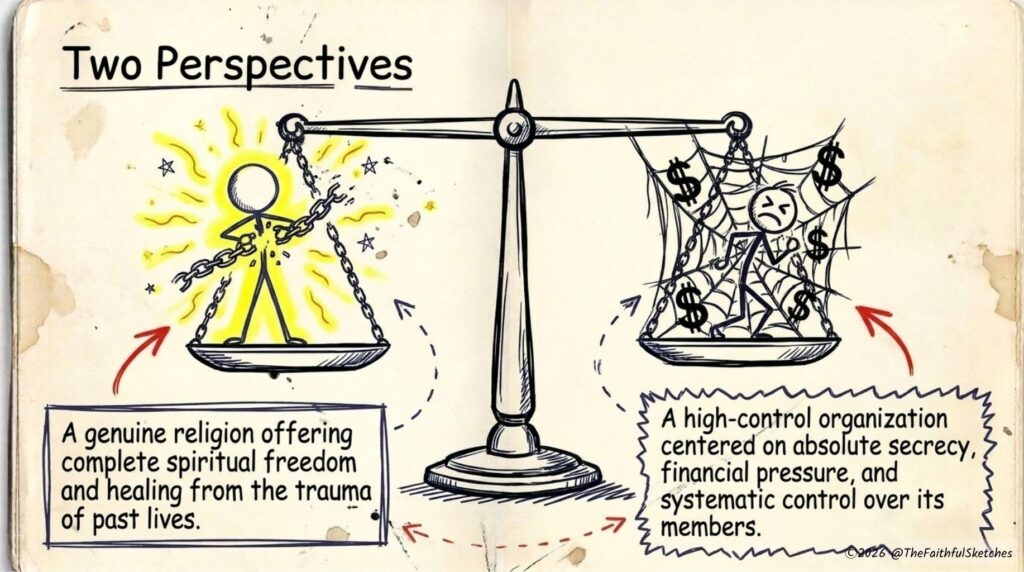
The ultimate goal is spiritual freedom, the rehabilitation of the human spirit and the restoration of the thetan’s true nature. Supporters describe Scientology as a genuine religion that helps people overcome the trauma of past lives. Critics argue it functions as a high-control organization built on secrecy and financial pressure. If you want to see how these beliefs led to government infiltrations, celebrity scandals, and internet speedruns, read my companion post on the Scientology empire, and for other movements that redefine familiar religious language, see my post on Mormonism vs Christianity. What surprised you most about Scientology’s beliefs? Drop your thoughts in the comments below.
Click Below to Download The Full PDF Summary Visual Guide:
*Free for personal use only. Please don’t resell or redistribute commercially.