
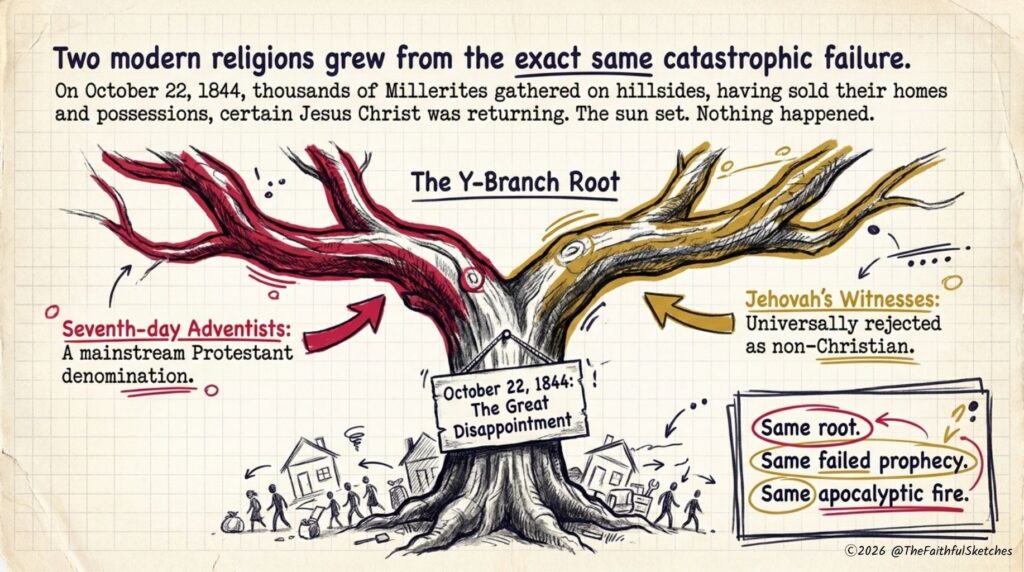
October 22, 1844. Thousands of people gathered on hillsides. They had sold their homes, given away their possessions, and said goodbye to their families, certain that Jesus Christ was returning to Earth that very day. The sun rose. The sun set. Nothing happened.
This was the Great Disappointment, and from its ashes grew two of the most controversial religious movements in modern history. One became the Seventh-day Adventists. The other, through a different chain of events, gave rise to the Jehovah’s Witnesses.
Same root, same failed prophecy, same apocalyptic fire, yet one is considered a mainstream Protestant denomination and the other is almost universally rejected as non-Christian. And strangely, both believe Jesus is the Archangel Michael.
This post examines every major belief and controversy in the Seventh-day Adventist vs Jehovah’s Witnesses divide.
A note before we start: this is meant to explain, not to attack either group. It draws on each organization’s own published teachings and on reliable historical and news sources. If you’re an Adventist or a Witness and feel something here is misunderstood, you’re welcome to share your perspective respectfully in the comments.
The Prophetess and the Plagiarism Controversy
Let’s start with the Seventh-day Adventists. After the Great Disappointment, most Millerites went home devastated. But a small group refused to give up. They believed God had meant something by 1844, and they simply misunderstood what.
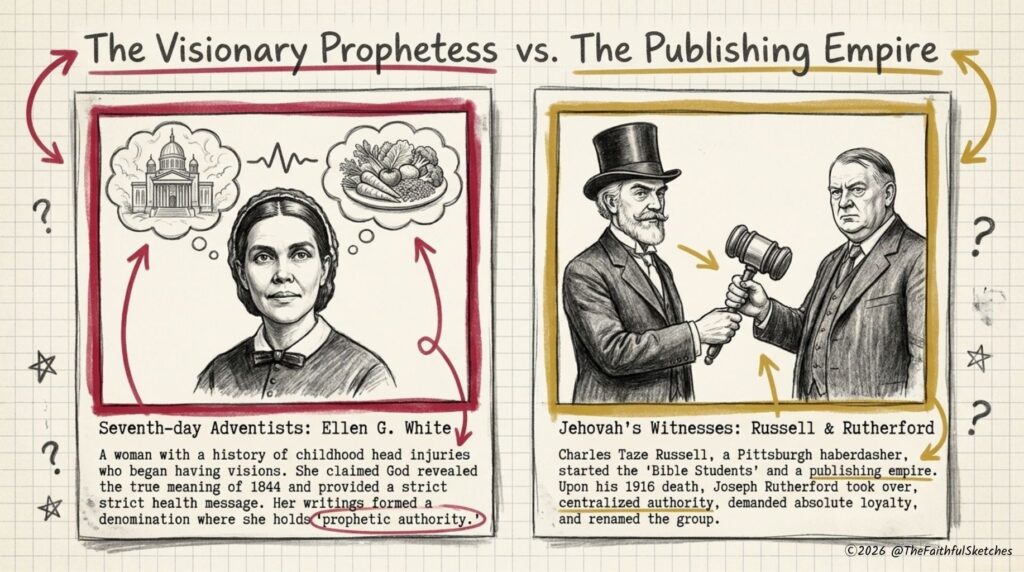
Ellen G. White, a woman with a history of childhood head injuries, began having visions. She claimed an angel showed her the heavenly sanctuary. She claimed God revealed the true meaning of 1844. White also claimed God gave her a health message covering vegetarianism, alcohol, tobacco, and pork.
Her followers soon came to see her as a modern-day prophet, and an entire denomination grew around her writings.
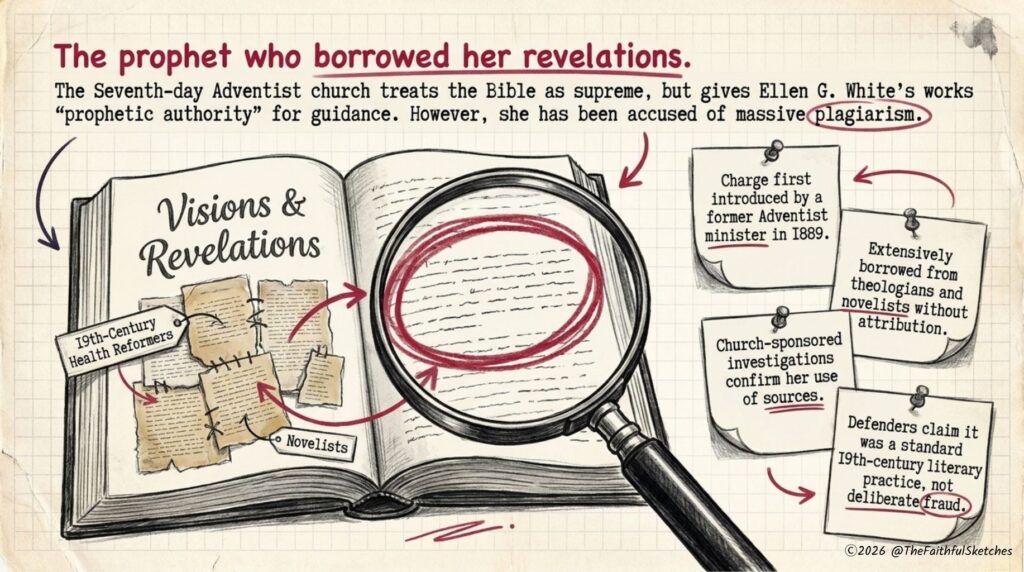
What most people don’t know is that White has faced serious plagiarism accusations. A former Adventist minister first raised the charge in 1889. Since then, researchers have documented how she borrowed extensively from 19th-century health reformers, theologians, and even novelists, often without attribution. In fact, entire passages of her books came directly from other authors.
The Adventist Church has sponsored its own investigations into her sources, and her defenders argue that her methods matched common 19th-century literary practice rather than deliberate fraud. Still, the church continues to treat her writings as authoritative. Officially, the Bible remains supreme, but her works carry what the church calls “prophetic authority” for guidance.
So here’s an honest question: if a prophet borrowed her revelations from other people’s books, how much of it actually came from God?
The “Shut Door” That Wasn’t Shut
Here’s something even most Adventists don’t know. In the aftermath of 1844, White taught the “Shut Door” doctrine. She claimed the door of mercy had closed, meaning no more sinners could be saved. Between 1844 and 1849, she taught this plainly and attributed it directly to visions from God. Later, though, she reversed course entirely.
Critics argue the church still carries “this unbiblical and nonsensical doctrine” without ever fully explaining it away. The Ellen G. White Estate has faced accusations of either a serious oversight or an active effort to minimize her early teachings.
So the founder of a major denomination once declared salvation closed to the world, changed her mind, and the movement built around her rarely discusses it today.
The Hat Salesman Who Started a Religion
Now let’s turn to the other side. Charles Taze Russell was a haberdasher, a hat salesman, from Pittsburgh. Raised Congregationalist, he grew skeptical of eternal hell and began studying the Bible on his own. Adventist teachers influenced him early on, and he eventually started his own Bible study group. His followers called themselves Bible Students.
Russell then began publishing his own interpretations. He predicted Christ’s invisible return in 1874 and the end of the world in 1914, and along the way he built a substantial publishing empire.
When he died in 1916, Joseph Rutherford took over. Rutherford transformed the movement into something far more centralized, renamed it Jehovah’s Witnesses, and demanded strict loyalty from members while issuing his own predictions.
The list of failed dates is striking. The Watch Tower Society set end-times dates in 1874, 1914, 1918, 1925, and 1975. One scholar even describes the pattern as “persistent prophecy failure.” In 1925, Rutherford announced that ancient patriarchs would be resurrected on Earth. Nothing happened, and the organization simply moved on.
Then in 1975, the organization strongly implied Armageddon would arrive. Thousands of Witnesses sold homes and quit jobs to prepare. Again, nothing happened. Critics say the organization has repeatedly revised its own historical record to obscure these failures.
The Jesus Problem: Trinity or Archangel?
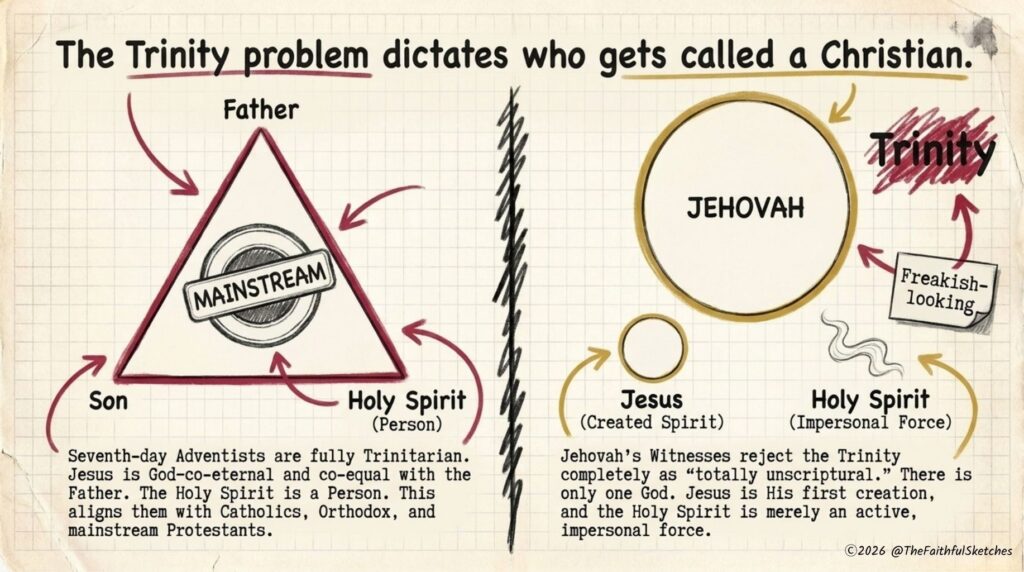
Now we reach the heart of the matter, the thing that fundamentally separates these two groups: the Trinity.
Seventh-day Adventists are fully Trinitarian. They believe Jesus is God, co-eternal and co-equal with the Father, and they believe the Holy Spirit is a Person. This places them theologically alongside Catholics, Orthodox Christians, and mainstream Protestants. Jehovah’s Witnesses, on the other hand, reject the Trinity completely, describing it as “totally unscriptural.” For them, only one God exists: Jehovah. Jesus is His first creation, a spirit being who later became human, while the Holy Spirit is merely an impersonal force.
This is the single biggest divide between the two groups, and it’s the reason most Christians don’t consider Witnesses to be Christian at all. If you want to see why this doctrine carries so much weight, my post on whether Calvinism is biblical touches on similar questions about who Jesus actually is.
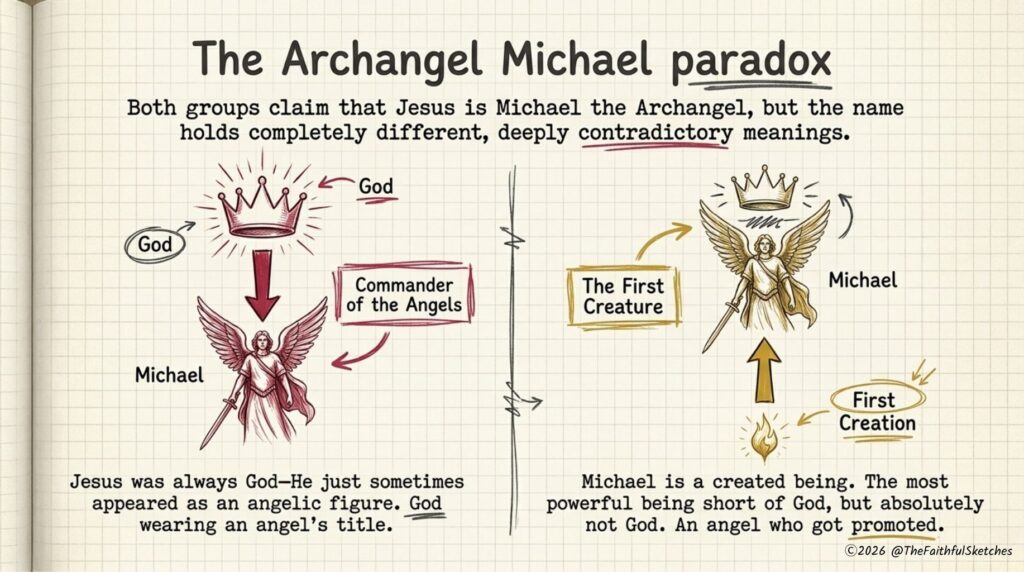
But here’s where it gets bizarre. Both groups say Jesus is Michael the Archangel, yet they mean two completely different things by it. For Adventists, “Michael” is simply a title for the pre-incarnate Son of God, meaning “commander of the angels.” In their view, Jesus was always God; He just sometimes appeared in an angelic role.
For Jehovah’s Witnesses, though, Jesus literally is Michael the Archangel, a created being. He’s the first created being, but still a creature, not God, and not equal to Jehovah. He’s simply the most powerful being short of God Himself. So one group says Jesus is God wearing an angel’s title. The other says Jesus is an angel who got promoted.
The 144,000 and the Shifting Generation
Jehovah’s Witnesses teach that only 144,000 people will go to heaven, based on Revelation 7:4. Everyone else, the “great crowd,” lives forever on a paradise Earth instead. The Witnesses once taught that this number was essentially filled by 1935. Later, they softened that position, so members today can still claim to be newly anointed.
A deeper controversy involves the “generation” of 1914. Witnesses used to teach that people alive in that year would live to see the world’s end. As that generation aged and began dying off, the organization reinterpreted “generation” in 1995 to mean something else entirely. It then moved forward without much public acknowledgment of the shift.
Saturday vs No Sabbath at All
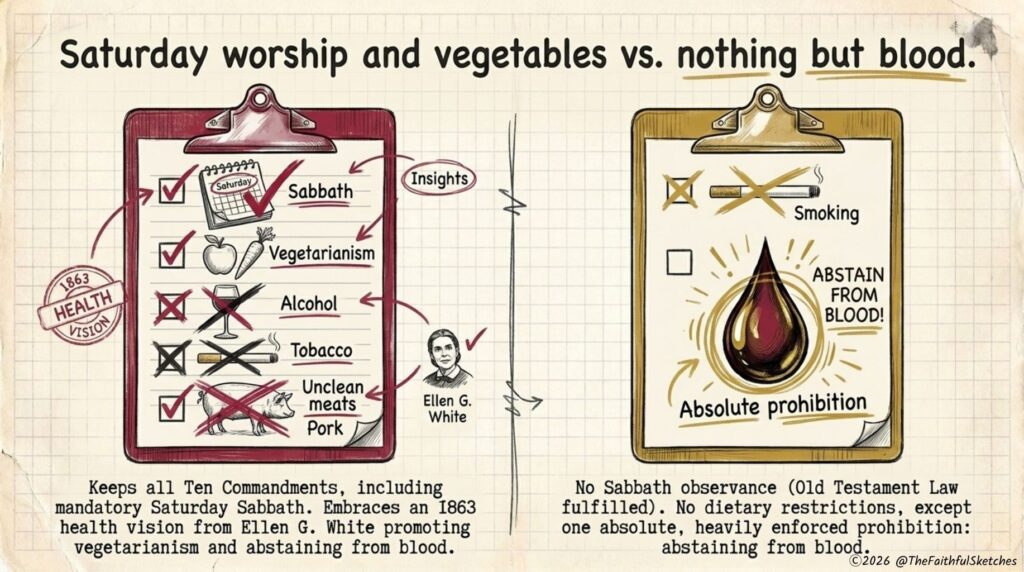
Here’s another major difference: the Sabbath. Adventists worship on Saturday, the seventh day, and this stands as one of their 28 Fundamental Beliefs. They hold that the fourth commandment in Exodus 20:8 remains binding today.
Jehovah’s Witnesses, by contrast, observe no Sabbath at all. They consider no day holy, since they believe Christ fulfilled the Old Testament Law. This isn’t a small detail. It actually reflects how each group reads the entire Bible. Adventists believe all Ten Commandments still apply, including the Sabbath, while Witnesses believe only the moral principles carry forward.
Adventists also follow a health message, promoting vegetarianism and avoiding alcohol, tobacco, and biblically unclean meats. An 1863 vision from Ellen White launched this whole movement. Witnesses have no comparable dietary code, apart from avoiding blood and improperly drained meat, and they also prohibit smoking.
So one group has a prophetess who told them what to eat. The other has a rule about blood that has proven fatal, which we’ll look at next.
The Blood Policy That Kills
If there’s one thing most people know about Jehovah’s Witnesses, it’s this: they refuse blood transfusions. They base the policy on Genesis 9:4 and Levitical commands to abstain from blood, even when it costs a life. And it has cost lives, repeatedly.
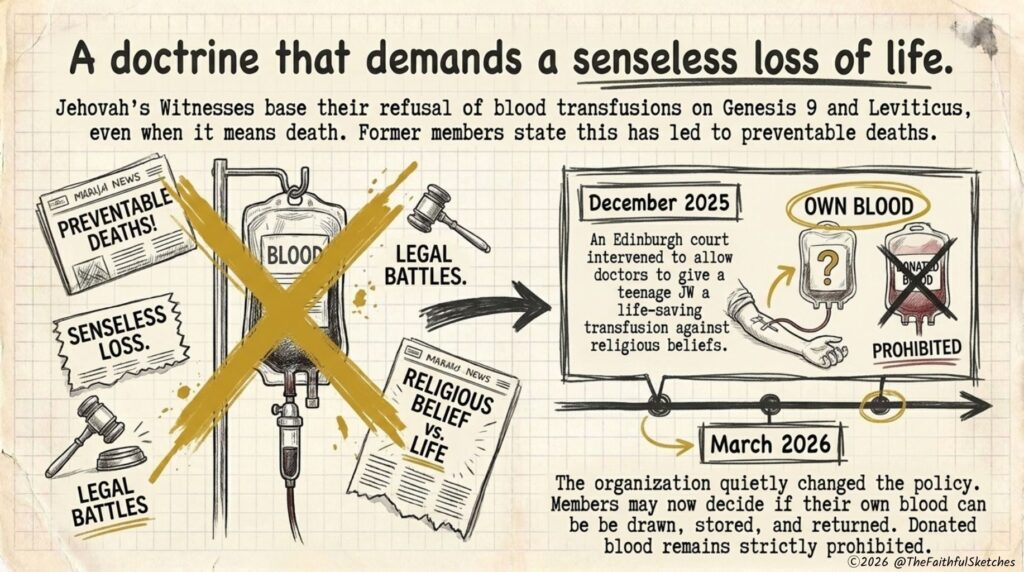
In December 2025, an Edinburgh court ruled that doctors could give a blood transfusion to a teenage Jehovah’s Witness if medically necessary after surgery. The courts had to step in to protect a child from her parents’ religious beliefs.
Former members describe the ban as leading to “senseless loss of life,” and they point to preventable deaths as a direct result. Interestingly, in March 2026 the organization quietly revised its policy. Members can now personally decide whether their own blood can be drawn, stored, and later returned during treatment. Donated blood from someone else, however, remains prohibited.
The Translation That Changed the Theology
Jehovah’s Witnesses use their own Bible translation, the New World Translation, and it has stirred controversy since its first publication in 1950. The translation committee remained anonymous, so their identities and qualifications were never publicly disclosed.
Critics allege the NWT has been “intentionally altered in key passages to support Jehovah’s Witnesses theology,” and both Catholic and Protestant scholars have widely rejected it as biased and unscholarly.
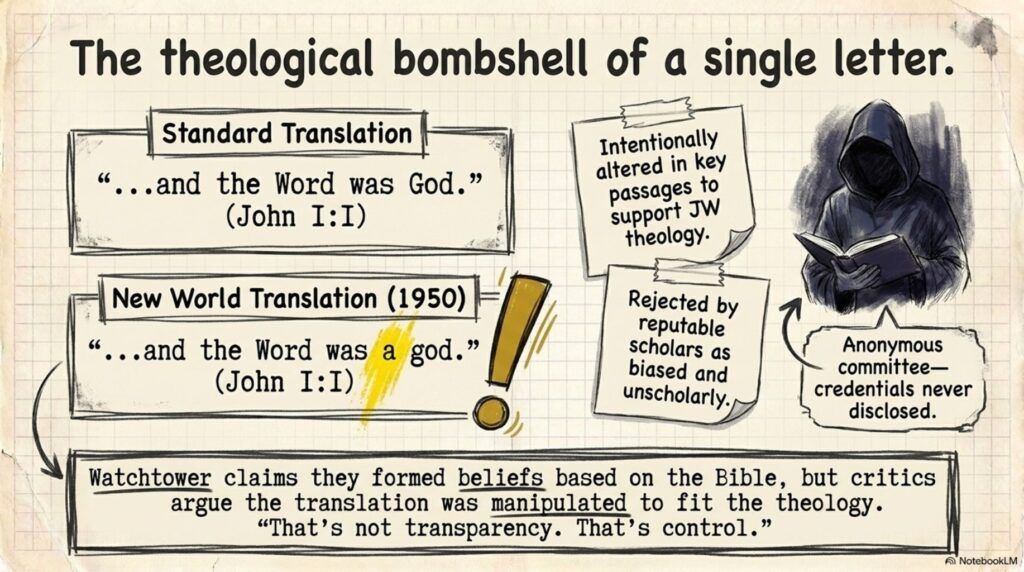
The most famous example appears in John 1:1. Every major English translation renders it “the Word was God.” The New World Translation instead renders it “the Word was ‘a’ god,” a small grammatical shift with enormous theological consequences.
The Watchtower defends the translation, saying members formed their beliefs from the Bible rather than the reverse. Critics counter that the anonymous, unaccountable translation process suggests the opposite.
Shunning and Broken Families
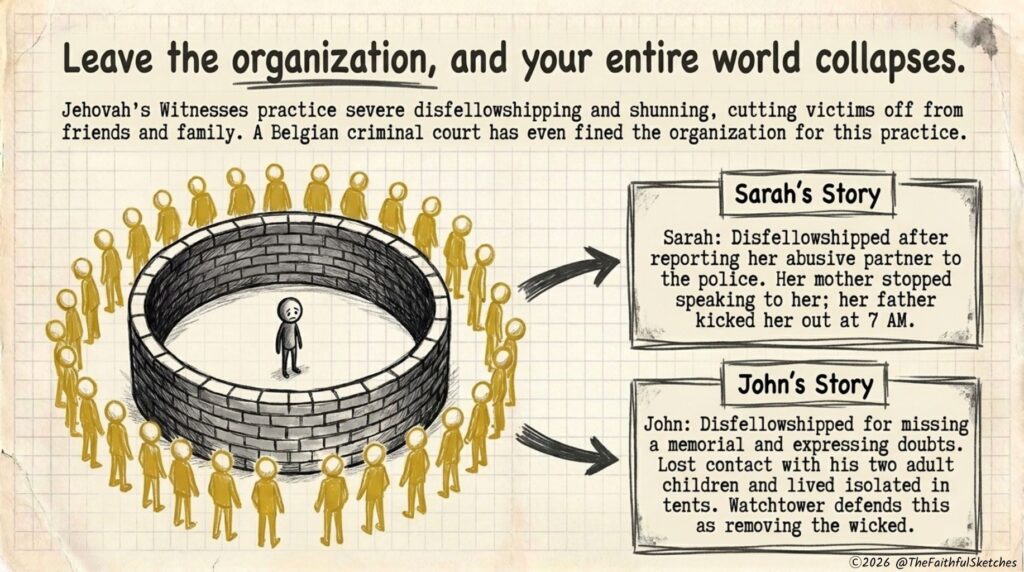
Jehovah’s Witnesses practice disfellowshipping and shunning. If you leave the organization, or the organization removes you, your entire social world can collapse. Family members may stop speaking to you, and friends may disappear overnight. In fact, a Belgian criminal court has actually fined the organization over this exact practice.
One former member, described as Sarah, faced disfellowshipping after she fled an abusive relationship in which her partner had broken her ribs. When she went to the police, elders reportedly declined to discipline him and disciplined her instead.
That night, her mother refused to speak to her, and her father woke her at 7 a.m. and asked her to leave the house. Another former member, John, faced disfellowshipping after missing a memorial service and voicing doubts. He then lost contact with his two adult children. He describes sending occasional messages telling them he loves them and still thinks of them, usually met with silence.
The Watchtower defends the practice by citing 1 Corinthians 5:13, “remove the wicked man from among yourselves,” and notes that members know the policy before they join.
Critics call it a form of control that severs victims from friends and family. This pattern mirrors what I documented in my post on Jehovah’s Witnesses and Watchtower control.
The Abuse Allegations
This is the darkest chapter. Jehovah’s Witnesses have faced accusations of systematically covering up child sexual abuse for decades. In 2022, the nonprofit newsroom InvestigateWest reported how the organization covered up decades of abuse cases in Washington state.
Separately, the Australian Royal Commission into child sexual abuse identified roughly 1,800 likely victims and 1,000 alleged perpetrators within Jehovah’s Witnesses in Australia alone.
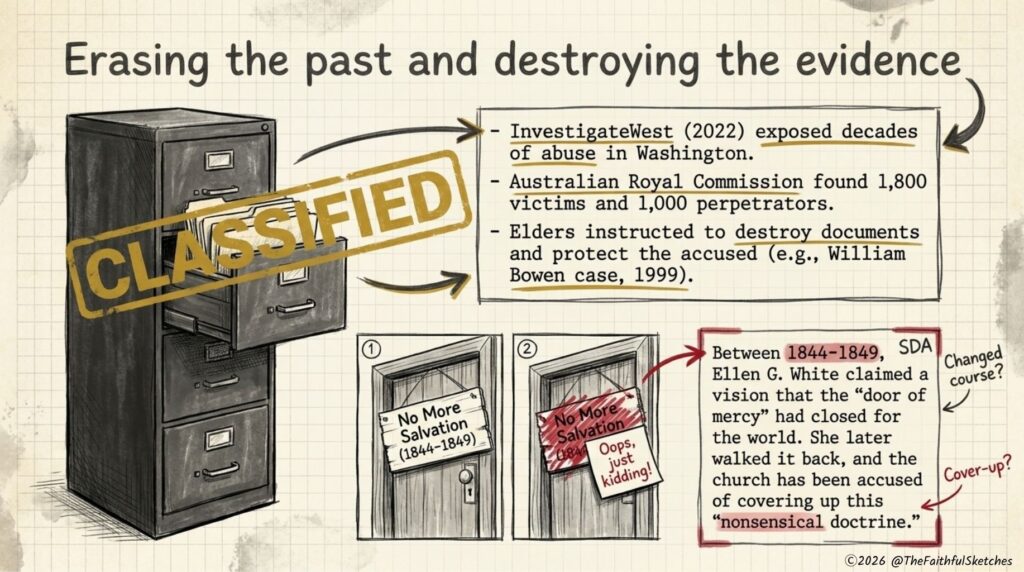
Church elders in New Zealand have reportedly received instructions to destroy documents, which has raised fears among survivors of further cover-up. A former Jehovah’s Witness member of the UK Parliament, Sam Carling, called for the group to lose its charitable status, describing a “culture of non-reporting and forgiveness for the abusers.”
A longtime Witness elder, William Bowen, says that when he contacted Watchtower headquarters in 1999 about an abuse case in his congregation, officials instructed him to protect the accused by keeping the charges confidential. Overall, the organization has faced accusations of discouraging members from reporting abuse to civil authorities and of prioritizing institutional protection over victims.
The Anti-Catholic Undercurrent in Adventism
Here’s something less widely known about Seventh-day Adventists. The movement holds a deep-rooted anti-Catholic theology, framed within what Adventists call the “Great Controversy,” a cosmic battle between God and Satan playing out across history.
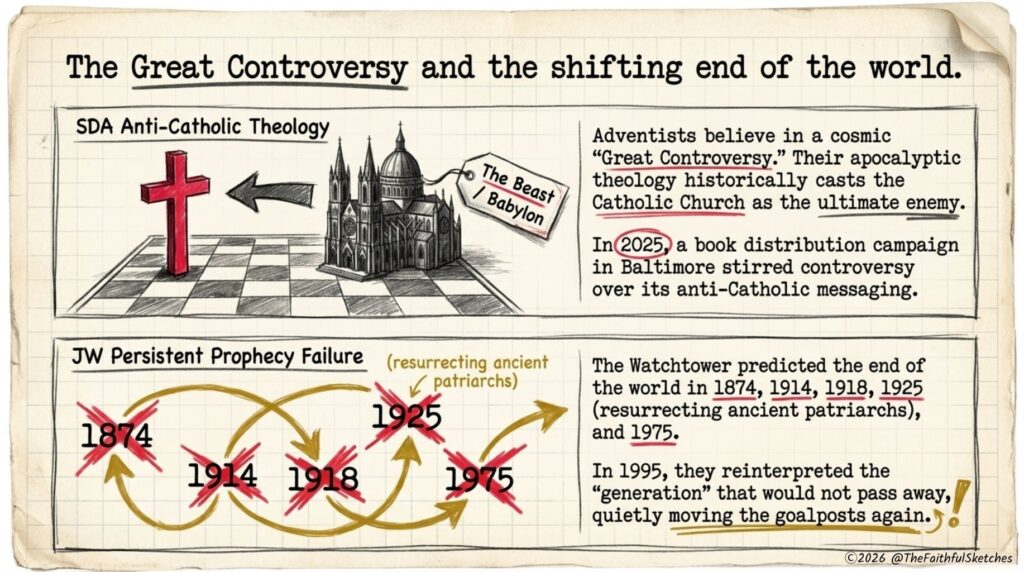
In this narrative, the Catholic Church often gets cast as the “beast” or the “whore of Babylon” from Revelation. Some Adventist literature has drawn controversy for anti-Catholic messaging as a result.
Adventists have also historically championed religious liberty, social justice, and church-state separation. That creates some tension with their apocalyptic framing of Catholicism as the ultimate end-times adversary.
In 2025, for example, a book distribution campaign in Baltimore promoted Adventist theology and contained anti-Catholic messaging, which drew public criticism. For a broader picture of how Adventism fits among Christian traditions, see my post asking whether Seventh-day Adventist beliefs are Christian.
Two Apocalypses, Two Sets of Wrong Predictions
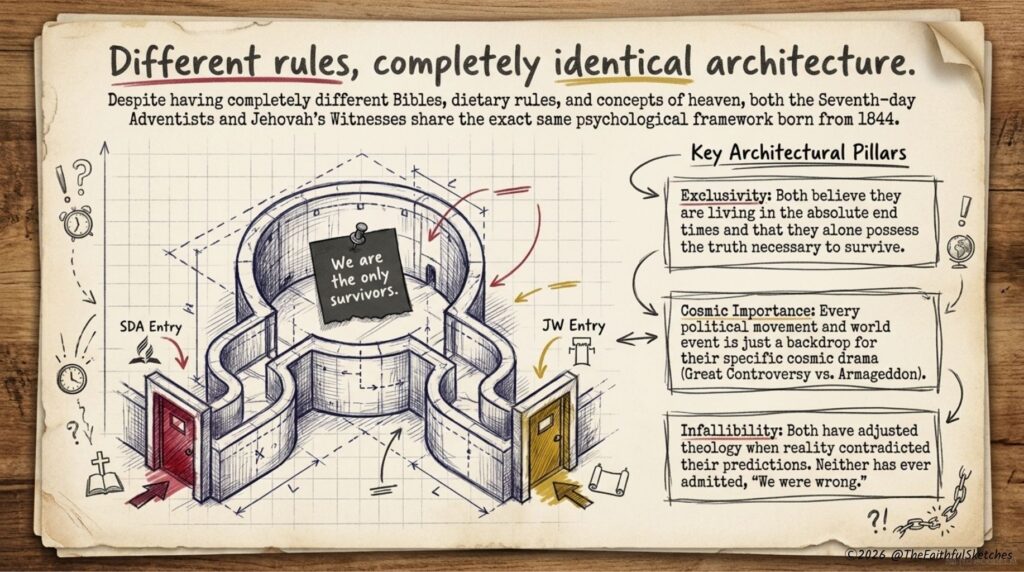
Both groups believe they’re living in the end times, and both believe they alone will survive what’s coming. Adventists frame history through the “Great Controversy,” a cosmic battle between God and Satan running through every war and political movement.
Jehovah’s Witnesses look toward Armageddon instead, the final battle between God and evil. They’ve predicted it repeatedly for over a century, missing the date every time.
Both movements have had to quietly revise their theology when predictions failed. Adventists reinterpreted 1844 as something other than Christ’s physical return.
Witnesses moved the date of Christ’s invisible presence from 1874 to 1914, then later redefined “generation” entirely. Yet neither organization has issued a direct, simple admission along the lines of “we were wrong.”
Seventh-day Adventist vs Jehovah’s Witnesses: Side by Side
| Issue | Seventh-day Adventist | Jehovah’s Witnesses |
|---|---|---|
| Founded | 1863, after the Great Disappointment | Grew from Russell’s Bible Students, renamed 1931 |
| Key figure | Ellen G. White, called a prophetess | Charles Taze Russell, then Joseph Rutherford |
| View of God | Fully Trinitarian | Rejects the Trinity; Jehovah alone is God |
| Jesus as Michael | A title for the divine, pre-incarnate Son | Jesus literally is a created archangel |
| Bible | Standard translations (e.g., ESV, KJV) | Their own New World Translation |
| Sabbath | Saturday, still binding | No day considered holy |
| Health code | Vegetarian emphasis, no alcohol or tobacco | No dietary code besides avoiding blood; no smoking |
| Blood transfusions | No restriction | Traditionally refused; policy partially eased in 2026 |
| Heaven | Open to all believers | Limited to 144,000; others live on paradise Earth |
| Major controversies | Plagiarism claims, the Shut Door doctrine, anti-Catholic messaging | Failed prophecies, shunning, blood policy deaths, abuse cover-up claims |
Conclusion: Which One Is Right?
So after all this, which one is right? Two faiths share the same 19th-century roots, the same apocalyptic urgency, and the same strange claim about Michael the Archangel. Yet they land on radically different answers to the most important questions in Christianity.
One is a denomination with a controversial prophetess. The other is an organization with a long history of failed prophecies and, according to critics, broken families. One built a health message. The other built a blood policy that has cost lives. One reads a standard Bible. The other reads a translation many scholars say was shaped to fit its theology. And still, both claim to hold the truth.
For more background on each group individually, see my posts on Seventh-day Adventist beliefs and Jehovah’s Witnesses beliefs. Which of these differences surprised you most? Share your thoughts respectfully in the comments below.
Click Below to Download The Full PDF Summary Visual Guide:
*Free for personal use only. Please don’t resell or redistribute commercially.