
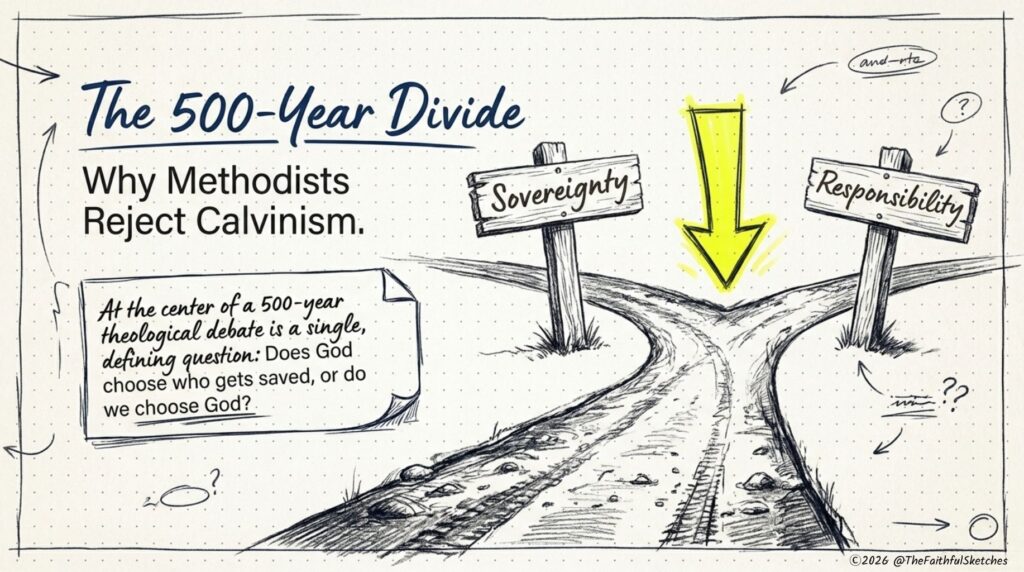
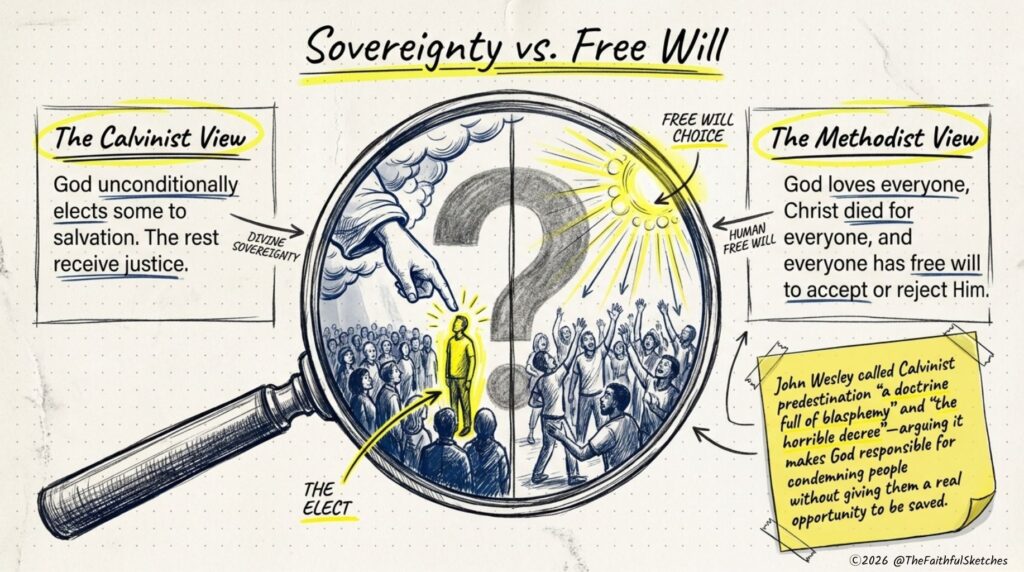
Does God choose who gets saved, or do we choose God? That question has divided Christians for 500 years. Calvinists say God unconditionally elects some to salvation, while the rest receive justice. Methodists say no. God loves everyone, Christ died for everyone, and everyone has free will to accept or reject Him.
John Wesley, the founder of Methodism, called Calvinist predestination “a doctrine full of blasphemy” and “the horrible decree.” He argued that it effectively makes God responsible for condemning people without giving them any real chance at salvation.
This post explains why Methodists reject Calvinism, using Wesley’s own arguments and Scripture. The goal isn’t to attack either view, so watch to the end and let me know in the comments where you stand.
What Is Calvinism?
Calvinism is often summarized by the acronym TULIP. Total Depravity teaches that sin affects every part of us, so we cannot choose God without grace. Unconditional Election holds that God chooses who to save before creation, based on nothing in them.
Limited Atonement says Jesus died only for the elect, not for everyone. Irresistible Grace teaches that when God calls you, you cannot ultimately say no. And Perseverance of the Saints means everyone God regenerates will persevere until the end, often summarized as “once saved, always saved.”
Methodists reject every point of this system. Here are the top five reasons why, starting with the doctrine Wesley found most troubling.
Reason 1: Unconditional Election Makes God Unfair
First, Methodists argue that unconditional election makes God a respecter of persons, something the Bible explicitly denies. Acts 10:34 states that “God does not show favoritism.”
But if God picks some for heaven and others for hell based on nothing except His own will, Methodists argue that fits the very definition of favoritism.
Then there’s 1 Timothy 2:4, which says God “desires all people to be saved.” Wesley asked a pointed question: how can God genuinely desire all to be saved if He decreed that only some can be? Calvinists typically distinguish between God’s revealed will, what He commands, and His sovereign will, what He ultimately ordains.
Wesley called that distinction a contradiction, insisting that a good God cannot sincerely want something He deliberately prevents. For Methodists, the bottom line is this: unconditional election makes God arbitrary and, in their view, less loving than a decent human father. That’s a conclusion no Methodist can accept.
Reason 2: Limited Atonement Contradicts Plain Scripture
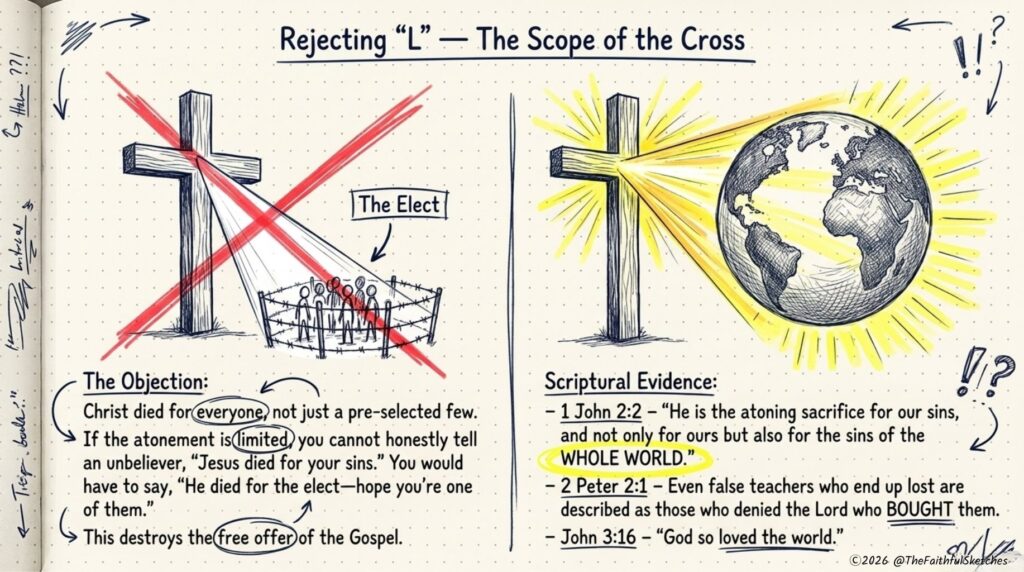
Methodists challenge Limited Atonement by pointing to several passages that emphasize God’s universal love. 1 John 2:2 says Christ “is the atoning sacrifice for our sins, and not only for ours but also for the sins of the whole world,” not merely the elect, but the whole world.
Then there’s 2 Peter 2:1, which describes false teachers as those “who denied the sovereign Lord who bought them.” If Christ “bought” even false teachers who end up lost, Methodists argue, He must have died for non-elect people too. Calvinists respond that “bought” here refers to Israel’s covenant deliverance rather than Christ’s atonement specifically.
And of course there’s John 3:16: “God so loved the world,” again not “the elect,” but the world. Calvinists often read “world” as people from every nation rather than every single individual. Still, Wesley pressed the practical implication hard.
If Christ didn’t die for every person, he argued, you can’t honestly tell an unbeliever “Jesus died for your sins.” You’d have to say instead, “He died for the elect; hope you’re one of them.” For Methodists, that undercuts the free offer of the gospel itself.
Reason 3: Irresistible Grace Destroys Free Will
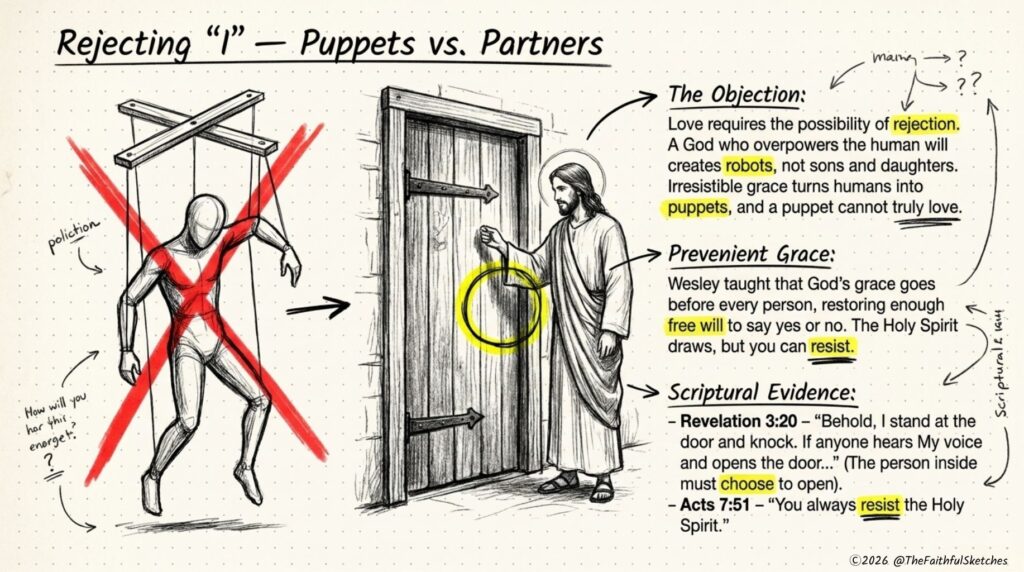
The “I” in TULIP, Irresistible Grace, teaches that once God decides to save you, you cannot resist. Methodists point to Revelation 3:20: “Behold, I stand at the door and knock.
If anyone hears my voice and opens the door…” Jesus knocks; He doesn’t force the door open from the outside. The person inside still has to choose to open it.
They also cite Acts 7:51, where Stephen tells the religious leaders, “You always resist the Holy Spirit.” According to Methodists, this shows grace can indeed be resisted; it isn’t irresistible by nature. Wesley taught what he called prevenient grace, the idea that God’s grace goes before every person and restores enough free will for a genuine yes or no. Love, he argued, requires the real possibility of rejection.
A God who simply overpowers your will produces robots, not sons and daughters. For Methodists, irresistible grace effectively turns humans into puppets, and a puppet can’t truly love.
Reason 4: Once Saved Always Saved Ignores Warnings
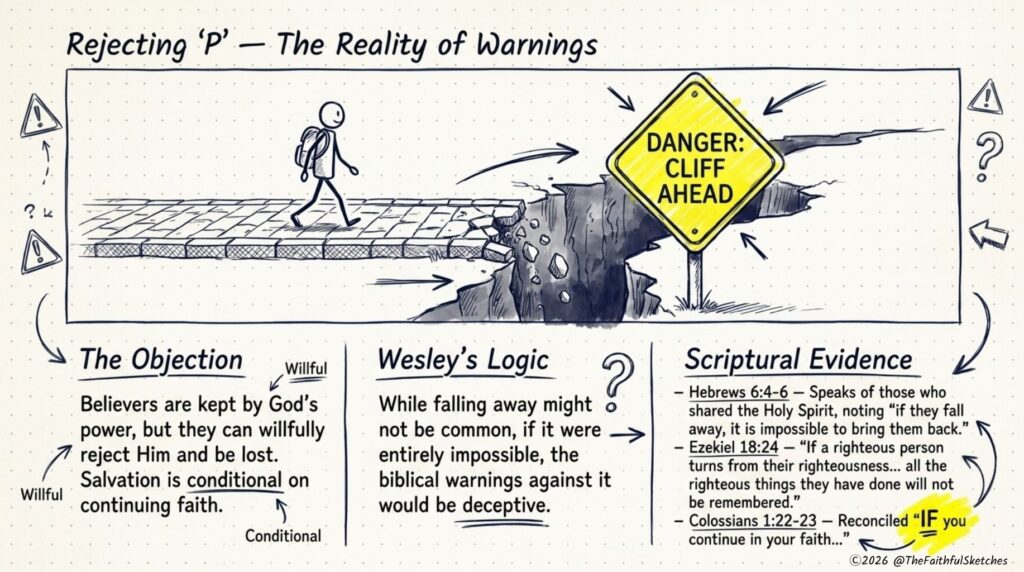
The “P” in TULIP, Perseverance of the Saints, is often summarized as “once saved, always saved.” Methodists reject this too.
Hebrews 6:4-6 speaks of those “who have once been enlightened, who have tasted the heavenly gift, who have shared in the Holy Spirit,” and warns that if they fall away, it’s impossible to bring them back to repentance. Methodists read this as describing genuine believers who later fall away completely.
They also point to Ezekiel 18:24: “If a righteous person turns from their righteousness… all the righteous things they have done will not be remembered.” And Colossians 1:22-23 says believers are reconciled “if you continue in your faith, established and firm.”
That word “if” matters a great deal to Methodists. Wesley himself didn’t think falling away was common, but he believed Scripture clearly warns about it, so it must be a real possibility. If it weren’t possible, he reasoned, the warnings themselves would be deceptive.
Calvinists typically respond that these warnings are precisely the means God uses to keep the elect from falling. Methodists counter that this reads the system into the text rather than reading the text plainly.
Reason 5: Calvinism Undermines Evangelism and Holiness
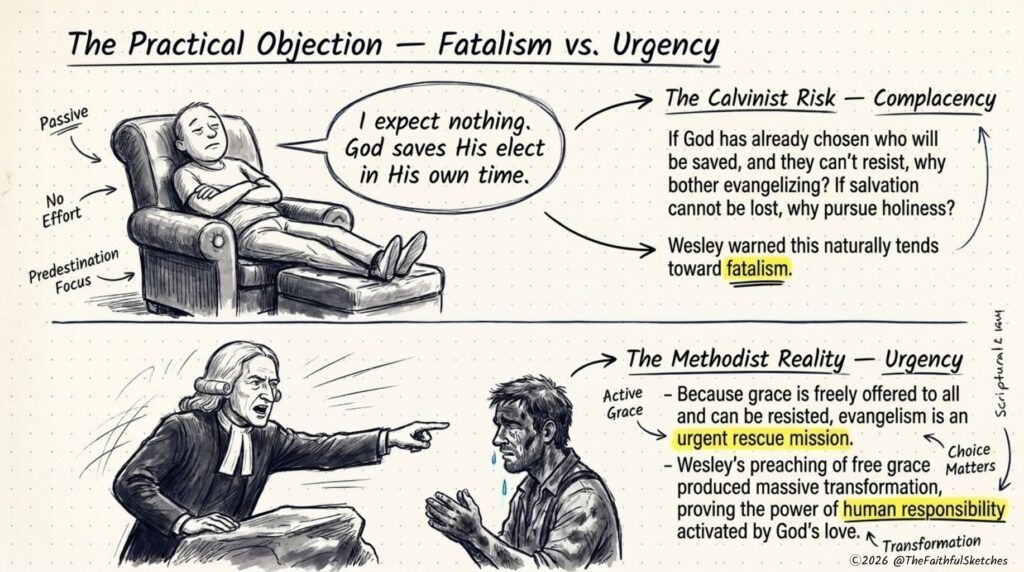
Finally, Methodists raise a practical objection. If God has already chosen who will be saved and those people cannot resist, two uncomfortable questions follow. Why bother evangelizing, since the elect will be saved whether you preach or not, and the non-elect can’t be saved regardless? And why pursue holiness at all, if your salvation can never be lost no matter how you live?
Calvinists do have answers to both questions. They argue that God uses preaching as His appointed means of calling the elect, and that true believers will naturally want holiness as evidence of genuine faith. But Wesley observed that in practice, this framework sometimes bred complacency.
He recounted a Calvinist preacher telling him, “I expect nothing. God saves His elect in His own time.” Wesley contrasted that with his own experience: when he preached the free offer of grace to everyone, coal miners wept openly and their lives transformed. For Methodists, Calvinism risks tipping into fatalism.
Wesley’s famous “Free Grace” sermon puts it starkly, concluding that this doctrine “directly and naturally tends to destroy the whole Christian Revelation.”
Wesley’s Alternative: Arminianism in a Nutshell
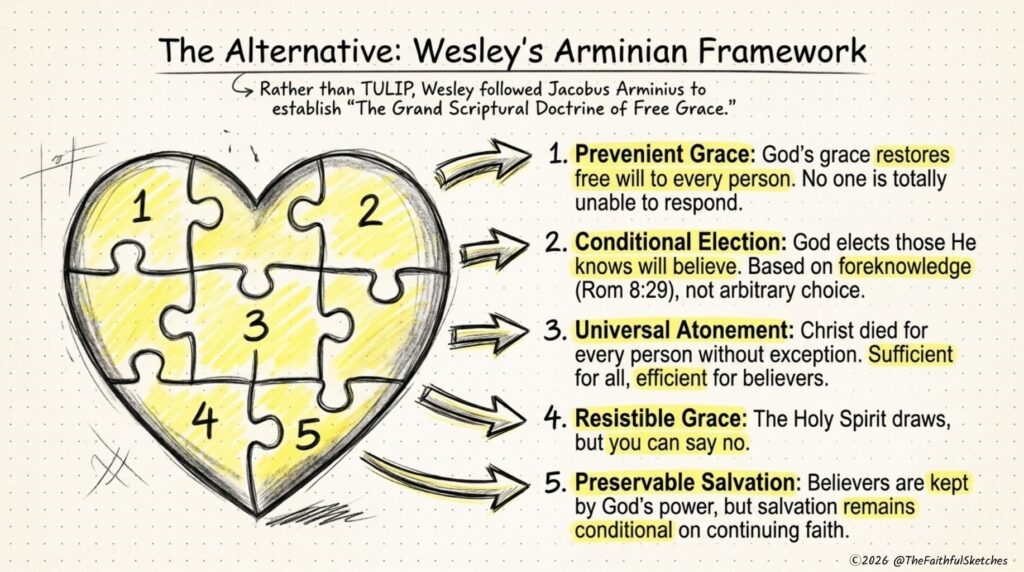
So what do Methodists believe instead? Wesley followed the theology of Jacobus Arminius, and his system offers a direct alternative to each point of TULIP.
Prevenient Grace teaches that God’s grace restores free will to every person, so no one is totally unable to respond. Conditional Election holds that God elects those He foreknows will believe, basing election on foreknowledge rather than an arbitrary choice, per Romans 8:29. Universal Atonement teaches that Christ died for every person without exception, His death sufficient for all and efficient for those who believe.
Resistible Grace means the Holy Spirit draws people toward God, but a person can still say no. And Preservable Salvation holds that believers are kept by God’s power, yet they can willfully reject Him and be lost; salvation remains conditional on continuing faith.
Wesley called this framework “The Grand Scriptural Doctrine of Free Grace,” believing it preserves God’s love, human responsibility, and the urgency of evangelism all at once. For a fuller breakdown of this same debate from both directions, see my post on Calvinism vs Arminianism.
Calvinism vs the Methodist Response
Here’s the whole debate side by side.
| TULIP Point | Calvinist View | Methodist (Wesleyan) Response |
|---|---|---|
| Total Depravity | We cannot respond to God without grace | Agreed, but prevenient grace restores the ability to respond |
| Unconditional Election | God chooses based on His will alone | Election is conditional, based on foreknown faith |
| Limited Atonement | Christ died only for the elect | Christ died for everyone, per John 3:16 and 1 John 2:2 |
| Irresistible Grace | God’s call cannot be refused | Grace can be resisted, per Acts 7:51 |
| Perseverance of the Saints | The truly saved cannot fall away | Salvation is conditional on continuing faith |
Conclusion: Sovereignty or Responsibility
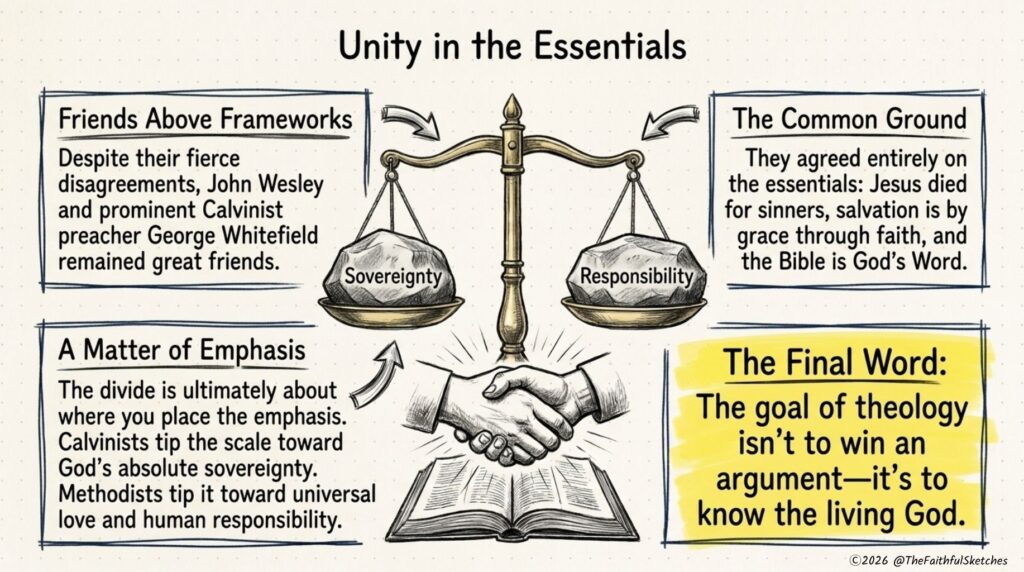
So why do Methodists reject Calvinism? Because they believe it makes God unfair, contradicts clear Scriptures on the scope of Christ’s atonement, denies genuine free will, ignores biblical warnings about falling away, and undermines both evangelism and the pursuit of holiness.
Here’s the important part, though. John Wesley and his Calvinist friend George Whitefield remained close friends despite this disagreement. They agreed on the essentials: Jesus died for sinners, salvation comes by grace through faith, and the Bible is God’s Word.
The real difference comes down to emphasis, whether you lean toward God’s sovereignty or human responsibility. Methodists lean toward responsibility. Calvinists lean toward sovereignty. If you want to explore the Calvinist side of this same argument in full, my post on whether Calvinism is biblical walks through it point by point.
What about you? Let me know your thoughts in the comments below. And remember, the goal here isn’t to win an argument. It’s to know the true, living God.
Click Below to Download The Full PDF Summary Visual Guide:
*Free for personal use only. Please don’t resell or redistribute commercially.