
You’re enjoying a quiet Saturday morning when you hear a knock at the door. You peek outside and see them: neatly dressed, carrying briefcases, always in pairs. They’re Jehovah’s Witnesses. You’ve probably seen them before, or at least heard about them. But what does life actually look like inside their world?
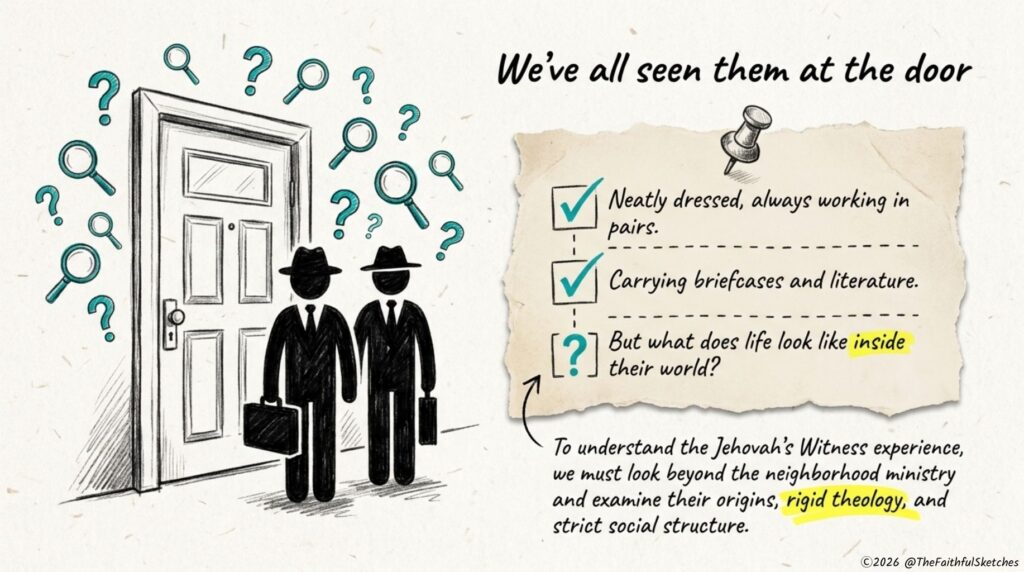
Understanding Jehovah’s Witnesses beliefs means looking at their origins, theology, daily practices, and the structure that governs every part of a member’s life. That’s exactly what this post covers.
Part 1: Origins — A Movement Born in 1870s Pittsburgh
The story doesn’t begin in ancient Jerusalem. It starts in 1870s Pittsburgh, Pennsylvania.
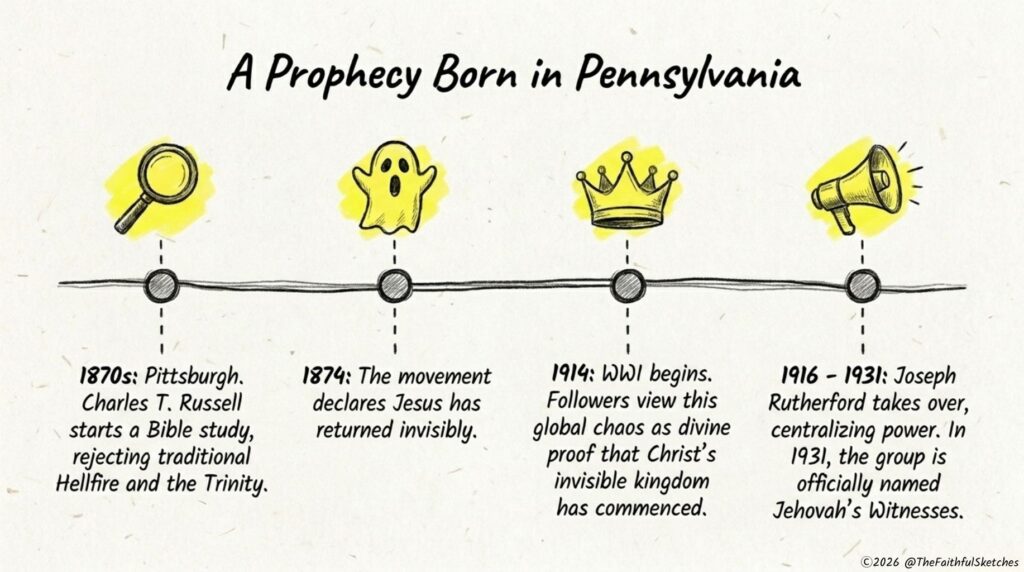
A young man named Charles Taze Russell grew uneasy with his church’s teachings on hellfire and the Trinity. As a result, he and a small group of Bible students began studying Scripture independently, eventually concluding that mainstream Christianity had lost its way. They taught that Jesus had already returned invisibly in 1874 and that the world’s end would come in 1914.
Notably, when World War I broke out that very year, Russell’s followers took it as divine confirmation. Christ’s invisible kingdom, they believed, had begun.
Russell died in 1916. Joseph Rutherford took control and reshaped the movement, making it more centralized and outspoken. In 1931, he gave it the name the world knows today: Jehovah’s Witnesses.
Part 2: Core Jehovah’s Witnesses Beliefs — 10 Theological Positions
Jehovah’s Witnesses hold a distinct set of beliefs that separates them sharply from mainstream Christianity. Here’s a breakdown of each one.
1. Jehovah — The One True God
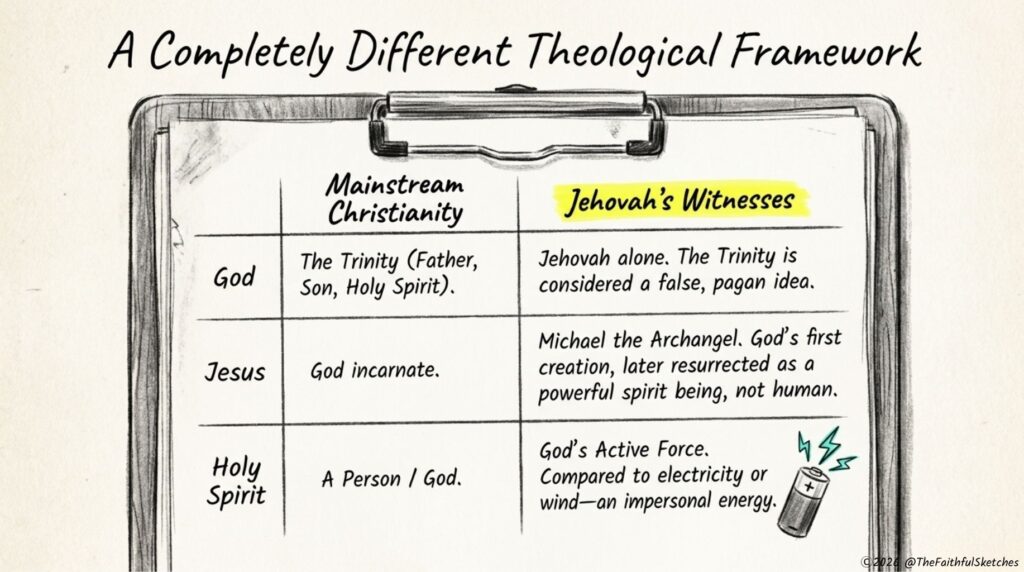
Witnesses believe there is one almighty God whose name is Jehovah. He is the Creator of all things, completely sovereign, and not part of any Trinity. The traditional Christian belief in the Father, Son, and Holy Spirit as one God is, in their view, a false idea rooted in paganism that distorts true worship.
2. Jesus Christ — God’s First Creation
According to Jehovah’s Witnesses beliefs, Jesus is not Almighty God. He is God’s first and only direct creation, existing before the world as the archangel Michael. He came to earth as a perfect man to ransom humanity from Adam’s sin, died obediently, and God raised him as a spirit being. Since 1914, they believe Jesus has been ruling as God’s appointed King from heaven.
3. The Holy Spirit — An Active Force, Not a Person
Witnesses do not believe the Holy Spirit is a person. Instead, they describe it as God’s invisible power, an active force that accomplishes His will. They compare it to electricity or wind: powerful, but entirely impersonal.
4. The Bible — Sole Authority, Their Own Translation
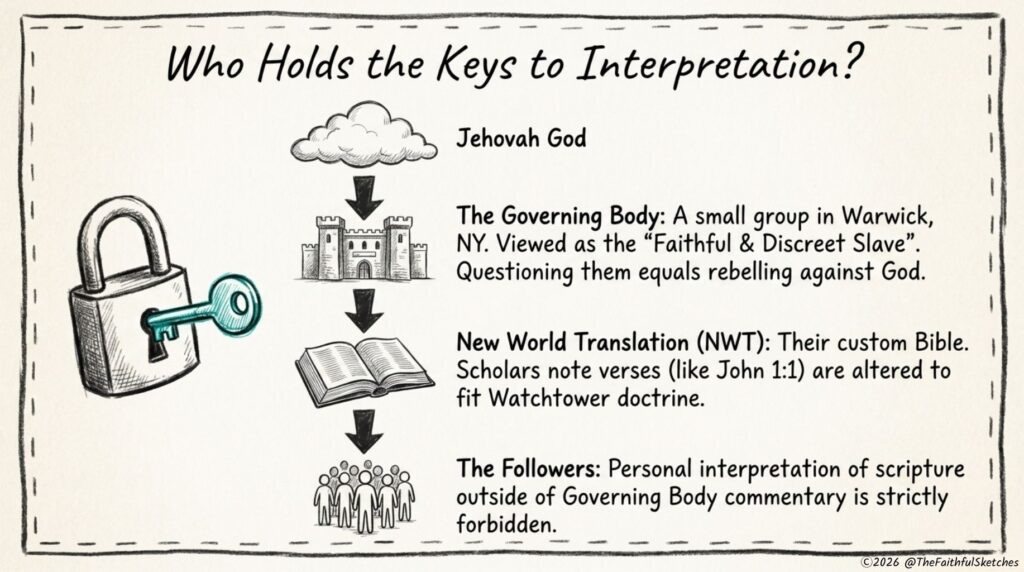
Jehovah’s Witnesses believe God inspired the Bible and made it perfect. However, they use their own version, the New World Translation (NWT), which biblical scholars frequently criticize for altering key verses like John 1:1 to align with Watchtower doctrine. The Governing Body teaches members to interpret Scripture only through its own guidance, not through personal study or outside sources.
5. The 144,000 — The Heavenly Class
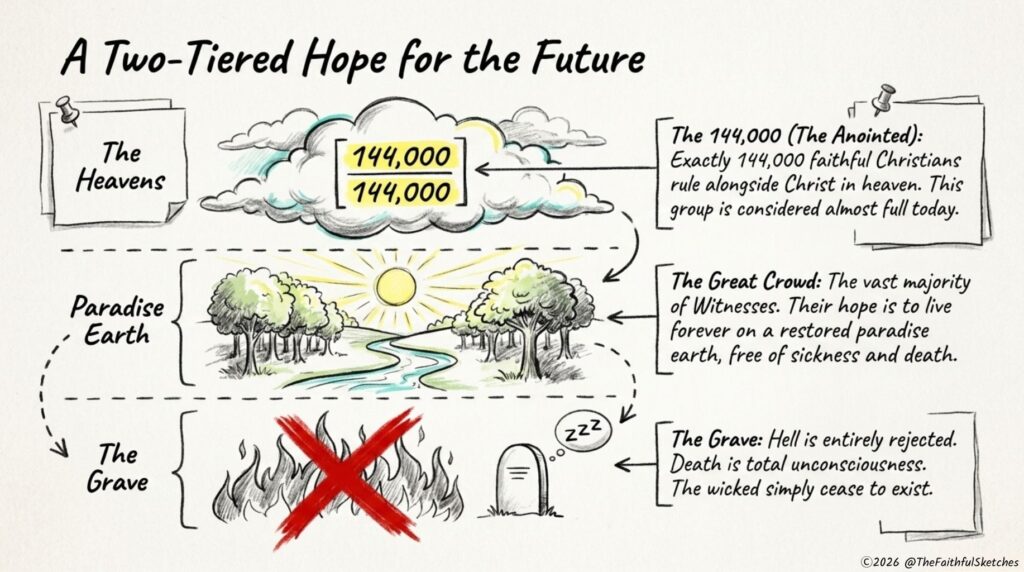
Witnesses teach that exactly 144,000 faithful Christians, beginning with the apostles, will go to heaven to rule alongside Christ. The church considers this group, called the “anointed,” almost complete today. Only they partake of the bread and wine during the yearly Memorial of Christ’s death.
6. The Great Crowd — Eternal Life on Earth
The vast majority of Witnesses belong to the “Great Crowd” or “Other Sheep.” Their hope is not heaven. Instead, they expect to live forever on a restored paradise Earth after Armageddon, free from war, sickness, and death.
7. Heaven and Hell — Redefined
Heaven is real in Jehovah’s Witnesses theology, but only for the 144,000. Witnesses reject the concept of Hell entirely. They teach that “Hell” (Sheol/Hades in scripture) simply means the grave, a state of nonexistence. The wicked don’t burn forever; they simply cease to exist. This position is similar to annihilationism, a view also held by Seventh-day Adventists.
8. Death and Resurrection — Soul Sleep
Witnesses believe humans have no immortal soul. When someone dies, they become completely unconscious, described as “asleep in death.” The only hope of life again comes through a future resurrection by God’s power in the coming paradise. For more on this concept, see our post on Seventh-day Adventist beliefs, which covers a similar doctrine.
9. Angels and Demons — Cast to Earth in 1914
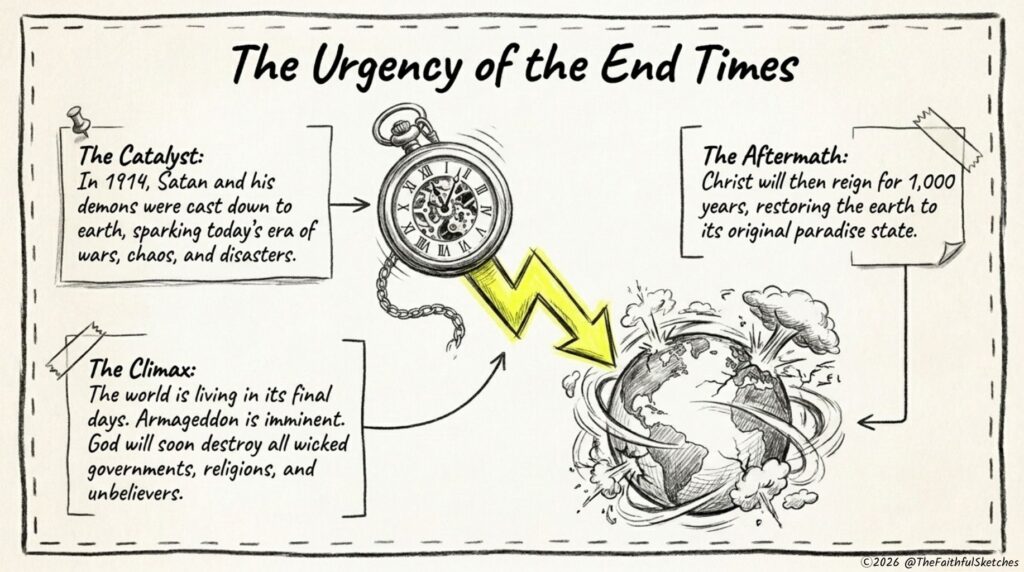
Jehovah created angels as spirit beings to serve him. Some, led by Satan, rebelled. According to Witness teaching, God cast Satan and his demons to Earth in 1914.
10. Armageddon — The End of the Current System
Jehovah’s Witnesses believe the world is living in its final days. At Armageddon, God will destroy all wicked governments, religions, and unbelievers. Christ will then reign for 1,000 years, restoring Earth to the paradise God originally intended. This imminent end shapes virtually every part of how they live.
Part 3: Practices — A Life Structured Around the Organization
Jehovah’s Witnesses beliefs don’t stay in the meeting hall. They shape every area of daily life. Here are the most defining practices.
Door-to-Door Ministry
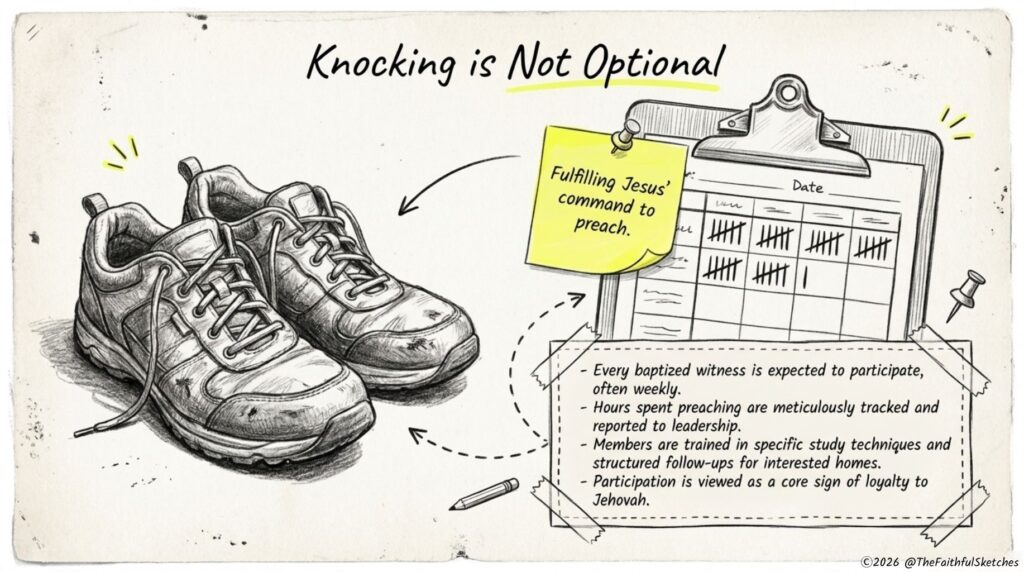
If there’s one thing Witnesses do consistently, it’s knock on doors. They believe they’re fulfilling Jesus’ command to preach the good news of the Kingdom, as recorded in Matthew 24:14. Ehe organization expects every baptized Witness to take part weekly. They track and report their hours, study techniques, and return to homes that show interest. This isn’t optional. Witnesses treat it as a core act of worship and a direct measure of loyalty to God.
Meetings and Worship
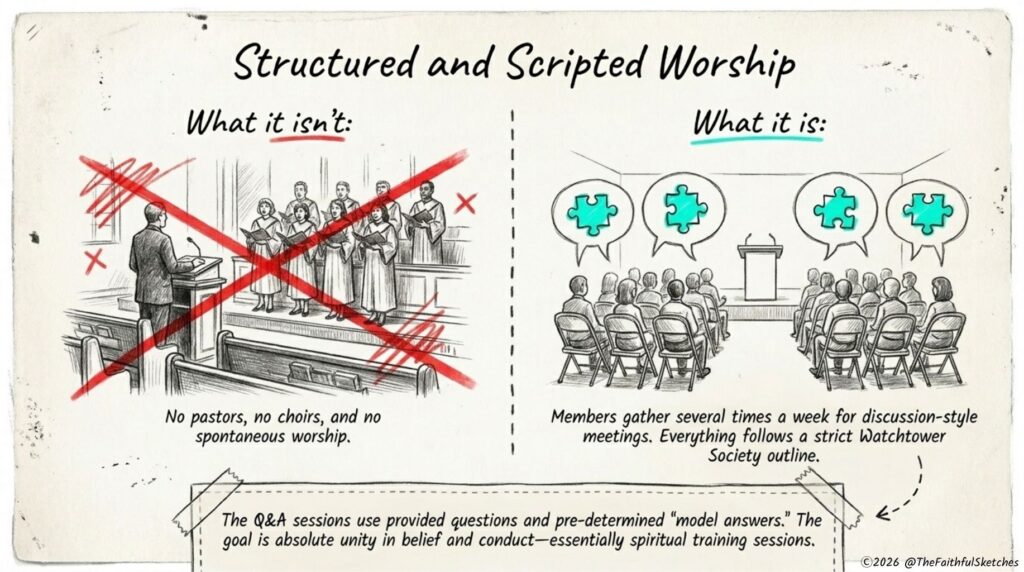
Witnesses don’t have pastors or choirs. They gather at Kingdom Halls several times a week for organized, discussion-style meetings that follow a strict outline provided by the Watchtower Society, including pre-written questions and model answers. Large annual conventions feature dramas, talks, and baptism ceremonies. The structure is deliberate: less spontaneous worship, more unified spiritual training.
The Governing Body
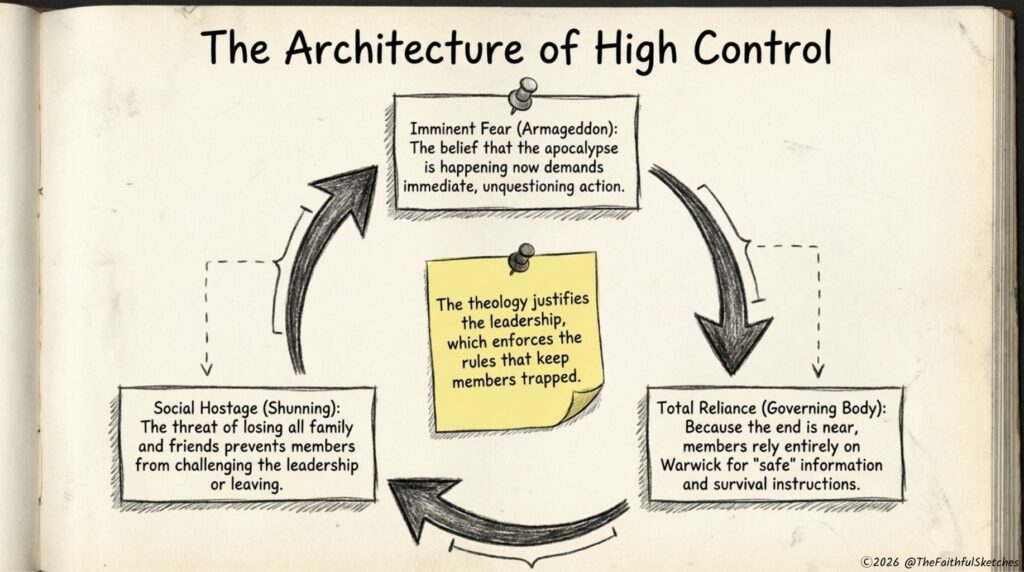
At the top of the organization sits the Governing Body, a small group of men based in Warwick, New York. They’re considered the “faithful and discreet slave” of Matthew 24:45, God’s sole channel of truth to humankind. Their decisions cover everything from doctrine and discipline to healthcare. Questioning them is not treated as disagreement. It’s viewed as rebelling against Jehovah himself.

Holidays and Birthdays
Christmas, Easter, and birthdays are all off limits. Witnesses believe these observances have pagan roots or place inappropriate focus on humans rather than God. The only annual event they observe is the Memorial of Christ’s Death, held once a year at sunset, similar in timing to Passover.
Political Neutrality
Witnesses view all human governments as part of Satan’s world system. As a result, they don’t vote, salute flags, serve in the military, or hold public office. Their stated loyalty belongs exclusively to God’s Kingdom.
Education and Work
The Watchtower actively discourages higher education. The Watchtower warns that college leads to worldly thinking and spiritual danger. Members are encouraged instead to pursue short-term trades or part-time work, keeping time available for ministry. The structure of life is designed to keep the organization at the center.
Entertainment and Social Life
Witnesses are directed to avoid movies, music, or media featuring violence, sexual content, or spiritism. Non-Witnesses are treated as potential bad influences. The goal is deliberate separation from mainstream society, focused on what they call spiritual purity.

Marriage and Morality
Witnesses treat marriage as sacred and permit divorce only in cases of adultery, based on Matthew 19:9. Dating a non-Witness is discouraged, and marrying outside the faith is strongly opposed. Traditional gender roles are taught, and sexual activity before marriage is grounds for disfellowshipping.
Finances and Donations
There is no formal tithing system, but regular donations are encouraged. Contributions fund printing operations, construction projects, and international preaching work. While the organization frames giving as voluntary, it is often presented as a demonstration of loyalty and gratitude to Jehovah.
Blood Transfusions
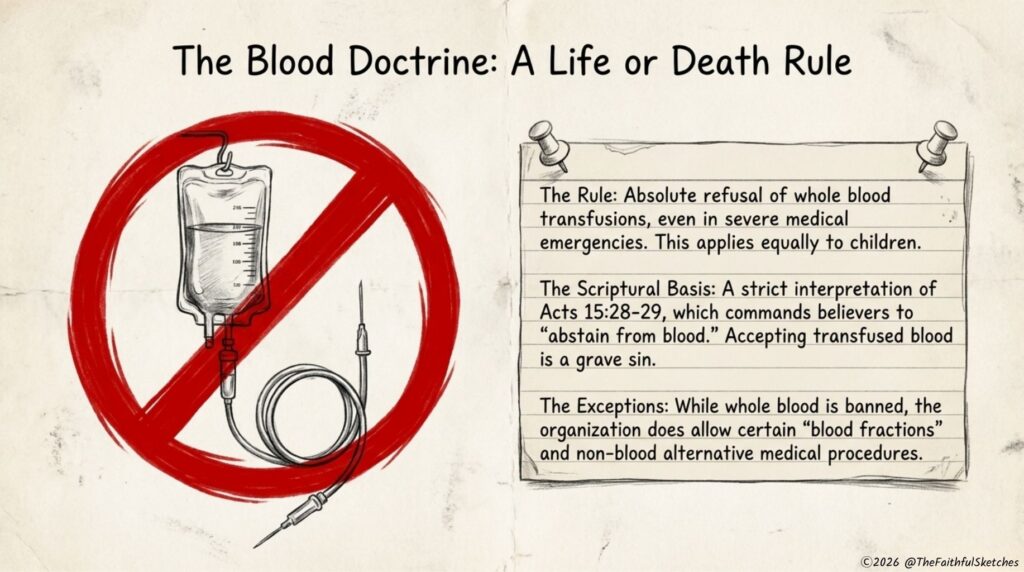
Witnesses refuse blood transfusions, even in life-threatening emergencies. They interpret Acts 15:28-29, which forbids consuming blood, to mean that accepting transfused blood is a sin. Members have died following this rule, including children. While certain blood fractions and alternative procedures are permitted, the core position remains firm.
Disfellowshipping and Shunning
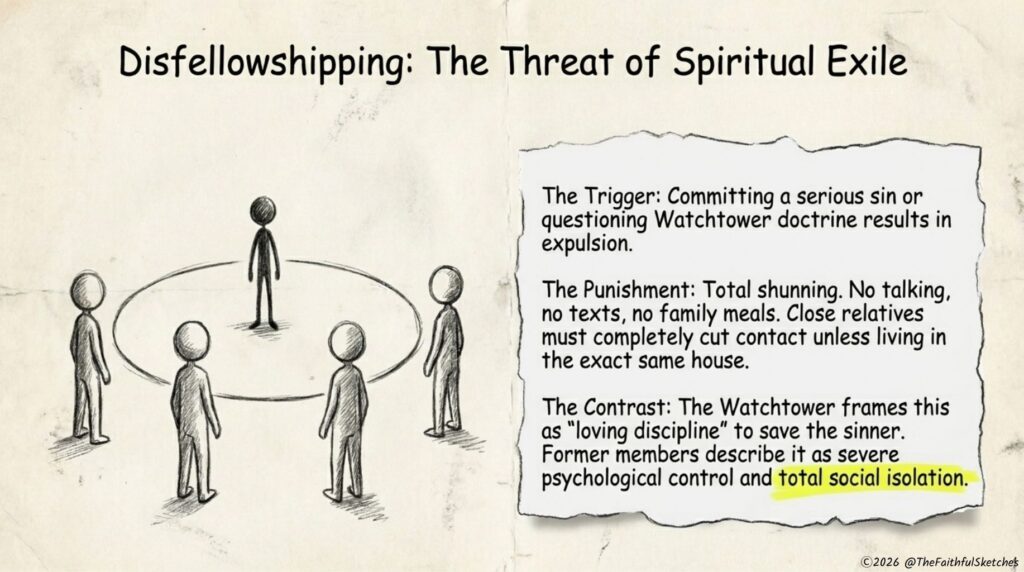
A member who commits a serious sin or questions doctrine can be disfellowshipped, meaning expelled. The consequences are total: no conversation, no texts, no family meals, no physical contact. Even close relatives must cut off contact. The Watchtower calls this a loving form of discipline meant to restore the sinner. Critics, including many former members, describe it as psychological control and deliberate social isolation.
The Urgency of Armageddon
At the core of every Jehovah’s Witnesses belief and practice is a sense of imminent apocalypse. Armageddon, in their view, is not approaching. It has already begun. That urgency drives their preaching, their separation from society, and their refusal to compromise on any doctrine.
Conclusion
That’s what life inside the Jehovah’s Witnesses looks like: the beliefs, the practices, and the organizational structure that governs every part of a member’s existence.
There is, however, more to the story. Beyond the door-to-door ministry and the promise of paradise, there are controversial practices, patterns of control, and serious consequences for those who dissent or leave. In Part 2 of this series “Jehovah’s Witnesses Cult: The Hidden Truth About Watchtower Control“. We will cover the hidden costs, the high-control characteristics, and why many former members and scholars have used far stronger language to describe what this organization actually is.
Want to understand how Jehovah’s Witnesses compare to other groups? Read our post on Seventh-day Adventist Beliefs: Are They Christian? for a detailed look at another denomination that sits outside mainstream Christianity.
Click Below to Download The Full PDF Summary Guide:
*Free for personal use only. Please don’t resell or redistribute commercially.