
This might be the single most terrifying question a Christian can ask. It has ended friendships, split churches, and kept sincere believers awake at 2 a.m. staring at the ceiling. Can you lose your salvation?
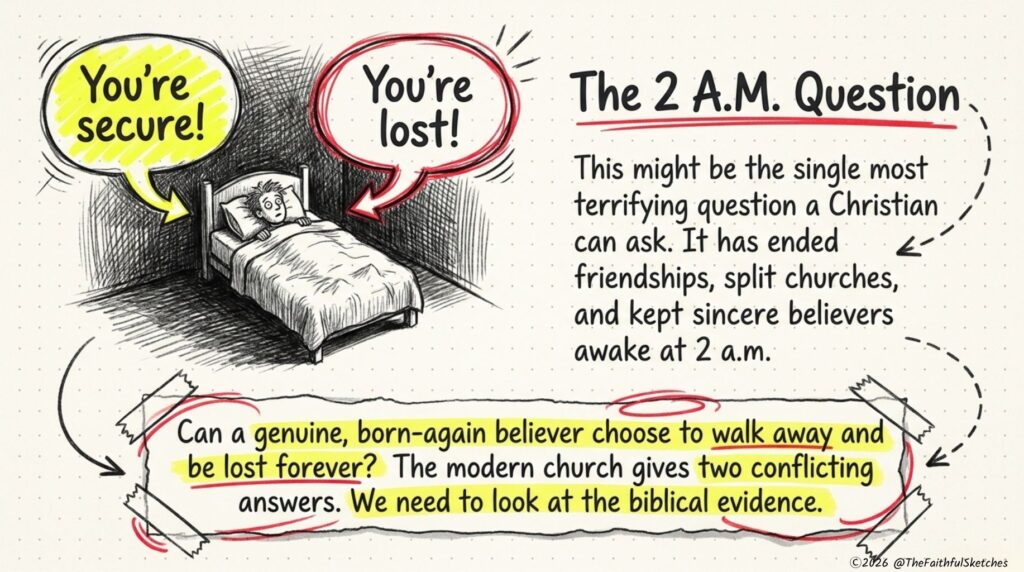
If you grew up in church, you probably heard one of two answers. Some say “once saved, always saved, no matter what.” Others say you can walk away and be lost forever. This post walks you through the biblical evidence on whether a genuine believer, someone who has truly been born again, can later choose to reject God, abandon their faith, and face eternal separation if they die in that state. Grab your Bible and let’s get into it.
Salvation Is a Covenant, Not an Insurance Policy
To understand why salvation can be lost, you first need to understand what salvation actually is. Many modern churches treat it like a transactional insurance policy. You pray a specific prayer, you sign the dotted line, you get your ticket to heaven, and you put it in your wallet as a one-time past event.
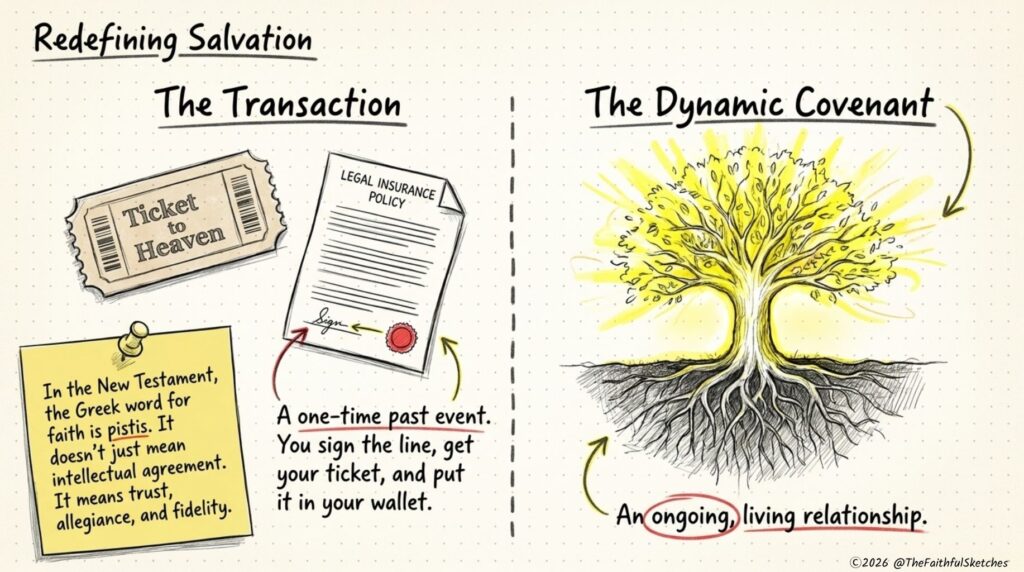
The New Testament never describes salvation this way. It describes a living covenant, a relationship. The Greek word for faith throughout the New Testament is pistis. The word means more than intellectual agreement with a set of facts. It means trust, allegiance, and fidelity. Salvation comes by grace through faith. God provides the grace, and you respond with faith.
Here is the critical theological point. God is completely faithful. He will never break His side of the covenant, never stop loving you, and never arbitrarily kick you out of His family. The weak link in the chain is never God. The weak link is always us. God honors human free will. The same free will that lets you choose to follow Jesus lets you choose to stop following Him. God does not remove your volition the moment you get baptized. If you completely abandon your trust, revoke your allegiance, and walk away from the relationship, God will ultimately respect your choice.
What Jesus Says About the Vine
Look at how Jesus explains this in John 15:1-6. He calls Himself the true vine and His Father the vinedresser. Every branch in Him that bears no fruit gets taken away. Anyone who does not abide in Him is thrown away, withers, and is burned.
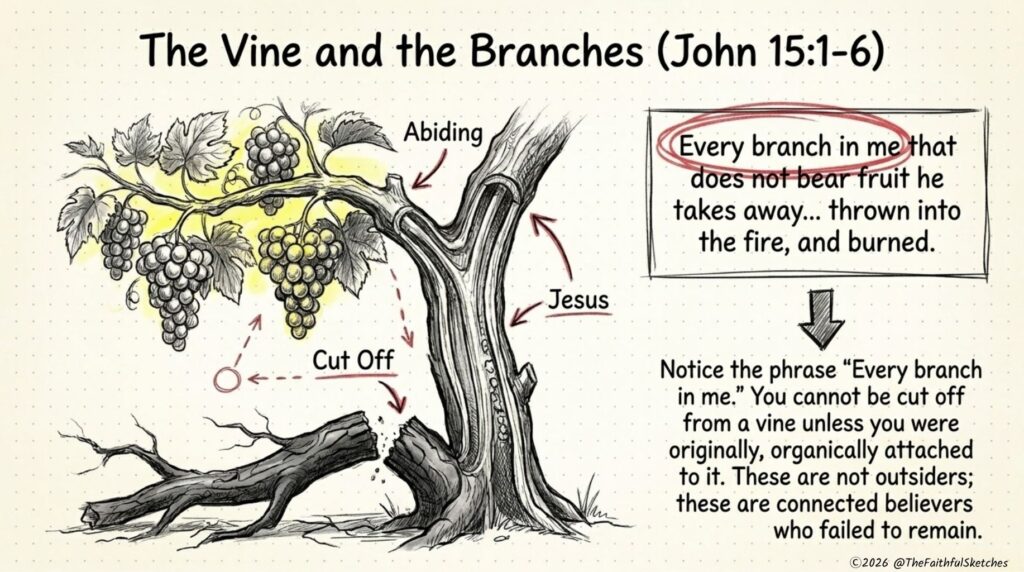
Pay close attention to His specific words. He says “every branch in me.” You cannot be cut off from a vine unless you were originally attached to it. These are not fake believers or outsiders. These branches were organically connected to Jesus Christ. Yet because they failed to abide, which means to remain or continue, they are cut off.
The Clear Warnings of Scripture
If “once saved, always saved” were true, the writers of the New Testament would have no reason to warn true believers about the danger of being cut off. Yet the Epistles are saturated with these exact warnings.
Look at the book of Hebrews. The entire letter went to Jewish Christians under intense persecution who were tempted to abandon Christianity and slide back into the old covenant. In Hebrews 6:4-6, the author gives one of the most sobering warnings in the Bible. He describes people who have been “enlightened,” who have “tasted the heavenly gift,” and who have “shared in the Holy Spirit,” then says they can fall away. Read that description carefully. This is the biblical vocabulary for a transformed, born-again Christian. You cannot share in the Holy Spirit as a fake believer. The Greek word for falling away is parapipto, which means to deviate, apostatize, or completely leave the right path.
Peter matches this tone in 2 Peter 2:20-22. He writes about people who genuinely escaped the corruption of the world through the knowledge of Christ, got entangled again, and ended up in a state worse than before they believed. Think about what that means. If eternal security were absolute, the last state could never be worse than the first. A person guaranteed heaven cannot be worse off than an unbeliever. Peter states plainly that knowing the truth and then abandoning it puts a person in a more dangerous spiritual position than never hearing the gospel at all.
Answering the Four Main Counter-Arguments
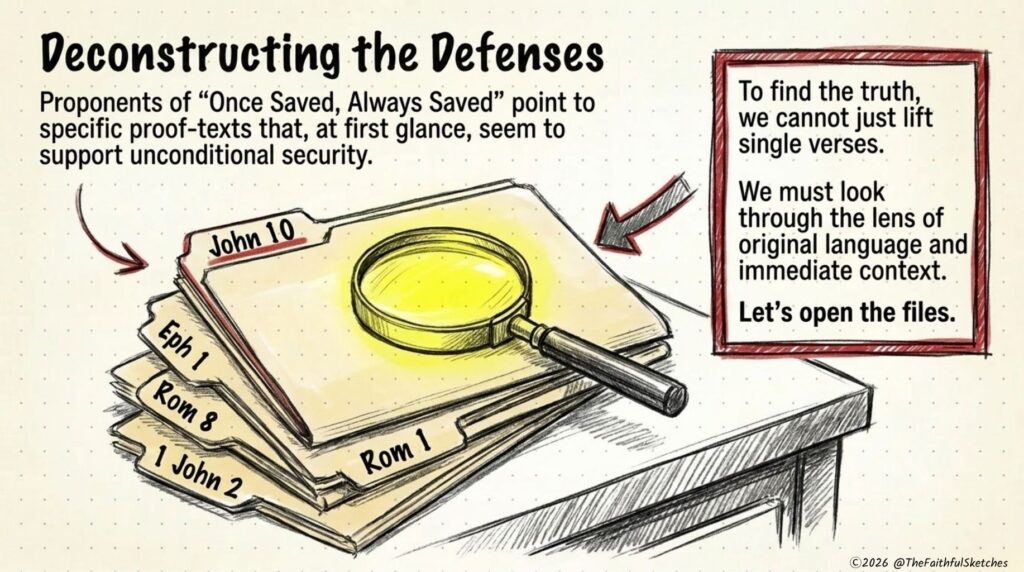
Anyone who holds “once saved, always saved,” often shortened to OSAS, will point to specific proof-texts. To be fair, several verses seem to support unconditional security at first glance. Context and the original language give a different picture. Here are the four most common arguments and the response to each.
| The OSAS Argument | Key Verse | The Response |
|---|---|---|
| No one can snatch you from God’s hand | John 10:28 | Verse 27 uses present continuous verbs: sheep who keep on hearing and keep on following. No external force can remove you, but you can still walk away yourself |
| You are sealed by the Spirit | Ephesians 1:13 | Paul warns the same readers not to grieve the Spirit (Ephesians 4:30) and not to quench Him (1 Thessalonians 5:19). The seal holds while you remain in the covenant |
| Nothing can separate you from God’s love | Romans 8:38-39 | Paul lists external forces only: death, rulers, powers, the future. The believer’s own rebellion is absent from the list |
| Those who leave were never saved | 1 John 2:19 | John describes a specific group of early false teachers, not a universal law for every person who falls away |
#1: The Snatching Argument
The most quoted verse is John 10:28, where Jesus promises His sheep will never perish and no one will snatch them from His hand. OSAS proponents treat this as total security. Look at verse 27 first. Jesus says His sheep hear His voice and follow Him, and the Greek verbs sit in the present continuous tense. A literal translation reads: my sheep keep on hearing my voice, and they keep on following me.
Jesus promises absolute protection to those actively maintaining their relationship with Him. No external force, not Satan, not persecution, not the world, can rip you away from God against your will. He does not say a sheep cannot willingly stop listening, stop following, and walk out of that hand on its own. External forces cannot snatch you. Internal rebellion can still cause you to abandon the shepherd.
#2: The Seal Argument
Ephesians 1:13 says believers were sealed with the promised Holy Spirit. In the ancient world, a king’s seal marked ownership and security, so the argument goes that once God seals you, the matter is closed until the day of redemption.
The problem is that a covenant seal never erased human agency. Paul writes to the same group of people later in the same letter. Ephesians 4:30 warns them not to grieve the Holy Spirit by whom they were sealed. Why warn sealed believers about grieving the Spirit if their actions carried no weight? 1 Thessalonians 5:19 adds a second warning: do not quench the Spirit. The Spirit can be grieved, resisted, and quenched through persistent, unrepentant rebellion. The seal remains as long as you remain in the covenant.
#3: The Separation Argument
Romans 8:38-39 declares that neither death nor life, nor angels nor rulers, nor anything else in all creation can separate us from the love of God in Christ Jesus. The argument runs: if nothing can separate us from God’s love, nothing we do can separate us from salvation.
Look carefully at Paul’s list. He names external factors: physical death, spiritual principalities, present struggles, future anxieties, cosmic powers. He is reassuring a heavily persecuted Roman church that a hostile world cannot break their bond with Christ. One thing is noticeably absent from the list: the believer themselves. Paul says external things cannot separate you from God. He does not say you cannot separate yourself through persistent unfaithfulness. Paul comforts the faithful. He does not hand a license to the rebellious.
#4: The Never Truly Saved Argument
When faced with real people who spent decades serving in church, preaching the gospel, and living upright lives, only to renounce Jesus and become atheists, OSAS proponents fall back on 1 John 2:19: “They went out from us, but they were not of us.” The claim is that anyone who walks away was never a true Christian in the first place.
This argument fails on historical context and on logic. Contextually, John writes about a specific group of early false teachers, pre-Gnostic antichrists who infiltrated the local church to spread destructive heresies. John observes that these specific heretics left because they never shared the apostolic faith. Turning that historical observation into a universal law for every backslider in history is an enormous theological leap. More importantly, if everyone who falls away was never saved, the severe warnings in Hebrews and 2 Peter make no sense. Why warn true believers against a danger they cannot structurally experience? You don’t put up “Danger: Cliff Ahead” signs for people who are physically incapable of walking near the edge.
Stumbling vs Apostasy
At this point you might be starting to panic. You might be thinking, “I sinned yesterday,” or “I have struggled with deep doubt for months. Have I lost my salvation? Am I doomed?”
Breathe. The answer is a definitive no. Scripture draws a critical distinction between stumbling and apostasy, and the difference matters enormously.
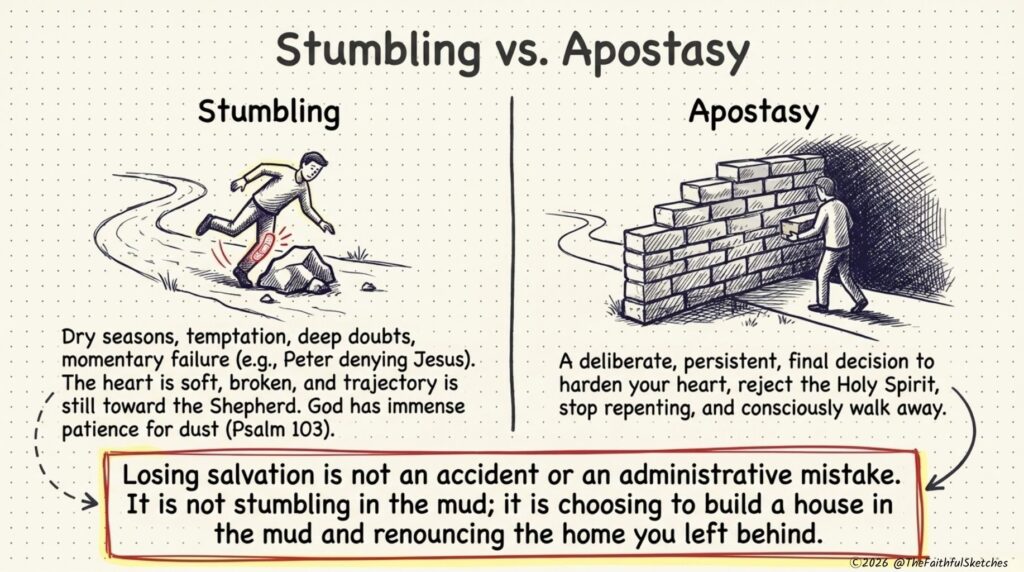
A true believer can stumble. You can go through a dry season, fall into temptation, and wrestle with agonizing intellectual doubts. Look at the Apostle Peter. He denied Jesus three times with curses on the night of the crucifixion. Yet Jesus restored him. Why? Peter’s heart stayed soft toward God. He wept bitterly over his failure, and his trajectory still pointed toward the Shepherd. God has immense patience with struggling believers. Psalm 103:14 says He knows our frame and remembers that we are dust. He does not cast you out of His family over a bad day, a bad month, or a moment of weakness.
Losing your salvation is nothing you do by accident. It results from a deliberate, persistent, and final decision to harden your heart, reject the convicting power of the Holy Spirit, stop repenting, and consciously walk away from Jesus Christ. Apostasy means renouncing the home you left behind, then refusing to ever return.
The True Foundation of Assurance
The OSAS doctrine offers assurance by pointing you to a moment in the past: a prayer you said, a card you signed, an emotional experience from decades ago. The New Testament locates true assurance somewhere else, in your relationship with God right now, in the present.
Salvation is secure because God is faithful. Salvation is conditional because it requires your ongoing, free-will trust. Your security rests in a living, abiding relationship with the Savior. This position sits within a centuries-old debate between Arminian and Reformed Christians, and you can read both sides in my posts on Calvinism vs Arminianism and predestination and free will.
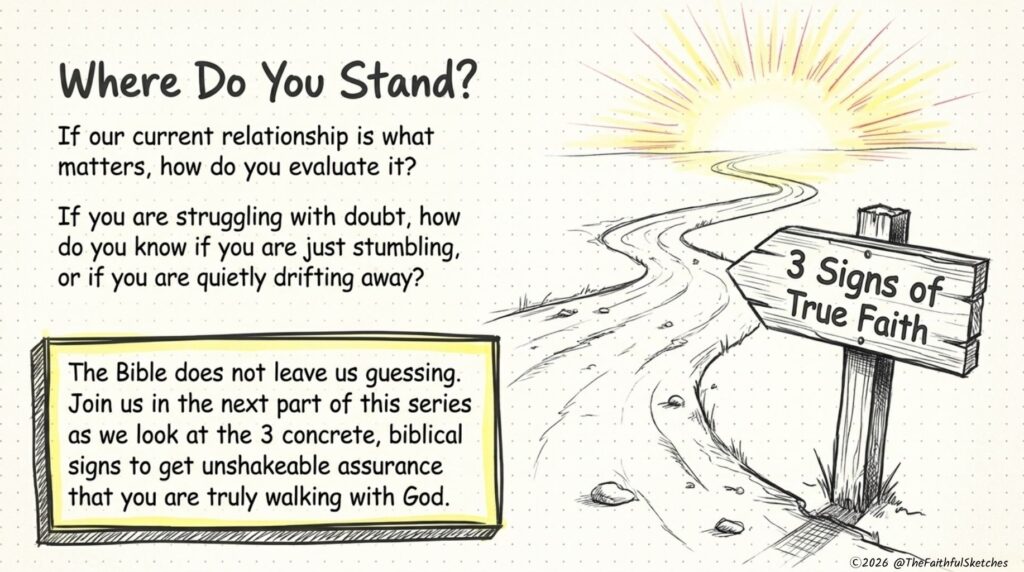
This raises the question that matters most for your daily life. If your current relationship matters, how do you evaluate it? If you struggle with doubt or sin right now, how can you know where you stand with God this second? The Bible does not leave you guessing. I cover the three concrete signs in my companion post on how to know you are truly saved, and I recommend reading it next, especially if this post stirred up anxiety.
Where do you land on this question? Let me know in the comments below, and let’s discuss it respectfully.
Click Below to Download The Full PDF Summary Visual Guide:
*Free for personal use only. Please don’t resell or redistribute commercially.