
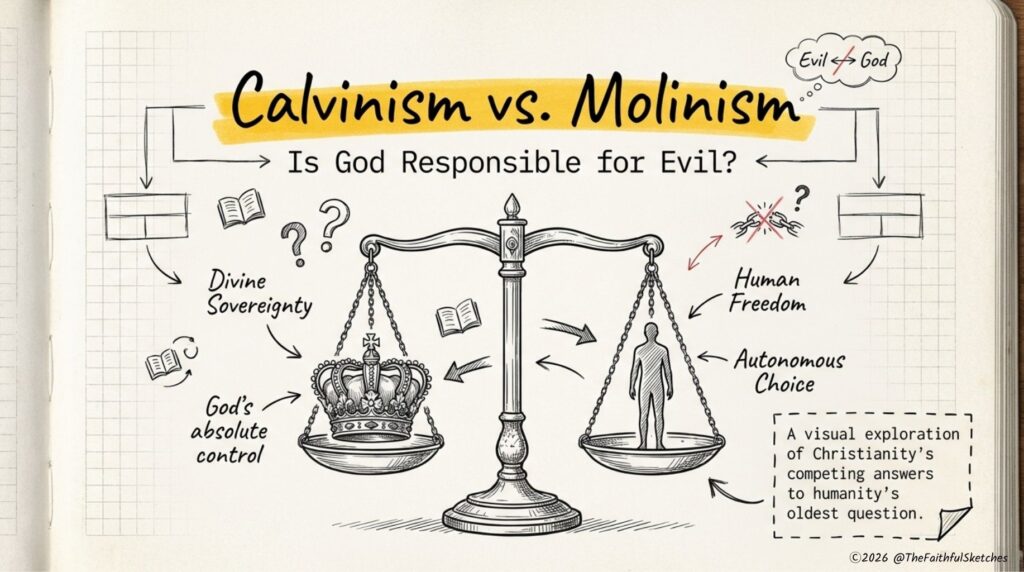
The problem of evil is the single greatest intellectual and emotional obstacle to faith. If God is all-powerful and all-good, why is there so much suffering? Humanity has wrestled with this question for millennia, and within Christianity, two profound theological systems, Calvinism and Molinism, offer competing answers. Both start from the Bible, yet they arrive at very different explanations.
This post isn’t about picking a team. It’s about understanding two serious attempts to defend God’s goodness while explaining evil, and hopefully deepening your awe for a God whose ways are higher than ours. Read to the end, and let me know which view you think offers the most coherent and biblically faithful answer.
Defining the Problem of Evil
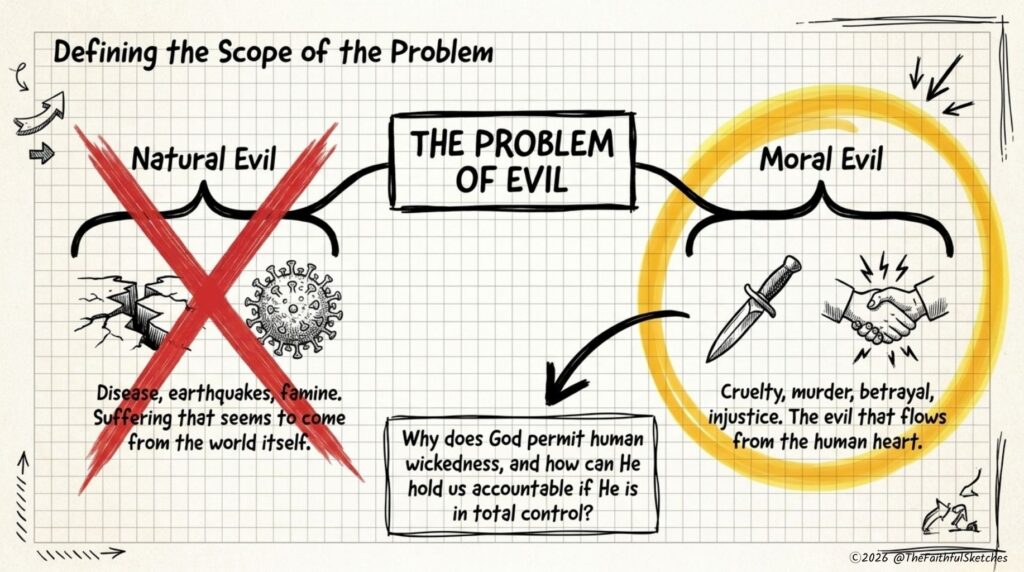
The problem of evil actually has two dimensions. There’s moral evil, the cruelty humans inflict on one another through murder, betrayal, and injustice. This kind of evil flows from the human heart. Then there’s natural evil, suffering that seems to come from the world itself, such as disease, earthquakes, and famine.
For this discussion, we’ll focus specifically on moral evil. Why does God permit human wickedness? And how can He hold us accountable if He remains in total control? Calvinism and Molinism answer both questions very differently.
Calvinism: The Sovereign King
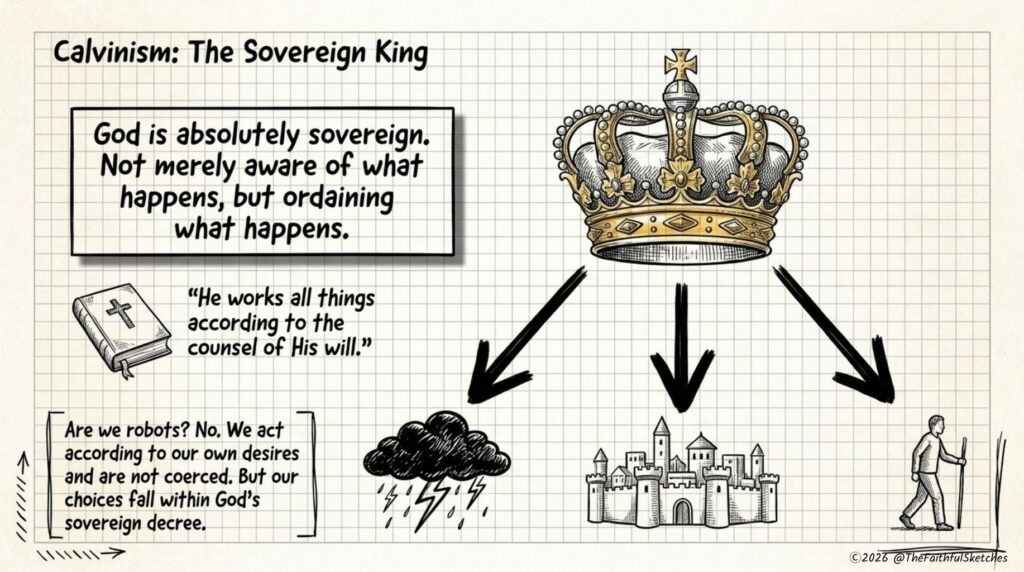
The Reformed tradition, often called Calvinism, begins with a non-negotiable truth: God is absolutely sovereign. He isn’t merely aware of what happens; He ordains what happens. Calvinists look to Scripture and see a God who, according to Ephesians 1:11, “works all things according to the counsel of his will.” Nothing is accidental, and nothing catches Him by surprise.
Does this make us robots? Calvinists say no. They teach that we act according to our own desires. We choose what we want to choose, and we are not coerced. However, and this is crucial, those actions still fall within God’s sovereign decree. He is the one who determines the overall path.
Joseph and the Crucifixion
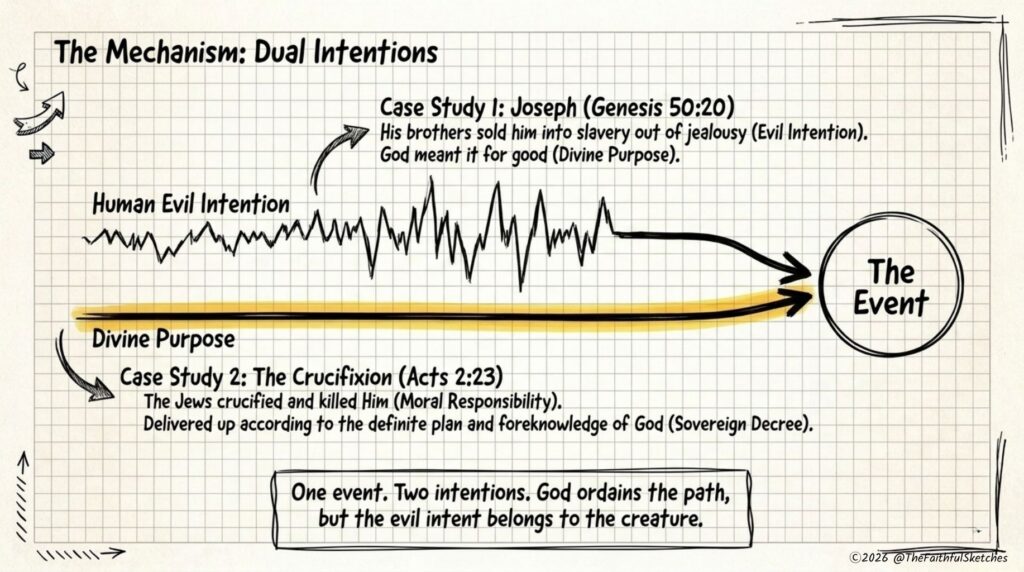
Consider the story of Joseph. His brothers sold him into slavery out of jealousy, and their intention was evil. Yet Joseph later declared in Genesis 50:20, “You meant it for evil, but God meant it for good.” One event, two intentions: human evil and divine purpose, held together.
Or consider the crucifixion itself. Peter declared that Jesus was “delivered up according to the definite plan and foreknowledge of God” in Acts 2:23. Yet in the same breath, Peter said the people “crucified and killed” Him. They bore genuine moral responsibility for their actions, even as God’s sovereign plan was being fulfilled through them.
For the Calvinist, this is the pattern throughout Scripture. Evil isn’t an accident; it’s part of a grand tapestry. We see the tangled threads from below, but God sees the finished work from above.
The Calvinist conclusion follows: God sovereignly ordains whatsoever comes to pass, yet He remains holy and never becomes the author of sin. Instead, He works through human choices, including evil ones, to accomplish His purposes. For more on this framework, see my post on Reformed theology and Calvinism.
Molinism: The Master Strategist
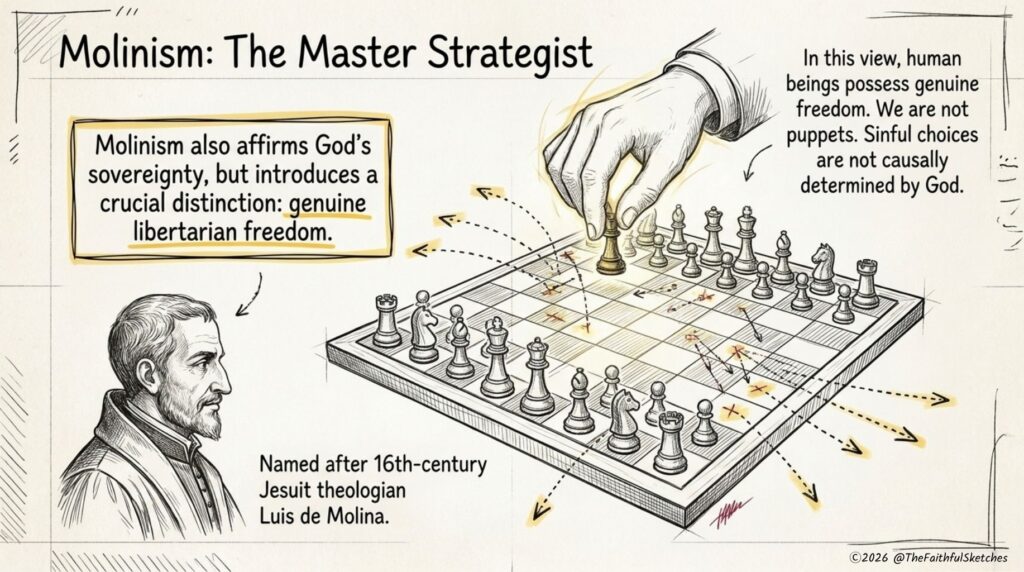
Now for the second view: Molinism, named after the 16th-century Jesuit theologian Luis de Molina. This tradition also affirms God’s sovereignty, but it introduces a crucial distinction through what theologians call God’s middle knowledge.
Molinists speak of three kinds of divine knowledge. Natural Knowledge is God’s knowledge of all necessary truths and all possibilities. Middle Knowledge is God’s knowledge of what any free creature would do in any given circumstance.
Free Knowledge is God’s knowledge of what actually happens in the world He creates. Middle Knowledge is the key piece. Before God created anything, He already knew every possible choice every person could make, including what you would do if born in the 21st century or in the Middle Ages.
Possible Worlds vs Feasible Worlds
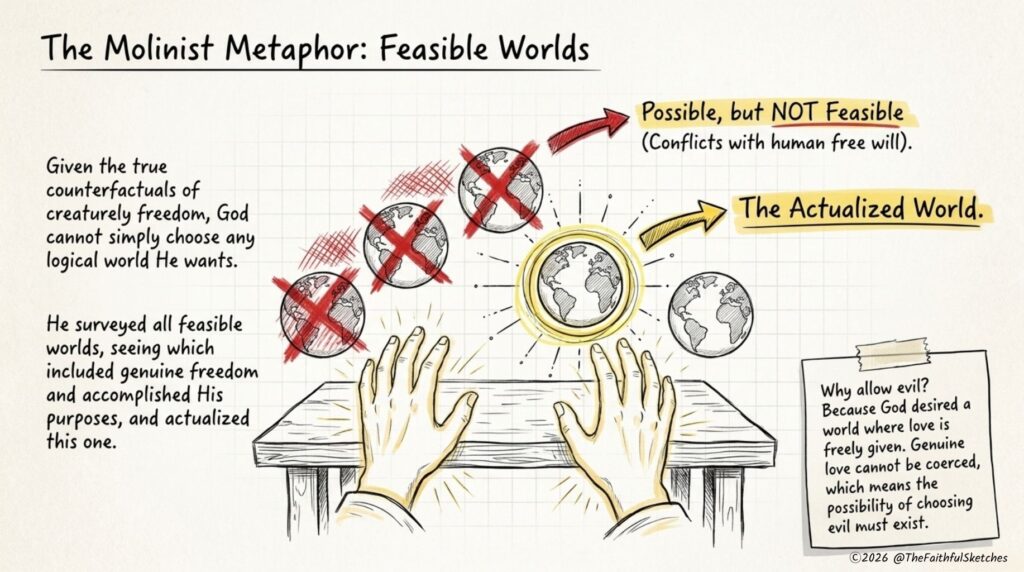
Here’s where Molinism gets precise. It distinguishes between possible worlds and feasible worlds. A world may be logically possible, yet given the true counterfactuals of creaturely freedom, not every possible world is actually feasible for God to bring about. If creatures are genuinely free, God cannot simply choose any world He wants. He must choose one consistent with the free choices creatures would actually make.
Using His Middle Knowledge, God surveyed every feasible world. He saw which ones preserved genuine human freedom, and He saw which ones accomplished His redemptive purposes. He then chose to actualize this world, the one that best fulfills His plan while still honoring creaturely freedom.
In this view, human beings possess real, libertarian freedom. We are not puppets. When we sin, the sinful choice belongs genuinely to us; it isn’t causally determined by God. This is why Molinists insist we bear full moral accountability: because the decision is genuinely free, responsibility rests squarely with the creature.
That still raises a painful question, though. Why did God create a world knowing such evil would occur? Molinists respond that God desired a world where love is freely given, and genuine love cannot be coerced. It must be chosen. A world containing real freedom necessarily includes the possibility that creatures will freely choose evil.
The Showdown: Where They Clash
Both systems have serious defenders using biblical and philosophical arguments, but they cannot both be fully correct in every respect. So where exactly do they differ?
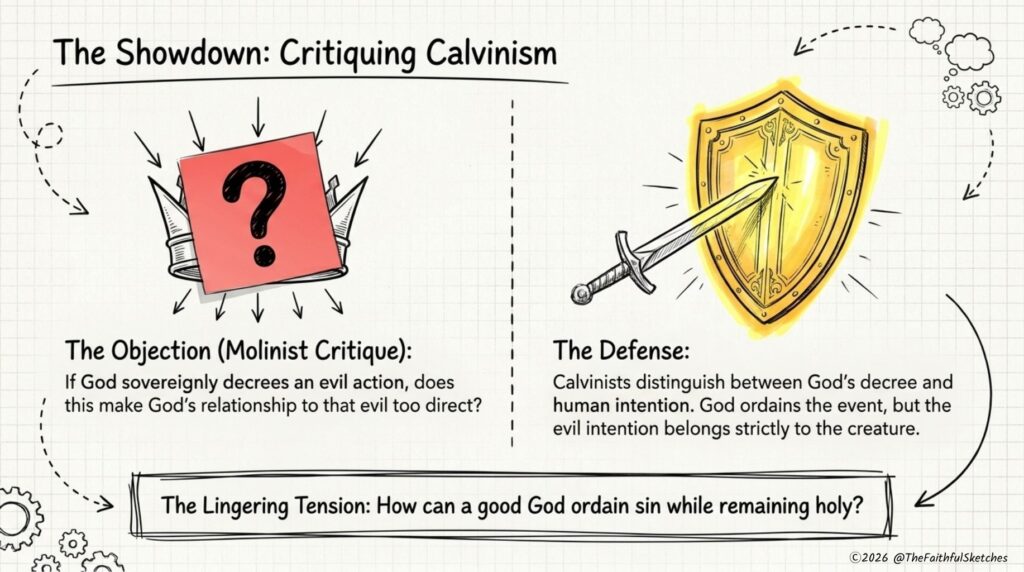
Molinists raise a pointed objection against Calvinism. If God sovereignly decrees an evil action, does that make His relationship to that evil too direct? Calvinists respond by distinguishing between God’s decree and human intention: God ordains that the event occurs, but the evil intention belongs entirely to the creature.
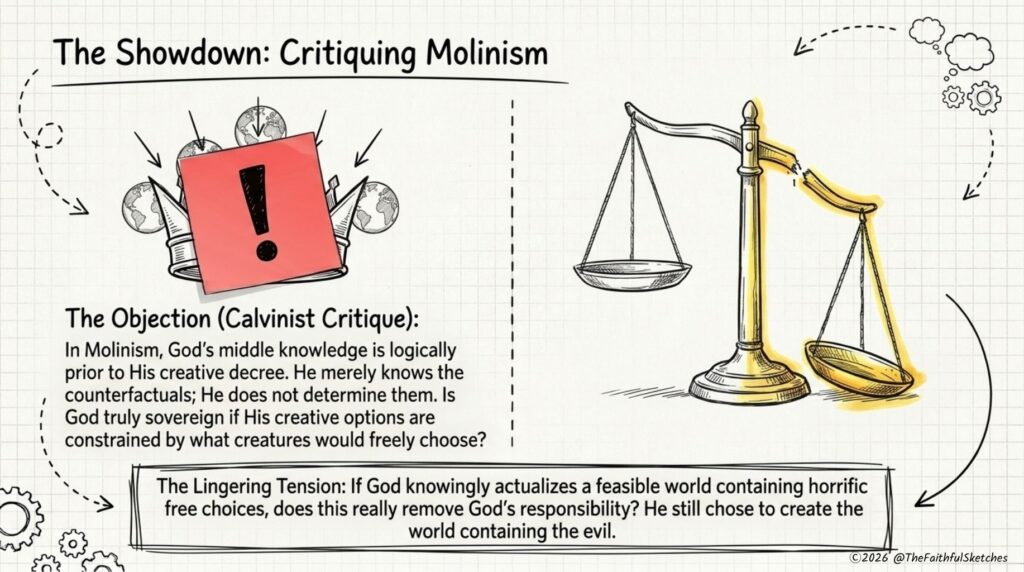
Calvinists fire back with an equally serious objection. If God knowingly actualizes a feasible world containing horrific free choices, why did He choose that particular world over another? Does Molinism actually remove God’s responsibility, or does it just relocate it one step earlier? In both views, after all, God still creates the world that contains the evil.
Calvinists also argue that Molinism compromises divine sovereignty in a deeper sense. In Molinism, God’s middle knowledge is logically prior to His creative decree. He doesn’t determine the counterfactuals of what creatures would freely do; He merely knows them. Calvinists ask whether God is truly sovereign if His creative options are constrained by what creatures would freely choose in the first place.
Both traditions carry deep strengths and deep tensions, and neither offers a fully tidy resolution to the problem of evil. Both, in the end, point us back to the cross, where God entered into our suffering and defeated evil not by avoiding it, but by bearing it Himself.
The Surprising Agreement
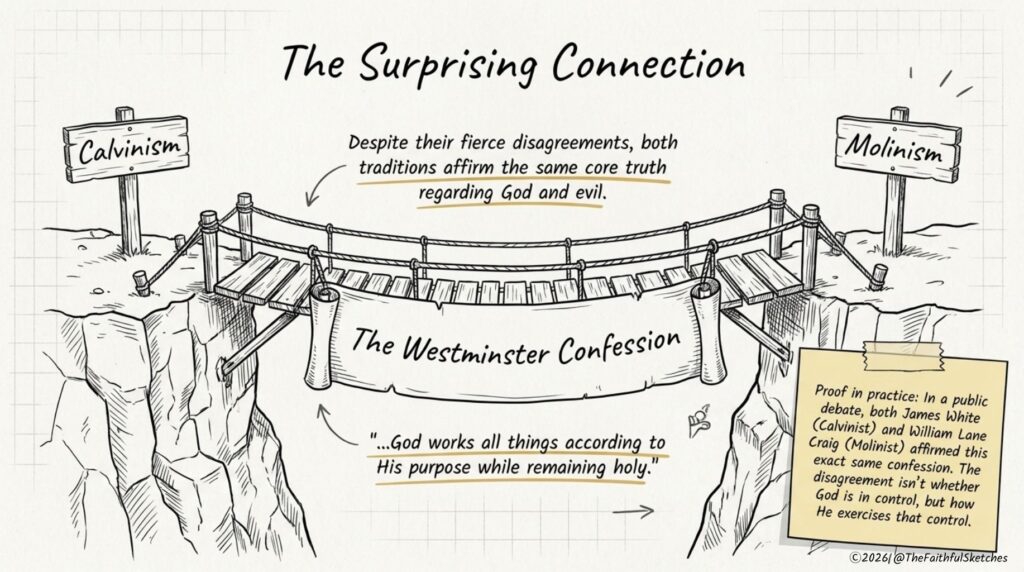
Here’s a surprising connection, though. Despite their fierce disagreements, both Calvinists and Molinists can affirm the Westminster Confession of Faith’s statement that God “works all things according to his purpose” while remaining holy.
In a public debate, both James White, a Calvinist, and William Lane Craig, a Molinist, affirmed this same confession. The disagreement isn’t really about whether God is in control. It’s about how He exercises that control.
Calvinism vs Molinism at a Glance
| Calvinism | Molinism | |
|---|---|---|
| God’s relationship to evil | Sovereignly decrees all events, including evil ones | Actualizes a feasible world containing free choices |
| Human freedom | Compatibilist: we choose what we desire, within God’s decree | Libertarian: genuinely free, uncoerced choices |
| Basis of moral responsibility | The creature’s intention, even within God’s decree | The creature’s genuinely free decision |
| Key mechanism | God’s sovereign decree | God’s Middle Knowledge of counterfactuals |
| Main strength | Preserves absolute divine sovereignty | Preserves clear human moral responsibility |
| Main tension | How can a holy God ordain sin? | Is God still fully sovereign if constrained by counterfactuals? |
Conclusion: Which View Best Explains Evil?
So which view do you think best addresses the problem of evil? Calvinism emphasizes divine sovereignty. God is in control, nothing is random, and evil has a purpose even when we cannot see it. But you have to wrestle with the tension: how can a good God ordain sin while remaining holy Himself?
Molinism emphasizes human freedom and moral accountability. Evil is genuinely our fault, and God is never the author of sin. But you have to wrestle with a different tension: if God’s creative options are constrained by what creatures would freely choose, what does sovereignty actually mean?
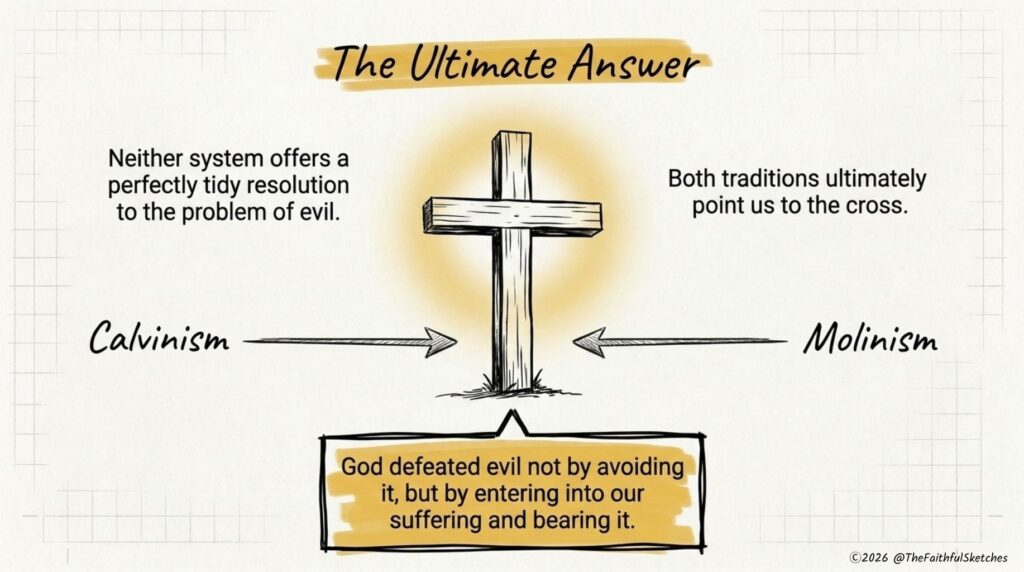
Both traditions represent the careful work of faithful believers. Both seek to honor God and defend His goodness. And both, in the end, acknowledge that evil remains a profound mystery this side of eternity. If you want to explore how this same tension plays out in the Calvinist and Arminian debate over free will more broadly, see my post on predestination and free will. Which view feels most coherent to you? Let me know in the comments below.
Click Below to Download The Full PDF Summary Visual Guide:
*Free for personal use only. Please don’t resell or redistribute commercially.