
In 1845, a group of Baptist pastors in the South packed up and walked out of their own denomination. The fight wasn’t over Jesus, and it wasn’t over the Bible. It was over whether a missionary could own slaves. The rest of the denomination said no, so the Southern Baptist Convention was born out of that single argument.
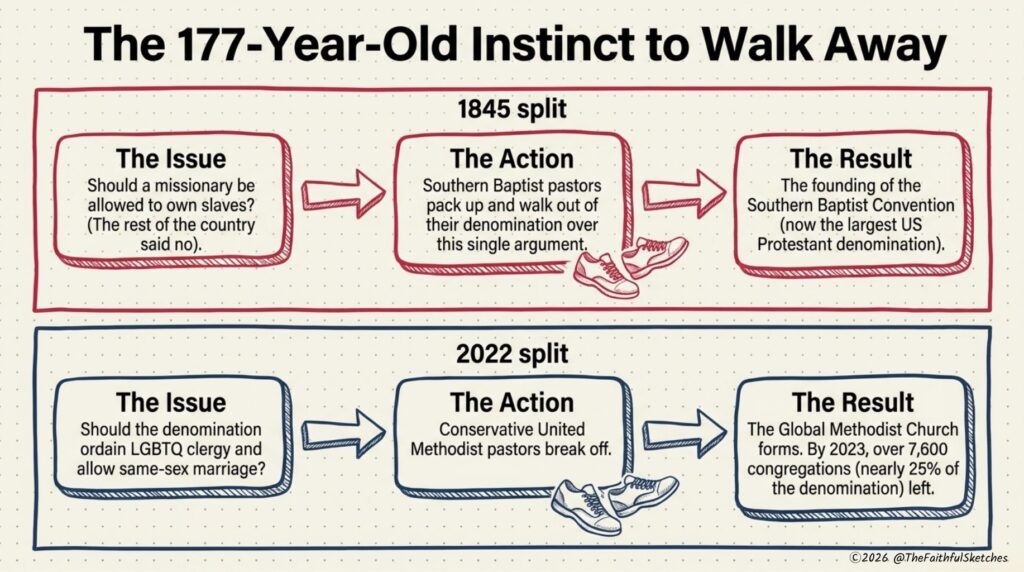
Fast forward to 2022. A group of Methodist pastors did almost the exact same thing. The issue was completely different this time, whether their denomination could ordain gay clergy, yet the instinct was identical: pack up, walk out, start a new church. Same move, 177 years apart. Baptist and Methodist churches share the same Bible and believe in the same Jesus, but they don’t agree on much else. Baptism, salvation, and even who’s actually in charge of the church all divide them. Stick around to the end, because we’ll cover not just why these two break apart, but a few interesting facts most people don’t know.
👉 Interesting fact 1: The 1845 split is the actual founding event of the Southern Baptist Convention, now the largest Protestant denomination in the United States. It began as a fight over slaveholding missionaries.
Both Churches Were Born Out of Rebellion
Let’s start at the beginning, because both traditions trace back to acts of defiance against the religious establishment of their day.
Baptist Origins
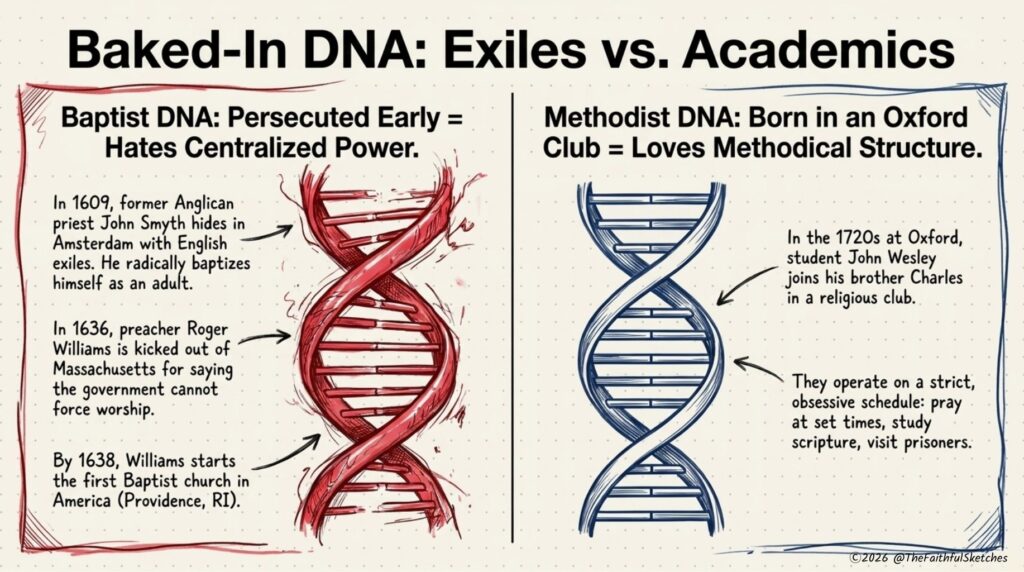
Go back to 1609. A former Anglican priest named John Smyth was hiding out in Amsterdam with a small group of English exiles. Smyth did something radical for the time: he baptized himself, not as a baby but as an adult, believing baptism only means something if the person being baptized understands what they’re agreeing to. That one decision became the seed of the entire Baptist movement.
Fast forward to the American colonies. A preacher named Roger Williams was expelled from Massachusetts in 1636 for arguing that the government had no business forcing anyone to worship a certain way. He headed south, and in 1638 he started the first Baptist church in America, in Providence, Rhode Island. That early persecution baked something permanent into Baptist identity: no bishops, no headquarters, and no one above the local church telling it what to do. Every Baptist church answers to itself.
👉 Interesting fact 2: Roger Williams didn’t stay Baptist for long. He later left the movement he helped start, becoming convinced that the true church had lost its original apostolic authority and that no existing Christian church could simply claim to be its legitimate continuation.
Methodist Origins
Now rewind to 1720s Oxford, England. A student named John Wesley joined his brother Charles and a handful of other students in a small religious club. They met on a strict, almost obsessive schedule, praying at set times, studying Scripture together, and visiting prisoners in jail. Other students found it ridiculous and started mocking the group, calling them “Methodists” because of how methodical and rigid their routine was. That insult is where the name comes from. It wasn’t a badge of honor. It was a joke.
👉 Interesting fact 3: John Wesley never intended to start a new church. He remained an Anglican priest until his death in 1791. Methodism only became its own separate denomination after his death, largely because there weren’t enough Anglican priests in America to keep up with how fast his movement was growing there.
So right from the start, you have two completely opposite instincts. Baptists believe every local church should govern itself, with no bishops, no hierarchy, and no one outside the congregation calling the shots. Methodists take the opposite approach, believing churches grow stronger when they’re connected through a larger structure of pastors, bishops, and congregations working together.
The Big Theological Fight: Calvinism vs Arminianism
Now for the argument underneath basically everything else: who actually gets saved, and who decides.
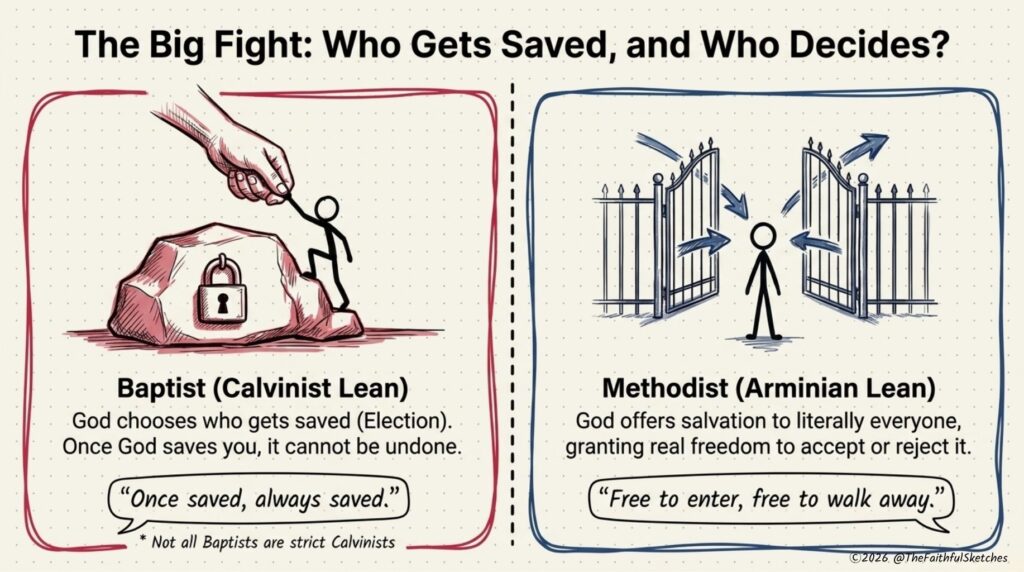
Historically, most Baptist theology leans Calvinist. That means God chooses who gets saved, an idea called election, and once God saves you, it cannot be undone. That’s where the phrase “once saved, always saved” comes from. Methodists, following John Wesley, stood firmly on the other side of this debate, a view called Arminian. In Wesley’s view, God offers salvation to literally everyone, but gives every person real freedom to accept or reject it, and he believed a person could genuinely walk away from that salvation later if they truly turned their back on God.
Wesleyans generally reject the idea that genuine believers are guaranteed to persevere no matter what they later choose. This exact fault line runs through much of Protestant Christianity, and I’ve unpacked it in more depth in my posts on Calvinism vs Arminianism and why Methodists reject Calvinism.
👉 Interesting fact 4: Not every Baptist is a strict Calvinist. Southern Baptists especially are split on this internally. But as a starting point, the Calvinist-versus-Arminian divide is the single biggest fault line running through all of Protestant Christianity.
Baptism: Who, and How?
Baptists only baptize believers, meaning someone old enough to understand what they’re doing and choose it for themselves, and it must be full immersion, all the way under the water. Methodists practice infant baptism while also baptizing older children and adults, using sprinkling, pouring, or immersion.
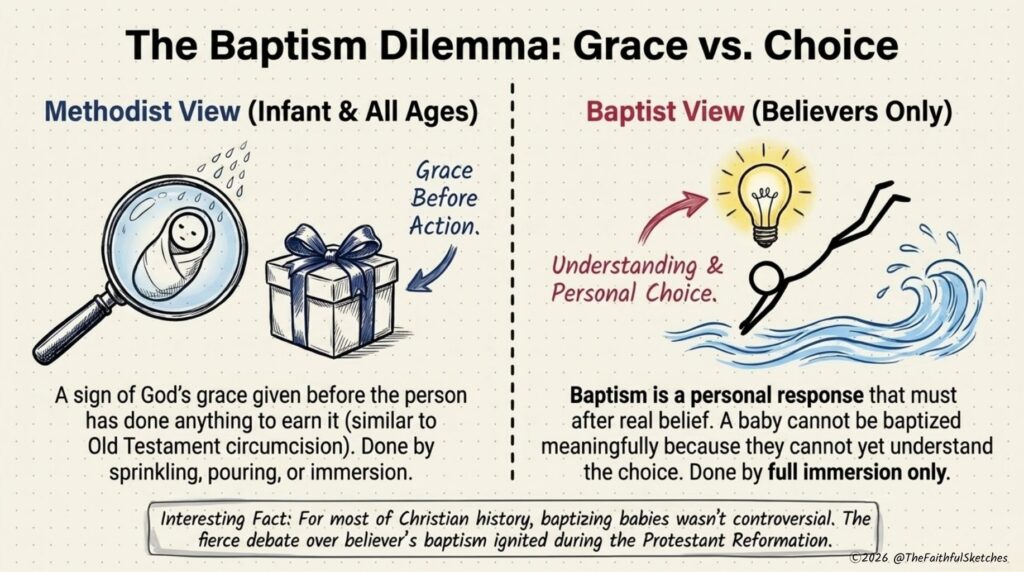
Methodists see baptism as a sign of God’s grace given before the person has done anything to earn it, similar to circumcision in the Old Covenant. Baptists see it as a personal response that has to come after real belief, arguing that you can’t respond to something you don’t yet understand, so in their view a baby can’t be baptized in any meaningful way. This exact debate, argued from both sides, is the subject of my post on whether infants should be baptized.
👉 Interesting fact 5: For most of Christian history, baptizing babies wasn’t controversial at all. The debate over infant baptism versus believer’s baptism became especially significant during the Protestant Reformation, when groups like the Baptists began pushing back against the practice.
Church Governance: Who’s in Charge?
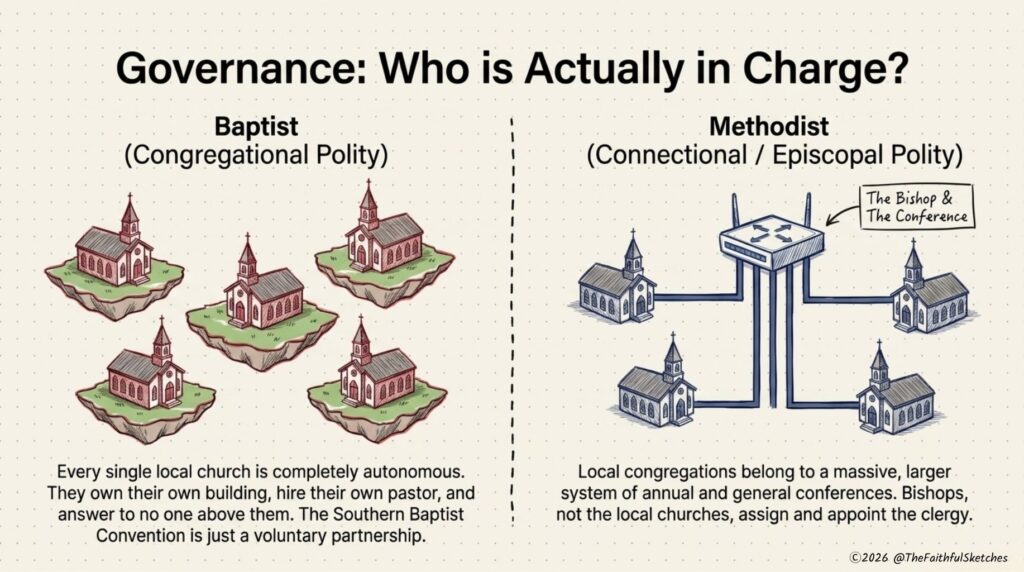
Baptist churches run on what’s called congregational polity. Every single local church owns its own building, hires its own pastor, and answers to no one above it. The Southern Baptist Convention isn’t a boss; it’s a voluntary partnership churches can join or leave whenever they choose. Methodist churches, by contrast, run on connectional, episcopal polity, where bishops assign pastors to churches. Methodists are connectional in the fullest sense: local congregations belong to a larger system of annual and general conferences, and bishops appoint clergy directly.
This structural difference is exactly why the 2022 Methodist split looked so different from a typical Baptist split. Methodist churches had to formally vote to disaffiliate, and in many cases pay the denomination to keep their own building. A Baptist church needs no permission to leave anything, because there’s nothing to leave. The local church was always autonomous to begin with.
Modern Splits: The Argument Isn’t Over
Let’s close the loop on that opening story, because this is where centuries-old theology turns into modern headlines. In 1845, Southern Baptists broke away specifically to keep appointing missionaries who owned slaves. That single argument became the founding event of what’s now the largest Protestant denomination in America.
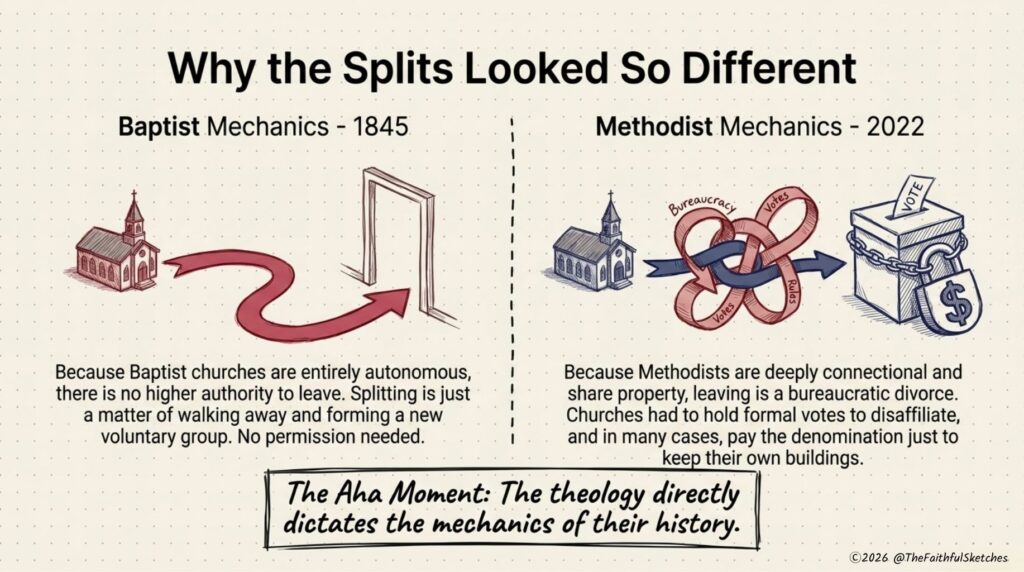
Methodists split over slavery too, in 1844, then spent nearly a century divided before reuniting in 1939. And in 2022, conservative Methodists broke off again to form the Global Methodist Church, this time over ordaining LGBTQ clergy and allowing same-sex marriage. By the end of 2023, more than 7,600 United Methodist congregations, close to a quarter of the entire denomination, had left.
Baptist vs Methodist at a Glance
| Issue | Baptist | Methodist |
|---|---|---|
| Founded | 1609, Amsterdam (John Smyth) | 1720s Oxford, formalized after 1791 |
| Theology | Historically Calvinist leaning | Arminian, following John Wesley |
| Salvation | Once saved, always saved (for most) | Can be walked away from |
| Baptism | Believers only, full immersion | Infants and adults; sprinkling, pouring, or immersion |
| Church governance | Congregational; each church autonomous | Connectional; bishops appoint clergy |
| 19th-century split | 1845, over slaveholding missionaries | 1844, over slavery; reunited 1939 |
| 21st-century split | N/A | 2022, over LGBTQ ordination (Global Methodist Church) |
Conclusion: Family, Not Enemies
Before we close, it’s worth remembering what Baptists and Methodists still hold in common. Both affirm the Trinity, salvation through Jesus, and the Bible as their final authority. Every disagreement we’ve covered here happens inside the same family, not across enemy lines.
The pattern is striking, though. Two very different founders, two very different views of church government, and two very different theological instincts, yet both traditions have repeatedly split over remarkably similar pressures: how to structure authority, and how to respond when the wider culture forces a moral reckoning. If you’d like to go deeper on either theological thread running through this post, see Calvinism vs Arminianism or should infants be baptized. Which of these differences surprised you most? Let me know in the comments below.

Click Below to Download The Full PDF Summary Visual Guide:
*Free for personal use only. Please don’t resell or redistribute commercially.