
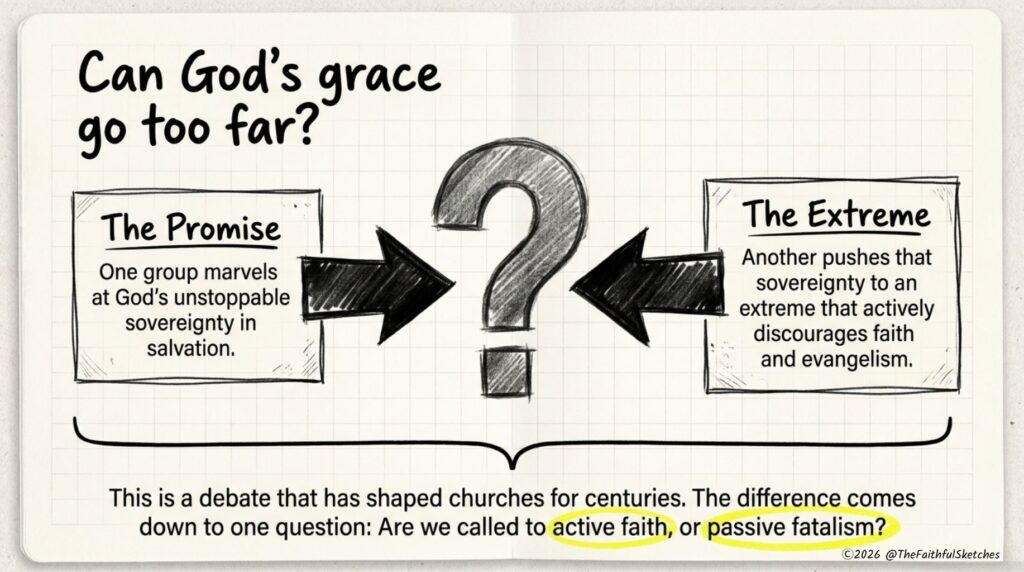
Can God’s sovereignty become an excuse for inaction? That question sits at the heart of the debate over Calvinism vs Hyper-Calvinism. Both systems claim to honour God’s control over salvation. But one calls believers to preach urgently, while the other has historically used God’s election as a reason not to bother. The difference matters more than many Christians realise.
What Is Calvinism?
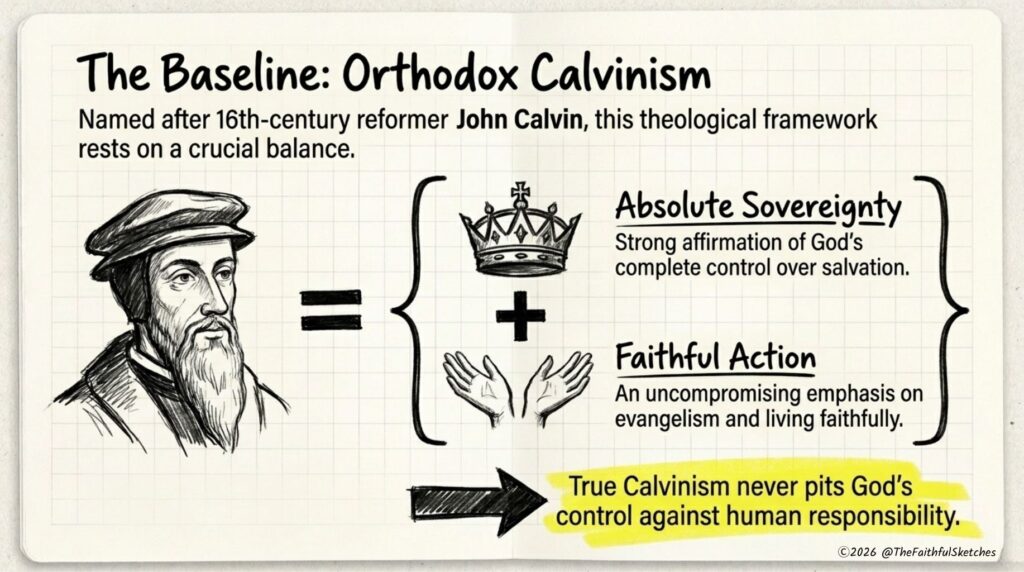
Calvinism is a theological system built on the work of John Calvin, a 16th-century Reformation leader. At its core, it asserts God’s absolute sovereignty in salvation. Calvinists typically summarise their view with the acronym T.U.L.I.P.:
- T – Total Depravity: Humans are sinful and cannot choose God on their own.
- U – Unconditional Election: God chooses who will be saved, not based on anything humans do.
- L – Limited Atonement: Christ’s death was specifically for the elect.
- I – Irresistible Grace: God’s saving call cannot be ultimately resisted.
- P – Perseverance of the Saints: Those whom God saves will never truly fall away.
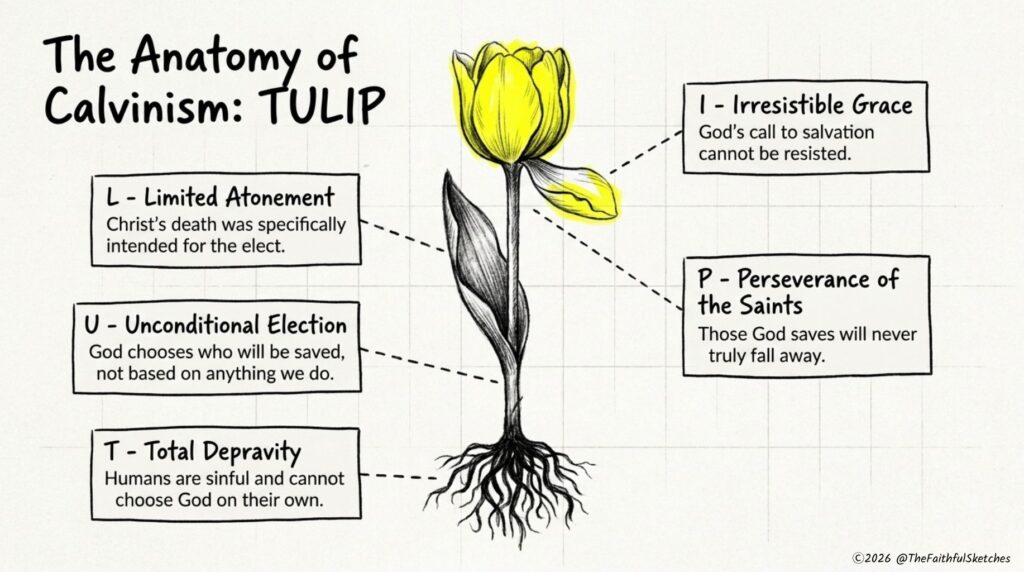
Importantly, Calvinism does not produce passivity. Calvinists affirm God’s total control over salvation and still insist on faithful evangelism, active discipleship, and urgent gospel proclamation. The two are not in conflict. For a fuller treatment of this system, see the post on Reformed theology and Calvinism.
What Is Hyper-Calvinism?
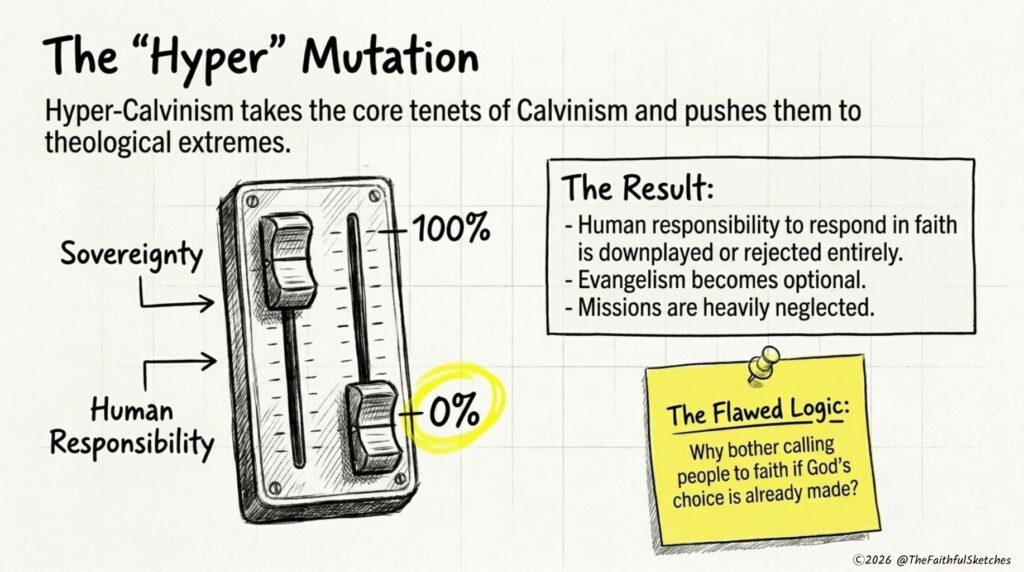
Hyper-Calvinism takes the doctrine of God’s sovereignty and pushes it to a conclusion the Bible does not actually support. Specifically, it downplays or denies the responsibility of humans to respond to the gospel in faith. Some Hyper-Calvinist teachers argue that since God has already chosen who will be saved, issuing a general gospel call to unbelievers is either unnecessary or theologically improper.
The result is often a church that stops evangelising, neglects missions, and treats spiritual inaction as faithfulness. But Scripture does not give that option. Matthew 28:19 records Jesus commanding: “Go therefore and make disciples of all nations.” 2 Corinthians 6:2 adds: “Behold, now is the favorable time; behold, now is the day of salvation.” Neither verse qualifies its urgency based on election.
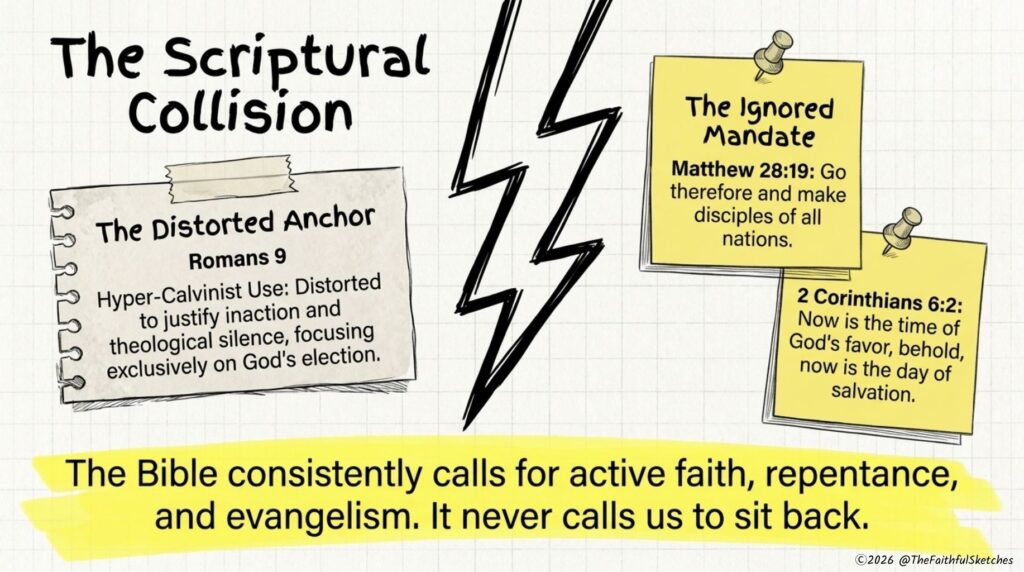
Hyper-Calvinists often lean heavily on Romans 9 to justify their position. But Romans 9 addresses why God’s election is just, not whether Christians should preach. Paul, who wrote Romans 9, also wrote Romans 10:14: “How then will they call on him in whom they have not believed? And how are they to believe in him of whom they have never heard? And how are they to hear without someone preaching?” The chapter that follows election is a chapter about the necessity of preaching.
Calvinism vs Hyper-Calvinism: Key Differences
The comparison below captures where these two systems diverge most clearly. The gap isn’t marginal. On the issues that most directly affect how a church functions, they reach opposite practical conclusions.
| Question | Calvinism | Hyper-Calvinism |
|---|---|---|
| Evangelism | Strongly encouraged; a means God uses to call the elect | Often minimised or rejected as unnecessary |
| Human Responsibility | Humans are responsible to respond to the gospel in faith | Human responsibility is downplayed; God’s choice is the only factor |
| The Gospel Call | The gospel should be preached to all people everywhere | Questions the need for a universal, indiscriminate gospel call |
| Assurance of Salvation | Believers find hope and security in perseverance of the saints | Can produce spiritual apathy or anxious paralysis |
| View of Prayer | Prayer is a means God ordains; believers pray for the lost | Prayer for the unsaved is sometimes questioned as pointless |
| Historical roots | John Calvin, Synod of Dort (1619), Whitefield, Spurgeon | Some 18th-century English Particular Baptist churches |
A Historical Warning
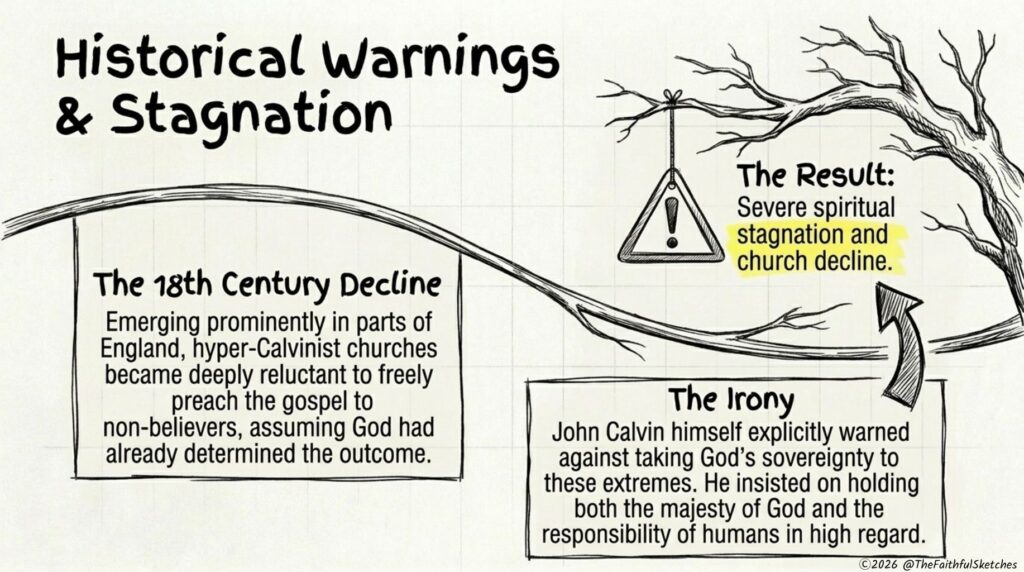
Hyper-Calvinism is not a new problem. It emerged most visibly in 18th-century England among some Particular Baptist congregations. Certain churches stopped preaching the gospel to unbelievers entirely, reasoning that God had already fixed the outcome. The result was spiritual stagnation and serious numerical decline.
William Carey, now regarded as the father of modern Protestant missions, faced direct opposition from Hyper-Calvinist ministers when he proposed sending missionaries to India in the 1790s. One minister reportedly told him that if God wanted to save the heathen, He would do it without Carey’s help. Carey went anyway. The contrast between his legacy and the legacy of those churches speaks for itself.
Calvin himself never endorsed this kind of fatalism. He wrote and preached extensively on the duty of believers to spread the gospel. His commentaries show a man who held God’s sovereignty and human responsibility simultaneously, without allowing one to cancel the other. This is exactly the balance the Synod of Dort (1618–1619) tried to preserve when it codified the five points of Calvinism in response to Arminian objections.
For more context on how theological disputes like this developed in church history, see the post on the Great Schism of 1054.
What Scripture Actually Teaches
The Bible holds God’s sovereignty and human responsibility together without resolving the tension into a neat system. This same tension appears throughout the predestination debate. See the post on predestination and free will for the full biblical case on both sides.
Acts 2:23 describes the crucifixion as both God’s deliberate plan and an act carried out by wicked human hands. Both are true at once. Philippians 2:12–13 instructs believers to “work out your own salvation with fear and trembling, for it is God who works in you, both to will and to work for his good pleasure.” God works. You work. Paul presents both without apology.
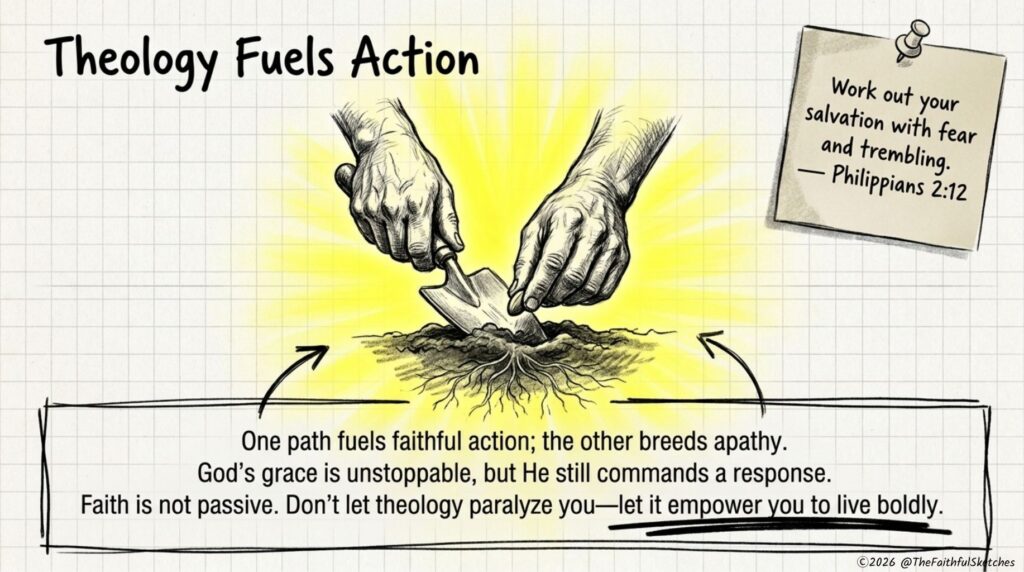
Hyper-Calvinism selects one half of this tension and discards the other. That is not faithful exegesis. It is a theological shortcut that produces a church without urgency, without mission, and ultimately without much gospel witness at all.
The philosophical question of free will has occupied thinkers for centuries. But the biblical framework does not require Christians to resolve it before acting. Scripture calls people to repent, to believe, and to preach, regardless of how sovereignty and freedom ultimately fit together. For a philosophical framework that attempts to address that fit, see the post on Molinism explained.
Why Calvinism vs Hyper-Calvinism Matters Today
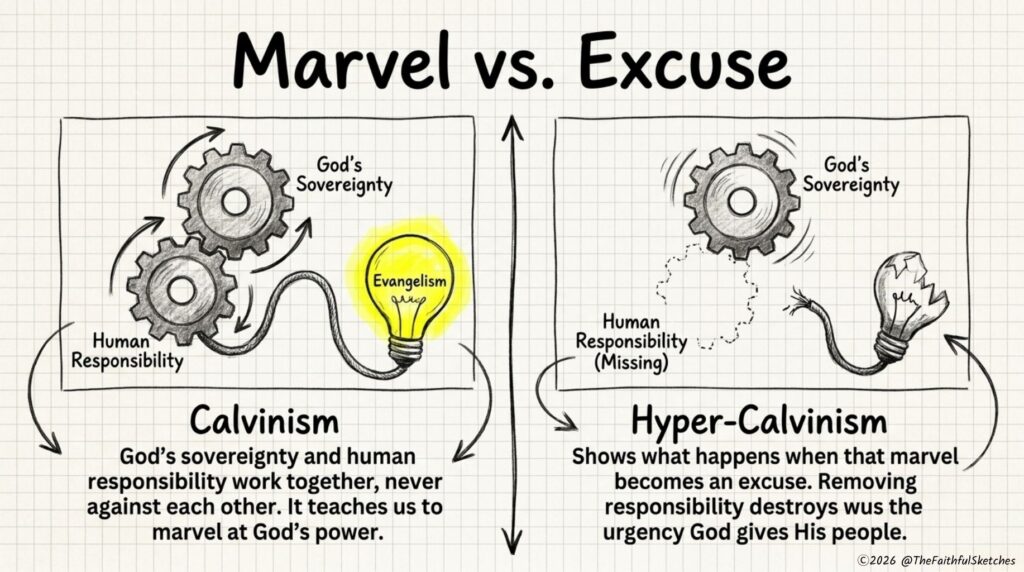
This debate is not purely historical. Some contemporary Reformed churches drift toward Hyper-Calvinist tendencies without using the label. You hear it when people question whether altar calls are appropriate, whether evangelising strangers makes sense, or whether praying for the salvation of specific individuals serves any purpose. These are Hyper-Calvinist instincts, even when no one names them that way.
Calvinism, rightly understood, should produce the opposite. Spurgeon, one of the most committed Calvinists in church history, was also one of the most prolific evangelists of the 19th century. He saw no contradiction. God’s sovereignty in salvation was, for him, the very reason to preach boldly: because God uses preaching as His means of calling the elect to faith.
The question to ask your own theology is simple: does it make you more urgent about the gospel, or less? A theology that produces passivity toward the lost has gone wrong somewhere, regardless of what label it wears. The connection between Reformed soteriology and evangelism runs directly through covenant theology, which frames the whole of Scripture as one unfolding plan of redemption, a plan that includes the preaching of the gospel to every nation.
The Bottom Line
Calvinism affirms that God sovereignly saves. Hyper-Calvinism uses that truth to excuse inaction. The difference is not a minor theological quibble. It shapes whether a church plants missionaries, trains evangelists, and actually tells people about Jesus.
God’s grace is unstoppable. And He has chosen to spread it through the preaching of His people. Romans 10:14 asks the question plainly: how will they hear without someone preaching? The answer assumes that someone will preach. That someone is you.
How do you hold God’s sovereignty and your own responsibility together in daily life? Leave a comment below.
Click Below to Download The Full PDF Summary Visual Guide:
*Free for personal use only. Please don’t resell or redistribute commercially.