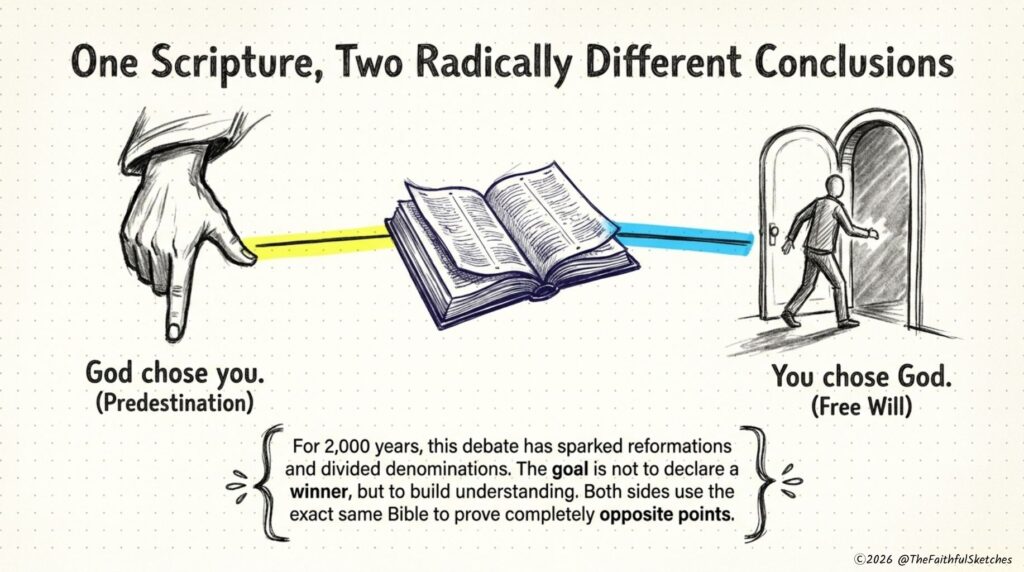
One of Christianity’s most debated questions cuts straight to something personal: the relationship between predestination and free will. Did God choose you before you were born? Or did you make a genuine choice to follow Him? Both sides use the exact same Bible to reach completely opposite conclusions. This post won’t declare a winner. Instead, it lays out both positions clearly, traces the historical fault lines, and examines what Scripture actually says.
Part 1: Defining the Terms
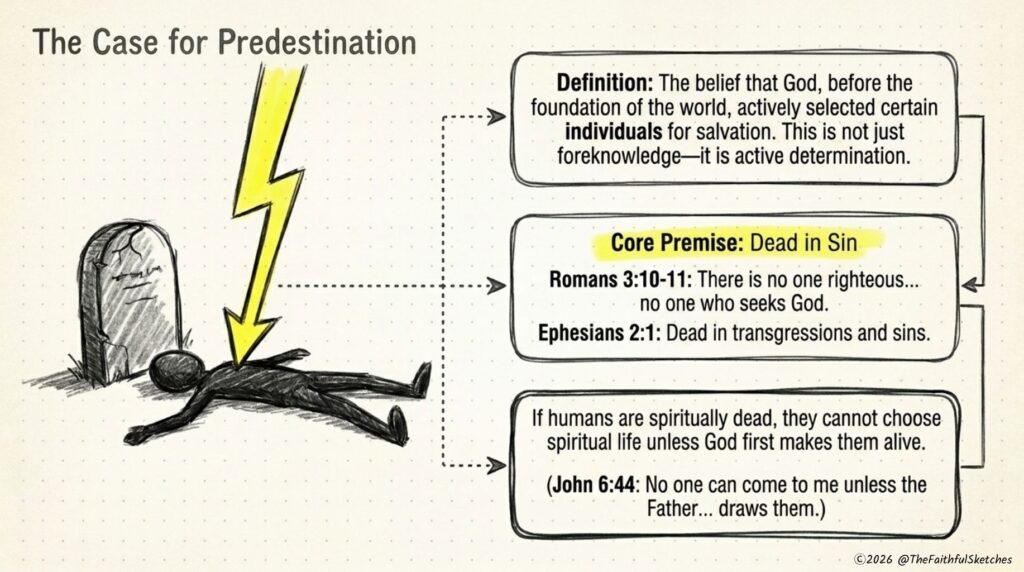
Predestination, in theological terms, is the belief that God chose certain individuals for salvation before the foundation of the world. This isn’t passive foreknowledge. It’s active selection. God didn’t simply foresee who would believe. He determines it.
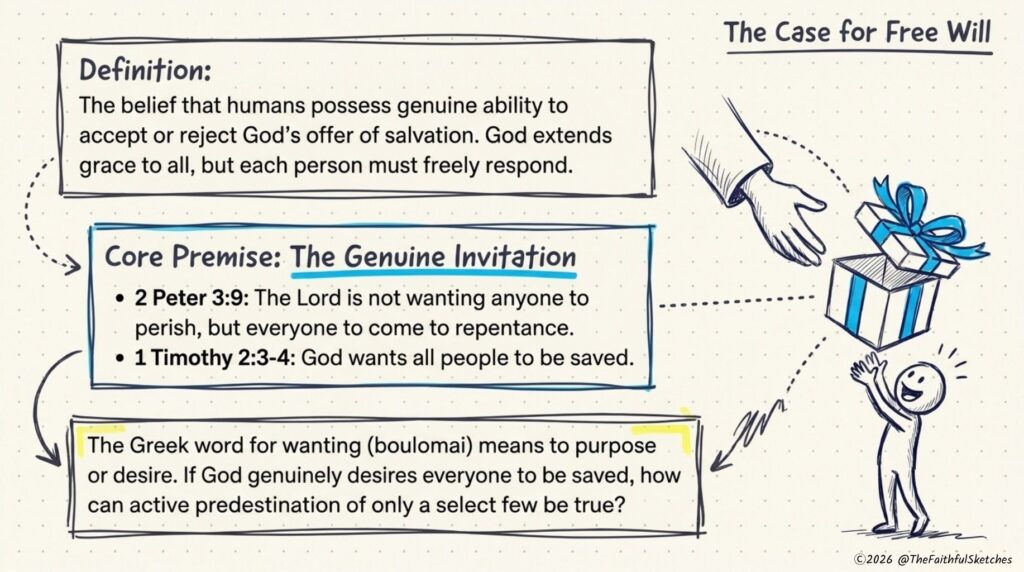
Free will is the belief that humans possess a genuine ability to accept or reject God’s offer of salvation. God extends grace to all. But each person must freely respond.
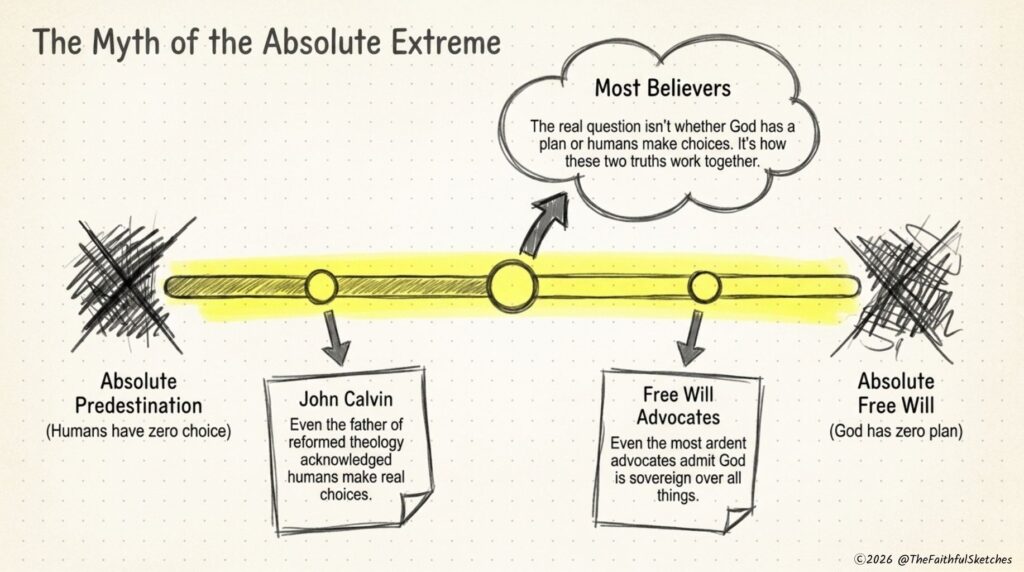
Very few Christians hold either position at its absolute extreme. Most land somewhere on a spectrum. Even John Calvin, the father of Reformed theology, acknowledged that humans make real choices. And even the most committed free-will advocate admits that God is sovereign over all things.
So the real question isn’t whether God has a plan or whether humans make choices. Most Christians agree on both. The question is: how do these two truths coexist?
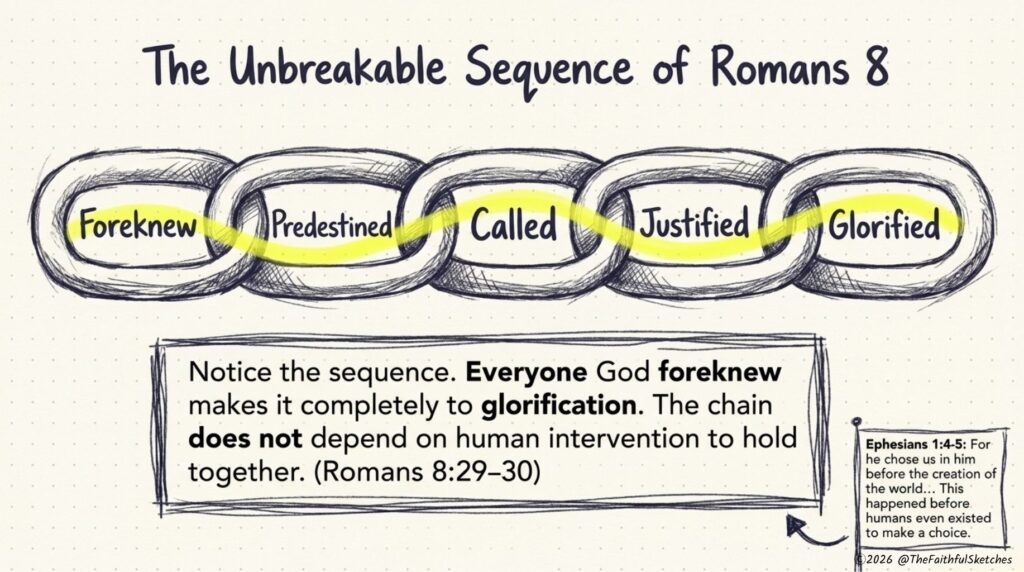
“For those God foreknew he also predestined to be conformed to the image of his Son, that he might be the firstborn among many brothers and sisters. And those he predestined, he also called; those he called, he also justified; those he justified, he also glorified.” (Romans 8:29–30)
Notice the chain: foreknew, predestined, called, justified, glorified. Everyone God foreknew makes it to glorification. No one drops out.
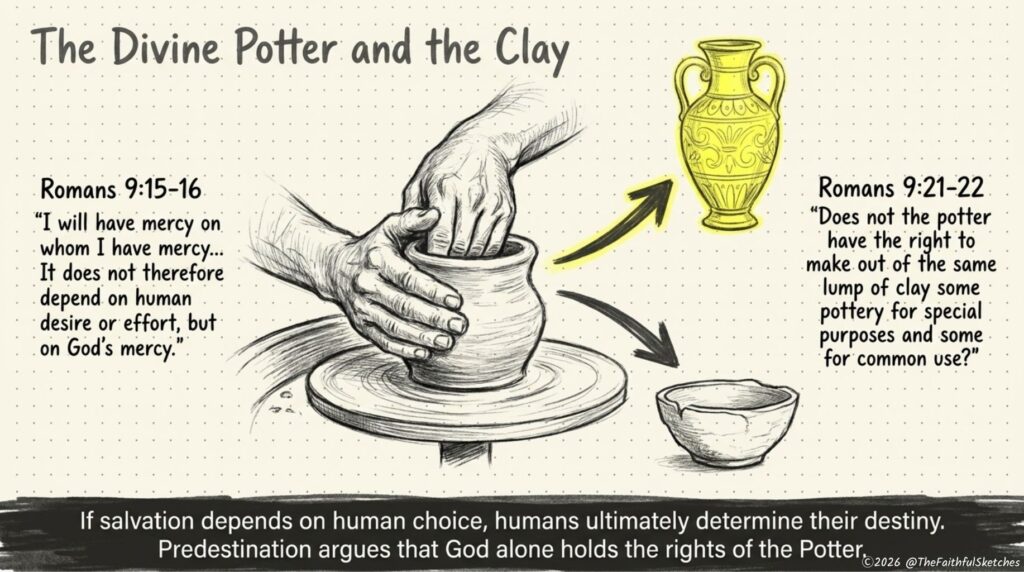
“I will have mercy on whom I have mercy, and I will have compassion on whom I have compassion. It does not, therefore, depend on human desire or effort, but on God’s mercy.” (Romans 9:15–16)
Paul then uses the potter and clay analogy in verses 21–22, asking whether the potter lacks the right to shape the same lump into different kinds of vessels. Ephesians 1:4–5 adds: “He chose us in him before the creation of the world.” The phrase “before the creation of the world” is significant. There were no humans yet. God’s choice preceded any human action entirely.
Predestination advocates also point to John 15:16 (“You did not choose me, but I chose you”) and John 6:44 (“No one can come to me unless the Father who sent me draws them”). If no one can come without being drawn, then human will depends entirely on divine initiative.
There’s also a question about the Fall. Romans 3:10–11 states that no one seeks God. Ephesians 2:1 describes humans as dead in sin. The predestination argument asks: can someone who is spiritually dead make a genuine choice for spiritual life without God first making them alive?
Part 3: The Biblical Case for Free Will
The free-will position draws heavily from 2 Peter 3:9:
“The Lord is not slow in keeping his promise, as some understand slowness. Instead he is patient with you, not wanting anyone to perish, but everyone to come to repentance.” (2 Peter 3:9)
The Greek word translated “wanting” here is boulomai, meaning to will, to purpose, to desire. 1 Timothy 2:3–4 reinforces this: God “wants all people to be saved and to come to a knowledge of the truth.”
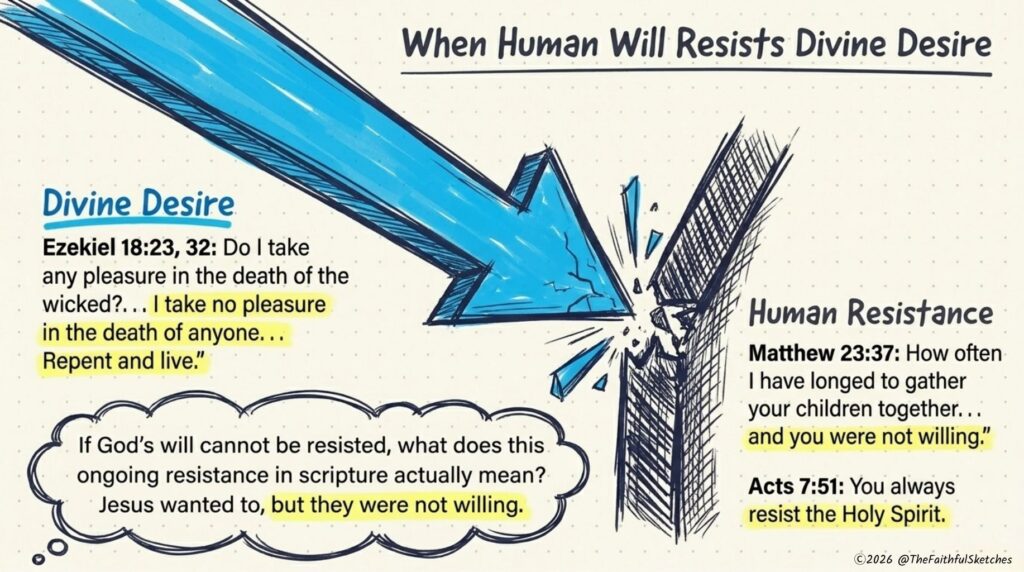
In Matthew 23:37, Jesus laments over Jerusalem: “How often I have longed to gather your children together… and you were not willing.” Jesus desired it. The people resisted. That resistance points to a genuine human choice, not a predetermined outcome.
Ezekiel 18:23 is less often cited in this debate but directly relevant. God asks: “Do I take any pleasure in the death of the wicked?… Rather, am I not pleased when they turn from their ways and live?” Verse 32 follows: “Repent and live!” Why issue a command if people cannot respond?
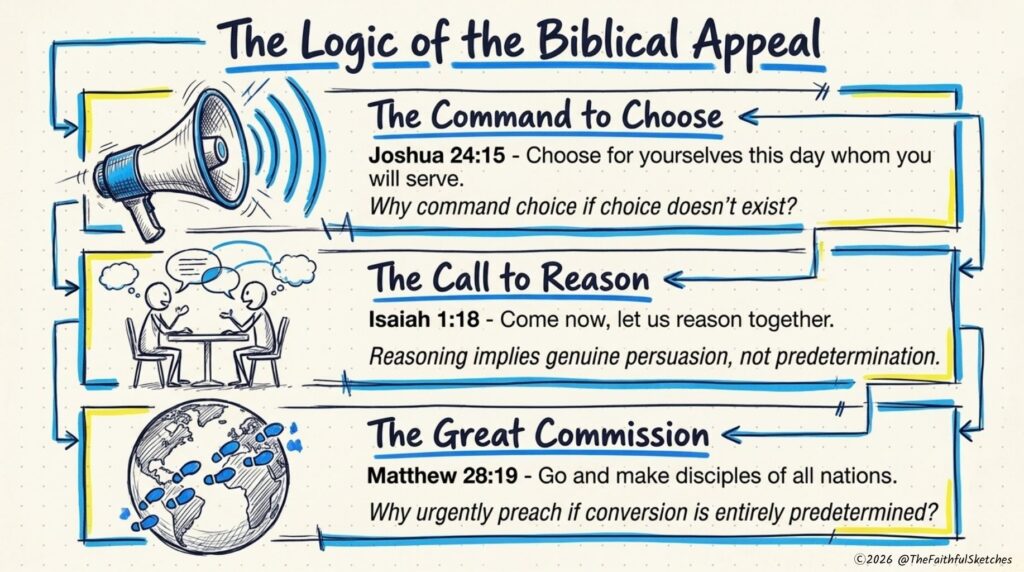
Joshua 24:15 makes the same point: “Choose for yourselves this day whom you will serve.” Revelation 22:17 extends an open invitation: “Whoever is thirsty, let him come.” The Greek ho thelōn means “the one who desires” or “the one willing.” Acts 7:51 records Stephen rebuking religious leaders for resisting the Holy Spirit. If God’s will cannot be resisted, what does that resistance mean?
Free-will advocates also point to the logic of the Great Commission in Matthew 28:19. Why preach and persuade if conversion is entirely predetermined? Isaiah 1:18 captures this logic directly: “Come now, let us reason together.” Reasoning implies persuasion, not predetermination.
Part 4: Where Scripture Holds Both Simultaneously
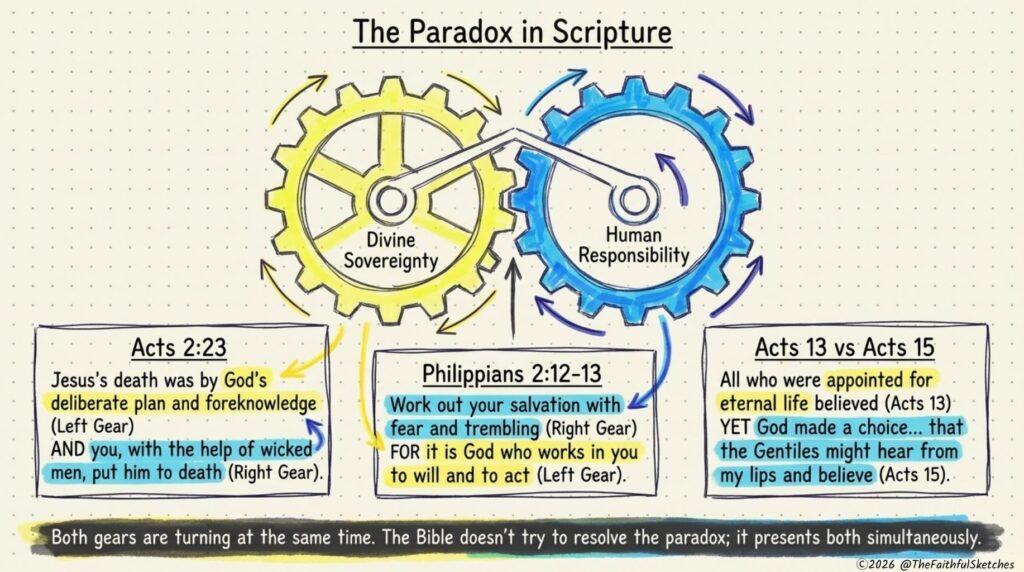
Here’s what makes this debate genuinely difficult: the Bible presents both positions at once, sometimes in a single verse.
Acts 2:23 describes Jesus’s death as happening “by God’s deliberate plan and foreknowledge,” yet carried out by people using their own wicked intentions. Divine sovereignty and human responsibility appear in the same sentence.
Philippians 2:12–13 creates the same tension: “Continue to work out your salvation with fear and trembling, for it is God who works in you to will and to act in order to fulfill his good purpose.” You work out your salvation. God works in you. Paul presents both as simultaneously true.
Acts 13:48 says “all who were appointed for eternal life believed.” Two chapters later, Acts 15:7 describes God choosing that the Gentiles would hear the gospel and believe. God made a choice. But the Gentiles still had to believe. The tension holds.
Part 5: How Church History Handled This
This debate has a long and contentious history. For a full overview of how early theological splits shaped Christian doctrine, see the post on the Great Schism of 1054.
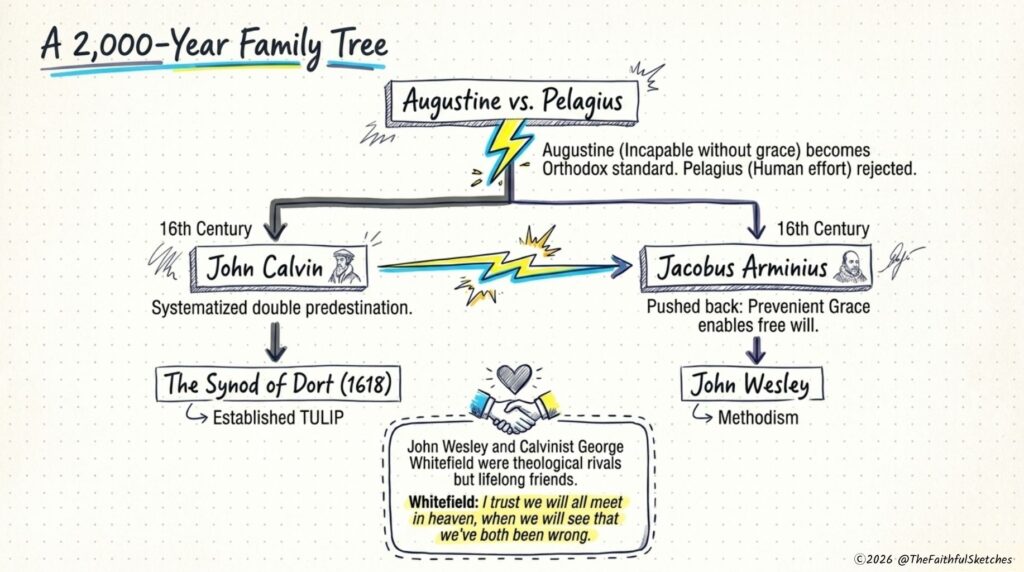
In the 5th century, Augustine debated Pelagius. Pelagius taught that humans could achieve righteousness through their own effort. Augustine argued that after the Fall, humans cannot choose God without grace. Augustine’s position became the orthodox view.
In the 16th century, the Reformation reopened the question. John Calvin systematized predestination in his Institutes of the Christian Religion, teaching “double predestination”: God actively chooses some for salvation and passes over others.
Jacobus Arminius, a Dutch theologian, pushed back. He argued for prevenient grace, a grace that precedes salvation and enables free will. God gives everyone sufficient grace to believe. Humans must choose to accept it.
The Synod of Dort (1618–1619) established the five points of Calvinism, summarised as TULIP, specifically in response to Arminian objections. John Wesley, the founder of Methodism, sided with Arminius and argued that God desires the salvation of all people.
Comparison: Calvinist vs. Arminian View at a Glance
Question
Calvinist Position
Arminian Position
Who initiates salvation?
God alone
God, but humans respond
Is grace resistible?
No (irresistible grace)
Yes (prevenient grace enables but doesn’t compel)
Basis of election
God’s sovereign will
God’s foreknowledge of faith
Can the saved fall away?
No (perseverance of the saints)
Yes, under some Arminian frameworks
Key theologians
Augustine, Calvin, Whitefield
Arminius, Wesley
Key synod/council
Synod of Dort (1619)
Remonstrance (1610)
Primary scripture emphasis
Romans 8–9, Ephesians 1
2 Peter 3:9, John 3:16
Part 6: Why This Debate Has Practical Weight
The theological position you hold shapes how you live.
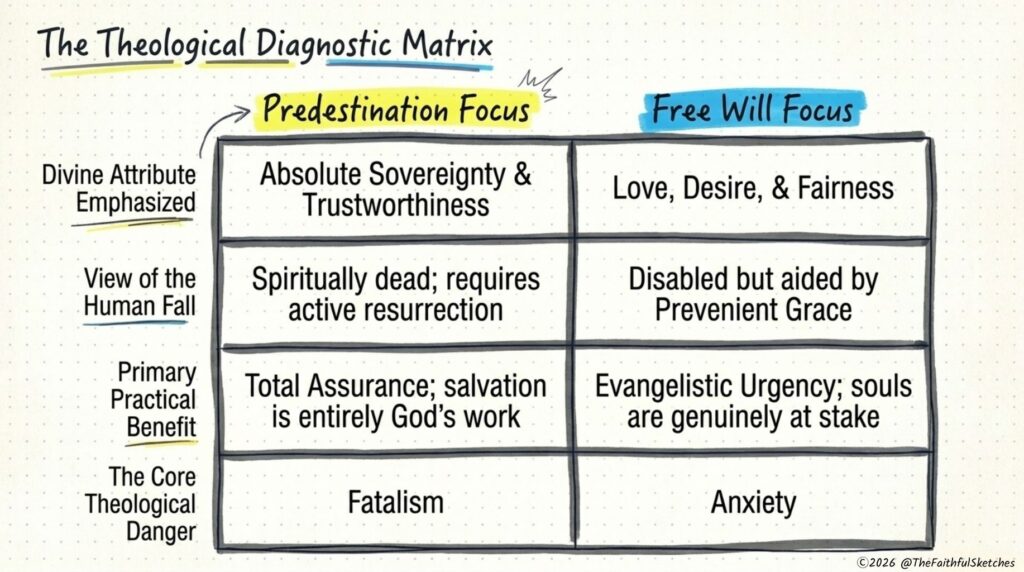
Strong predestination tends to produce: deep confidence in God’s sovereignty, humility about salvation as entirely God’s work, assurance that nothing can separate the elect from God’s love, and worship directed entirely to God.
Free will tends to produce: a sense of real human accountability, urgency in evangelism because souls are genuinely at stake, confidence that prayer for the lost matters, and a view of God as fair to all people.
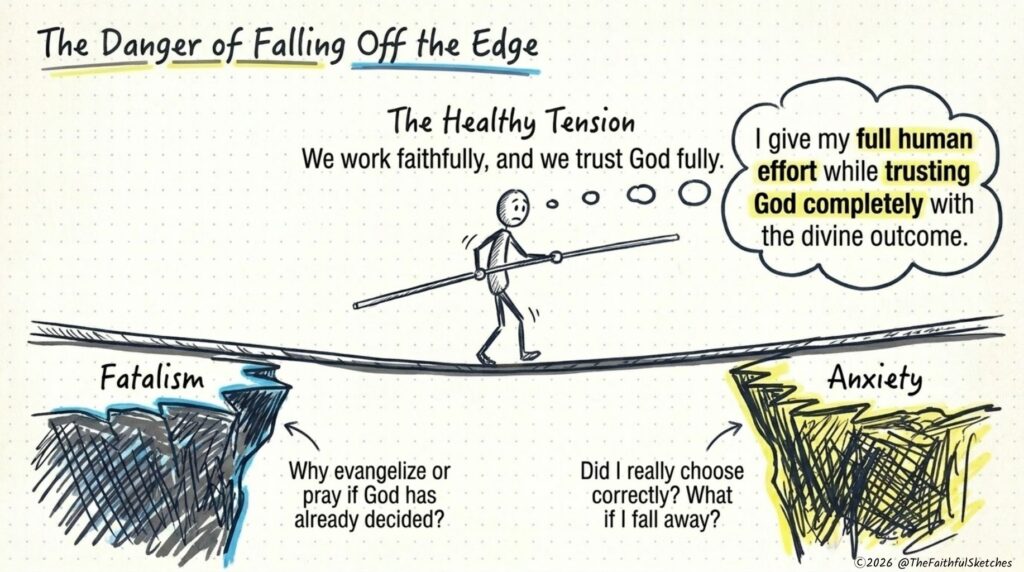
Both positions carry real dangers too. Predestination can drift toward fatalism: “Why evangelise if God has already decided?” Free will can produce anxiety: “Did I really choose correctly? What if I drift?” The most stable Christians seem to live in the tension, working faithfully while trusting God fully with the outcome.
Part 7: Living with the Mystery
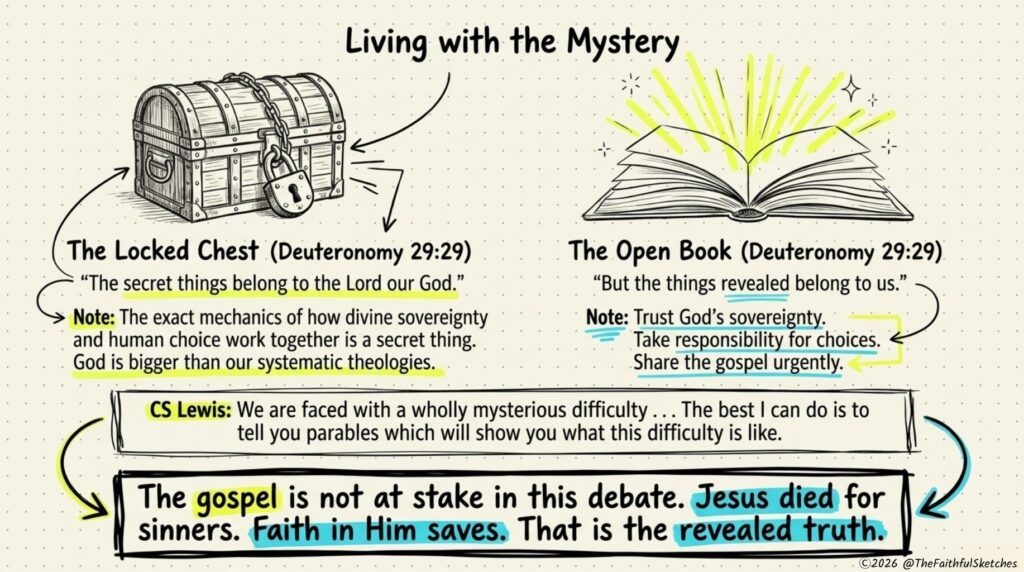
Perhaps the most honest position is theological humility. Deuteronomy 29:29 says: “The secret things belong to the Lord our God, but the things revealed belong to us and to our children forever.” Some things are secret. Some are revealed. The exact mechanics of how divine sovereignty and human choice work together may belong in the first category.
C.S. Lewis acknowledged this when he wrote that the difficulty is genuinely mysterious. He wasn’t claiming to solve it. He was describing it honestly.
The gospel isn’t at stake in this debate. Jesus died for sinners. Faith in Him saves. Repentance is necessary. That’s the revealed truth. The mechanics behind it may remain, for now, one of the secret things.