
A prophecy of doom and triumph. A vision of the end and a new beginning. This is the Book of Revelation, the final battle between light and darkness, where God’s ultimate victory is revealed. For many readers, it’s the most mysterious and intimidating book in the Bible, packed with strange beasts, cosmic plagues, and dazzling visions.
So let’s have the Book of Revelation explained the simple way, part by part, following the story exactly as the apostle John recorded it. By the end, you’ll see the big picture clearly: judgment is real, but so is the hope at the very end.
Part 1: The Vision on Patmos
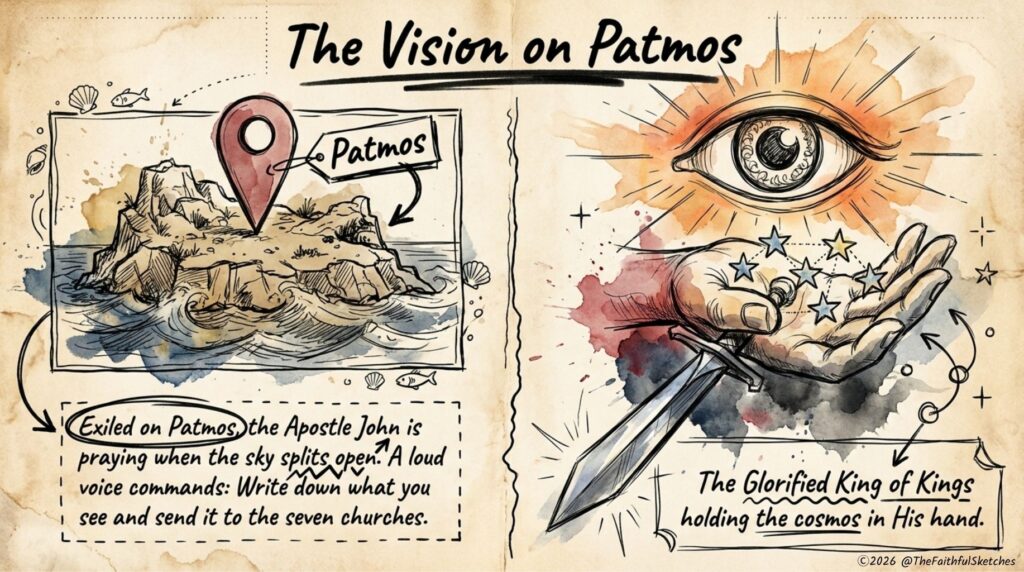
The apostle John, exiled on the island of Patmos, was praying when the sky split open. He heard a loud voice say, “write what you see… and send it to the seven churches,” as recorded in Revelation 1:11. Then he saw a vision of Jesus, no longer the humble carpenter, but the glorified King of Kings.
His eyes blazed like fire. He held seven stars in his hand and a sharp two-edged sword came from his mouth, described in Revelation 1:16. This was the risen Christ in full glory, and John was told to write urgent messages to seven real churches.
Part 2: The Seven Letters, Jesus’ Warning to His Church
Before revealing the future, Jesus speaks to seven real churches in Revelation 2 and 3. Each message carried a warning that still echoes for believers today.
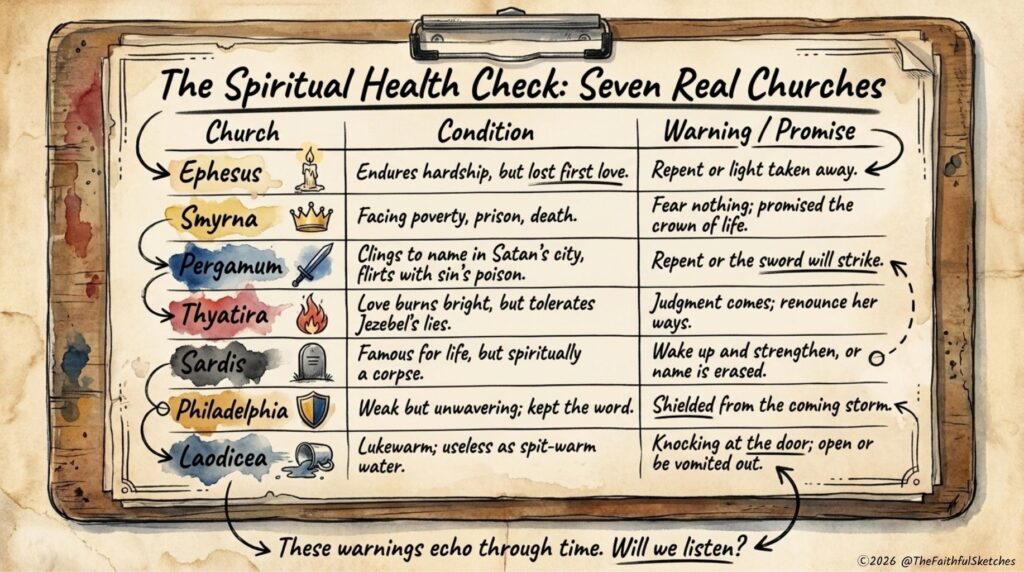
1. To Ephesus, he said: you endure hardship and expose false apostles, yet your love has grown cold. Repent, or your light will be removed.
2. To Smyrna: suffering is coming, poverty, prison, even death. But endure, and receive the crown of life.
3. To Pergamum: you cling to my name in Satan’s own city, yet some flirt with sin. Repent, or my sword will strike.
4. To Thyatira: your love burns bright, but you tolerate Jezebel’s lies. Judgment comes unless you renounce her ways.
5. To Sardis: famous for being alive, yet you’re a corpse. Wake up and strengthen what remains, or I’ll erase your name.
6. To Philadelphia: weak but unwavering, you kept my word when others folded, so I’ll shield you from the coming storm.
7. To Laodicea: lukewarm and useless as tepid water. I stand at the door and knock, so open now or be spit out.
These warnings echo through time. Will we listen before it’s too late?
Part 3: The Throne Room and the Seven Seals
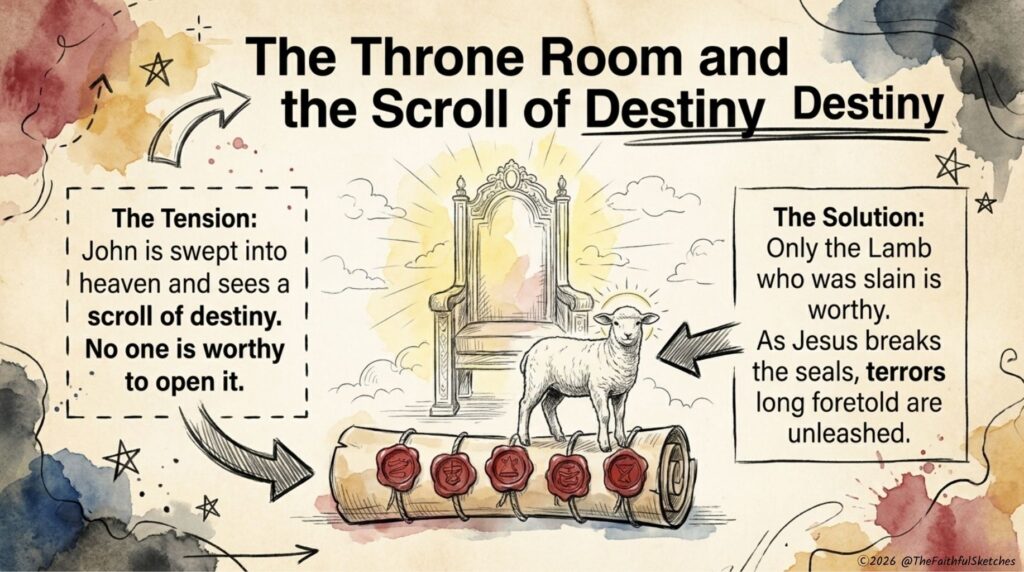
John is then swept into heaven, where God sits enthroned, worshipped day and night. But a crucial question rings out: who is worthy to open the scroll of destiny? Only the Lamb who was slain, Jesus himself, as shown in Revelation 5.
As the Lamb breaks each seal in Revelation 6, terrors long foretold are unleashed.
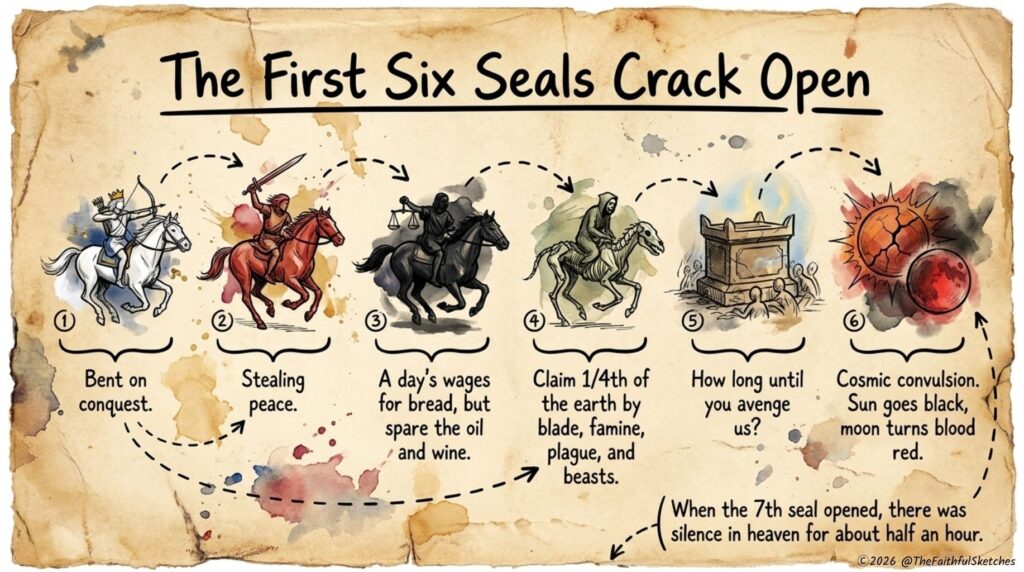
The first seal releases a white horse, its crowned rider bent on conquest.
The second brings a blood-red stallion whose rider steals peace from mankind.
The third reveals a black horse with scales, a voice declaring famine prices for bread while sparing oil and wine.
The fourth unleashes pale Death, with Hades following, claiming a fourth of the earth by sword, famine, plague, and beasts.
Beneath the fifth seal, the souls of martyrs cry out, “how long,” and are told to wait.
When the sixth seal breaks, creation convulses: the sun turns black, the moon blood-red, and stars fall like fruit. Then the Lamb opens the seventh seal, and there is silence in heaven for about half an hour.
Part 4: The Seven Trumpets, Judgment Intensifies
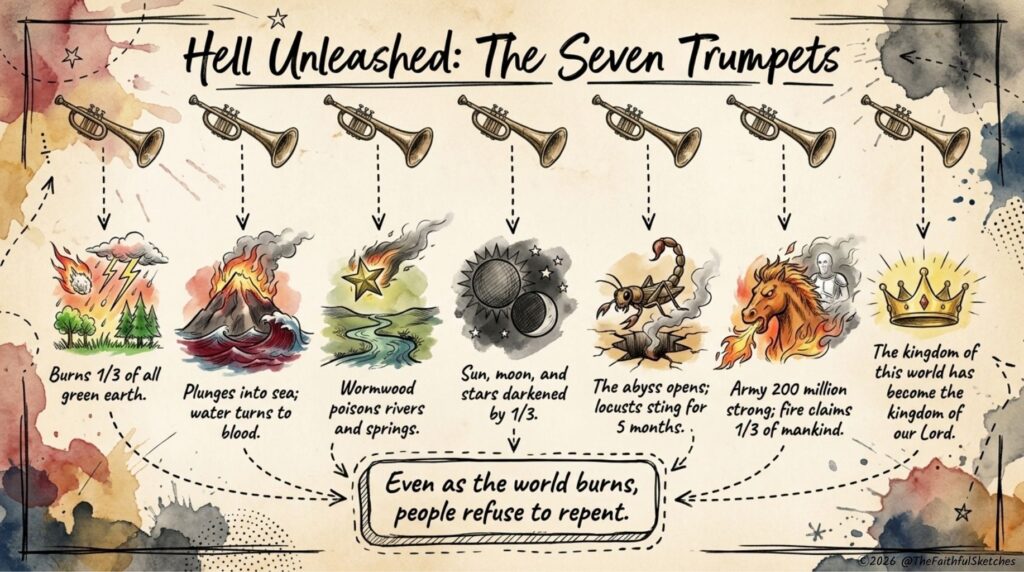
Then seven angels raise their trumpets in Revelation 8 and 9. The first sounds, and hail and fire burn a third of the green earth. The second hurls a flaming mountain into the sea, turning water to blood and sinking ships. The third drops a star called Wormwood, poisoning the rivers. The fourth darkens a third of the sun, moon, and stars.
Then the fifth trumpet opens the Abyss, releasing locusts that sting like scorpions and torment men for five months. The sixth unleashes four bound angels commanding an army two hundred million strong, claiming a third of mankind through fire and sulfur. When the seventh trumpet finally sounds, voices in heaven proclaim what all creation awaited: the kingdom of the world has become the kingdom of the Lord and of his Christ. Yet even now, people refuse to repent, and the worst is still to come.
Part 5: The Woman, the Dragon, and the Beast
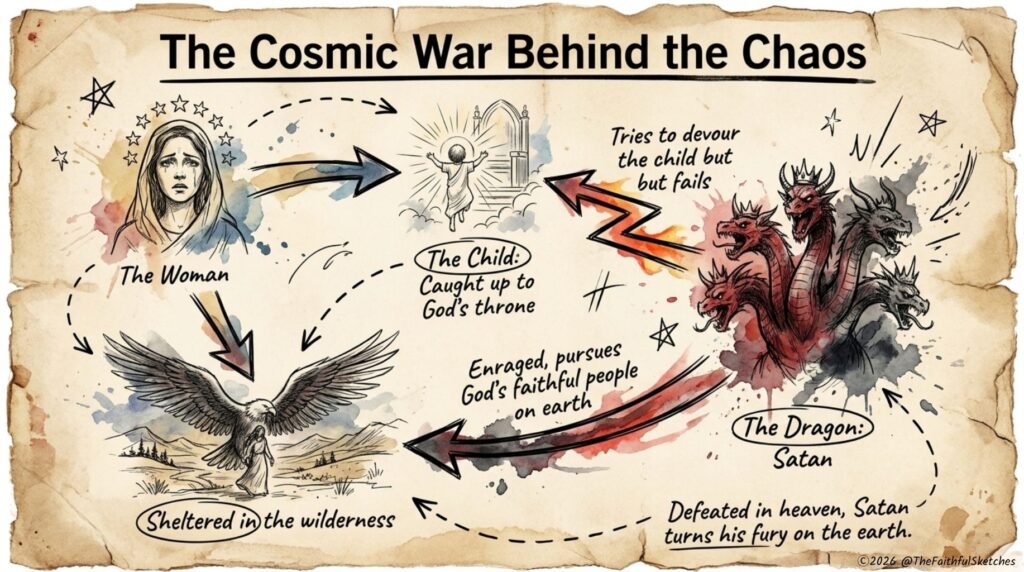
A cosmic war erupts in heaven in Revelation 12. A woman cries out in labor, and the dragon, Satan himself, stands ready to devour her child. But the child is caught up to God’s throne. Enraged, Satan turns on the woman, yet God gives her wings and shelters her in the wilderness. Defeated and furious, the dragon pursues God’s faithful people.
The Beast Rises
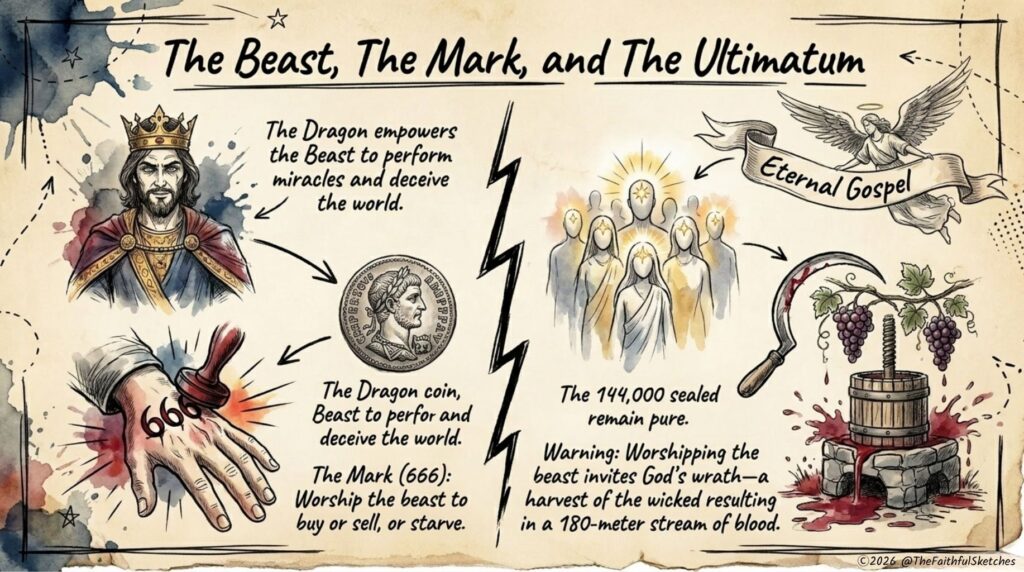
Then the dragon gives his power to a beast, the Antichrist, in Revelation 13. This ruler is so charismatic that everyone whose name is not written in the Book of Life worships him. The beast performs miracles and deceives the world. He forces all people to take the Mark, 666, so that no one can buy or sell without it. The choice becomes stark: worship the beast, or starve.
The Faithful Remnant
But not all bow. In Revelation 14, the 144,000, sealed by God, remain pure. An angel flies overhead proclaiming the eternal Gospel. Another shouts that Babylon the Great has fallen. A third warns that anyone who worships the beast will drink the wine of God’s wrath. Then John sees Jesus on a cloud, wearing a golden crown and holding a sharp sickle, harvesting the righteous, while an angel gathers the wicked into the great winepress of God’s wrath.
Part 6: The Seven Bowls of Wrath
Then come the final plagues, God’s wrath poured out without mercy, in Revelation 16.
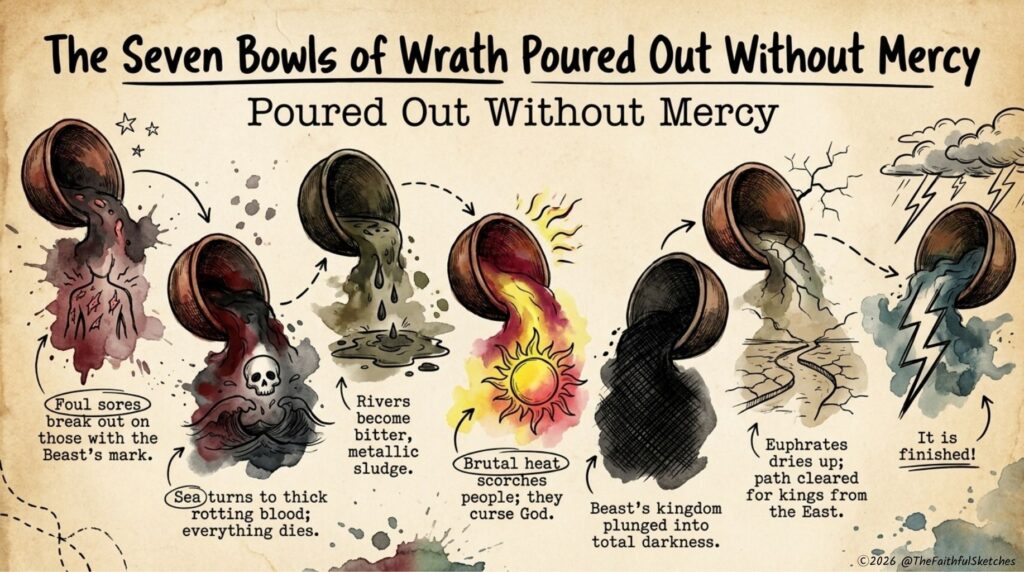
The first bowl brings horrid sores on those who bear the beast’s mark.
The second turns the sea to blood.
The third curdles the rivers and springs crimson.
The fourth makes the sun scorch men with fire, yet they curse God and refuse to repent.
The fifth bowl plunges the beast’s throne into darkness as his followers grind their teeth in torment.
The sixth dries up the Euphrates, opening a highway for armies converging at Armageddon.
Then the seventh bowl falls, and a shout splits heaven like lightning: “It is done.”
Yet still they curse God and refuse to repent.
Part 7: The Fall of Babylon the Great
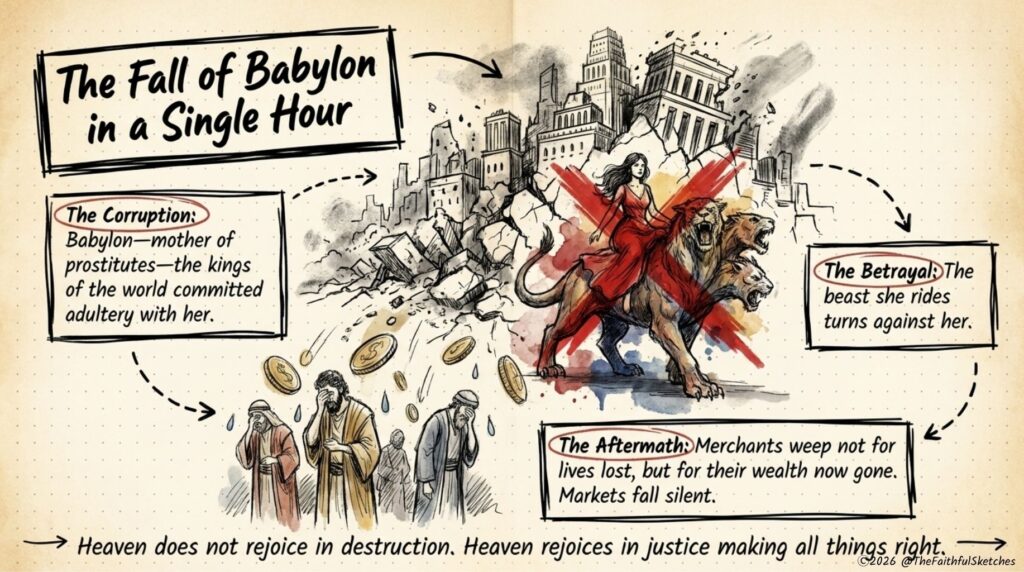
Next, an angel shows John a vision in Revelation 17 and 18: a woman dressed in scarlet, seated on a scarlet beast. She is Babylon, the mother of prostitutes, and the kings of the world have committed adultery with her. The angel explains that the beast she rides will eventually turn against her, and the kings who followed her will watch her fall.
Then another angel speaks with sorrow: Babylon is fallen, so come out of her, my people, lest you share in her judgment. The merchants weep, not for the lives lost but for their vanished wealth. The music fades, the markets fall silent, and in a single hour all her glory crumbles. But heaven does not rejoice in destruction. Heaven rejoices in justice, in God making all things right.
Part 8: The Marriage Supper of the Lamb
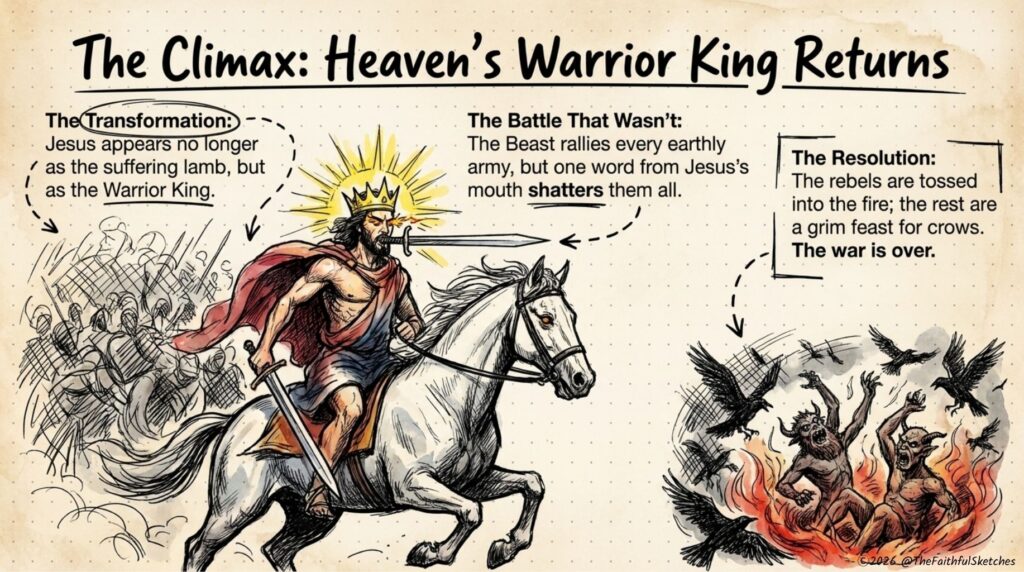
Then heaven erupts with “Hallelujah” in Revelation 19. Jesus appears, no longer the suffering Lamb but Heaven’s Warrior-King, his eyes burning with holy fire. The beast and the false prophet rally every army on earth, but a single word from Jesus’ mouth shatters them. The rebels are thrown into the lake of fire, and suddenly the war is over.
Part 9: The Millennium and Final Judgment
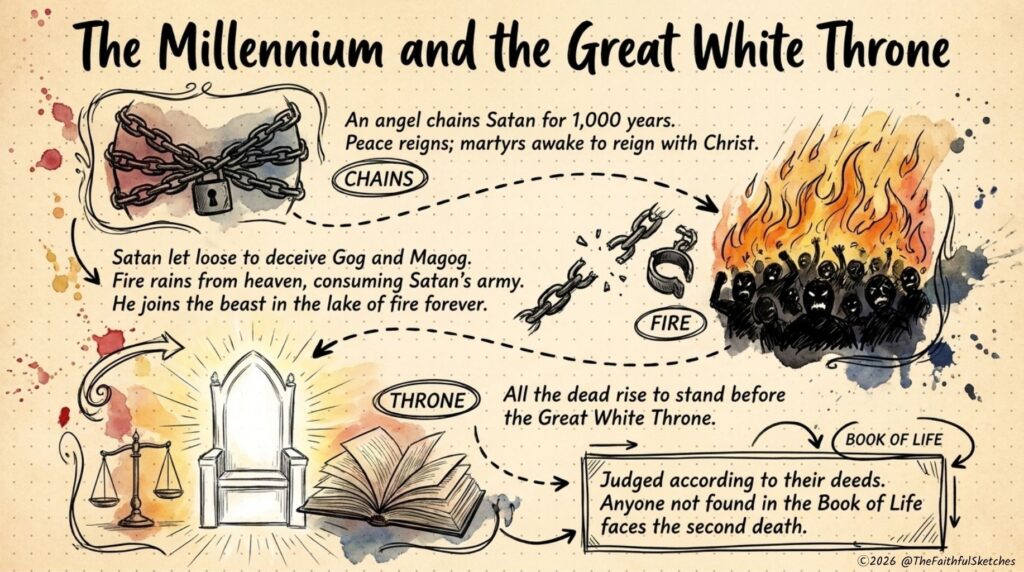
An angel chains Satan for 1,000 years, and peace reigns in Revelation 20. The martyrs come to life and reign with Christ, untouched by the second death. After the thousand years, Satan is released one last time to deceive the nations, called Gog and Magog. Then fire rains from heaven and consumes his army, and Satan is thrown into the lake of fire to join the beast and false prophet forever.
Then all the dead rise and stand before the Great White Throne, judged according to their deeds. Anyone whose name is not found in the Book of Life is thrown into the lake of fire, the second death. The Judge has taken his throne, and history reaches its final reckoning.
Part 10: A New Heaven and a New Earth
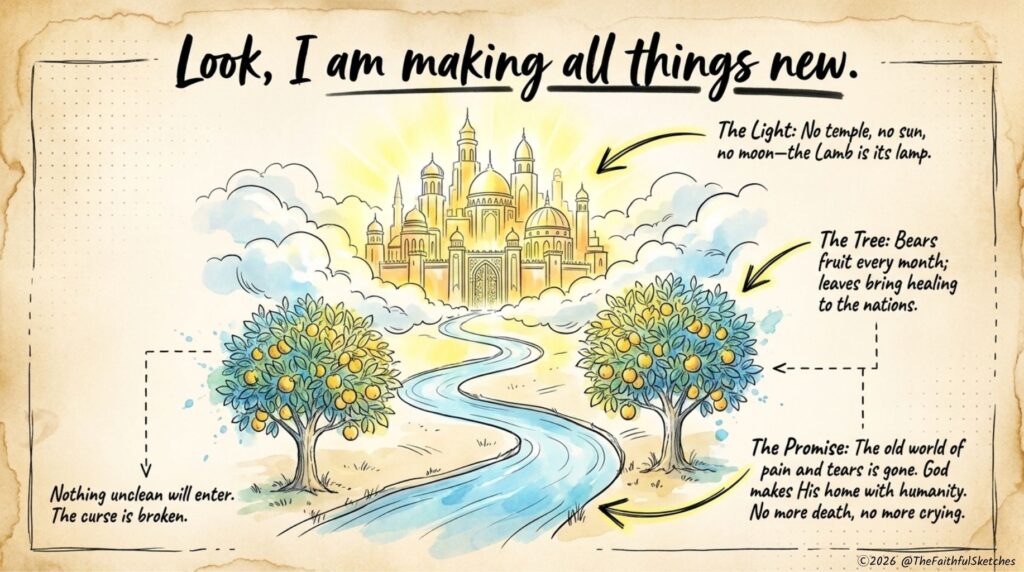
Then John sees the most beautiful vision of all in Revelation 21 and 22. The old world of pain and tears is gone, and God declares, “Behold, I am making all things new.” The Holy City, the New Jerusalem, descends like a bride dressed in pure light, its radiance like precious jewels, its gates never shut, for there is no night and no fear.
God’s home is now with his people. The city needs no temple, no sun, and no moon, for God’s glory lights it and the Lamb is its lamp. He wipes every tear from their eyes, and there is no more death, crying, or pain. A river of life, clear as crystal, flows from God’s throne, and the tree of life grows on its banks, its leaves bringing healing to the nations. Then Jesus says, “I am coming soon,” and the Spirit and the bride say, “Come.” Everyone who is thirsty is invited to take the free gift of the water of life. The end, it turns out, is only the beginning.
How the Judgments Compare
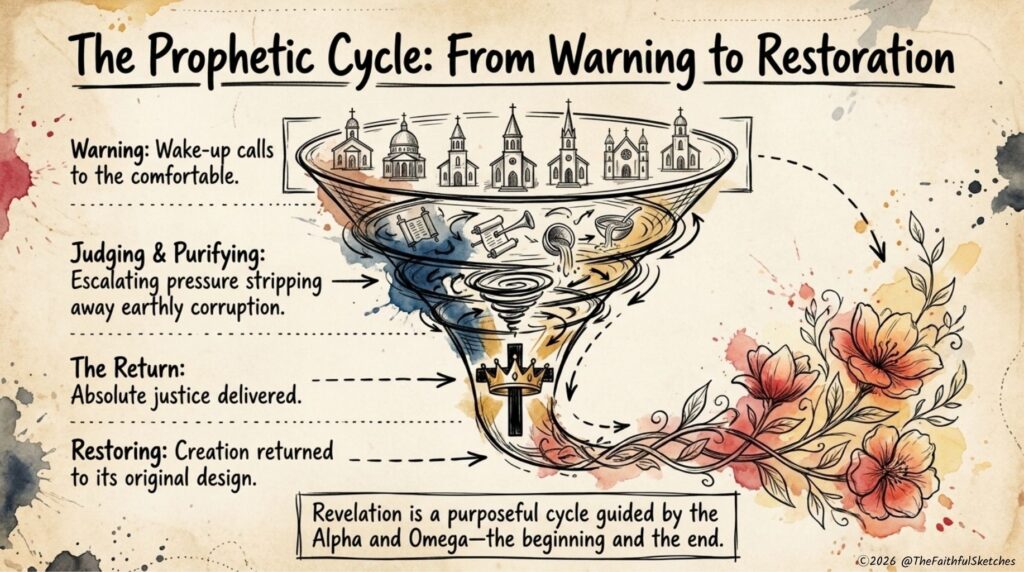
Revelation moves through three sets of seven judgments. Here’s how the seals, trumpets, and bowls line up so you can see the escalation at a glance.
| Seals (Rev. 6) | Trumpets (Rev. 8-9) | Bowls (Rev. 16) | |
|---|---|---|---|
| Scope | A fourth of the earth | A third of the earth | Full and final |
| Mercy | Warning judgments | Partial judgments | Wrath without mercy |
| Imagery | Four horsemen, martyrs, cosmic signs | Fire, Wormwood, locusts, vast army | Sores, blood seas, darkness, Armageddon |
| Human response | Fear and hiding | Refusal to repent | Cursing God, still no repentance |
| Ends with | Silence in heaven | Kingdom proclaimed | “It is done” |
Conclusion: A Wake-Up Call for Today
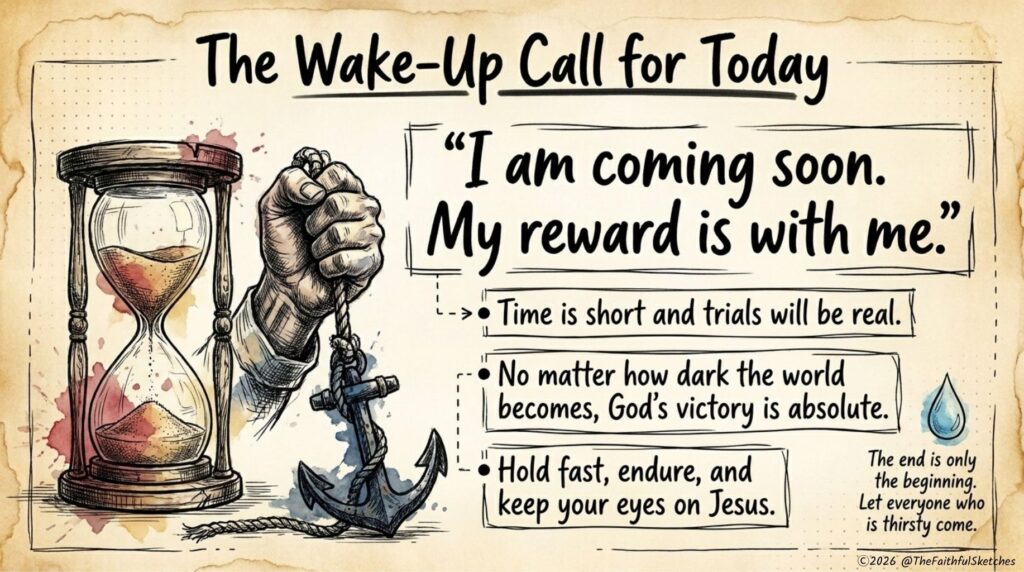
The Book of Revelation is not just a prophecy of the future. It’s a wake-up call for today. It reminds us that time is short. The trials will be real, but so is God’s victory. No matter how dark the world becomes, believers are called to hold fast, endure, and keep their eyes on Jesus. Because soon, the book promises, he will return, and those who remain faithful will reign with him forever.
If you’d like to explore related themes, my post on the difference between Catholics and Protestants touches on how traditions read the end times differently, and my post on why Christians have different Bibles explains how books like Revelation made it into the canon in the first place. What part of Revelation do you find most striking? Let me know in the comments below.
Click Below to Download The Full PDF Summary Visual Guide:
*Free for personal use only. Please don’t resell or redistribute commercially.