
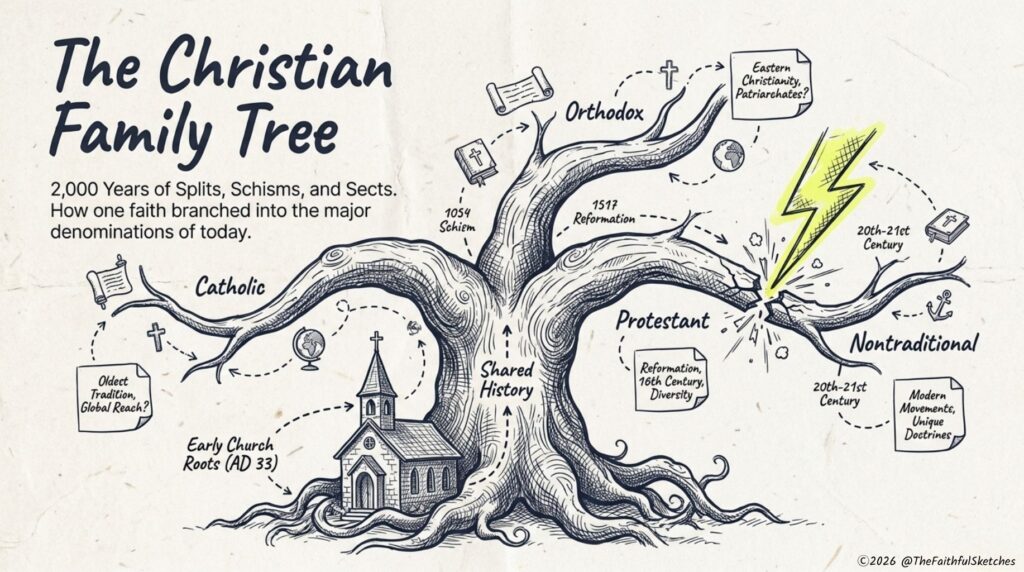
Imagine a massive family tree, one that’s been growing for 2,000 years, with branches spreading across continents, cultures, and centuries. This is the story of Christianity, the world’s largest religion. But it’s not a single, unified group. Instead, it’s a collection of traditions, each with its own beliefs, practices, and even conflicts.
Today we’re going on a journey through the 10 major Christian denominations explained one by one, from the ancient halls of Rome to the revival tents of America. Some of these splits were dramatic, full of political intrigue, theological showdowns, and even wars. Others were quiet rebellions sparked by a single person’s courage.
We’ll also look at the 3 most controversial denominations that most reject as Christians.
Let’s dive in, starting with the oldest and largest branch of them all.
1. The Roman Catholic Church (~1.3 billion)
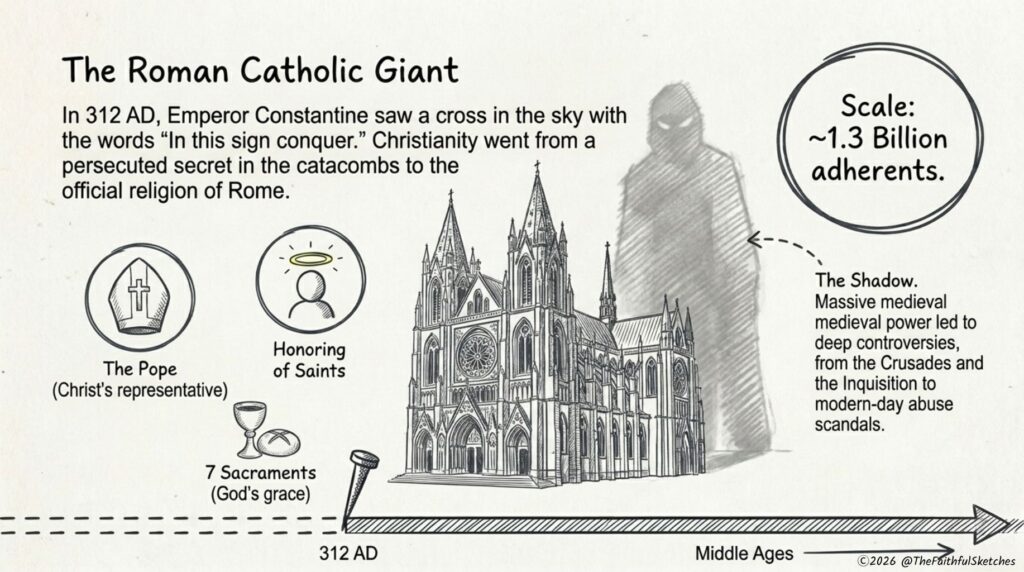
Our story begins in the backstreets of ancient Rome, where the first Christians worshipped in secret, hiding in catacombs to avoid persecution. Everything changed in 312 AD, when Emperor Constantine had a vision before a great battle: a cross in the sky with the words, “In this sign, conquer.” He won, converted to Christianity, and set it on the path to becoming the official religion of Rome. Suddenly the Church wasn’t just surviving. It was in charge.
Over time, the Bishop of Rome, later called the Pope, claimed authority over all Christendom. By the Middle Ages, the Catholic Church was the most powerful institution in Europe, crowning kings, building grand cathedrals, and sending missionaries across the world. But with great power came controversy. The Church sold indulgences, essentially paying for forgiveness, which outraged a German monk named Martin Luther.
What makes Catholicism distinct? Catholics believe in seven sacraments, sacred rituals that convey God’s grace. They honor saints, pray to Mary, and follow the Pope as Christ’s representative on Earth. That authority has also led to deep scandals, from the Crusades and Inquisition to modern abuse cases. Yet over a billion people still call themselves Catholic today. For a closer look at how Catholic belief compares to Protestant belief, see my post on the difference between Catholics and Protestants.
2. Protestantism (~900 million to 1.1 billion)
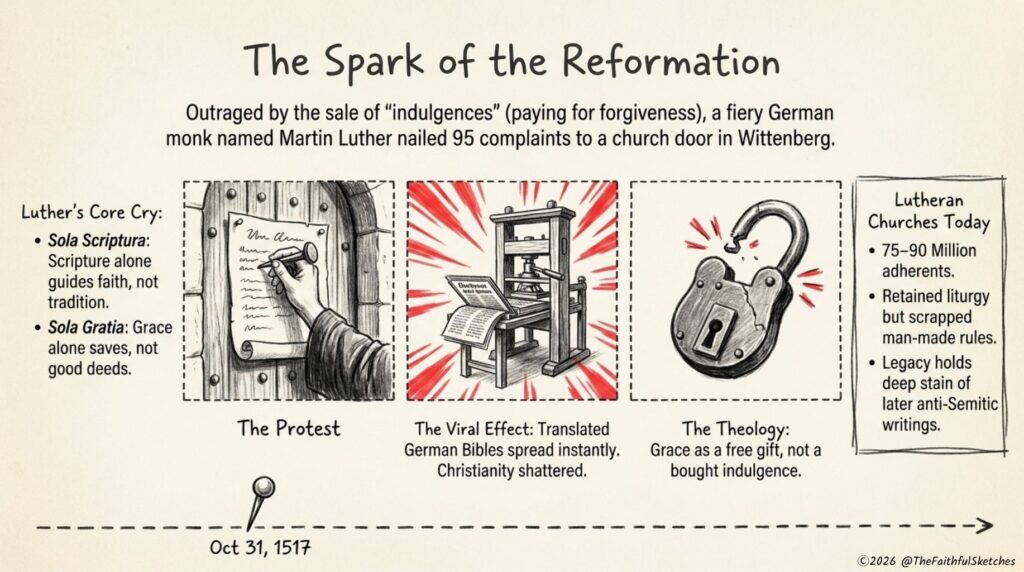
October 31, 1517, is a date that changed history. On that day, Martin Luther nailed a list of 95 complaints to a church door in Wittenberg. He was furious about corruption, especially the sale of indulgences. How, he asked, can a rich man buy his way into heaven while a poor man suffers in sin?
Luther didn’t mean to start a revolution. He just wanted to reform the Church. But when the Pope excommunicated him, Luther burned the order in public, and the Protestant Reformation had begun. Thanks to the new printing press, his ideas spread like wildfire. He translated the Bible into German so ordinary people could read it, no priests needed. His rallying cries were Sola Scriptura, Scripture alone, and Sola Fide, salvation by faith alone.
What followed was chaos. Wars erupted between Catholic kings and Protestant rebels. New denominations sprang up, Lutherans, Calvinists, Baptists, each interpreting the Bible differently. But they agreed on one thing: no more Pope, no more Latin masses, just faith, the Bible, and a personal connection to God.
3. The Eastern Orthodox Church (~220 to 290 million)
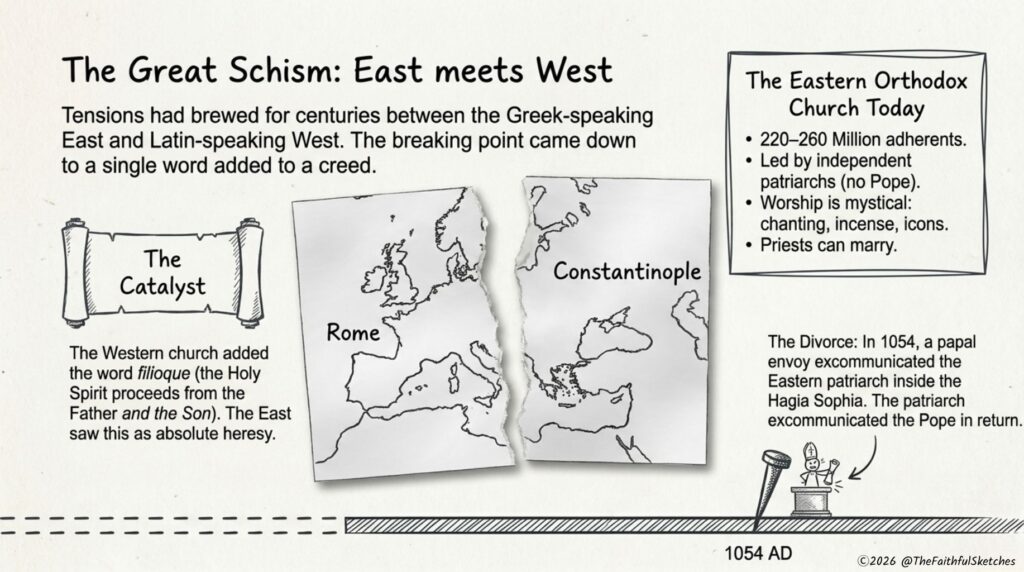
While the Protestant split happened in the 1500s, Christianity’s first big division came much earlier, in 1054. In Constantinople, the heart of Eastern Christianity, tensions had been brewing for centuries. The East spoke Greek; the West spoke Latin. The East had bearded priests who could marry; the West had celibate clergy. But the final straw was a single word.
The Western Church added “Filioque” to the Creed, claiming the Holy Spirit proceeds from the Father “and the Son.” The East saw this as heresy. One day a papal envoy stormed into the Hagia Sophia, slammed a document on the altar, and excommunicated the Eastern Patriarch. The Patriarch excommunicated the Pope right back. Christianity was now split in two, Catholic West and Orthodox East.
Today, Orthodox Christianity feels mystical and ancient. There’s no Pope. Instead, independent patriarchs lead. Worship is full of chanting, incense, and breathtaking icons. And unlike Catholics, Orthodox priests can marry, though bishops must stay celibate. I cover this break in full in my post on the Great Schism of 1054.
4. Pentecostal Churches (~280 to 660 million)
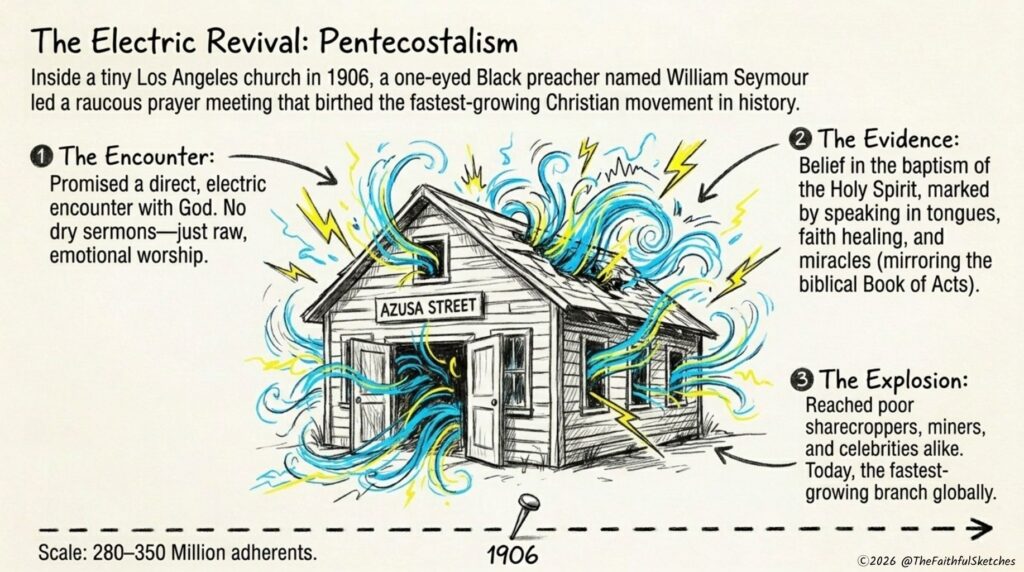
Now jump to a tiny, ramshackle church in Los Angeles in 1906. Inside, a one-eyed Black preacher named William Seymour leads a raucous prayer meeting. Suddenly something extraordinary happens. People start speaking in languages they’ve never learned. Some collapse, shaking. Others shout prophecies. Newspapers call it a “weird babble,” but those inside believe it’s the Holy Spirit, just like in the Book of Acts. This was the Azusa Street Revival, the birth of Pentecostalism.
From there, Pentecostalism exploded. It reached poor sharecroppers in the South, miners in Appalachia, and even Hollywood celebrities. Why? Because it promised something electric: a direct encounter with God. No dry sermons, no stuffy rituals, just raw, emotional worship where miracles could happen.
Pentecostals believe in baptism in the Holy Spirit, marked by speaking in tongues. They practice faith healing, exorcisms, and “holy laughter.” Critics call it chaotic or fake, but for millions it’s the purest form of Christianity, alive, unpredictable, and powerful. It’s also the fastest-growing segment of the faith worldwide.
5. Baptist Churches (~100 million)
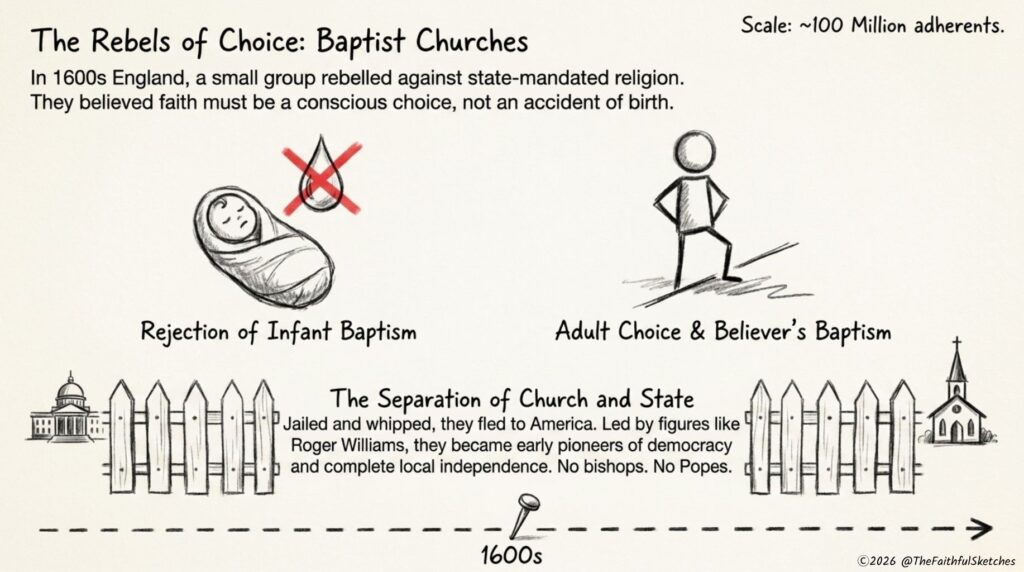
Imagine you’re in 1600s England. The king demands everyone worship his way. But a small group of rebels, called Baptists, refuse. They insist only adults should be baptized, not babies. Why? Because faith must be a choice, not an accident of birth. For this they’re jailed, whipped, and chased out of town. So they flee to America, where they plant the seeds of religious freedom.
Baptists became pioneers of self-governance, no bishops, no popes. Each church governs itself. They fought for separation of church and state, thanks largely to a fiery preacher named Roger Williams. They’re also known for strict biblical literalism, with no drinking or dancing in some circles. Their history has shadows too. Some supported slavery, while others, like Martin Luther King Jr., led the Civil Rights Movement.
6. The Anglican Communion (~85 million)
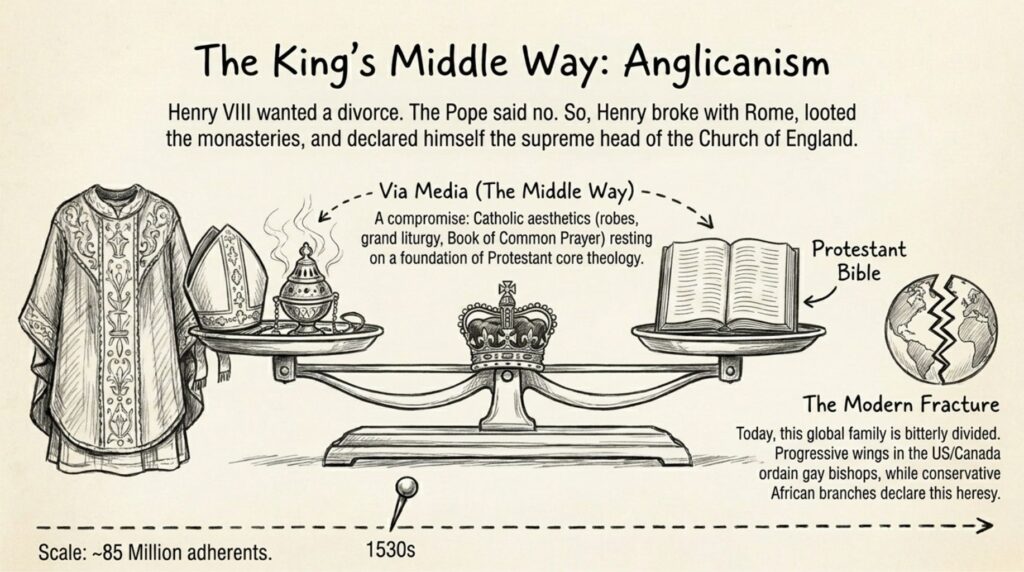
Our next story starts with a king’s love life. Henry VIII of England wanted a divorce from Catherine of Aragon, but the Pope said no. So Henry did what any power-hungry Tudor monarch would do. He broke with the Catholic Church, declared himself the Supreme Head of the Church of England, and seized the monasteries to fill his royal coffers.
Almost overnight, a new Anglican church was born, a middle way, or via media, that looked Catholic with its robes and rituals but was Protestant in its core theology, rejecting the Pope’s authority. Under later reformers, the Book of Common Prayer gave everyone a shared liturgy in English rather than Latin.
Today, Anglicanism is a vast global family, from the grand, often empty cathedrals of England to the booming, conservative congregations in Nigeria and Uganda. That global span is also its biggest challenge. The church is now deeply divided. Progressive wings in the U.S. and Canada ordain gay bishops and perform same-sex marriages, while African and conservative branches call it a break with Scripture. The irony? A church born from a king’s desire for a divorce is now straining over the modern definition of marriage itself.
7. Lutheran Churches (~70 to 90 million)
After Luther’s rebellion sparked a continent-wide firestorm, his ideas took deep root across Northern Europe. Luther himself was a complex figure. He didn’t want to throw everything out. He kept the liturgy, the structured order of worship with its hymns and creeds, because he believed it centered on God’s word. But he fiercely scrapped what he called “man-made rules” that put a barrier between people and God’s grace.
His core, revolutionary idea was Sola Gratia, grace alone. You are saved by God’s free gift, received through faith, not earned through rituals, good deeds, or payments to the church. It’s a gift, full stop.
But here’s the uncomfortable part of history. The same man who championed spiritual freedom later wrote horrifically violent and hateful things about Jewish people and about peasant rebels seeking better lives. It’s a stark reminder that a person can be a visionary in one area and tragically blind in another. Yet the core of his theology endured. Today, Lutheran churches still hold to that central promise of grace, often summed up in Luther’s own hymn, “A Mighty Fortress Is Our God.” They’re known for rich musical tradition, an emphasis on education, and a faith that seeks to be both thoughtful and deeply trusting.
8. Methodist Churches (~70 to 80 million)
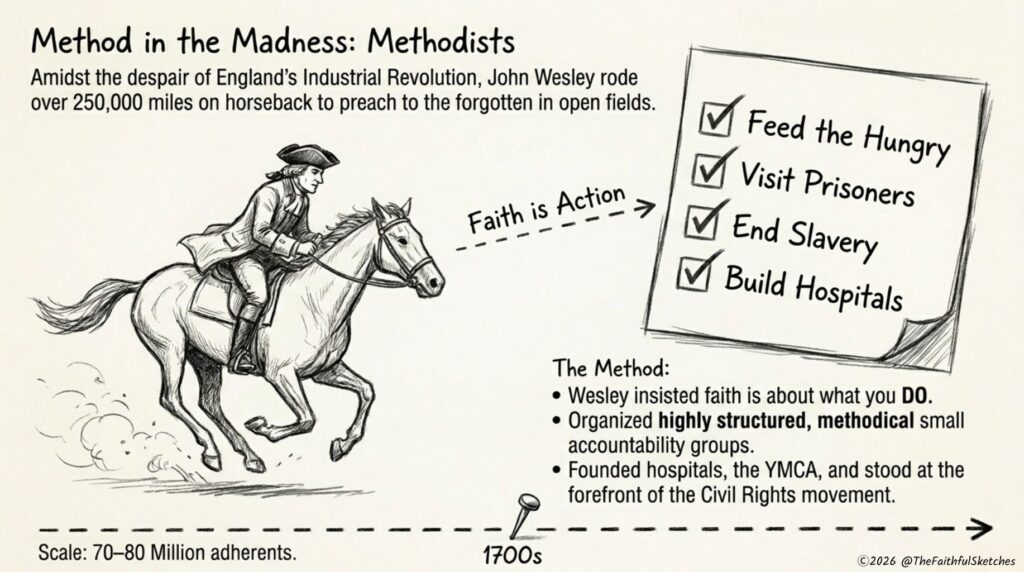
England’s Industrial Revolution was a mess of soot-filled cities, child labor, alcoholism, and despair. Then came John Wesley, a small but fiery preacher who spent his life riding over 250,000 miles on horseback to bring hope to the forgotten. He preached in open fields because traditional churches banned him, and he organized “methodical” small groups for prayer and accountability. That’s actually how they got the name Methodists.
Wesley didn’t just talk. He said faith isn’t only about what you believe; it’s about what you do. Feed the hungry. Visit the prisoner. End slavery. This passion for social justice didn’t stop with him. Methodists founded schools, hospitals, and organizations like the YMCA. In America, Methodist circuit riders brought community to isolated frontier towns. Centuries later, Methodists stood at the forefront of the Civil Rights Movement beside leaders like Dr. Martin Luther King Jr. Yet today, like many denominations, Methodists face deep tensions, especially over LGBTQ+ inclusion. The cycle continues: reform, divide, and reform again.
9. Presbyterian and Reformed Churches (~70 to 75 million)
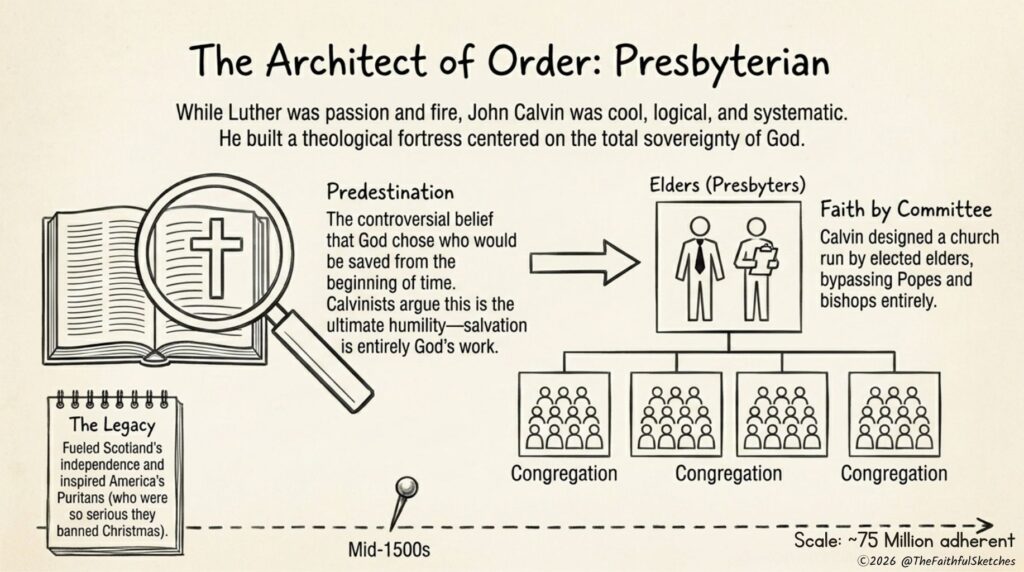
Meet John Calvin, the systematic thinker of the Reformation. While Luther was all fire and passion, Calvin was cool, logical, and orderly. He took Luther’s ideas and built a whole theological structure around them. His most famous and controversial teaching was predestination, the idea that God, from the beginning of time, already chose who would be saved. It sounds intense, even harsh to modern ears, but Calvinists argued it was the ultimate expression of humility, since salvation was entirely God’s work, not something humans could earn.
This wasn’t just abstract theology. Calvin designed a church run by elected elders, called presbyters, which gives us the name Presbyterian. It was faith by committee, orderly and communal. Calvin’s influence spread far beyond church walls, shaping Scotland’s independence, the Dutch Republic’s rise, and America’s early Puritans, who were so serious about faith they actually banned Christmas.
Today, Presbyterian and Reformed churches still wrestle with Calvin’s legacy, debating the role of women in leadership, LGBTQ+ inclusion, and how to apply centuries-old beliefs today. If you want to go deeper on Calvin’s actual theology, see my posts on Reformed theology and Calvinism and predestination and free will.
10. Oriental Orthodox Churches (~60 to 80 million)
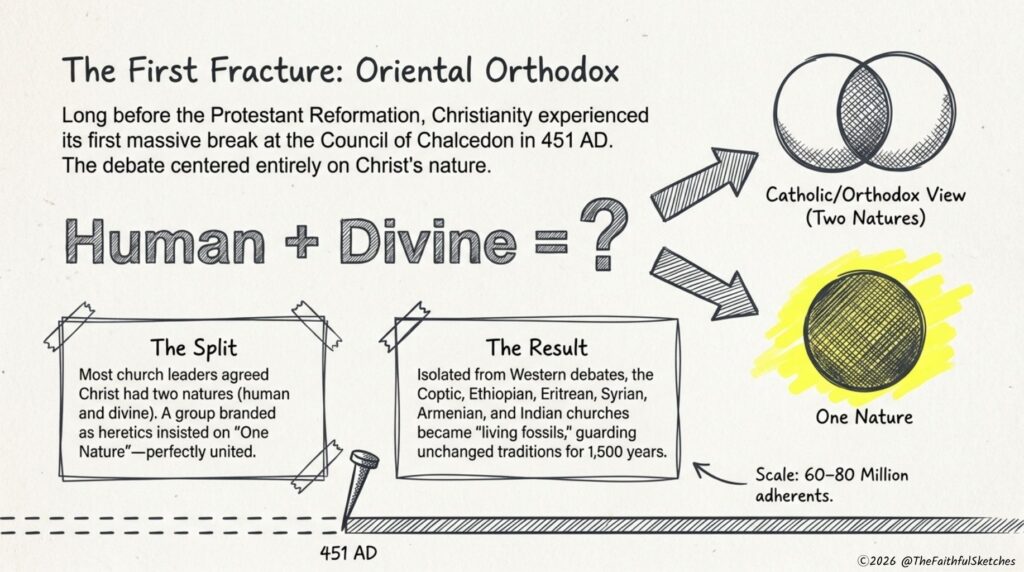
Before Catholic versus Orthodox, there was an even earlier split, the first major fracture in Christianity, in 451 AD at the Council of Chalcedon. While most church leaders agreed on a formula that Christ had two natures, fully human and fully divine, united in one person, a group now known as the Oriental Orthodox said no. To them, this sounded like splitting Christ in two. Their cry was “One Nature,” believing his divinity and humanity were perfectly united in a single nature.
Branded as heretics and exiled, these churches, the Coptic, Ethiopian, Eritrean, Syrian, Armenian, and Indian, became spiritual islands. That isolation became their preservation. Cut off from the debates that reshaped the West, they guarded ancient traditions, languages, and liturgies almost unchanged for over 1,500 years. Today many of these communities, especially in Egypt and the Middle East, face intense persecution, yet they cling to their ancient faith with remarkable resilience. To explore one of these traditions, read my post on the Ethiopian Bible explained.
11. Seventh-day Adventists (~22 million)
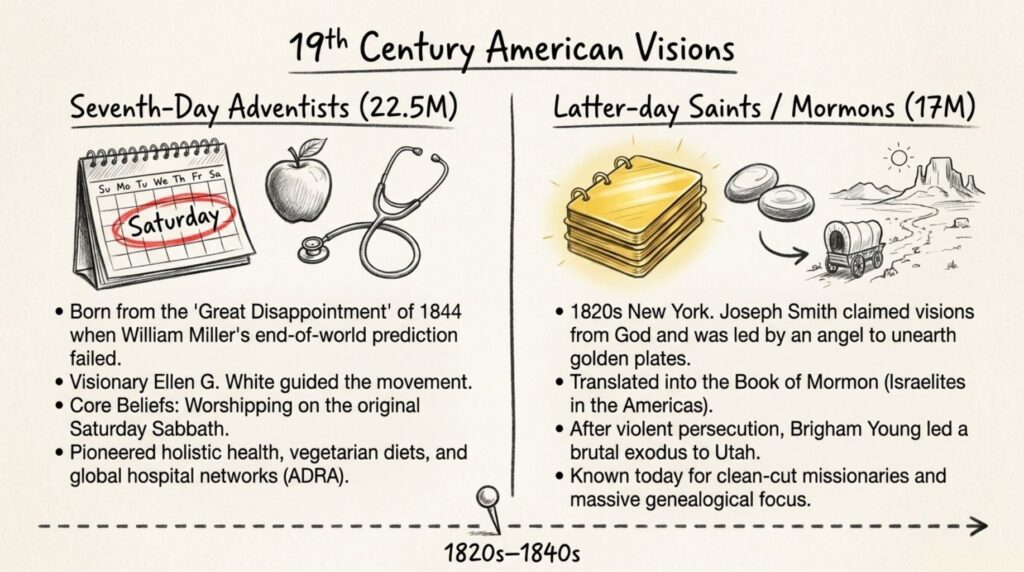
In the mid-1800s in America, a Baptist preacher named William Miller predicted that Jesus would return on October 22, 1844. Thousands of his followers, called Millerites, sold their possessions and waited on hilltops, only to face a crushing letdown when the day passed like any other. This became known as the Great Disappointment.
But from the ashes of that failed prophecy, a new movement was born. A small group, including a visionary named Ellen G. White, concluded that the date wasn’t wrong, just the event. They believed Christ didn’t return to Earth but entered the heavenly sanctuary to begin a final judgment. They called themselves Seventh-day Adventists, a name revealing two core beliefs: “Adventist” for the awaited second advent of Christ, and “Seventh-day” for worshipping on Saturday, the original biblical Sabbath.
This was a whole-life philosophy. Inspired by White’s visions, they became pioneers of holistic health, advocating vegetarian diets, clean living, and the founding of sanitariums and hospitals long before wellness was a trend. They’re known for their schools and their humanitarian arm, ADRA. Yet they live with a constant sense of urgency, believing the world is on the brink of a final crisis. For a deeper look at their beliefs, see my post asking whether Seventh-day Adventist beliefs are Christian.
12. Latter-day Saints (Mormons) (~17 million)
In the 1820s, in upstate New York, a region so swept by fiery revivals they called it the “Burned-Over District,” a young farm boy named Joseph Smith wandered into the woods to pray, overwhelmed by competing preachers. He later claimed that in a dazzling vision, God the Father and Jesus Christ appeared and told him that all existing churches had strayed from the truth, and that he would help restore the true church.
Years later, he said an angel named Moroni guided him to a hillside where he unearthed ancient golden plates. Using special seer stones, Smith translated them into the Book of Mormon, a scripture describing ancient Israelites who sailed to the Americas and built civilizations that Christ visited after his resurrection.
Persecuted violently, the early Mormons, led by Smith’s successor Brigham Young, undertook a brutal exodus across the continent to the Salt Lake valley, where they built a thriving desert kingdom. Their practice of polygamy sparked national outrage and was eventually abandoned for Utah to gain statehood. Today they’re globally recognized for clean-cut missionaries on bicycles, an immense focus on family and genealogy, and a cultural footprint ranging from the Tabernacle Choir to a Broadway musical.
13. Jehovah’s Witnesses (~8.5 million)
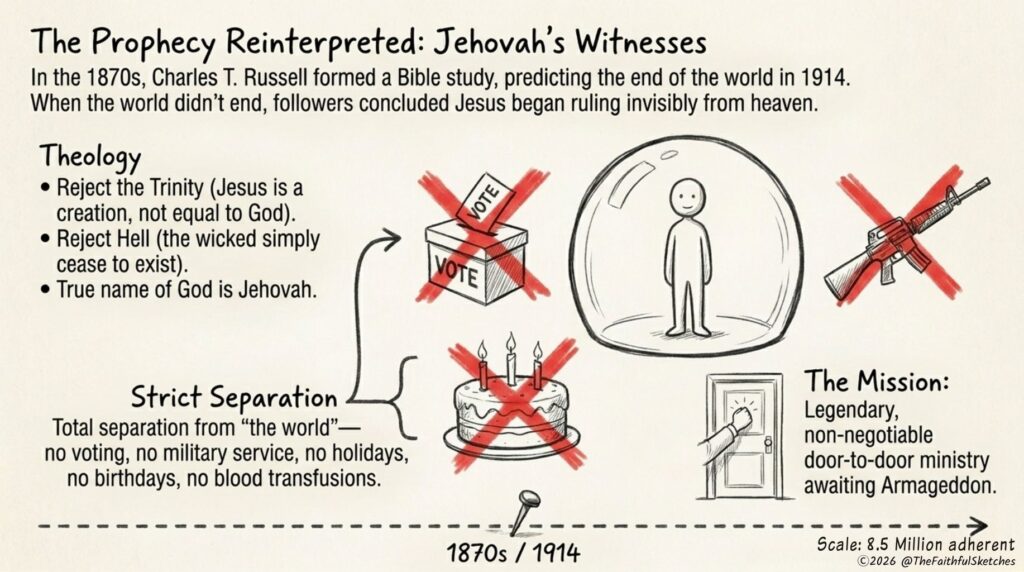
In the late 1870s, a Pennsylvania businessman named Charles Taze Russell became convinced that traditional Christianity had lost its way. He formed a Bible study group and began predicting the date of Christ’s invisible return, finally settling on 1914. When the world didn’t end as expected, his followers reinterpreted the prophecy, believing that was the year Jesus began ruling invisibly from heaven.
This group evolved into the Jehovah’s Witnesses, named for their belief that God’s true name is Jehovah and their mission to be his witnesses on earth. Their beliefs set them starkly apart.
They reject the Trinity, seeing Jesus as God’s first creation rather than an equal. They don’t believe hell is a place of eternal torment, but that the wicked simply cease to exist. And they refuse blood transfusions, celebrate no holidays or birthdays they deem pagan, and maintain a firm separation from “the world,” which means no voting, no military service, and limited association outside the faith.
Their door-to-door ministry is legendary, a non-negotiable command for all members, and it’s fueled their growth into a global movement, all awaiting the final battle of Armageddon. For more on this group, see my posts on Jehovah’s Witnesses beliefs and the Watchtower’s control over members.
Christian Denominations at a Glance
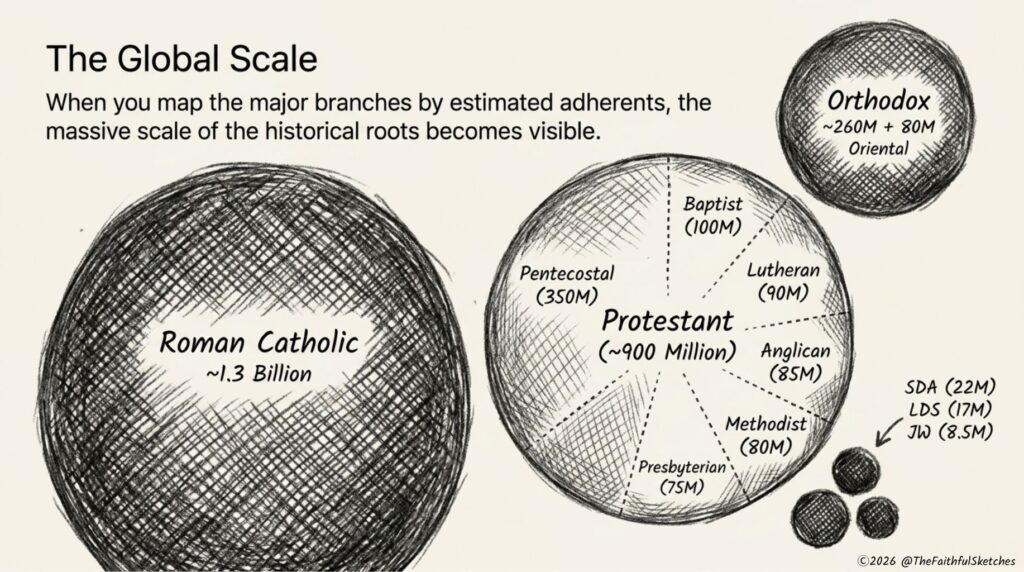
Here are all thirteen branches side by side, so you can compare origins and size in one view.
| Denomination | Origin | Approx. Adherents |
|---|---|---|
| Roman Catholic Church | Ancient Rome, papacy formalized over centuries | ~1.3 billion |
| Protestantism (umbrella) | Reformation, 1517 | ~900 million to 1.1 billion |
| Eastern Orthodox Church | Great Schism, 1054 | ~220 to 290 million |
| Pentecostal Churches | Azusa Street Revival, 1906 | ~280 to 660 million |
| Baptist Churches | 1600s England | ~100 million |
| Anglican Communion | Henry VIII, 1530s | ~85 million |
| Lutheran Churches | Luther, 1500s Germany | ~70 to 90 million |
| Methodist Churches | John Wesley, 1700s England | ~70 to 80 million |
| Presbyterian / Reformed | John Calvin, 1500s Geneva | ~70 to 75 million |
| Oriental Orthodox | Council of Chalcedon, 451 AD | ~60 to 80 million |
| Seventh-day Adventists | Great Disappointment, 1844 | ~22 million |
| Latter-day Saints | Joseph Smith, 1820s New York | ~17 million |
| Jehovah’s Witnesses | Charles Taze Russell, 1870s | ~8.5 million |
Conclusion
That’s the major Christian denominations explained, a family tree shaped by emperors, kings, councils, monks, and even a single disputed word. Some branches split over deep theology, others over politics or prophecy. Many are still wrestling with the same questions today. Yet for all their differences, most of these traditions trace back to the same root and the same central figure. Which branch surprised you most? Let me know in the comments below.
Click Below to Download The Full PDF Summary Visual Guide:
*Free for personal use only. Please don’t resell or redistribute commercially.