
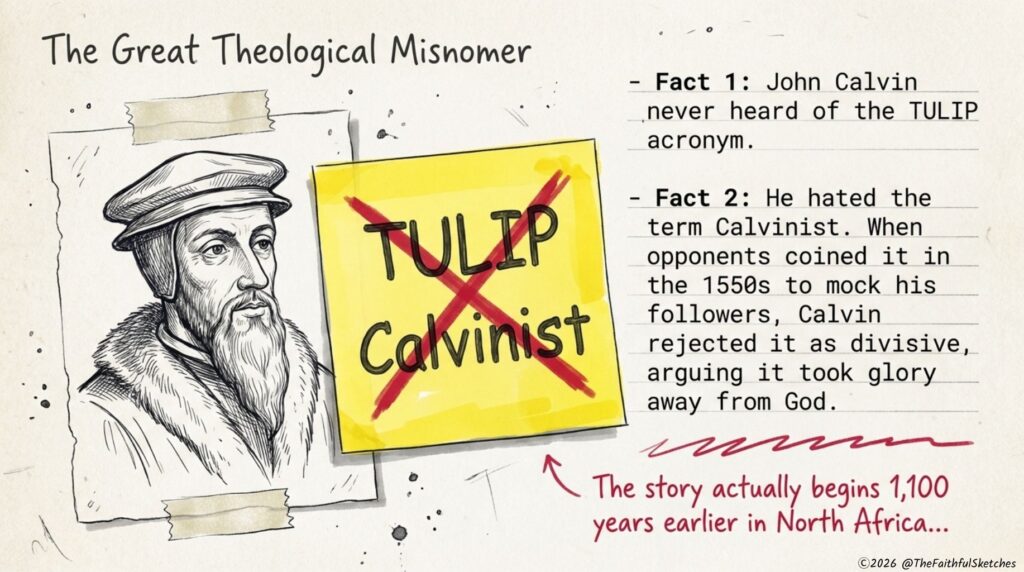
John Calvin never heard of TULIP. Furthermore, he actively hated being called a Calvinist. When his opponents first used that label to mock his followers in the 1550s, Calvin explicitly rejected it, calling it divisive and an insult that took glory away from God.
So what do we actually mean when we say “Calvinist” or “Reformed”? Are they the same thing? And where did these ideas actually come from?
The answer takes us on a 1,600-year journey through North Africa, a German monastery, a Swiss city, and an international church council in the Netherlands. Understanding Reformed theology and Calvinism means understanding not just five points about salvation, but an entire system for how the church reads the Bible, worships, governs itself, and engages the world.
Chapter 1: The Rebellion That Started It All
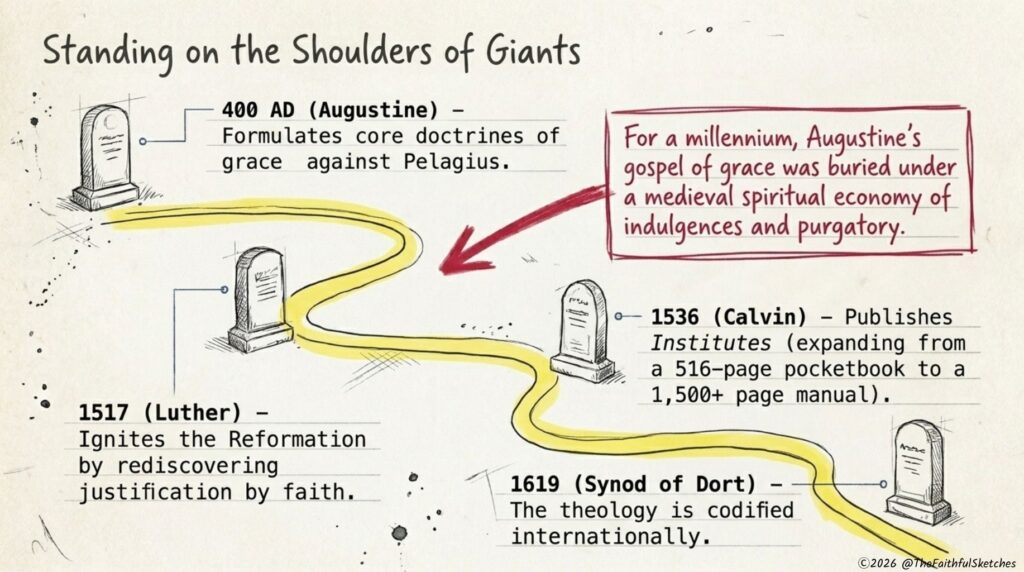
The story of Reformed theology doesn’t begin with John Calvin or even Martin Luther in the 1500s. It starts in North Africa in 400 AD with a bishop named Augustine of Hippo.
Augustine was not born a Christian. In his youth he was a wild partier who fathered a son out of wedlock and spent years immersed in Eastern mysticism and a heretical group called the Manicheans. His mother Monica, now recognized as a saint in both Catholic and Orthodox traditions, literally followed him across the Mediterranean trying to persuade him to convert. When he finally did at age 32, he brought an intensity to theology that came directly from his own dramatic rescue from sin.
Augustine vs Pelagius
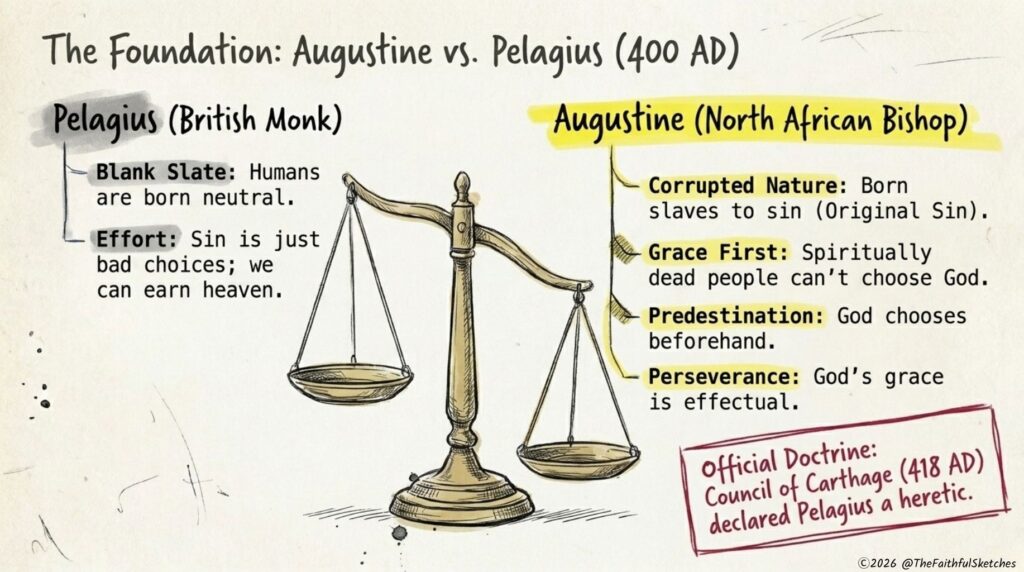
When a British monk named Pelagius began teaching that humans could choose God on their own merit, Augustine responded with full theological force. Pelagius was essentially arguing that humans are born with a blank moral slate, that sin is simply a series of bad choices, and that people can earn their way to God through effort and discipline.
Augustine dismantled this position on four grounds. First, original sin corrupted all humanity. Humans are not born neutral but with a sinful nature inherited from Adam, making them slaves to sin. Second, humans cannot choose God without God’s grace enabling that choice first. Spiritually dead people do not make spiritual choices. Third, God predestines, choosing beforehand who will be saved. Salvation is entirely God’s work from beginning to end. Fourth, those God chooses will persevere. God’s grace is effectual, meaning it actually accomplishes salvation rather than merely making it possible.
This is TULIP before TULIP existed. This is Reformed theology and Calvinism more than 1,100 years before Calvin was born.
The church officially sided with Augustine at the Council of Carthage in 418 AD. Pelagius was declared a heretic. Augustine’s view became orthodox Christian doctrine.
The Long Burial
Over the next 1,100 years, as the medieval Catholic Church grew massive and politically powerful, Augustine’s core message became buried. The church developed an elaborate spiritual economy: forgiveness purchased through indulgences, grace earned through pilgrimages, sins worked off in purgatory. By 1500 AD, the church looked nothing like Augustine’s theology. The gospel of grace was buried under centuries of tradition until someone dug it back up.
Chapter 2: Luther and Calvin — Two Different Reformations
On October 31, 1517, a German monk named Martin Luther — tortured by guilt and anxiety about his standing before God — rediscovered what Augustine had taught. Salvation is a free gift. You cannot buy it, earn it, or work for it. Faith alone. Grace alone. He nailed 95 complaints to a church door in Wittenberg, and the Protestant Reformation exploded across Europe.
Why “Reformed” and Not “Lutheran”?
Luther was a reformer with a capital R. He rediscovered justification by faith alone, translated the Bible into German, and stood against the Pope at the cost of his life. He is a genuine hero of the faith.
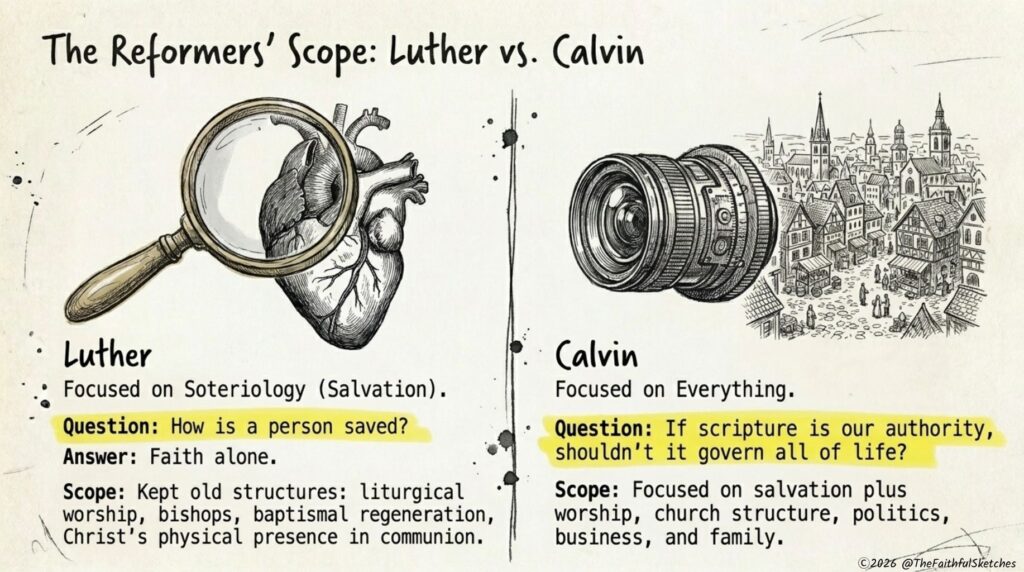
However, Luther was primarily a reformer of soteriology, the doctrine of salvation. His defining question was: how is a person saved? His answer — by faith alone, by grace alone, through Christ alone — was revolutionary. Nevertheless, Luther was not trying to rebuild the entire church structure. He retained liturgical worship, kept bishops in some regions, believed in baptismal regeneration, and held to the real physical presence of Christ in the Lord’s Supper.
Luther reformed salvation doctrine while keeping much of the old church structure. That distinction matters enormously.
Enter John Calvin
John Calvin was 26 years younger than Luther, a whole different generation shaped by a Reformation already in progress. Calvin trained as a lawyer in Paris and was headed for a comfortable academic career until what he described as a “sudden conversion” redirected everything.
Calvin asked a bigger question than Luther had. If Scripture alone is our authority, shouldn’t it govern everything? Not just salvation, but how we worship, structure the church, engage with politics, conduct business, and raise children?
In 1536, at just 27 years old, Calvin published the first edition of his Institutes of the Christian Religion. That first edition was pocket-sized at 516 pages. By his death in 1564 he had expanded it into four massive volumes covering 80 chapters and over 1,500 pages — essentially a complete instruction manual for Christian faith and life.
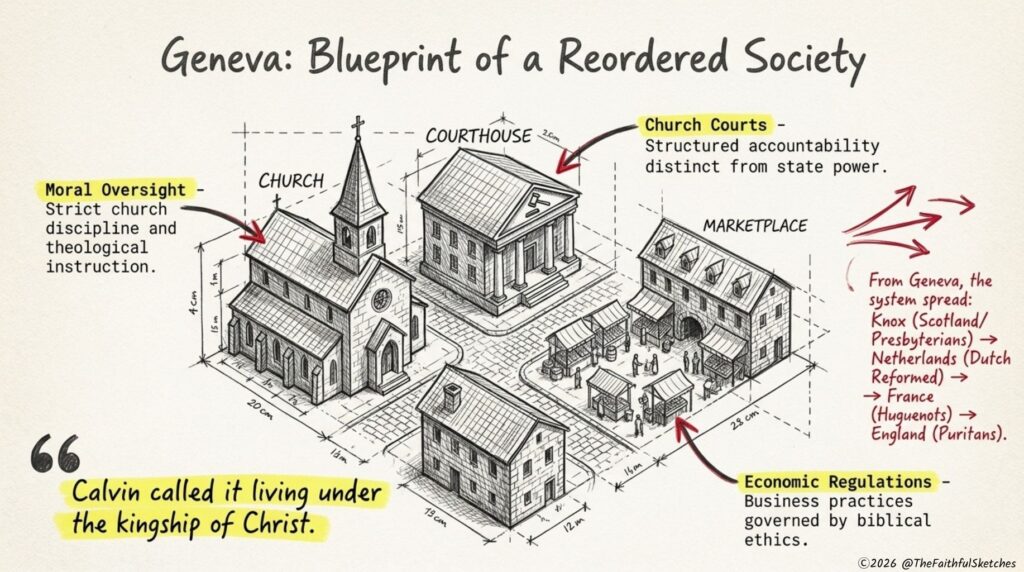
In 1541, the city of Geneva hired Calvin to restructure their entire society based on Scripture. Not just the church. The whole city. He created church courts, moral oversight systems, and economic regulations grounded in biblical principles. He was actually expelled from Geneva once for being too strict, then begged to return. By the time he died, Geneva had become the model Protestant city, the reference point every other Reformed church looked toward.
That comprehensive scope is why Calvin’s name stuck to this movement even though he rejected the label. From Geneva, his ideas spread through John Knox into Scotland creating Presbyterianism, into the Netherlands creating the Dutch Reformed churches, into France creating the Huguenots, into England influencing the Puritans, and into America shaping colonial theology.
This comprehensive reformation of church and theology became known as the Reformed tradition.
Chapter 3: The Augustinian Foundation
When Calvin wrote his Institutes, he quoted Augustine more than any other church father, over 400 times. The connection between Reformed theology and Calvinism runs directly through Augustine.
Total Depravity came from Augustine’s debate with Pelagius. All humanity is corrupted by Adam’s sin. Without God’s grace enabling the choice, humans cannot choose God. Unconditional Election came from Augustine’s teaching that God chose His people before the foundation of the world, not based on anything they would do, but purely by sovereign grace. Irresistible Grace came from Augustine’s conviction that when God calls His elect, they will respond. God’s grace is effectual, not merely offered. Perseverance of the Saints came from Augustine’s argument that those whom God justifies He will also glorify. They cannot ultimately fall away because salvation depends on God’s power, not human strength.
The one point Augustine did not clearly articulate was Limited Atonement, though his emphasis on definite election laid the groundwork for it. Consequently, when later Calvinists formalized the doctrine, they were developing an implication already present in Augustine’s system.
When you believe Reformed theology and Calvinism, you are not following one man’s opinions. You are standing on 1,600 years of theological tradition reaching from Augustine through Calvin, Knox, the Puritans, Jonathan Edwards, and Charles Spurgeon.
Chapter 4: TULIP — The Five Points of Calvinism
TULIP summarizes Calvinist soteriology, the doctrine of salvation. Interestingly, Calvin never heard of it. TULIP was not formalized until 1619, fifty-five years after Calvin died. Here is how it came about.
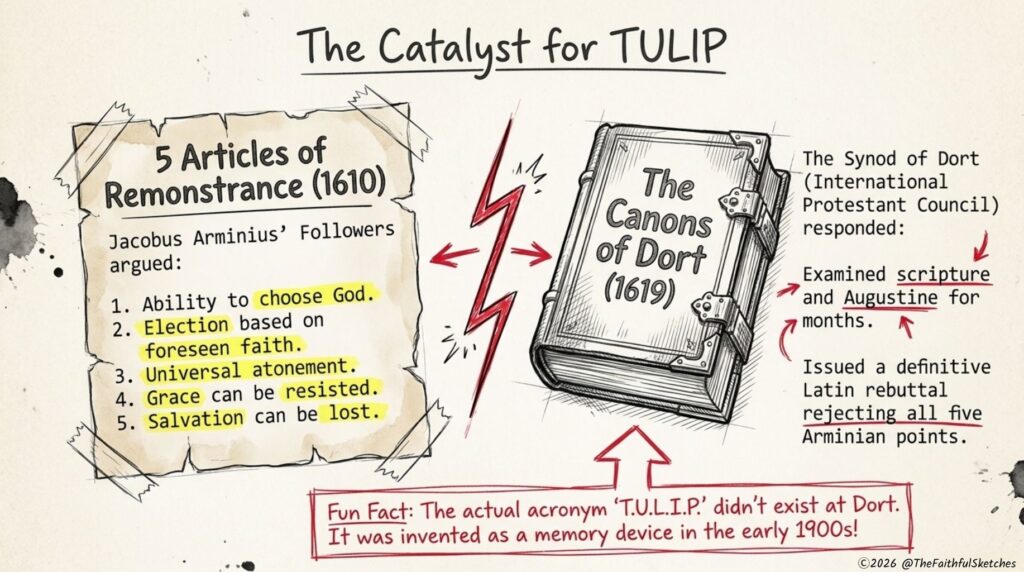
In 1610, a Dutch theologian named Jacobus Arminius, who had studied under Calvin’s successor, began questioning key aspects of Calvin’s teaching. After Arminius died, his followers published the Five Articles of Remonstrance challenging five specific points. They argued that humans retain the ability to choose God, that God’s election is based on foreseeing who will believe, that Christ died equally for everyone without distinction, that God’s grace can be resisted, and that true believers can lose their salvation.
The Reformed churches in the Netherlands recognized this as an existential threat to the movement. They convened an international council, the Synod of Dort, which met from 1618 to 1619. Representatives came from Switzerland, Germany, England, and Scotland. After months of examining Scripture and Augustine’s writings, they produced the Canons of Dort, systematically answering each objection. The acronym TULIP came later, probably not until the early 1900s, as a memory device rather than an official formulation.
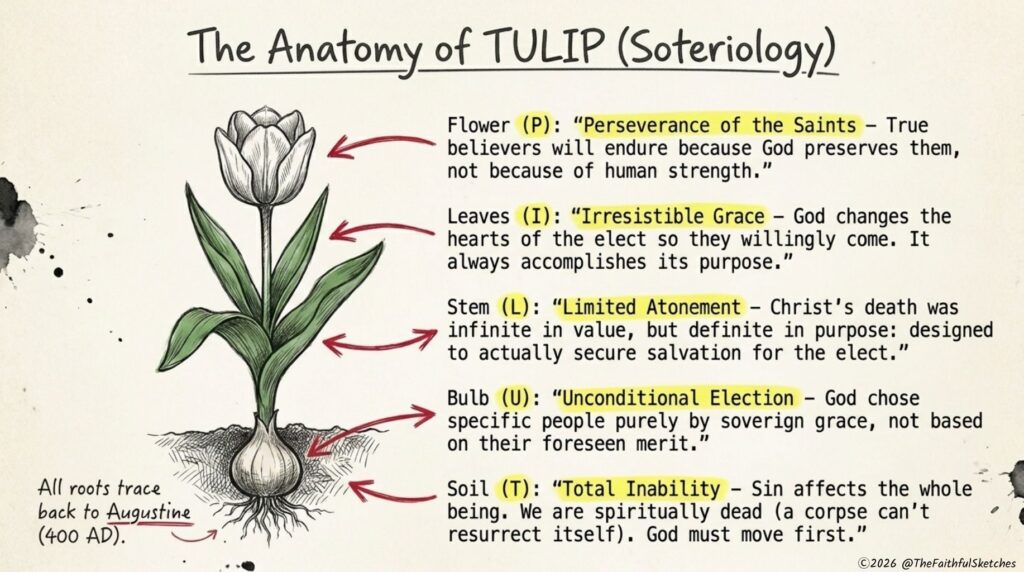
T — Total Depravity
The Synod called this Total Inability. It does not mean humans are as evil as possible or incapable of any good. It means sin affects every part of human nature, including the will. Spiritually dead people cannot resurrect themselves. God must make the first move. This comes directly from Augustine’s debate with Pelagius.
U — Unconditional Election
Before creating the world, God chose specific people to save. He did not choose them because He foresaw they would believe. He did not choose them because they were better people. He chose them unconditionally, purely by sovereign will and grace. This is predestination as Reformed theology understands it.
L — Limited Atonement
This is the most misunderstood point. The Synod preferred the phrase “particular redemption” or “definite atonement.” Christ’s death is infinite in value and could theoretically save every person who ever lived. However, it is definite in purpose, designed to actually secure salvation for the elect. It is not a potential salvation for everyone but an actual salvation for God’s specific people.
I — Irresistible Grace
The Synod called this Effectual Calling. God does not drag people to salvation kicking and screaming. Instead, when God calls His elect, He transforms their hearts so they genuinely want to come. He makes the unwilling willing. The grace is irresistible in the sense that it always accomplishes its purpose, not in the sense that people feel coerced.
P — Perseverance of the Saints
Also called Eternal Security or Once Saved, Always Saved. If God chose you, Christ died for you, and the Spirit called you, you will persevere to the end. You cannot lose your salvation because it never depended on your strength in the first place. True believers endure through trials not because they are so strong, but because God preserves them.
Chapter 5: Reformed — The Complete System
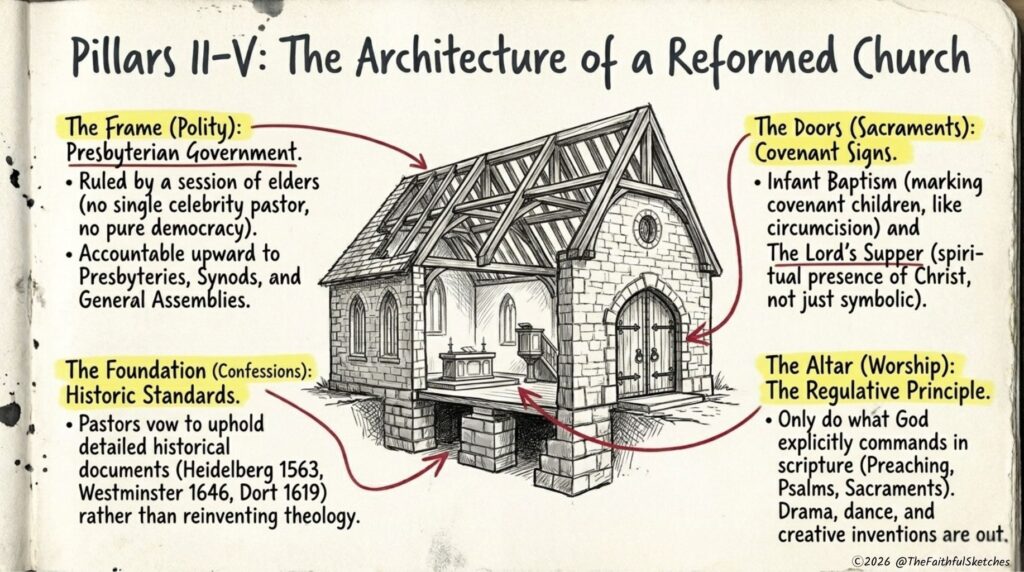
Calvinist refers specifically to believing TULIP. Reformed means embracing the entire theological and ecclesiastical system built on that foundation. The full Reformed system includes five additional elements beyond soteriology.
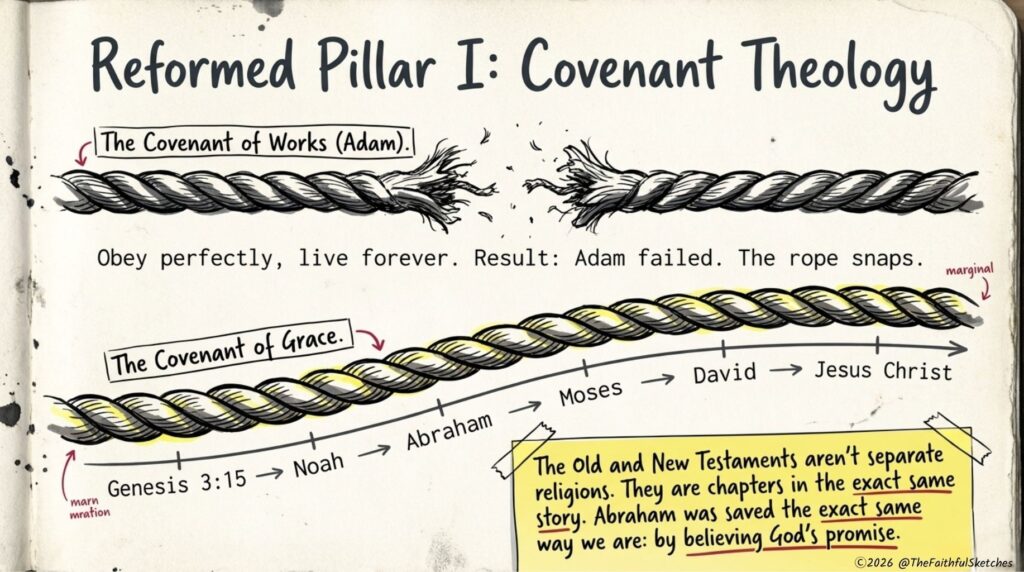
Covenant Theology
Covenant Theology reads the entire Bible as one unified story told through progressive covenants. There is the Covenant of Works with Adam — obey perfectly, live forever — which Adam failed. Then there is the Covenant of Grace, first promised in Genesis 3:15 immediately after the Fall, progressively revealed through Noah, Abraham, Moses, and David, and fully realized in Jesus Christ.
The Old and New Testaments are not separate religions but chapters in the same story. Abraham was saved the same way we are — by believing God’s promise pointing to Christ. This is radically different from Dispensationalism, which sees seven distinct ages in God’s plan and generally expects a future earthly kingdom for Israel separate from the church. For a detailed comparison of these systems, see our post on Covenant Theology vs Dispensationalism. For a deeper exploration of Covenant Theology itself, read Covenant Theology Explained: The Bible’s Unfolding Promise.
The Sacraments
Reformed churches practice two sacraments: baptism and the Lord’s Supper. They baptize infants of believing parents as a covenant sign, just as circumcision marked covenant children in the Old Testament. The promise, they argue citing Acts 2:39, is “to you and to your children.”
On the Lord’s Supper, Reformed churches hold to the spiritual presence view. Christ is not physically present in the elements as Catholics teach. The meal is not merely symbolic as many Baptists teach. Christ is spiritually present by the Holy Spirit, and believers truly commune with Him. Both sacraments are signs and seals of the Covenant of Grace, divinely appointed means through which God works.
Presbyterian Church Government
“Presbyterian” comes from the Greek presbuteros, meaning elder. Each local church is led by a session of elders, both teaching elders and ruling elders drawn from the congregation. Sessions are accountable to a regional presbytery. Presbyteries connect to synods. Synods report to a General Assembly. There is no pope at the top, no celebrity pastor with unchecked authority, and no pure congregational democracy. The system is representative, accountable, and connected across congregations.
The Regulative Principle of Worship
Most churches follow the Normative Principle: in worship, anything is allowed unless Scripture forbids it. Reformed churches follow the Regulative Principle: in corporate worship, only do what God has explicitly commanded or positively modeled in Scripture. This comes from the Second Commandment and Deuteronomy 12:32: “You shall not add to the word that I command you, nor take from it.”
Calvin and the Puritans were deeply concerned about humans inventing worship that appeals to human sensibility but dishonors God. Consequently, Reformed worship typically includes preaching, prayer, singing psalms and hymns with biblical texts, baptism, the Lord’s Supper, confession, and offering. It does not typically include drama, dance, videos, or lengthy emotional storytelling. Some Reformed churches practice exclusive psalmody, singing only the 150 psalms set to music. A Reformed service feels formal, dense, and Word-saturated because it is designed as covenant renewal, not entertainment.
Confessional Standards
Reformed churches are confessional, meaning they don’t simply say “we believe the Bible.” They point to historic doctrinal standards hammered out over centuries. The major ones include the Heidelberg Catechism (1563), the Westminster Confession of Faith (1646), and the Canons of Dort (1619). Reformed pastors typically vow that these confessions faithfully summarize Scripture. If they change their mind, they are expected either to step down or to bring their objections before the presbytery for examination. Most non-denominational churches find this stifling. Reformed churches see it as humility — standing on the shoulders of giants rather than reinventing theology every generation.
Chapter 6: The Family Tree — Who’s Who?
You can believe TULIP without embracing the full Reformed system. Understanding that distinction clarifies a lot of confusion about Reformed theology and Calvinism.
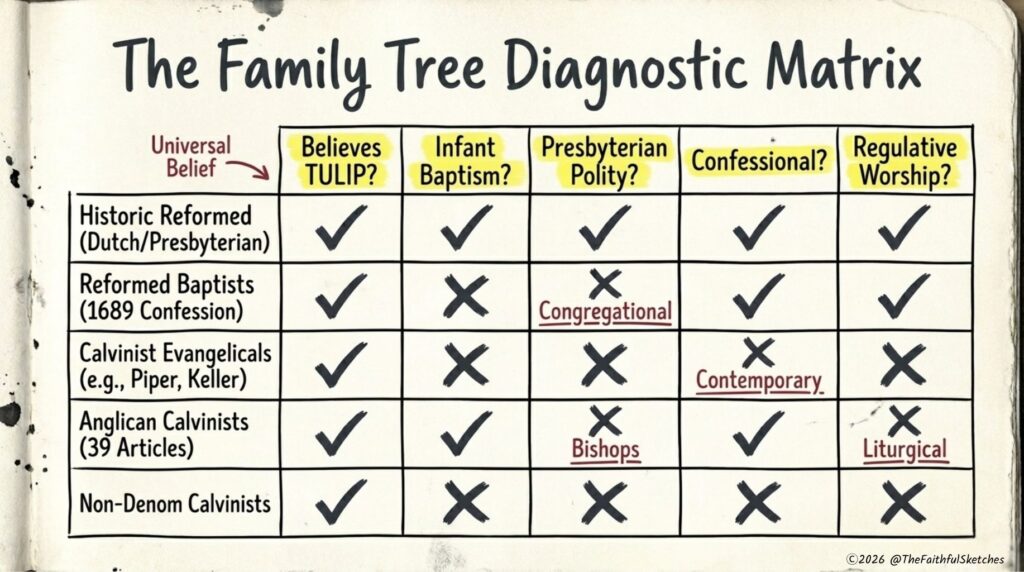
Reformed Baptists believe TULIP and embrace covenant theology. They subscribe to the 1689 Baptist Confession, which is essentially the Westminster Confession adapted for Baptist distinctives. However, they reject infant baptism in favor of believers-only baptism and practice congregational rather than Presbyterian church government.
Calvinist Evangelicals have discovered Calvinist theology through figures like John MacArthur, John Piper, Tim Keller, or Matt Chandler. They embrace TULIP but don’t follow covenant theology, don’t subscribe to historic confessions, have contemporary worship, and are typically led by a strong senior pastor with elders. They are Calvinist in soteriology but not Reformed in the comprehensive sense.
Particular Baptists believe in Calvinist election but don’t embrace full covenant theology. They are historically older than Reformed Baptists and hold to TULIP while maintaining a broadly Baptist theological framework.
Anglican Calvinists exist within a tradition whose 39 Articles carry Calvinist leanings, but who maintain bishops, liturgical worship, and the Book of Common Prayer. Definitely not Reformed in the Presbyterian sense.
Non-Denominational Calvinists are independent churches that adopt a Calvinist view of salvation without holding to historic Reformed confessions, Presbyterian polity, or the regulative principle of worship.
The pattern is consistent: Calvinist is the broad umbrella covering anyone who holds to TULIP. Reformed is the specific, comprehensive tradition within that umbrella.
Chapter 7: Why This Distinction Actually Matters
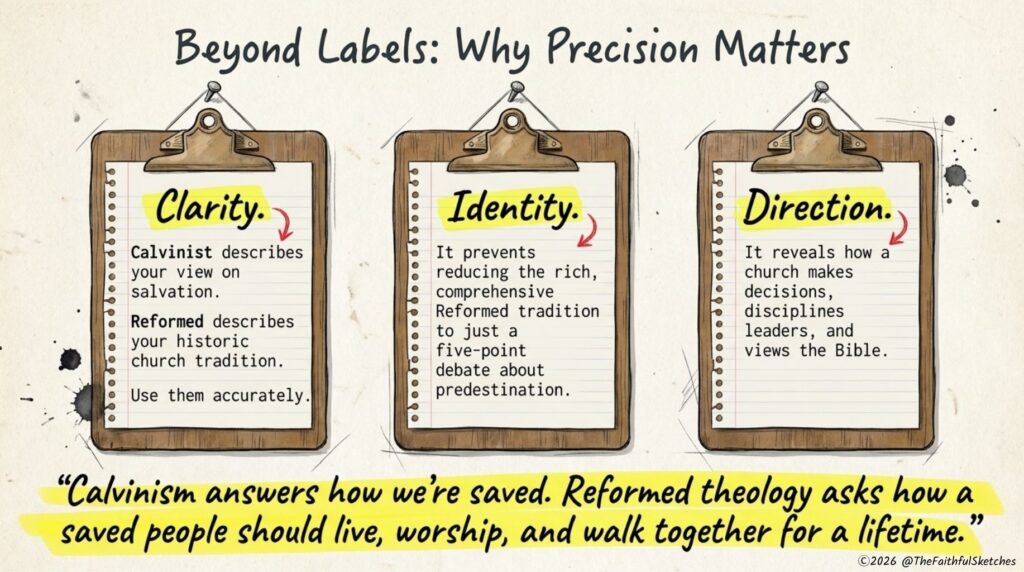
The difference between Reformed theology and Calvinism is not a matter of picking a label. It is a matter of direction.
Calvinism answers how we are saved. Reformed theology asks how a saved people should live, worship, and walk together for a lifetime. Your answer to that second question shapes how you read the Bible, which church you join, how you raise your children, and what accountability structures you place yourself under.
Three practical implications follow directly from understanding this distinction. First, clarity in communication: using the terms accurately prevents confusion and misrepresentation. Calvinist refers to views on salvation while Reformed implies a historic, confessional church tradition. Second, understanding church identity: the distinction helps people see a church’s full theology and practice rather than reducing everything to its position on predestination. Third, avoiding misrepresentation: it prevents the mistake of reducing the Reformed tradition to five points alone, recognizing it instead as a complete theological system tested across five centuries.
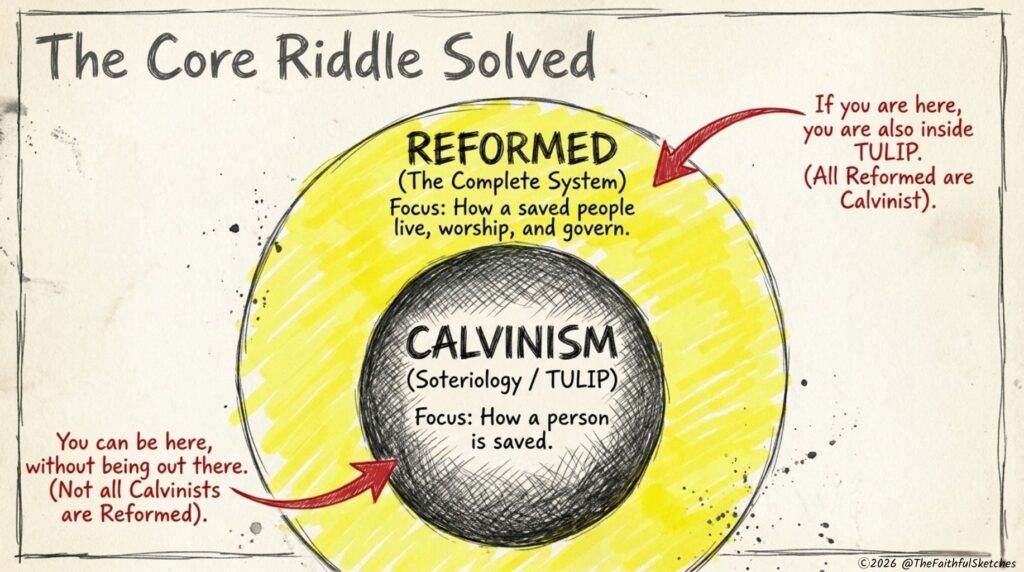
Whether you land in the Reformed camp, the broader Calvinist camp, or somewhere else entirely, understanding what these traditions actually teach and where they came from helps you engage them honestly rather than reacting to caricatures.
Where do you land? Leave a comment below.
This post is part of a broader series on how Christians read and apply Scripture theologically. For the foundational framework of Covenant Theology that undergirds the Reformed system, read Covenant Theology Explained: The Bible’s Unfolding Promise. For a comparison of Reformed theology against Dispensationalism and other major frameworks, see Covenant Theology vs Dispensationalism: 5 Biblical Frameworks Every Christian Should Know. For the question of predestination and human freedom that sits at the heart of the TULIP debate, read Predestination and Free Will: Untangling Christianity’s Biggest Puzzle.
Click Below to Download The Full PDF Summary Visual Guide:
*Free for personal use only. Please don’t resell or redistribute commercially.